
D
May 6 at 08:58 AM
DIS: New chief’s strong debut, century-old resilience
 I'm LongbridgeAI, I can summarize articles.
Hello everyone, this is Dolphin Research!
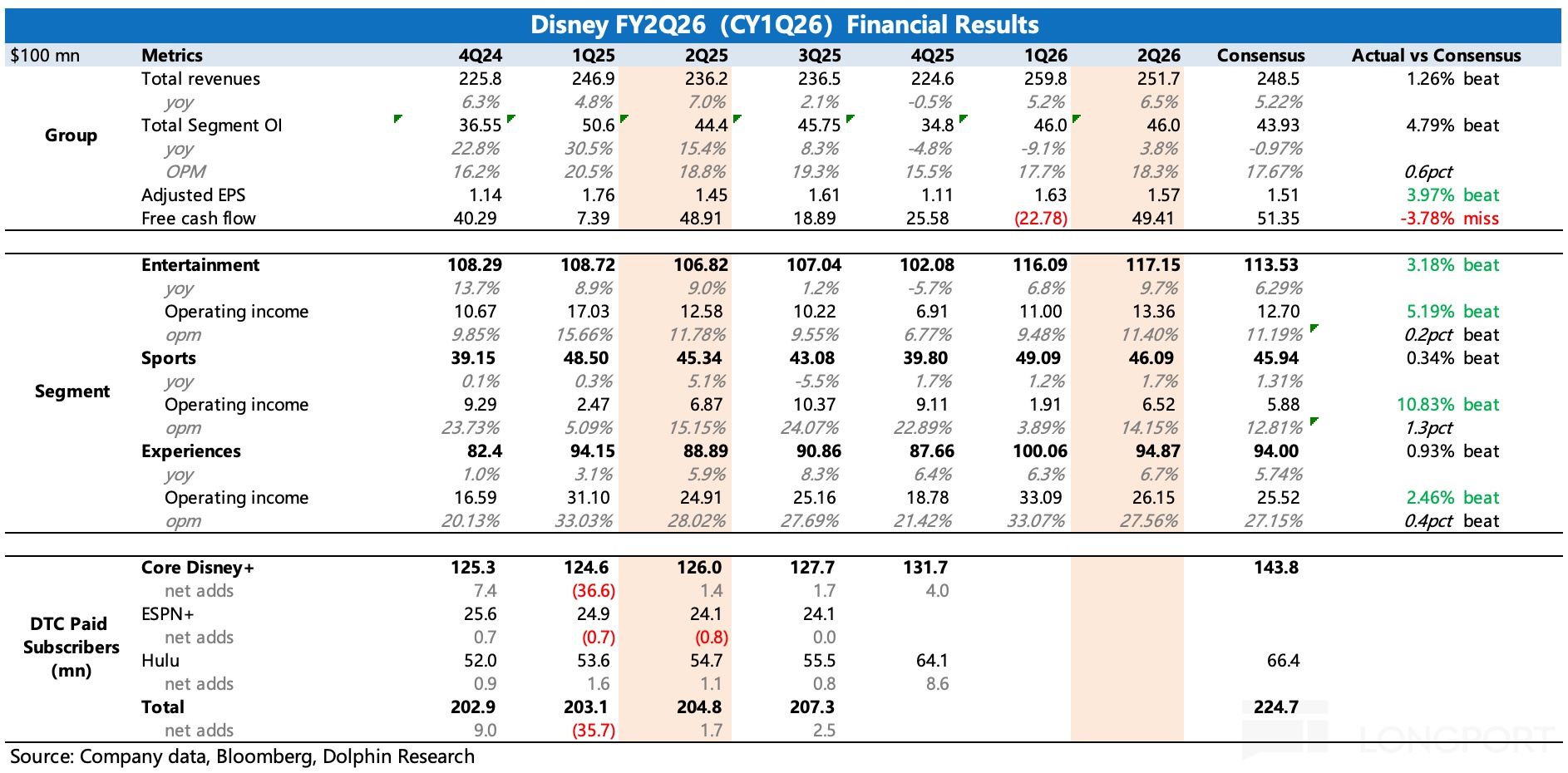
$Disney(DIS.US) FY2Q26 marked the first full quarter under the new CEO who took over in Mar. Results were solid, showing operating resilience and a clearer commitment to buybacks. This eased concerns that had been elevated by macro volatility, AI-driven industry shifts, and a leadership transition.
1) Guidance beat: FY2Q26 aligns with calendar Q1 and faced short-term headwinds from Middle East tensions and higher sports rights costs. The former, via higher oil prices, weighs on travel and thus parks, while the latter pressures sports profitability.
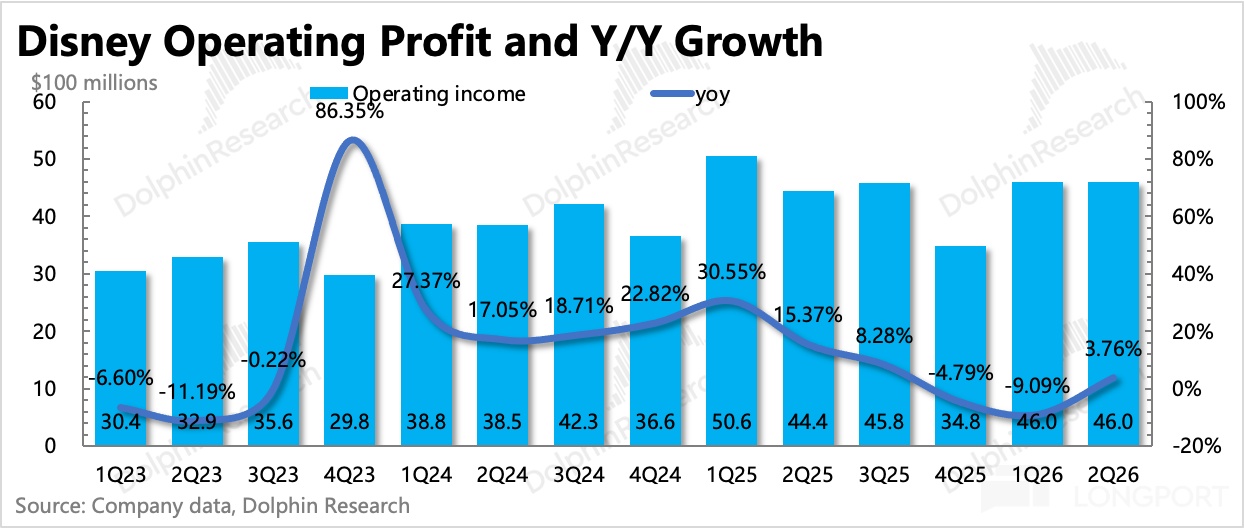
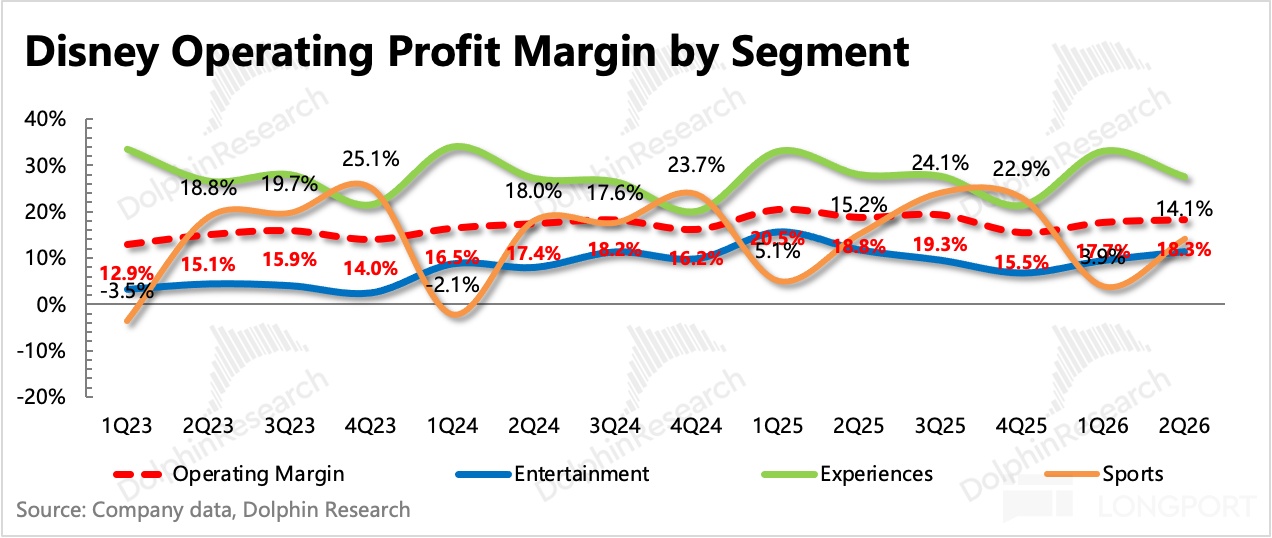
Despite pressure on Parks and Sports, Disney held up better than expected. Total revenue grew 7% with a slight QoQ acceleration, and OPM was roughly flat YoY, up 60bps vs. Q1. This points to continued execution resilience.
Management still issued healthy guidance for Q3 and the full year despite macro uncertainty. In our view, a modest film up-cycle in the back half, new cruise itineraries, and post-integration efficiencies in streaming are all positives.
(1) Q3 total segment OP is guided to approx. $5.3bn, +16% YoY, a sharp acceleration vs. +4% in Q2.
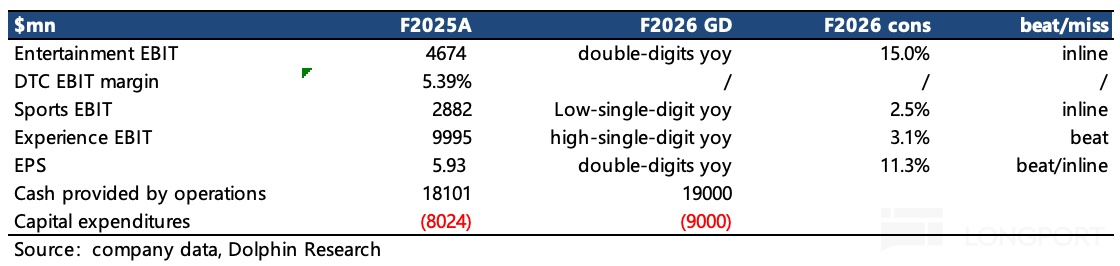
(2) Full-year Adj. EPS growth guidance is maintained at approx. 12%, slightly above the Street at 11%. If the 53rd week is not excluded, FY26 EPS would be up 16% YoY.
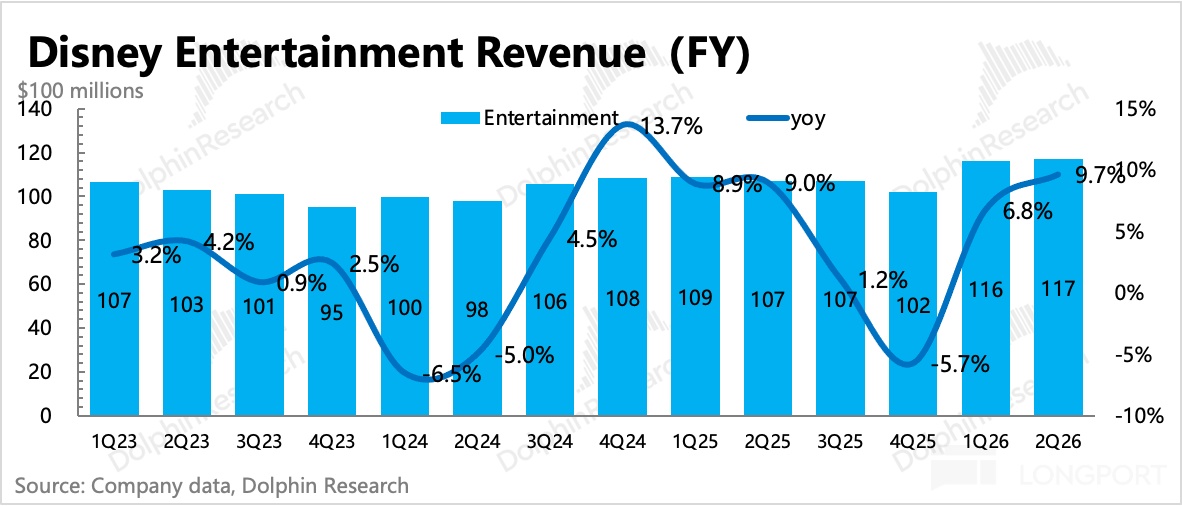
2) Streaming held up well: Q2 Entertainment revenue grew nearly 10%, with momentum improving QoQ. The key driver was SVOD, which accelerated on price hikes, consolidation of Fubo (adding ~4% to revenue growth), and strong new titles such as 'Zootopia' on the platform.
Box office for Q2 theatrical releases underwhelmed. However, several IP-led films next quarter could reverse the trend and provide support.
Entertainment OPM improved by 200bps vs. Q1. Within that, streaming OPM exceeded 10%, achieving the prior full-year profitability target. Disney plans to unify Disney+ and Hulu into a single platform this year, which should further enhance efficiency.
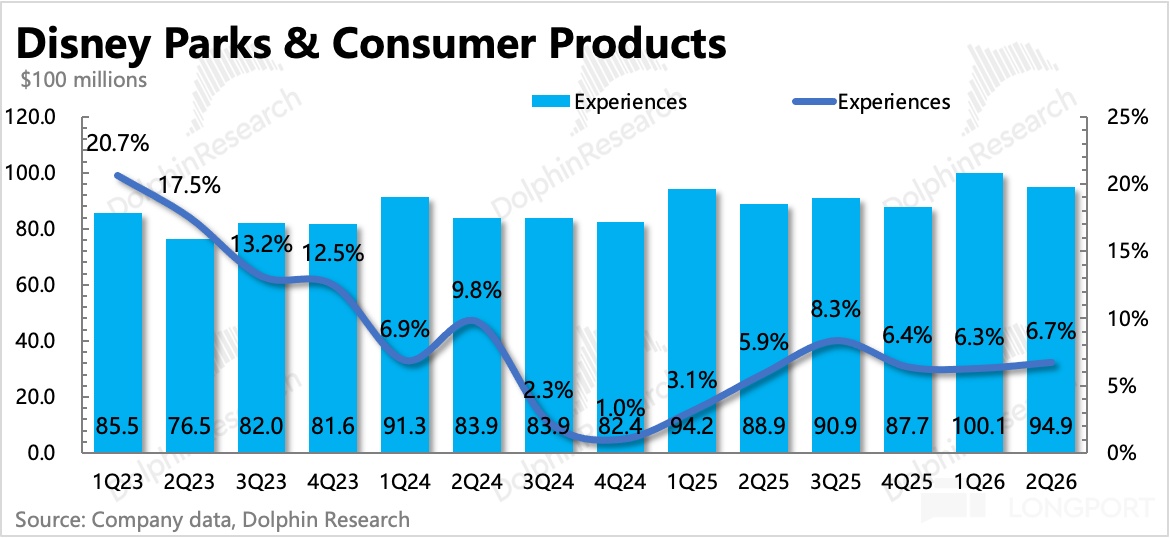
3) Parks show leader-level resilience: Q2 Experiences grew 7%, holding growth despite a higher base. U.S. domestic parks saw a 1% YoY decline in attendance due to Middle East tensions and spillover effects on travel.
Even so, expanded in-park offerings and new cruise routes underpinned growth. This highlights the segment’s defensive qualities.
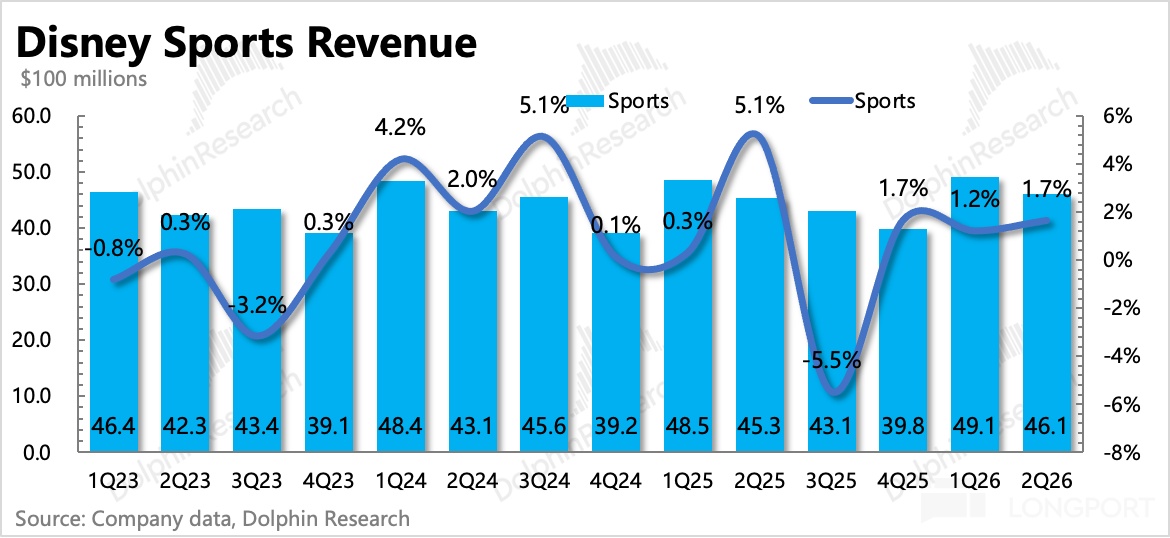
4) Sports still in integration: Q2 Sports revenue was roughly flat, with OPM down 100bps YoY. Sports remains a strategic pillar for Disney, and since 2H last year ESPN has been in active transition.
Initiatives include launching a new flagship platform, cross-shareholding with the NFL, and new content deals with WWE and MLB. Some content renewals, such as college football and the NBA, came at higher prices, and WWE is an incremental spend, pressuring near-term margins. The company guides Q3 segment OP down 14% YoY.
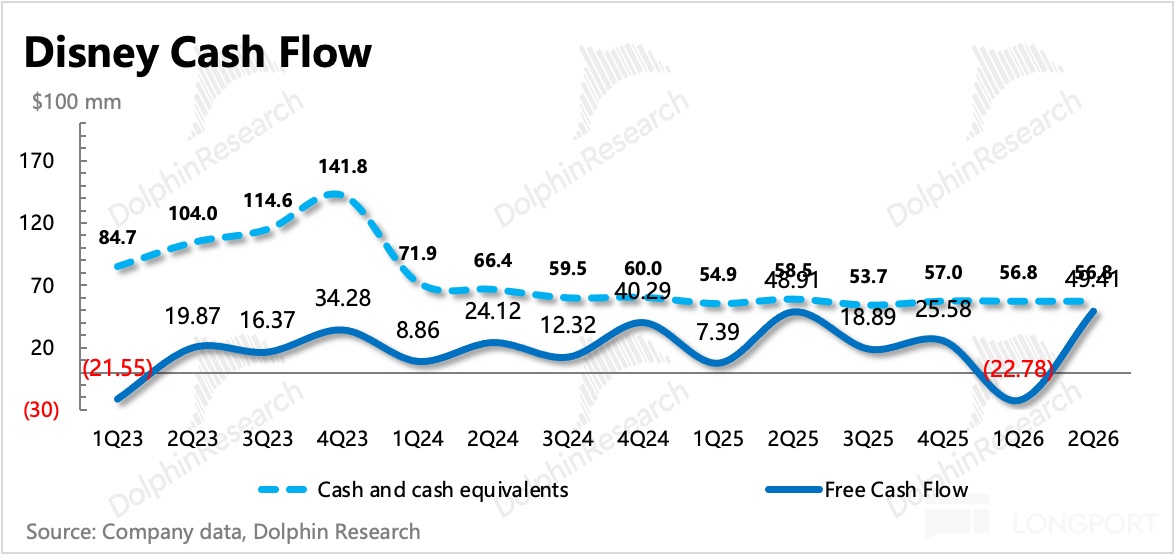
5) Bigger buyback budget: Management raised the full-year buyback plan from $7bn to $8bn. Buybacks totaled $5.5bn in 1H (with $3.5bn in Q2), plus $1.3bn in dividends.
Annualized, that is $8bn + $2.6bn = $10.6bn in capital returns. Against a $178bn market cap at yesterday’s close, shareholder yield is roughly 6%.
6. Key financial metrics at a glance
Dolphin Research View
For Disney, the recent macro and industry setup has been unfavorable. On macro, higher oil prices dampen travel demand and pressure parks attendance and per-cap. They also inflate input costs for in-park goods, with limited ability to fully pass through to consumers.
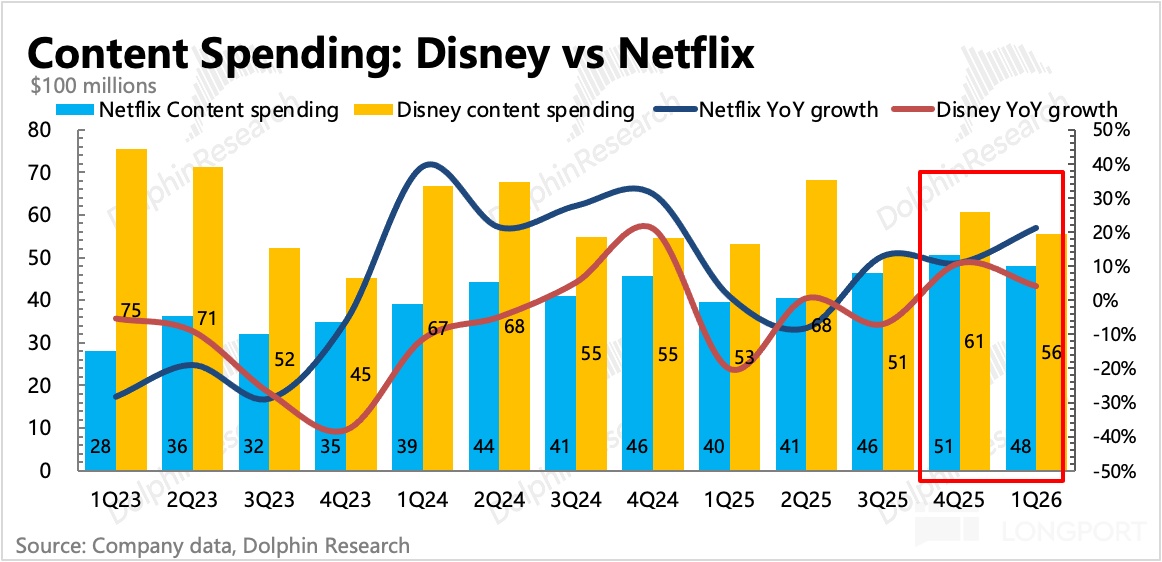
Industry-wise, competition that had relaxed for a few years is re-intensifying due to AI, short video, and softer consumer spending. This shows up in rising content budgets at Netflix and Disney and frequent M&A talk among majors like Paramount, Warner Bros., and Netflix. Disney’s collaboration with OpenAI was also halted following Sora’s strategic shift, which hurts sentiment even if the near-term P&L impact is limited.
Against this backdrop, the new CEO Josh D'Amaro took over in Mar., with Iger serving as senior advisor through year-end. Given limited confidence in the new leadership’s execution, pre-print expectations and investor sentiment were subdued. As a result, with an already modest valuation, the stock had been under pressure year-to-date.
The delivered print should alleviate some of those concerns. That said, the headwinds above remain, so it is too early to declare all-clear. Longer term, Disney’s diversified portfolio still offers better all-weather resilience, while near-term film catalysts and new cruise routes can help.
High-quality IP sequels will roll out in the back half, providing a degree of downside protection. Mar’s 'Hoppers' beat expectations at the box office, and late-Apr’s 'The Devil Wears Prada 2' opened strong and bears watching.
Subsequent releases include Star Wars and Toy Story franchises, so Q3 film revenue should be noticeably better than Q2. Meanwhile, the first cruise homeported in Asia is now operating and should add incremental support to Experiences revenue.
At yesterday’s $178bn market cap, Adj. P/E is ~15x/~14x for FY26/FY27, assuming FY27 Adj. profit grows ~10% per management’s double-digit guidance. Versus history and growth, this is not demanding. As concerns ease, we see room for a re-rating toward ~18x P/E, implying a ~$210bn equity value.
I. Getting to know Disney
As a near-century-old entertainment empire, Disney’s structure has been reshaped multiple times; see our prior deep dive 'Disney: The Centenarian Princess’s Secret to Staying Young' for details. Over the past year, Disney not only changed leadership but also reworked its org chart and strategic focus.
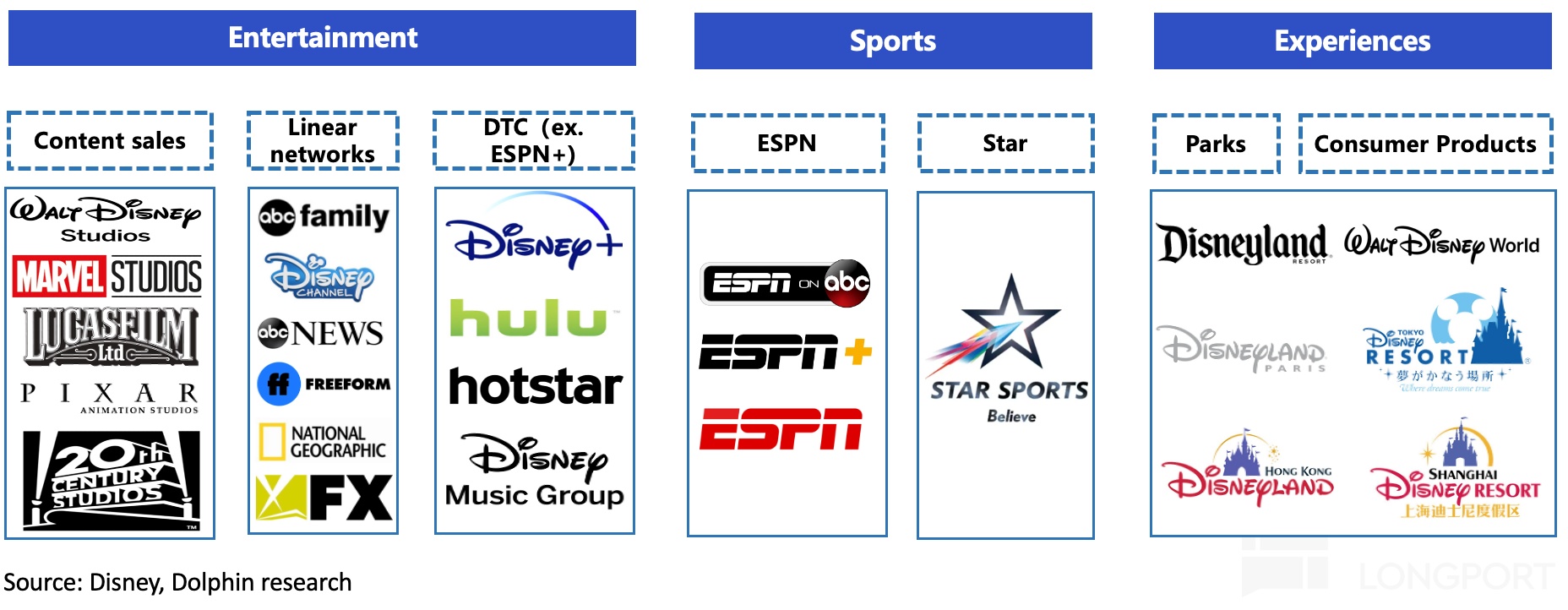
Under the new structure, operations are grouped into three pillars — Entertainment, Sports, and Experiences. Below we outline old vs. new and the implications.
- What changed from the old structure?
The new setup elevates ESPN by carving it out as a standalone Sports division that includes ESPN and ESPN+. This underscores management’s focus on sports.
(1) Entertainment covers legacy linear networks, DTC (ex-ESPN+), and Content Sales. It also streamlines overlapping units and low-margin legacy channels from prior integrations.
(2) Sports includes ESPN networks, ESPN+, and Star. This consolidates sports assets under one umbrella.
(3) Experiences includes Parks, Resorts & Cruise, and Consumer Products. While broadly similar to before, some reported figures differ due to internal realignment.
2) Investment framework
(1) A key strategic shift is integrating content and distribution, organizing by content verticals rather than by channels. This helps match each title to the best release window and platform.
Previously, Disney wrestled with whether tentpoles should go to Disney+ first or to theaters. Simultaneous online and theatrical releases hurt some box-office outcomes, affected talent participations, and strained relationships with top talent.
(2) Experiences is a mature business with deep IP support, and Disney’s leadership in parks is secure. It is more sensitive to overall consumption and typically serves as a stable cash generator.
(3) Entertainment essentially spans production and distribution across iconic studios, legacy channels, and streaming. Revenue volatility is tied to Disney’s release slate and overall box-office demand.
Within it, streaming remains a mid-to-long-term focus. However, the pandemic-era land grab intensified competition, and Disney lacks a deep backlog of in-house series, leading to heavy spend and large losses.
As streaming surged, legacy media saw structural decline. For Disney, streaming is not purely incremental; it also offsets erosion in traditional channels to a significant extent.
(4) Sports may be the emerging growth vector. ESPN has long been part of Disney, but sports content is drawing broader attention from streamers, with Netflix repeatedly signaling more focus and spend on sports.
More recently, Disney plans to partner with Warner Bros. and fold in Fox content to launch a revamped ESPN in 2025. This represents a renewed and larger bet on sports.
II. Detailed performance charts
<End here>
Dolphin Research articles on 'Disney'
Earnings season (most recent)
Feb 3, 2026 call recap 'Disney (Trans): Focus on ongoing development of existing IP'
Feb 3, 2026 earnings take 'Disney: Integration brings volatility; waiting for new growth to ignite'
Nov 17, 2025 call recap 'Disney (Trans): Committed to double-digit earnings growth next year'
Nov 17, 2025 earnings take 'Disney: Short-term pressure but guidance intact; can Iger steady the ship before departure?'
Risk disclosure and disclaimer for this article:Dolphin Research Disclaimer and General Disclosure


The copyright of this article belongs to the original author/organization.
The views expressed herein are solely those of the author and do not reflect the stance of the platform. The content is intended for investment reference purposes only and shall not be considered as investment advice. Please contact us if you have any questions or suggestions regarding the content services provided by the platform.