D
May 6 at 10:28 PM
APP (Trans): Multiple growth engines firing; ample runway for investment
Below is Dolphin Research’s summary of the $AppLovin(APP.US) Q1 2026 earnings call. For the earnings take, see: Applovin: Still a sweetheart, but have funds moved on?
I. Core earnings takeaways
1. Shareholder returns: Repurchased 2.23 mn shares in Q1 for $1.0 bn. Ending diluted shares were 336 mn, with ~$2.3 bn remaining under authorization. Capital allocation priorities unchanged. Invest in organic growth first, then return via buybacks.
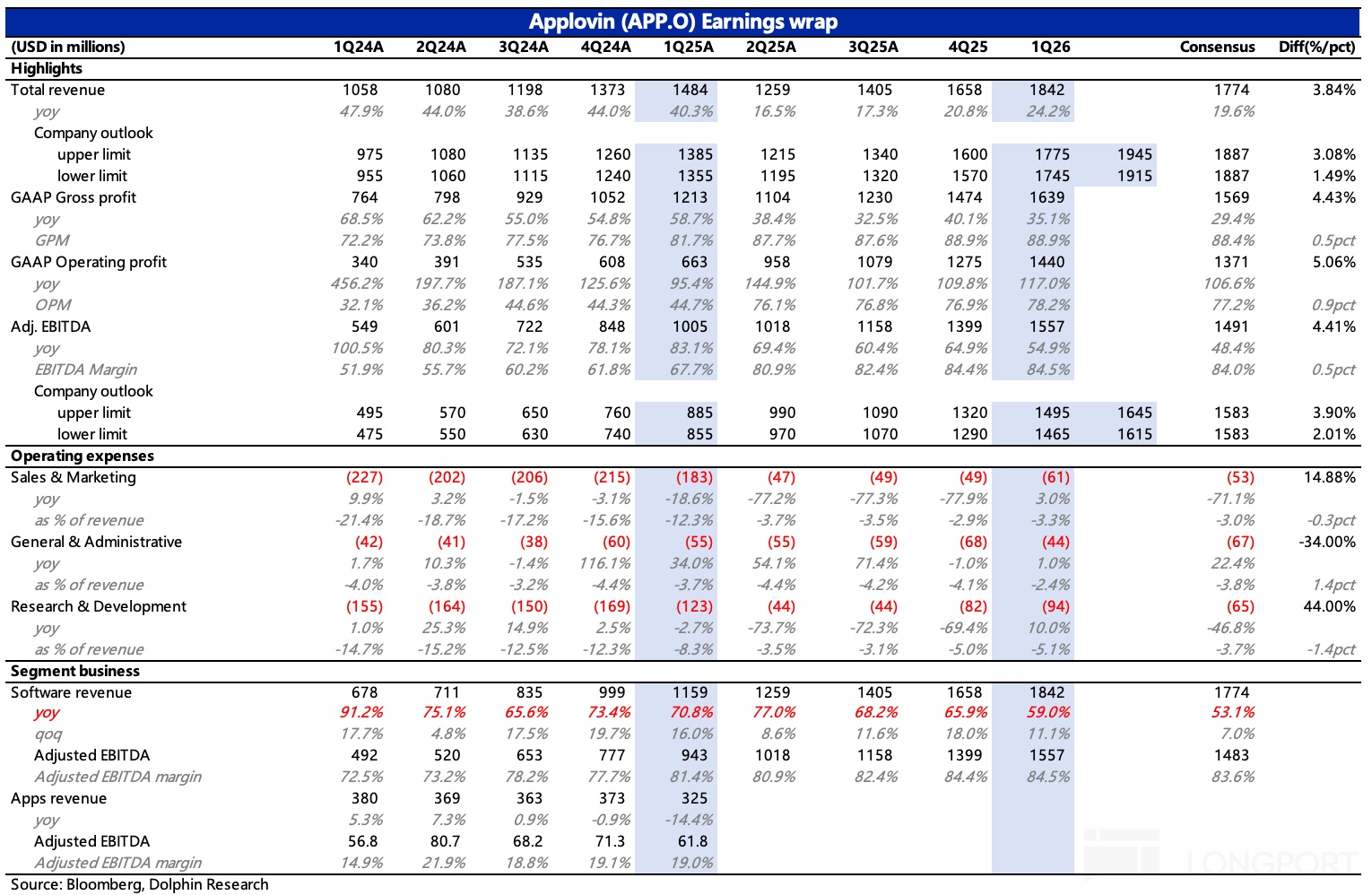
2. Outlook: Q2 revenue guided to $1.915–1.945 bn (+52%–55% YoY, +4%–6% QoQ). Adj. EBITDA guided to $1.615–1.645 bn, implying 84%–85% margin.
3. Q1 key metrics: Revenue of $1.84 bn (+59% YoY, +11% QoQ), above the high end of guidance. Adj. EBITDA of $1.56 bn (+66% YoY) with 85% margin, up ~400 bps YoY. Incremental QoQ EBITDA flow-through was 86%.
4. FCF and balance sheet: Q1 FCF was $1.29 bn, elevated by timing of interest and taxes. Full-year FCF conversion expected at ~75% of EBITDA as cash taxes cluster in Q2/Q3. Cash and equivalents were $2.76 bn at quarter-end.
II. Earnings call details
2.1 Management highlights
1. Gaming ads
a. Gaming remains the company’s cornerstone and continues to post strong growth. Since Axon 2 launched, growth has been elevated for 12 straight quarters with no signs of slowing.
b. AI tools are enabling top studios to improve existing titles and launch new ones faster and at lower cost. This feeds the platform with more high-quality content.
c. IAP titles are accelerating their shift to hybrid monetization (IAP + ads) as non-competitive advertisers such as e-comm and consumer brands join. This removes devs’ concerns about showing competitor ads. This trend should be a multi-quarter tailwind.
d. The ad-supported ecosystem is growing far faster than the mature IAP market, where growth is only single digit. Management expects the two to converge in scale over the next five years.
2. Consumer vertical
a. Only 18 months post-launch, growth is already outpacing Gaming. A major model upgrade rolled out a few weeks ago, driving a notable lift in advertiser scale and ROAS in Consumer.
b. Retail ad revenue in Mar. was up ~25% vs. Jan. Apr. set an all-time monthly spend record, above any Q4 peak month. That is rare in ads, as Q1 typically trails Q4 by a wide margin.
c. Self-serve onboarding for advertisers will open globally in Jun. This is the first time in 14 years the platform moves from closed to open, which should fundamentally change the growth trajectory.
d. Each new client is expected to spend over $70k in year one. If 100k clients sign within a year post-open, that implies ~$7 bn of first-year revenue, with subsequent cohorts stacking on top.
e. Once clients pass their first 30 days, churn is near zero. UA spend currently pays back within 30 days.
3. AI creative tools
a. The Interactive Page Generator is live for all clients with broad adoption.
b. The AI video ad generator is in testing and will go fully live within days, ahead of the Jun. open platform. AI-generated video quality is approaching human-made at substantially lower cost.
c. Longer term, the company will develop a Playable generator and more templates. It may also explore new ad formats.
4. AI Agents and automation
a. Some advertisers already use AI Agents to manage spend on Axon. The company is building Axon to natively support Agent access.
b. Vision: with LLMs, advertisers will complete onboarding, generate video creatives, launch campaigns, and scale operations end-to-end without human touch.
5. New growth vectors
a. Lead Generation: In testing across autos/health insurance, fintech, food delivery and other lead-centric categories. This resembles the early days of the Consumer launch.
b. Connected TV (CTV): Still early. The vision is to let SMBs buy big-screen ads in a performance format and prove incremental ROI. There will be no material financial contribution in 2026, but the long-term opportunity is large.
c. Social apps: Low-cost experiments using vibe-coding tools. The aim is talent attraction in recommender systems and engagement algo testing, not near-term monetization.
6. Inventory and supply
a. The platform reaches over 1 bn DAUs. Existing inventory remains under-monetized with low per-mille conversion, leaving ample headroom as models and advertiser density improve.
b. The IAP game market is ~$100 bn. Using Activision’s King at ~15% ads mix as a proxy, potential incremental publisher ad revenue is ~$7.5 bn per year. This is a near-term supply-side expansion opportunity.
2.2 Q&A
Q: What was the recent major model update, and what milestones should we track for Consumer?
A: Looking back on the 12 quarters of elevated growth since Axon 2, two things drove it. New products like longer attribution windows, and continual core model upgrades, akin to LLMs iterating for better performance.
Consumer is still very early, roughly where Axon 2 was ~10 quarters ago. We are iterating models and learning consumer needs, and as more advertisers join, more data sharpens the models and outcomes. Last quarter we noted a model uplift. The iteration a few weeks ago was sizable, hence the strong exit-rate acceleration I highlighted. Apr. beat any month in Q4, which is highly unusual in e-comm where the first half typically trails the Q4 peak. Hitting that before the open platform is exciting.
Q: How is adoption of GenAI creative tools, and what impact do they have on advertisers?
A: Our creative placement is unlike anywhere else, and I believe it is the best. Users watch for 30+ seconds with no distractions, letting brands deliver crafted messages and drive conversion. That uniqueness creates a creative-resource hurdle for newcomers. On Gaming, we are the largest mobile UA platform globally, and creatives are tailored to us, but Consumer advertisers often lack suitable video assets.
We launched the Interactive Page Generator early in the quarter, now open to all with broad uptake. More importantly, the video tool is in testing and will go fully live soon. This is critical ahead of opening, as many advertisers got stuck on not having video assets. We will hand them those assets via these tools.
Q: Is Gaming’s QoQ ramp accelerating, and are GPUs a moat?
A: Delivering this kind of QoQ growth in Q1, which had two fewer days and follows the Q4 holidays, is strong. Of the 59% YoY growth, the majority still came from Gaming given its scale in our mix.
Since Axon 2, we have not seen a slowdown. As noted, many IAP devs can now build more titles at lower cost, and most will use hybrid monetization. This hybrid category is exploding on our platform. We once cited a 20%–30% long-term growth rate for Gaming six to eight quarters ago, and we have exceeded that every quarter since.
On GPUs, as models get more complex and clients increase, we need more capacity and currently partner with Google Cloud. But in our market, GPU count is not the determinant of success. Versus mobile gaming ad platforms, we may have the largest infra, but we are nowhere near Google or Facebook in absolute scale.
What makes the biz compelling is that we have built the best models and products for advertisers in this domain. We process data and deliver results better than anyone. Technical leadership plus more data plus budgets prioritizing our platform drive scale, growth, and success.
Q: How big is the IAP-to-hybrid shift, and how to size the impact on AppLovin?
A: Hard to size precisely, but here is the color. IAP is a mature ~$100 bn market, and most of the largest IAP titles are already our big clients. Almost all new titles and many legacy titles are seriously evaluating hybrid, given the category’s explosive growth. A Turkish studio with ~a dozen people was acquired for nearly $1 bn about six months after launch, having adopted hybrid and spending heavily with us, scaling to a nine-figure run-rate in half a year.
Why? Because most potential payers in mobile gaming are likely on our platform given our adult audience, yet at any moment, fewer than 10% of users will pay within our optimized 28-day window. If I build a great IAP title and come to Axon but can only buy 10% of the audience, the logical next step is hybrid. That expands the addressable opportunity per client by 10x.
The ad-supported market is smaller today but growing far faster than single-digit IAP. Over the next five years I expect convergence in scale. Layer in new demand and model improvements, and you have the catalysts behind our growth.
Q: How are you addressing Consumer onboarding churn, and how far from your target churn?
A: I am not sure we have a specific target. Any platform, whether social or ads, will have some onboarding churn, and our job is to build the best tools and identify friction points.
The main issue we cited last call is being addressed ahead of opening in the coming weeks: out-of-the-box video ads. It is non-trivial, but we began rolling it out a few weeks ago. Our blog showcases some AI-generated ads, which are already hard to distinguish from human-made and cost far less. We expect anyone to plug in, get OOTB video, and in Jun. we open the platform.
Q: Will S&M step up meaningfully in 2H after the platform opens?
A: We invest in performance marketing like our clients do, based on ROI. You might see some temporary lift in S&M with the open and brand building. But if spend steps up sustainably over time, that should be seen as positive, as it implies strong profitable returns.
A few data points. Our UA spend still pays back within 30 days, and we mix paid and sponsorships like podcasts, social, and search with discipline. We are not racing, because as we attract advertisers we also need time to keep improving models and product. Each improvement lifts everything.
Also, I checked the realized first-year value of new clients. Once they retain, cohort growth is substantial, and after the first 30 days churn is almost nil. Current annualized ad spend per new client is over $70k. If we sign 100k clients post-open next year, that is ~$7 bn in first-year revenue, with cohorts stacking thereafter. The TAM is very large, and it is about execution.
Q: How transferable is Consumer beyond e-comm into Lead Gen and fintech, and how big is the inventory uplift from hybrid in Gaming?
A: On inventory, long-term expansion matters, but near term it is not required. We have 1 bn+ DAUs and under-monetized inventory with low per-mille conversion that should rise with better models and more advertiser density. There are also clear paths to expand supply.
The IAP market is ~$100 bn. Using King’s ~15% ads mix implies ~$15 bn/year on the publisher side, plus network take, yet most IAP titles do not run ads today. If half adopt ads, that is ~$7.5 bn of incremental publisher revenue, a near-term supply expansion for us.
As more publishers view us as their ads monetization platform, we face almost no competition with most others. Game ads do not fit well on social or music streaming, but e-comm, lead gen, and fintech do. So as we enter these new categories, build models, and onboard demand, we will in parallel source more mobile and CTV supply. These are on the roadmap and underway, though there will be no material 2026 financial impact.
On demand expansion, we will never do brand-only ads. Everything must be performance. We already generate revenue for nearly all advertisers we serve, but we lack a massive category: leads. On social, the biggest advertiser cohorts include e-comm, gaming, and subscription apps, all revenue-generative and areas where we execute well.
Another massive cohort is lead-based businesses like auto insurance, health insurance, fintech, and food delivery. We are missing that today. We are testing models and are in an early stage similar to Consumer six quarters ago. Our 1 bn+ DAUs are not only gamers and D2C shoppers; they also need financial services and insurance, which is a key strategic pillar.
Q: What differentiates successful vs. unsuccessful Consumer advertisers, and is bypassing app-store fees a tailwind for Gaming?
A: On the latter, we have not noticed a visible impact. Lower app-store fees will trickle into the ecosystem, but gaming devs are fragmented and risk-averse, so large-scale economic changes are unlikely yet.
On success factors, creative matters a lot. Early on we told advertisers to port social creatives, which is a trap, since a 10-second spot for a 3-second attention window does not fit a 30-second placement. We have spent 18 months helping clients internalize that our placement is different and needs bespoke creatives.
Advertiser density also matters. On social, users rarely see the same advertiser five times in a row, but we are early, so if we infer interest in mattresses, users might see five back-to-back mattress ads. That brand had better have five distinct creatives. A year from now, with more home-category advertisers, those five slots will show different brands and conversion will naturally rise.
In short, those investing in creatives tailored to our placement perform well, while those simply reusing other-platform assets underperform. Over time, as advertiser density rises and competition intensifies, frequency per advertiser falls and conversion must go up.
Q: With App Store vibe-coded apps up sharply (+170% YoY in Mar.), does AppLovin need to change how it distributes its Mediation solution, and any interest in building or acquiring a social platform?
A: Many vibe-coded apps today are low-quality content rather than high-value products. Looking ahead, these tools will help the best devs create more content. Quality will rise, volume will rise, and discovery needs will rise—all strengths for us.
High-quality apps will need Mediation, and integrating our Mediation with popular vibe-coding tools is straightforward. We do not need to change much. But we will not focus on long-tail apps making $0.1/day, as the long tail has limited value. What excites us is empowering the top devs with vibe-coding tools.
On social, as I said on a podcast, we can vibe-code products ourselves. We once bid for TikTok, so we are interested in better monetizing social. We believe we are strong in recommender-engine tech and have one of the most sophisticated ad-tech stacks globally. Building engagement algos for social is very appealing to our team.
From a vibe-coding perspective, the cost is low. More importantly, building new products attracts top engineers. Our CTO Giovanni’s job is to recruit the world’s best recommender-system talent. Social apps help do that, energizing the team, and vibe-coding lets us test and iterate rapidly at very low cost.
Q: Will rising Consumer advertiser density crowd out Gaming economics through auctions?
A: Great question. When we first entered e-comm, now called Consumer, we also worried about cannibalization. We believed a lot of Gaming impressions were wasted and that personalization would drive incremental transactions rather than cannibalize.
That proved true. We talked about a $1 bn e-comm ARR a year ago, and it is much larger now, with Apr. above any Q4 month, while we also just posted a big growth quarter mostly driven by Gaming. We have seen no cannibalization.
More than that, three forces help. First, wasted impressions are now used for more precise product ads. Second, more Consumer brands bring more data, and more data improves models for both sides—Gaming targeting remains sharp. Third, devs are getting more sophisticated, launching more titles and adopting hybrid, and app-store fee cuts help, expanding monetization and reach across the ecosystem.
Q: Is model iteration speeding up, and will the next 1.3% conversion lift come faster?
A: The 1.3% lift came from onboarding and model gains, which is a team achievement. We now better understand how to improve these models, and the team is more sophisticated. AI research is moving fast, with many LLM releases, and similar trends apply to us.
Fundamentally, our team is getting smarter about testing. We are 100% confident iteration is accelerating across both Consumer and Gaming, with no reason to slow. As research gets better at experimentation, success rates rise, pushing the tech forward and improving ROAS. Better ROAS drives same-store growth, then the open platform brings new advertisers and data on top.
Q: What is the CTV vision, and how does it fit a performance-only stance?
A: Last year Consumer grew so fast we went all-in, as the opportunity was too big to ignore. I still think the TV screen is badly under-monetized.
Performance on TV means enabling SMBs, who cannot access the big screen today, to buy it and prove incremental revenue. If we do that, clients can one-click extend to TV with our creatives. We are still pushing on this.
With creatives we generate, they can select a big screen, and we prove revenue exceeds what they pay us. If executed well, this can scale massively, as TV has long been over-indexed to brand and under-served for SMB performance. We are building the tools for those businesses.
As always, we only talk externally once we know it can scale. CTV is still early. When it is formed and ready to post big numbers, we will discuss more.
Q: Was Apr.’s Consumer strength driven by new or existing clients?
A: Both. But new clients do not contribute much at first—over $70k in year one is not large on a monthly per-client basis. If you see substantial growth, it is almost certainly from existing clients increasing spend after product improvements.
We focus on existing-client growth. If today’s cohorts outperform, then opening the platform will naturally bring new clients. We do not want new-client growth to distract us. Driving existing-client growth is the key KPI, and we are achieving that via model improvements.
Q: Are Gaming clients getting as many new features as Consumer?
A: At the core model level, Gaming is evolving as fast as Consumer. That is why Gaming is still growing very fast at our scale, which can only mean rapid model improvement.
On creative tools, Gaming is already very sophisticated and does not need them as urgently as Consumer. Top clients may have 50k+ creatives live simultaneously. Our top priority is scaling Consumer, but we will also enhance tools for Gaming, such as a Playable generator. Given how early the tools are, Consumer is the lowest-hanging fruit today.
Q: Did macro factors like higher oil prices affect Q1, and is self-serve retention ahead of plan?
A: Macro typically does not affect us much. We sell revenue and profit to advertisers, and if they are buying profit, they do not cut the last dollar that yields the best ROI. Consumer is still mostly U.S./EU, and we have not truly begun global acquisition. In short, no impact, and our business model makes us structurally macro-resilient.
Self-serve retention is absolutely ahead of expectations. As noted, once clients pass 30 days of spend, churn is near zero. We sell profit, and they see strong ROAS with very low cost and then scale. That is why we are excited about 30-day payback on UA, which implies strong retention and strong net dollar retention in cohorts. If payback is that fast, acquiring more clients is highly profitable.
Q: Status of the AI video tool, any impact from OpenAI removing Sora, and implications for cost and margins at scale?
A: The video tool is new, and adoption and volume are still small. The priority is to ensure clients can access the UI, request video ads, and get satisfactory outputs. Once that works without heavy back-and-forth, we will go GA, which is days away.
We are confident more creatives tailored to our placement will lift spend. That matters less for large Gaming clients already investing heavily, but matters a lot for the long tail and many Consumer brands that have under-invested in creative.
On cost, we will initially offer unlimited access. If usage spikes, that signals product-market fit and becomes a revenue stream where we can charge or meter. Standalone companies doing only this have raised large sums at high valuations, so if adoption looks like that, we can charge directly. Cost is far below human-made creatives, and I do not expect margin compression. We also use third-party compute, so this is pass-through cost.
On Sora 2’s removal, no impact. Being independent means we are model-agnostic. Seedance and other China models are options. We can deploy any open or closed models across text, image, and video and use the best. Sora 2’s status does not affect us.
Q: Have the three targeting types (Discovery, Prospecting, Universal) unlocked budgets?
A: Yes. Discovery is top-of-funnel, sending net-new users who never visited a site and attempting to convert them. Prospecting is a level down but still high-funnel, aiming for first-time buyers without retargeting, though they may have visited the site. Universal mixes re-targeting and non-re-targeting.
Covering full-funnel from top to bottom has unlocked larger total budgets. Clients with strong brand loyalty often use all three and get more tools. Since launch, we have only seen success with these additions.
Q: Are you spreading resources too thin across Consumer sub-verticals, Lead Gen, CTV, and Social?
A: We have a great team that loves the work and products. We have not hit a ‘too much’ breakpoint. Although we are lean, these are adjacent products we understand well, all aimed at better monetizing our audience.
For example, launching CPL and entering Lead Gen is not a huge engineering lift vs. what we already do, because we know what is required. Likewise, enabling Dashboard access for Agents or popular LLMs lets advertisers automate everything with their preferred LLM—create videos and end cards, launch, generate profit and leads, and scale.
This does not require massive extra spend. In the world we are entering, much will be automated. It then comes down to our elite engineering building great products and our biz and growth teams driving awareness and client acquisition. That applies across Lead Gen and CTV alike.
What excites us is how interconnected these growth vectors are. Many investments are not about this year, and we are not counting on them for 2026. The core is already growing fast. We are talking about a set of related, very large opportunities that can underpin years of outsized growth and margin expansion.
<End of text>
Risk disclosure and statement:Dolphin Research disclaimer and general disclosure
Login to unlock22,312characters for free
This content is only available to signed-in users. Sign in to your Longbridge account to read the full post.