D
May 11 at 10:23 AM
Circle (Trans): Guidance excludes Arc token presale; to be revised next qtr.
Dolphin Research recap of$Circle(CRCL.US) Q1 2026 earnings call. For the earnings take, see Circle: Brutal market, but the No.1 stablecoin play keeps expanding.
I. Key takeaways
1. Guide: Reaffirmed full-year 2026 guidance. It excludes future P&L impact from the Arc token presale, Arc incentive programs, and related revenues; updated guidance to be provided next call.
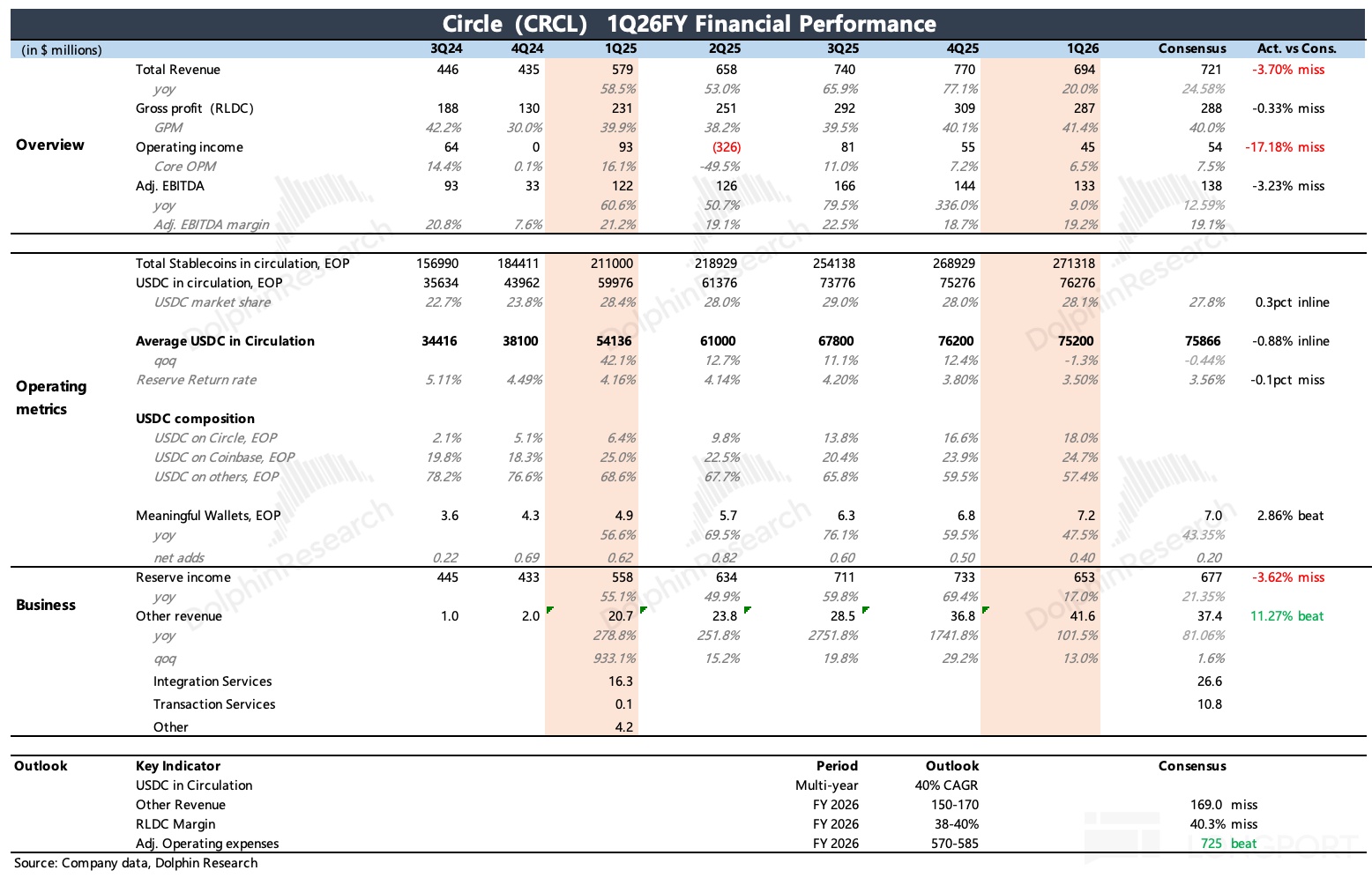
2. Revenue and profit: Total revenue plus reserve interest $694 mn (+20% YoY). Adj. EBITDA $151 mn (+24% YoY) with a 53% margin. RLDC (revenue less distribution costs) $287 mn (+24% YoY), RLDC margin 41.4% (+150 bps YoY).
3. Key metric moves: Reserve yield 3.5%, down 66 bps YoY, reflecting lower SOFR. Other revenue $42 mn, roughly doubled YoY. Adj. OpEx $136 mn (+32% YoY), with continued investment in product, distribution, and operating infra.
4. Arc token presale: Raised $222 mn at $3 bn fully diluted valuation (post-circulation total value). Tokens recorded at zero cost on the balance sheet; upon delivery, recognized as other revenue, flowing directly to RLDC and Adj. EBITDA. Circle holds 25% of Arc tokens.
II. Call details
2.1 Management highlights
1. USDC network
a. USDC in circulation ended the quarter at $77 bn (+28% YoY). Despite digital asset markets being ~45% off the Oct 2025 peak, supply was flat QoQ, signaling underlying non-crypto use-case growth.
b. On-chain volume $21.5 tn (+263% YoY). Visa indicates USDC accounts for 63% of stablecoin commerce volume; third-party data (incl. Solana) shows nearly $30 tn USDC volume, ~80% share.
c. ~$150 bn USDC minted and redeemed in Q1. USDC held on Circle platforms rose 3.5x YoY to $13.7 bn, 18% of total supply.
d. EURC doubled YoY to €358 mn. Tokenized MMF USYC grew ~300% YoY, topping $3 bn AUM as of May 7, the largest tokenized MMF globally.
e. Plan to launch serBTC — a compliant, secure wrapped Bitcoin issued by Circle on Ethereum and Arc.
2. Enterprise adoption and use cases
a. Meta started using USDC for creator payouts; DoorDash pays drivers in USDC. Polymarket uses USDC for funding and settlement.
b. Arbor Bank supports 24/7 banking via USDC. Partnerships expanded with top Korean exchanges.
c. Circle joined DTCC tokenized securities settlement pilots. USDC is gaining traction as collateral at regulated derivatives venues.
d. Broad partnership with Kyriba; Ramp uses USDC for cross-border and domestic pay. Y Combinator runs treasury ops in USDC.
3. CPN (Circle Payment Network)
a. Trailing-30D annualized TPV was $8.3 bn at quarter end, +17% QoQ. As of May 7 it was near $10 bn, up ~75% vs. last update.
b. 136+ FIs are live on CPN products, +36% QoQ.
c. Launched CPN managed payments, a one-stop solution for banks and PSPs addressing licensing, USDC liquidity, account infra, and blockchain compliance ops, compressing time-to-go-live.
4. Arc network
a. Testnet performed strongly; mainnet is imminent. Designed as a general-purpose horizontal economic OS for payments, capital markets, and agentic apps.
b. Arc presale led by a16z crypto; participants include Apollo Funds, Ark Invest, BlackRock, Janus Henderson, Bullish, ICE, Marshall Wace, SBI Group, Standard Chartered Ventures, General Catalyst, among others.
c. 60% of Arc tokens earmarked for ecosystem grants, airdrops, and incentive programs.
d. CCTP cross-chain transfer volume was nearly $50 bn in Q1, up 3x YoY. CCTP is being opened to other asset issuers.
e. Published a post-quantum security roadmap; Arc transaction messages are PQ-secure from day one.
5. Circle Agent Stack and AI strategy
a. Rolled out Agent Wallet, Agent Nano payments (USDC transfers as low as millionths of a cent), Agent Marketplace (500+ endpoints), and Circle Platform CLI.
b. USDC accounts for 99.8% of settlement on the X402 agentic payments protocol.
c. Internal AI transformation is accelerating: ~85% of employees are weekly active AI users. Over 600 AI-native apps have been deployed this year.
2.2 Q&A
Q: What is Circle doing to maintain leadership in stablecoins?
A: Third-party data for Q1 shows USDC at 80% of on-chain digital dollar transactions, a major YoY gain, which we are pleased with. We are executing on several fronts. First, make USDC as broadly available as possible globally, expanding access and liquidity across markets, including EMs.
Second, keep scaling partners and use cases. USDC is a network-effects core; when Meta, DoorDash, and treasury platforms adopt it, those effects compound and spread to more enterprises.
Arc itself is a native stablecoin L1 infra that will unlock broad apps in payments, capital markets, and agentic use. In an agentic economy, we believe most transactions will run on these new economic OSs, with USDC as the preferred means of payment — USDC is already 99.8% on AI agent protocols like X402. Finally, we are advancing clear policy frameworks globally so digital dollars can operate efficiently everywhere. This is an all-fronts push across go-to-market, product, innovation, policy, and intl expansion.
Q: What share of USDC usage ties to real-economy activity vs. trading/arbitrage? How do you shift toward durable, non-spec demand?
A: Increasingly robust third-party datasets parse activities by type. Visa’s analysis shows commerce transaction activity up several hundred percent YoY, with USDC roughly 60% of real commerce flows.
Our own data show more FIs globally building on our infra and delivering digital dollars to end users. Since the last update, CPN’s trailing-30D annualized TPV is up 75%, driven almost entirely by B2B cross-border flows using the stablecoin payments network.
Layer in Meta, banks’ 24/7 USDC corridors, and Fortune 100 enterprises served via Kyriba — all expanding new use cases. GENIUS and the upcoming CLARITY bills are critical, as they place stablecoins within the lawful global financial system and give enterprises and FIs confidence.
Q: What drove the strong RLDC margin this quarter, and is it sustainable?
A: We do not break out specific RLDC margin drivers, but our deck shows net reserve margin and the makeup of other revenue. Strength in other revenue helped RLDC margin.
On net reserve margin broadly, as noted before, multiple puts and takes drive it. This quarter, we saw growth in on-platform holdings at Coinbase, especially in the final month, and some moderation in high-incentive channels, which together supported a very strong RLDC margin.
Q: How is adoption of agentic commercial use cases on Circle Agent Stack?
A: The Agent Stack launch was significant, enabling agents to hold value, transact in USDC, and do so safely using Circle’s infra. We see several trends. First, agent payment protocols like X402 are moving from inception to healthy growth. The agentic tech breakout really happened over the past few months.
Every enterprise, FI, and key partner discussion now centers on applied AI strategies and agentic deployment plans. As a platform company, we are clear that AI- and agent-driven infra and automation become core, so we have made the product stack a top investment priority.
Notably, amid the surge in stablecoin volumes — USDC is 80% of on-chain digital dollar transactions — agents are being deployed and executed across markets and other settings beyond X402. We do believe a meaningful share of on-chain activity is already AI-driven, which spiked in Q1 with agentic advances. Our core thesis: AI operating platforms and economic operating platforms are converging, and the agentic economy will drive more labor, work, output, and exchange across the system.
Q: With USDC revenues tied to reserve assets while user incentives skew toward transactions under regulation, how does this affect go-to-market? Does legislation push a shift toward more transaction-driven revenues?
A: We focus on utility for this new form of money. Legislation makes it clear that if you are a distributor of stablecoins — Circle can continue to build sound economics with platforms globally — platforms that wish to incentivize users with stablecoins must do so based on real utility, real transactions, real payment volume, and real activity. Those are exactly the incentives we want, as they align stablecoin rewards with network utility growth. In a network-effects business, that alignment can be a strong flywheel for USDC adoption.
On CLARITY specifics — Heath Tarbert (President of Circle) adds: Even absent Congress, we are making history. But Congressional action would help in several ways.
First, today’s token presale and blockchain work fit within CLARITY’s framework. Second, it provides legal certainty for TradFi to use digital assets at scale. Third, Title IV expressly authorizes banks, broker-dealers, and custodians to engage in stablecoin use cases. On the so-called compromise clause (Section 404), we think it is the right answer and far better than status quo.
USDC’s value is in speed and utility, not idle. We expect Congress to clarify allowable stablecoin reward use cases — payments, FX, remittances, market making, collateral release, and Web3-native staking and validation — which are exactly where Circle aims to drive incentives.
Q: How should we think about G&A? Is this quarter’s $57 mn a reasonable full-year run-rate base?
A: For the full-year expense view, please refer to our total OpEx guidance, which includes all components. We continue to invest behind product, distribution, and capabilities for this very large opportunity.
Q: How will value be shared between Arc and Circle? How do you avoid economic tension?
A: The key is Arc token design. Arc and its token are purpose-built to drive value for all stakeholders in the Arc ecosystem. As the founder, Circle retains 25% of Arc tokens, reflecting the substantial value we create and contribute. But to scale a distributed network into a global economic OS, we need participation from large companies, key stakeholders, app developers, and end users. That requires economic incentives and giving them the utility of a digital token. CLARITY also provides a legal framework for enterprises to build incentive systems using digital tokens.
On guidance, we expect Arc to materially impact revenue, margin structure, and EBITDA, with details next call. More importantly, Arc’s success should create a flywheel for the stablecoin network, digital assets, CPN, and other Circle businesses. This is entirely incremental; we do not see tension.
Q: What edge does Circle’s full stack have vs. competitors’ point solutions?
A: Whether you are an FI, enterprise, or startup, full stack matters. The core operating infra is simple, stablecoin-native, and high performance. Layer on CCTP, the most broadly adopted interoperability tech — now open to other asset issuers — and apps can exchange value seamlessly across networks.
Add developer tools, wallet tooling, and now the agentic stack, and builders can dramatically accelerate time-to-solution. We are building a developer platform, an operating platform, higher-level service infra and protocols, and bringing leading digital assets — dollars, euros, MMFs — plus a new programmable Bitcoin asset. That integrated capability is highly differentiated.
Q: How will Arc token creation affect revenue and other revenue lines? For example, how much other revenue is recognized if $100 mn of Arc tokens are created?
A: Arc tokens are booked at zero cost on Circle’s balance sheet. When we satisfy obligations from the token presale, we recognize their value as other revenue, flowing directly into RLDC and Adj. EBITDA.
Q: What advantages does Arc L1 have vs. other networks? Is the vision focused on payments, capital markets settlement, or tokenization?
A: Arc is designed as a general-purpose horizontal economic OS. We expect payments, financial services, capital markets, and agentic activity to run on these OSs, increasingly driven by AI agents. Presale participants tell the story: leading asset managers and private credit firms for asset issuance; GSIBs investing for payments, capital markets, and FX; hundreds of design partners across sectors.
Concretely: First, Arc will be the best global infra for USDC liquidity, interoperability, and payment settlement — not just for USDC but also other stablecoins. Second, it offers the compliance and security assurances required by regulated banks and capital markets participants; we expect tokenized repos and intraday FX to run on Arc. Third, Arc is issuer-centric — issuers get USDC liquidity on Arc and cross-network distribution via CCTP. It is a full-spectrum platform.
Q: Will there be more Arc token sale rounds? Given Circle’s $750 mn token holdings, higher FDV could be very meaningful.
A: We completed this presale at $3 bn FDV, raising $222 mn, and are obligated to distribute tokens to participants. The focus now is mainnet launch, driving network utility and growth. Arc tokens play roles in utility, governance, staking, and security. As the white paper notes, 60% of tokens are for ecosystem grants, airdrops, and other incentives — with broad community and Circle involvement in allocations.
Q: Have recent DeFi security incidents shaken confidence? How does Circle’s new Bitcoin product address concerns?
A: To clarify: it was not Aave that was hacked. A core system of an interoperability infra company was compromised by North Korean actors, then routed through other DeFi protocols. The protocols themselves did not 'break' — Aave remains a major on-chain lending protocol. Circle has publicly disclosed purchasing AAVE tokens to support that ecosystem.
On-chain lending and other financial market primitives continue to grow. On Arc, we are working with key ecosystem participants to build institutional-grade on-chain protocols — with institutional participants, institutional vault management, and where appropriate (like our stablecoin FX liquidity environment) permissioned, institution-grade controls. The key lesson: the industry lacks explicit self-regulation; SRO-like structures and stronger InfoSec controls are necessary. As a regulated company, Circle’s control framework should also apply to on-chain protocols, apps, and services.
Q: For L1 competition, is Arc competing or collaborating with Canton and other real-world-focused L1s?
A: A few points. Our stablecoin network is market- and platform-neutral — USDC operates on 34 chains today, with CCTP connecting many networks. Our priority is to provide the most liquid, reliable, and compliant digital dollar to every major platform globally. Interoperability is paramount; for example, we participate on Canton and provide CCTP connectivity.
At the same time, we see a clear inflection from the pre-iPhone era to platforms designed for mainstream scale, developer friendliness, and great UX. We believe Arc can be one of them. Over the next 5–10 years as AI OS and economic OS converge, we aim to be at the center with leading tech and tools. Interop is a core theme of Arc — issuers on Arc can use CCTP to bring assets to Canton, Ethereum, Base, Solana, and beyond, addressing cross-platform reach and interop, a core focus for nearly all institutions.
Q: Will Kyriba and similar treasury platforms be key distribution for corporate balance-sheet adoption of USDC? What other channels matter?
A: As a corporate CFO, I speak with many CFOs. They understand stablecoin benefits and 24/7 rails and want seamless integration into existing systems and control frameworks. Integrations by leading TMS providers like Kyriba are both necessary for mainstream adoption and exciting milestones. We expect all major providers to integrate USDC and related capabilities over time.
Q: You mentioned moderation in high-incentive channels (possibly Binance) helped RLDC margin — is that positive or neutral?
A: We will not comment on specific channels. We do not view it as positive or negative. There are puts and takes any given quarter, and we have consistently said so, with data reflecting it. We are comfortable with the full-year guide.
Q: Platform USDC holdings grew sharply this quarter — what drove it and how do you see the outlook?
A: We continue to onboard more enterprises building on our infra, leveraging our wallet and custody tech and developer tools. As partnerships expand, on-platform holdings have room to grow. As a market-neutral infra company, with the Agent Stack built atop our Wallet Stack and Circle Gateway, agentic activity and developers building AI automation on our infra can also drive on-platform growth. We will keep investing in best-in-class infra so builders on Circle capture maximum benefit.
Q: USDC supply was flat QoQ, and on-chain data dipped after briefly topping $79 bn intra-quarter — macro or other drivers?
A: A few points. We do not guide to specific quarter or even full-year supply; we focus on the compounding growth rate and trend. Historically, supply ebbs and flows — sometimes flat, sometimes pulsed. Global macro — the price and velocity of money, sentiment — and endogenous crypto factors all play roles.
This quarter was a tale of two worlds: on one hand, large exchanges saw sharp declines in crypto trading volumes and prices, but stablecoins held up — the market grew ~32% YoY, and Circle was around 30%. Q4 deleveraging and losses from hacks also caused some deleveraging. Stepping back, fundamentals are strong: more apps are being built, volumes are up, more use cases and institutions are joining, regulatory clarity is a tailwind, and tech performance keeps improving. That is why we remain constructive on stablecoins and regulated digital dollars scaling to the trillions over the coming years.
The CFO adds: While supply was roughly flat QoQ, note USDC’s share of on-chain transactional utility continued to rise. This quarter USDC for the first time took the majority share of on-chain utility — a key trend for mainstreaming these technologies.
Q: Help unpack the main components of other revenue related to Arc tokens. Are there potential trading revenues or spreads?
A: Arc tokens can impact other revenue in several ways. First, if Circle sells tokens — as in the presale we just completed — the value flows into other revenue; these tokens are on Circle’s balance sheet and represent a substantial asset creation. Second, Arc tokens enable incentive programs to drive network growth — if Circle grants performance-based incentives, their value is first recognized in other revenue, while the granted tokens are recognized in other costs. Third, Arc opens new revenue surfaces, e.g., operating validators on Arc can provide direct other revenue to Circle. That is one example; more to come in due course.
<End of transcript>
Risk disclosure and statement:Dolphin Research disclaimer and general disclosure
Login to unlock18,602characters for free
This content is only available to signed-in users. Sign in to your Longbridge account to read the full post.