D
May 12 at 08:57 AM
TME (Trans): Intense Competition; Deepening WeChat Channels Collaboration in 2024
Below is Dolphin Research's transcript of$Tencent Music(TME.US) FY26Q1's earnings call. For our earnings take, see 'With Ximalaya onboard, can Tencent Music win the defense?'
I. Key financial highlights
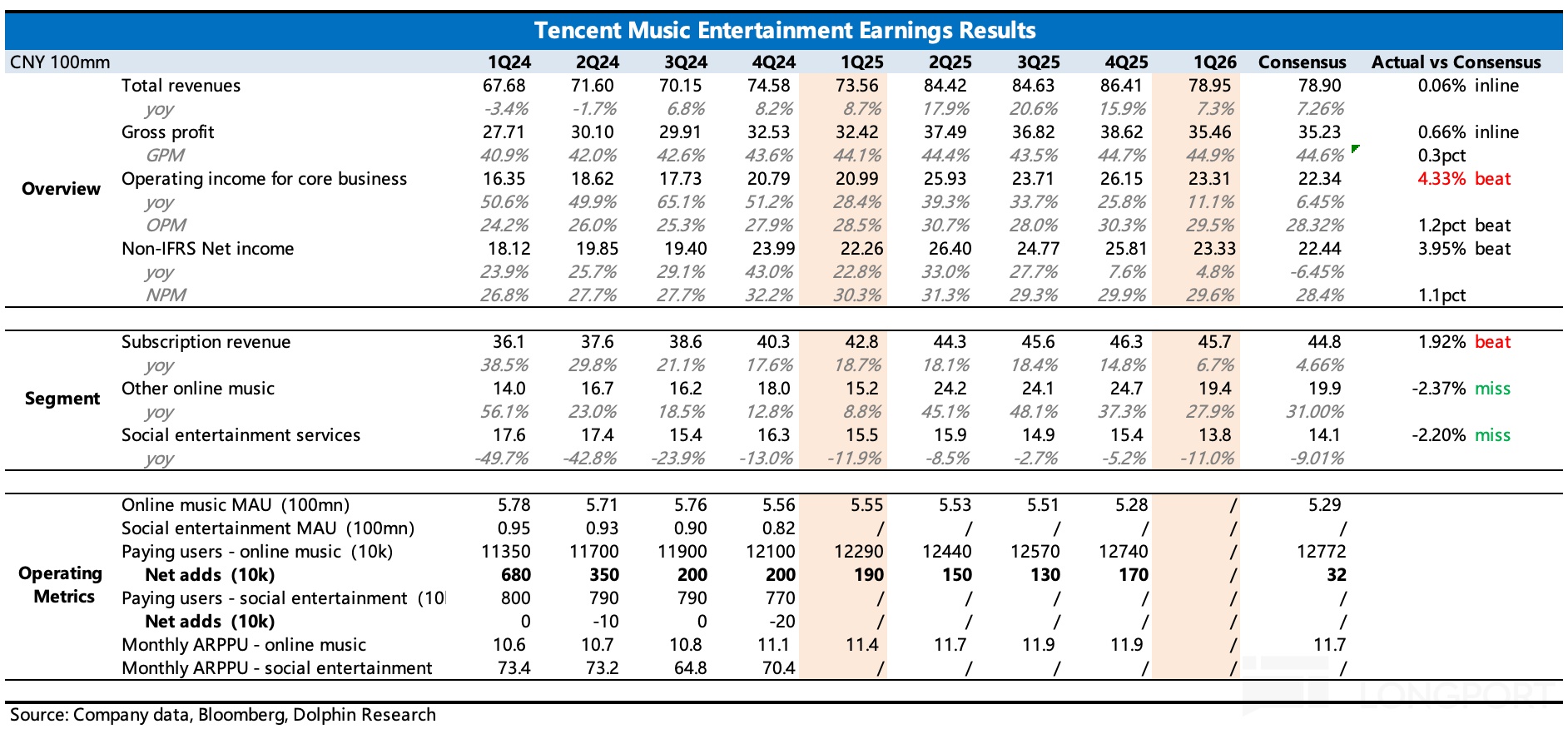
1. Shareholder returns: A FY2025 cash dividend of $0.12 per ordinary share ($0.24 per ADS) was paid in Apr 2026, totaling approx. $317mn. The two-year share repurchase program announced in Mar 2025 will be completed on schedule.
2. Key metrics: Q1 total revenue rose 7% YoY. Music services revenue grew 12% YoY; member services revenue was RMB 4.6bn (+7% YoY), while social and channel services revenue was RMB 1.4bn (-11% YoY); Non-IFRS net income attributable to shareholders reached RMB 2.3bn (+7% YoY); Adj. EBITDA was RMB 2.8bn (+10% YoY); diluted EPS per ADS was RMB 1.34.
3. GPM: Q1 GPM expanded 80bps YoY, driven by growth in membership and ads and lower channel fees. IP-related businesses had near-zero impact on margins, and Q2 GPM is expected to be flat YoY, with long-term confidence in maintaining industry-leading levels.
4. OpEx: S&M expenses were RMB 271mn (+36% YoY), mainly due to higher user acquisition amid intensified competition, and the full-year expense ratio is expected to normalize. G&A was RMB 140mn, roughly flat YoY.
5. Cash: As of Mar 31, 2026, cash and cash equivalents, term deposits and short-term investments totaled RMB 41.0bn.
II. Earnings call details
2.1 Management remarks
1. Copyright governance and AI challenges
a. The industry faces significant challenges from the proliferation of AI-generated content, where unauthorized AI content not only poses a headwind to subscription growth but also erodes creators' rights and the long-term value of the music ecosystem.
b. We are working with creators, rights holders and regulators to lead on copyright protection. The company has successfully navigated multiple major copyright and IP transitions in the past and is confident in its leadership in IP protection in the AI era.
c. Original human creativity and high-quality music IP are the ultimate differentiators. We are evolving from a traditional streaming service to an integrated music ecosystem to further unlock IP value.
2. Content ecosystem build-out
a. The classic catalog continues to strengthen: renewed with labels such as JVR Music and HIM, securing classics from artists including Jay Chou, Karen Mok, Harlem Yu and Angela Chang. A deeper strategic partnership with TF Entertainment adds a 30-day early-listen window for new releases and expands IP collaborations into physical products and offline shows.
b. The streaming share of self-released new tracks kept rising. Our collaboration with Sony Pictures on the movie theme song 'Rescue Plan' delivered strong performance, quickly topping multiple charts.
c. AI empowers end-to-end creation: a one-stop AI music suite now spans composing, arranging, vocals and mixing. Compliant AI covers of classics reactivate legacy IP with fresh styles and voices, driving a rebound in streams of the original songs.
d. Offline concerts again delivered triple-digit YoY growth: multiple flagship shows drew over 10k attendees, including Baby Monster's Taipei concert and the NCT tour, engaging both core fans and broader audiences.
3. Pan-IP ecosystem operations
a. We partnered with Jay Chou on the digital album 'Son of the Sun', offering a bundle of album + SVIP + physical merch with offline promotion across 45 cities. Sales exceeded RMB 100mn, boosting SVIP conversion.
b. We are deepening offline collaborations with top domestic and international labels and artists to broaden cross-cultural reach.
c. We are taking Chinese music global, with world tours covering Asia and North America.
d. We released the 2025 ESG report and received an ESG rating upgrade.
4. User growth and platform differentiation
a. Deep integration with the WeChat ecosystem enables a seamless jump from short-video discovery on WeChat Channels to full-track listening on QQ Music. This converts casual short-video users into loyal fans and gives creators greater exposure.
b. KuGou faces heavy user competition, and we are responding with more flexible pricing and a free + ad-supported membership model.
c. AI-driven engagement: upgraded AI recommendations, an AI Agent for efficient discovery, and AI-powered messaging lifted DAU in playback, with personalized players and interactive tools strengthening users' sense of belonging.
d. We are shifting to a value-based membership model beyond content subscriptions to deliver a more immersive music experience. While still early, we see strong long-term potential for IP-driven memberships.
5. Membership system and IP monetization
a. SVIP membership continues to grow strongly with high retention. Our first IP co-branded ambassador significantly enhanced perceived value and public awareness of the premium tier.
b. We launched TME Connect for high-fidelity audio transmission across devices, KuGou rolled out Live House effects, and we became the first music platform in China to support Dolby Atmos, complemented by CUBE House offline audio spaces.
c. We pioneered IP-centric memberships, such as the 'Cloud Romance Universe' fan services that offer early ticketing, exclusive content and artist-specific benefits.
d. On the content side, we introduced China-limited digital albums plus physical collectibles from K-pop artists including BLACKPINK.
e. IP-driven offline scaled up: as exclusive distributor of physical merch (New Year gift boxes, limited collectibles, etc.) and co-curator of immersive exhibitions.
2.2 Q&A
Q: What is the revenue outlook for the rest of 2026, and what are the growth drivers for member and non-member businesses? How will overall ecosystem performance improve after WeChat Channels received regulatory approval?
A: Despite a challenging competitive backdrop, Q1 delivered a solid print thanks to our dual-engine strategy of content plus platform, which underpins an irreplaceable one-stop music entertainment ecosystem. Non-member businesses grew strongly, with live events again posting triple-digit YoY growth.
That said, competitive pressure remains significant. Price competition across the industry and the spread of AI-driven pirated content add uncertainty to future revenue growth for traditional streaming services. We will focus on three areas going forward.
First, we will strengthen copyright enforcement to prevent AI from becoming an infringement tool, having established a dedicated taskforce to firmly protect the legitimate rights of the platform, rights holders and creators while welcoming innovation but cracking down on practices such as 'song-washing'.
Second, we will expand user entry points through deeper integration with Tencent's ecosystem. In Apr, we launched a tight collaboration with WeChat Channels that enables one-tap jumps from short videos to full tracks on QQ Music, creating a seamless path from discovery to listening, collecting and premium consumption.
Third, we will leverage our thriving ecosystem to entrench one-stop music consumption by widening our advantage along two vectors—expanding the artist/IP roster and extending the value chain. In parallel with broadening artist partnerships, we are building an in-house artist system and extending from digital rights into tours, physical merch and fan-centric memberships.
For the full year, membership and ads growth may see short-term volatility due to competition, but longer term we are optimistic on IP-based integrated monetization and expect steady growth. On Ximalaya, we just received approval and TME along with Tencent will proceed strictly per the transaction commitments to ensure compliance and orderly execution.
Q: How is the membership subscription tiering structured? What are the growth and retention trends for ad-supported subscribers? How much can new subscriptions such as fan clubs and Bubble contribute to blended ARPU, and what are the plans for long-audio subscriptions after the deal is approved?
A: TME is positioned this year as a one-stop music services platform. QQ Music has been around for over 20 years, and we have been expanding its boundaries, evolving over the past three years from traditional streaming into a broader portfolio.
We do not disclose retention by tier, and there are differences across tiers. Our multi-tier design targets different user needs: for light or less active users, a free + ad-supported model improves retention and monetization; core music subscriptions target higher-need, stickier users; and for deeper-value users, products such as Fans Cloud and Bubble meet diversified needs.
We believe IP-led audio subscriptions—not only music but also audiobooks and kids' audio—will create larger commercial opportunities and enhance retention. In short, we will continue to build a one-stop, IP-centric music services platform to lift retention and unlock more monetization, which is our key edge versus peers.
Q: Member services revenue grew nicely YoY but dipped slightly QoQ. Beyond seasonality, were there other reasons, such as high-value users downgrading or churn, and how should we think about sequential trends?
A: First, it was not SVIP users trading down, nor was it driven by user losses. SVIP continues to grow steadily, and our mid- to high-value cohorts remain solid.
The slight QoQ decline mainly reflects intensified competition in music streaming, particularly in free and ad-supported tiers. We have observed some market behavior that deviates from business fundamentals—certain competitors rapidly fill catalogs with AI content and deploy aggressive tactics to grab traffic and users, focusing on light users. In our view, this overdraws the industry's economic value and their own commercial value.
In this context, we remain committed to building a one-stop integrated music services platform. We offer monthly subscription services across two music platforms, and KuGou's users are more price- and promo-sensitive and therefore more prone to churn amid more choices, which weighed on KuGou's member net adds.
To address this, we adopted a free + ad-supported model to lower the entry barrier, and KuGou Lite delivered strong growth in Q1, aided by more flexible pricing and content strategies to retain light users.
QQ Music is the more comprehensive platform with healthy operating metrics, and user value is even improving. The recent integration with WeChat Channels will further strengthen our competitive edge, while offline shows, multi-device experiences and scale remain core strengths that underpin further monetization.
Q: Q1 GPM improved YoY—does this change the full-year margin guide (previously guided to flat to slightly down)? Is the jump in S&M linked to deeper integration with Tencent's ecosystem, and is that increase one-off or ongoing?
A: Q1 GPM improved YoY for three reasons. First, continued growth in membership and ads contributed positively; second, despite rapid growth in IP-related businesses—especially exponential growth in agency services with a rising revenue mix—alongside expansion in offline shows and events, accumulated expertise and operating efficiency drove a near-zero impact from IP businesses on margins; third, strict cost control helped.
Sequentially, margin expansion was mainly due to seasonality in IP-related businesses, where Q1 contributions were far below Q4, which offset seasonal swings in memberships and ads. Looking ahead, we expect Q2 GPM to be flat YoY.
Longer term, even if membership and ads growth moderates, we will rely on strict cost controls—reducing allocation to low-value, low-efficiency content and benefiting from lower Apple Store channel fees—to support margin resilience. In parallel, our online + offline content strategy and a higher mix of owned IP revenue will sustain solid profitability, and we are confident in maintaining industry-leading margins.
Regarding the 36% YoY increase in Q1 S&M, it reflects intensified competition, and we strategically stepped up user acquisition on our music platforms. Actions included sourcing high-value users through multiple channels, leveraging star collaborations to acquire high-quality users, and boosting promotion of self-produced content to raise exposure and the competitiveness of core content, thereby strengthening stickiness.
This year within Tencent's ecosystem, we will allocate strategic resources to WeChat Channels to help build its music capability, jointly promoting and distributing with top artists and studios to improve coordination efficiency. As the WeChat Channels music platform matures and self-produced content contributes more, both platforms should achieve a win-win outcome. For the full year, the S&M ratio will remain at a reasonable level, consistent with prior guidance, and subsequent quarters will not maintain a 36% growth rate.
<End of text>
Risk disclosure and statements:Dolphin Research Disclaimer and General Disclosure
Login to unlock12,903characters for free
This content is only available to signed-in users. Sign in to your Longbridge account to read the full post.