

JD (Trans): Q2 3C & Appliances Under Greater Pressure; Margins Set to Improve Further

Below is Dolphin Research's summary of$JD.com(JD.US) FY26 Q1 earnings call. For our take on the print, see 'State subsidies faded, but JD's earnings power holds up'.
I. Key takeaways
1. Shareholder returns: Repurchased ~44.5 mn ordinary shares in Q1 (equivalent to 22.3 mn ADSs) for a total of $631 mn, ~1.6% of total shares outstanding. Remaining buyback authorization is $1.4 bn through Aug 2027. Cash dividend for 2025 is $1 per ADS (~$1.4 bn), paid in Apr.
2. Outlook: In Q2, Electronics & Home Appliances still face tough comps from the 'trade-in' program and ASP pressure, but management is confident growth will re-accelerate in 2H. For the full year, General Merchandise and ad/commission revenue are expected to deliver healthy growth, supporting overall healthy growth for the year.
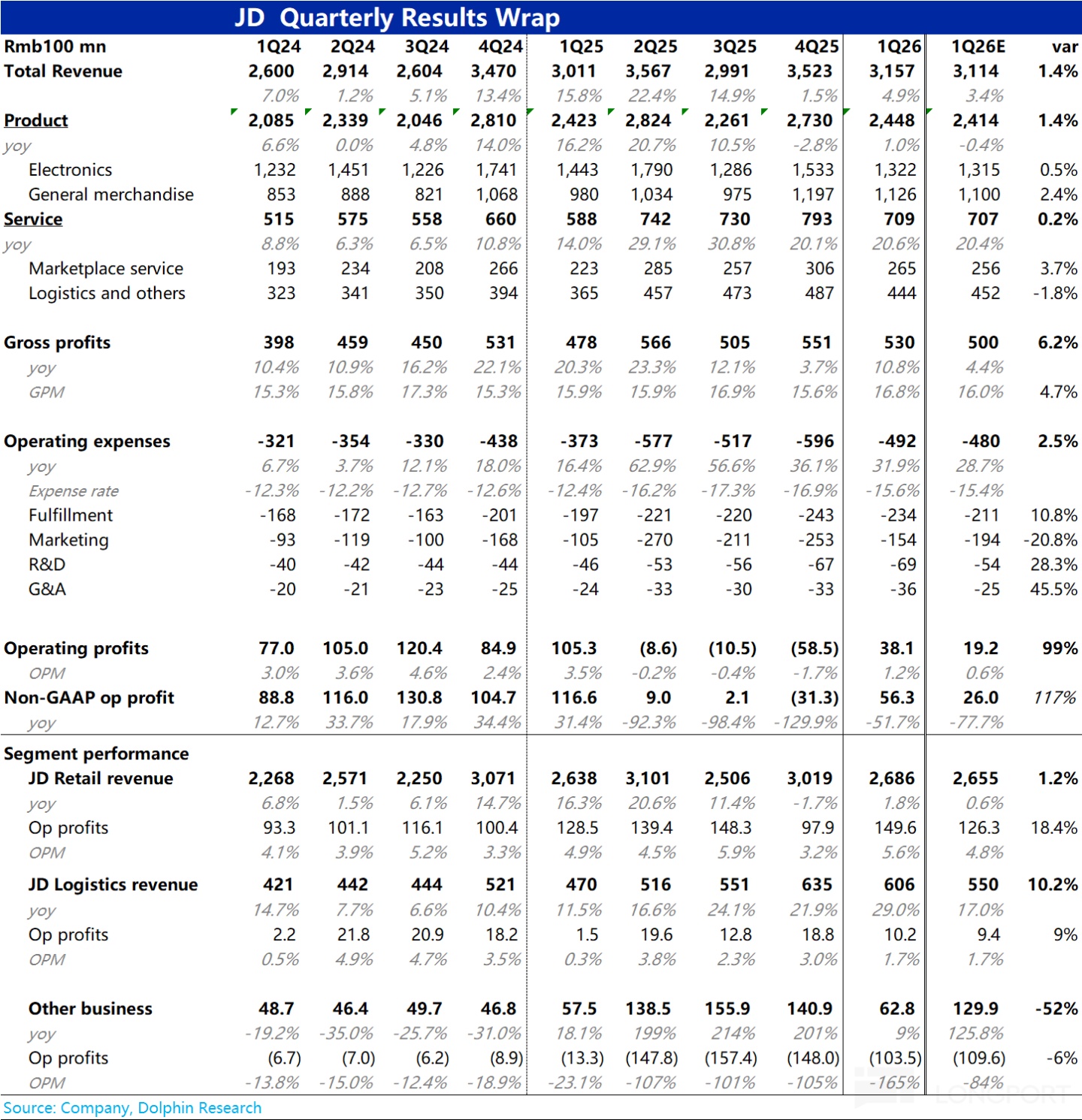
3. Profit: Q1 revenue was RMB 315.7 bn (+5% YoY). Non-GAAP net income to shareholders was RMB 7.4 bn with a 2.3% margin. JD Retail posted OP of RMB 15.0 bn (+16.5% YoY), OPM of 5.6% (+0.7pp YoY), and GPM of 18.6% (+1.8pp YoY), all at record highs. Group GPM reached 16.8% (+90bps YoY).
4. Cash flow & liquidity: LTM FCF was RMB 22.0 bn (vs. RMB 38.0 bn a year ago), mainly due to cash outflows related to trade-in subsidies and timing of OP growth. Cash and equivalents, restricted cash and ST investments totaled RMB 216.0 bn at quarter-end.
5. New biz losses narrowed sharply: Q1 Non-GAAP operating loss for New Biz narrowed QoQ to RMB 10.4 bn, with JD Food Delivery delivering the largest QoQ loss reduction since launch.
II. Details from the call
2.1 Management remarks
1. JD Retail
a. Q1 revenue grew 1.8% YoY with sequential acceleration across revenue streams. Electronics & Home Appliances revenue fell 8.4% YoY but improved QoQ, while General Merchandise grew 14.9% YoY, marking six consecutive quarters of double-digit growth; Supermarket has delivered double-digit growth for nine straight quarters. General Merchandise now contributes over half of GMV.
b. Ad and commission revenue delivered another strong double-digit increase, the sixth consecutive quarter of double-digit growth, and was the main driver of the Group's 18.8% growth in marketing revenue. JD Food Delivery contributed roughly 3% incremental ad revenue.
c. GPM reached 18.6% (+1.8pp YoY), improving YoY for 16 straight quarters, driven by supply-chain-led margin expansion across categories and a higher mix of high-margin revenue from ads and commissions.
d. Marketing ratio declined YoY for a third consecutive quarter, helped by traffic synergies from new businesses (Food Delivery and Jingxi). R&D spending rose meaningfully in Q1 and is expected to trend higher in the near term.
e. Long-term OPM target remains in the high single digits, underpinned by 1P supply-chain scale driving sustained GPM expansion, margin upside in Supermarket and other categories, and rapid growth of high-margin service revenue (commissions and ads) as the platform ecosystem scales. The current take rate is still below industry peers.
2. User growth & engagement
a. Quarterly active users and annual active users both grew over 20% YoY in Q1, with AAC at an all-time high. Growth was driven by organic gains in core retail and strategic contributions from new businesses (Food Delivery and Jingxi).
b. JD PLUS membership continued to post double-digit YoY growth.
c. Shopping frequency per user jumped 37% YoY in the quarter, and DAU rose over 20% YoY.
3. JD Logistics
a. Q1 revenue grew 29% YoY, driven by incremental food delivery revenue and strong performance across diversified services.
b. Non-GAAP OP rose 600% YoY, supported by AI and robotics enablement and overall operational optimization.
4. New businesses
a. JD Food Delivery: Delivered the largest QoQ narrowing of losses since launch, with unit economics continuing to improve. Total revenue from commissions and ads nearly doubled QoQ. JD maintained rational subsidies amid industry competition and kept optimizing operating and marketing efficiency by user cohort and region. Food delivery and on-demand retail are long-term strategies for JD.
b. Jingxi: Continues to deepen presence in lower-tier markets (Tier-6 cities and rural townships), creating new user-growth opportunities for the platform while maintaining disciplined investment.
c. Joybuy (Intl): Launched on Mar 16, offering same-/next-day delivery to 30+ major European cities, covering over 40 mn people. Partnering with top global brands across categories at competitive pricing. Maintains high user ratings on Trust Pilot. Q1 investments were stable QoQ, overall spend remains controlled and in line with expectations.
5. AI applications
a. AI shopping assistant 'Jingyan' (Xin Yang): Q1 quarterly active users rose over 200% YoY, while user interactions grew over 300% YoY.
b. AI digital live-streaming host Joy Streamer: merchants and live sessions using the tool rose 10x YoY.
c. Procurement AI Agent analyzes front-end demand, identifies new opportunities, matches with merchants and products, and automates day-to-day tasks in merchant management, inventory management and marketing.
d. Logistics automation: Rolled out the new-generation 'Longtaker' robotic arm in Q1, handling a wide range of parcel sizes and auto-boxing, successfully moving from lab to production. The 'Lonzo' robot family now covers the full logistics chain and is deployed at scale globally.
2.2 Q&A
Q: JD Retail outgrew expectations in Q1 despite tough comps, and held up well in Mar when the broader market slowed. Any changes in consumer behavior? How are electronics price hikes impacting demand? How do you see growth over the next two quarters?
A: JD Retail delivered a solid Q1, with sequential acceleration in Electronics & Home Appliances. While growth was impacted by last year's high base from the trade-in program, our supply-chain strengths and brand equity helped us win more consumer trust and reinforce our leadership. General Merchandise growth accelerated to 15%, with Supermarket posting its ninth straight quarter of double-digit increase, underscoring deepening consumer mindshare in these categories.
On 3C and appliance price hikes, smartphones and PCs saw industry-wide price increases since Mar due to rising storage costs. The magnitude and breadth of increases were significant and did dampen demand in the short term. We also see a mix shift toward mid-to-high-end models and leading brands. In this challenging backdrop, JD's value proposition stands out: we leverage supply-chain efficiency to deliver better prices and service, while enabling brands to sell more efficiently and predictably. Our edge is strongest in premium products and top brands, which should further solidify our position.
For the full year, Q2 electronics and appliance sales will likely remain under near-term pressure, given the higher trade-in comps last year and the impact of smartphone/PC price hikes on sentiment. We will keep building brand and user mindshare and help partners achieve more predictable sales. Into 2H, we have stronger confidence in a growth rebound, especially in appliances as comps normalize and our omni-channel network continues to expand, unlocking more category potential. Meanwhile, we remain confident in healthy growth for General Merchandise and ad/commission revenue. With increasingly diversified growth engines, we believe JD can deliver healthy full-year growth in a volatile year.
Q: With rising macro uncertainty, intensifying competition, more platform subsidies and higher electronics ASPs, how should we think about JD Retail's margin trajectory?
A: JD Retail delivered double-digit OP growth in Q1, with OPM expanding to 5.6%. Several drivers are at work: first, GPM expansion — both core Electronics & Home Appliances and fast-growing General Merchandise saw YoY margin gains as our supply-chain capabilities lifted industry efficiency, creating value for brands while improving our profitability and expanding GPM across categories. Second, better marketing efficiency — the marketing ratio improved YoY for the third straight quarter, with new businesses like Food Delivery and Jingxi bringing incremental traffic and allowing more precise and efficient marketing allocation. Third, alongside margin and marketing improvements, we kept investing in R&D, especially AI, with Q1 R&D up significantly and set to rise further. These investments should translate into operational benefits, driving AI-enabled efficiency gains and a leaner cost structure.
Looking ahead, Q1 further validates JD Retail's ability to steadily expand margins over the long term. We reaffirm our long-term high single-digit OPM target. Key drivers include: 1P scale effects continuing to lift merchandise GPM, room for margin expansion in Supermarket and other categories, and ongoing product-mix upgrades within Electronics & Home Appliances; a healthy platform ecosystem supporting rapid growth of high-margin services such as commissions and ads, with our current take rate still below industry levels, leaving ample upside. Long term, as China's largest supply-chain-centric retailer, JD has the broadest AI and automation use cases, offering significant potential to enhance user experience and reduce costs.
Q: Joybuy has launched in multiple European countries. How do you view near-term investment intensity and the ramp toward key order-volume milestones? How will new businesses affect losses and ROI long term?
A: Joybuy launched on Mar 16, leveraging JD's supply chain and local operations, partnering with top global brands to offer competitive, full-category assortments to European users. With our self-built logistics infrastructure in Europe, Joybuy brings JD's same-/next-day delivery experience from China to local consumers. It maintains high user ratings on Trust Pilot, and high-quality products plus superior delivery are building local trust.
On investment, Intl spending was stable QoQ in Q1 as we kept improving operating efficiency. We will execute on our strategy over the next few quarters, and overall investment may gradually increase as the business grows healthily. Scale effects should keep improving unit economics as order volumes rise. Overall, Intl investment remains highly controllable and in line with initial expectations.
Looking forward, Intl expansion is a long-term strategy. We will steadily broaden coverage and build capabilities while maintaining strict financial discipline, focusing on ROI to drive healthy, sustainable growth. Investments will target supply-chain pillars — product, fulfillment and tech systems — to offer more competitive assortments and better delivery, further differentiating the Joybuy experience in Europe. Over time, these investments should translate into better retention, scale benefits and stronger long-term ROI. We are confident JD's core supply-chain moat, especially the efficient 1P model plus logistics strength, can redefine efficiency and user experience globally.
Q: How does JD see AI Agents changing consumer search and purchasing behavior? What are JD's unique moats as China's largest retailer? Any defensive or offensive strategies around AI Agent interactions?
A: We believe that regardless of technology evolution — whether AI-assisted shopping or otherwise — retail fundamentals do not change: delivering better user experience at lower cost and higher efficiency to meet demand for good products, prices and services. This has been JD's core supply-chain moat over two decades. Today we are deploying AI and robotics to further enhance experience and drive efficiency gains.
On the demand side, our in-house AI Agent 'Jingyan' is being fully upgraded to better identify, stimulate and match consumer needs, offering a more efficient shopping experience within the JD app. In Q1, Jingyan's quarterly active users rose over 200% YoY, and user interactions climbed over 300% YoY.
On internal processes, the Procurement AI Agent analyzes front-end market demand, identifies new opportunities, and matches the right merchants and products. It also automates daily tasks across merchant management, inventory management and marketing, enabling teams to operate and decide more efficiently. We have also built AI tools to improve merchant productivity, including marketing content generation, the Joy Streamer digital live host and AI customer service.
On the supply-chain side, we are deploying AI and robotics at scale to raise automation and coverage. JD's 'Lonzo' robot family now spans the full logistics chain and has been rolled out globally at scale, steadily reducing costs and improving efficiency.
By deploying these Agents, we are upgrading individual links into a seamless end-to-end workflow, effectively building an Agent-to-Agent framework that replaces inefficient intermediaries and delivers step-function gains in overall efficiency.
Q: Is JD Food Delivery's goal profitability? Will you target breakeven in line with peers, or run near breakeven/slight loss as a long-term strategic investment?
A: In Q1, JD Food Delivery delivered the biggest QoQ narrowing in losses since launch while maintaining healthy order volumes, with substantive improvements in unit economics. On the revenue side, as we optimized operations and upgraded the ad system, combined commission and ad revenue nearly doubled QoQ. We stayed rational on subsidies amid industry competition and kept refining operating and marketing efficiency across user segments and regions. Supply-chain innovation will also drive growth. We will fully comply with regulations and operate in accordance with rules.
We believe food delivery will ultimately be profitable. But it is not a standalone business — we will unlock ecosystem synergies. On the user side, there are three areas: first, user scale — food delivery drives healthy growth in platform traffic and user base, with DAU and quarterly active users both up over 20% YoY in Q1, which also supported ad revenue growth. Second, engagement — food delivery meets the needs of our high-quality users and lifted shopping frequency by 37% YoY. Third, cross-selling — food delivery users exhibit stronger cross-category purchasing, especially in Supermarket and on-demand retail.
On the supply side, food delivery enriches location-based supply, expanding from restaurants to Supermarket and General Merchandise, and deepens collaboration with merchants and brands. In fulfillment, food delivery and logistics will explore synergies — building strong last-mile infrastructure not only enhances on-demand delivery but also improves coordination and optimization across the logistics network.
Food delivery and on-demand retail are long-term strategies for JD, and we will develop the business with a long-term, healthy-growth mindset.
Q: How do you see the competitive landscape in FMCG and fresh food going forward? How will share evolve among big-box supermarkets, online, and on-demand/quick commerce? Which model does JD prefer, and which is more profitable?
A: China's supermarket market is close to RMB 10 tn and remains highly fragmented, implying ample room for cost optimization and efficiency gains, with significant headroom for online penetration.
Within Supermarket, JD operates multiple models: the 1P self-operated model focuses on a reliable consumer experience, the platform model offers selection and variety, and the on-demand model has grown rapidly on JD in recent years. These are not substitutes but complementary, serving different use cases with varying efficiency, timeliness and assortment.
As a supply-chain-focused B2C retailer, JD Supermarket has strong advantages in product curation, supply chain and warehousing, cost and price competitiveness, and user experience. As China's largest Supermarket, it has posted double-digit revenue growth for nine consecutive quarters, demonstrating resilience. On profitability, we continue to improve margins through scale and supply-chain capabilities, with room to optimize both GPM and fulfillment ratio. Scale and steady growth should gradually expand profits.
We believe competition in Supermarket will ultimately come down to user experience, cost and efficiency. With continuously improving self-operated supply-chain capabilities, JD Supermarket delivers better products at lower prices while helping brands achieve stable incremental sales. We are confident in its long-term, healthy growth, as it becomes a key growth engine over the next few years.
Q: Any updates on the 3P ecosystem? How are merchant count, contribution and the outlook for the next few quarters?
A: Our platform ecosystem centers on user experience, low cost and high efficiency. Through different business models, we offer the optimal combination of products, prices and services to meet diverse consumer needs.
In Q1, we made solid progress building the platform ecosystem. Several key metrics maintained rapid growth: first, active merchant base grew triple digits YoY in Q1, as we onboarded more quality brands and manufacturing-belt merchants, enriching selection. Food delivery also brought in a large number of quality restaurant merchants, further extending services. Second, user feedback is positive — the number of users buying 3P goods grew rapidly, outpacing total user growth, supporting strong 3P order growth, with 3P orders exceeding 50% of total orders in Q1.
Financially, 3P GMV grew faster than 1P and overall GMV in Q1. More importantly, marketing revenue has delivered double-digit growth for six straight quarters, and the rising mix of these high-margin streams continues to lift profitability. Longer term, we expect 3P GMV contribution to surpass 1P, with the platform ecosystem becoming a key driver of revenue growth and margin expansion.
Q: Any updates on shareholder returns?
A: In Q1, we repurchased ~44.5 mn ordinary shares (equal to 22.3 mn ADSs) for $631 mn, ~1.6% of YE25 shares outstanding. The remaining authorization is $1.4 bn through next Aug, and we expect to continue repurchases as planned. In addition, the $1 per ADS cash dividend for 2025 was announced in Mar and paid in Apr as scheduled.
Looking ahead, we will continue to return capital via dividends and buybacks. We remain focused on long-term healthy growth in scale, profitability and cash flow, sharing JD's success with shareholders in multiple ways.
<End of text>
Risk disclosure and statements for this article:Dolphin Research Disclaimer and General Disclosure
The copyright of this article belongs to the original author/organization.
The views expressed herein are solely those of the author and do not reflect the stance of the platform. The content is intended for investment reference purposes only and shall not be considered as investment advice. Please contact us if you have any questions or suggestions regarding the content services provided by the platform.
