

What does SNOW do? Why did it go up again today?

I often see people asking what $Snowflake(SNOW.US) actually does. Let me explain it simply:
In one sentence: Snowflake is a "data warehouse cloud platform"—it helps large companies store, manage, and analyze their data in the cloud, essentially building a super database for enterprises that can be accessed online.
How it makes money: It charges based on usage, not per seat or a fixed monthly fee. The more computing power used and the more data stored, the more you pay. Therefore, its revenue is directly linked to customers' data usage. The more companies adopt AI, the greater the data processing volume, and the more Snowflake earns.
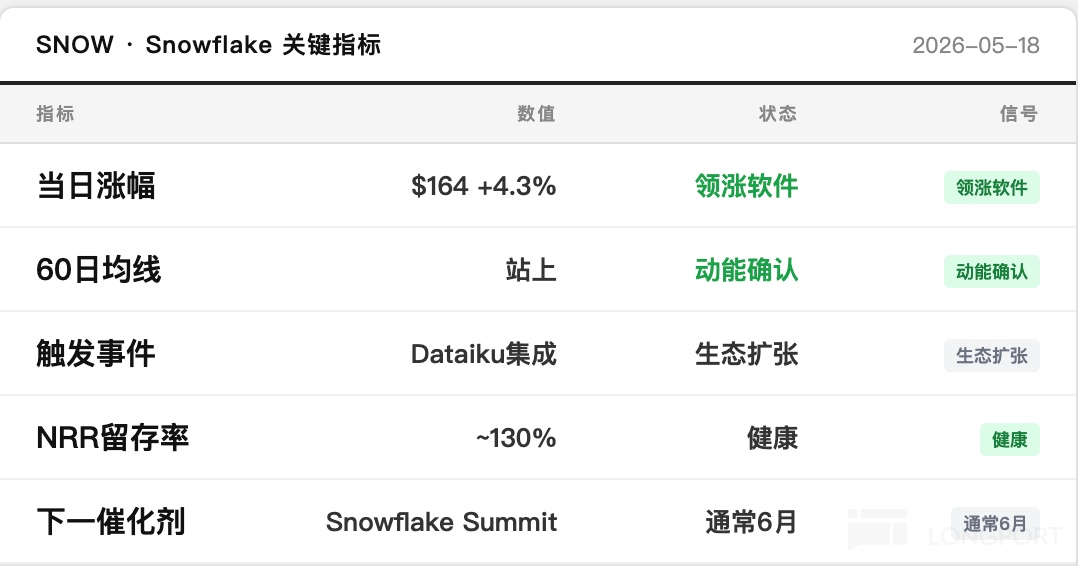
Why it's up today: Dataiku (an enterprise AI platform) announced the launch of its "Cobuild" feature on Snowflake, allowing the generation of production-ready AI models directly from prompts. This type of third-party integration is a pure positive for Snowflake, indicating its ecosystem is extending into the AI application layer.
Relationship with AI: Snowflake's growth logic is: Enterprise AI needs data → Data needs to be processed on a platform → Snowflake is the place to store data. Last year's growth slowdown worried the market, but recently analysts have started warming up to it ("Wall Street warming up" was last week's headline).
Trading Tips:
- SNOW has broken through with increased volume for two consecutive days, now standing above its 60-day moving average. Short-term momentum looks decent.
- Earnings season just ended. The next catalyst is the Snowflake Summit developer conference (usually in June), a key event for product announcements.
- To increase exposure, consider SNOU (a 2x leveraged long ETP on SNOW), suitable for short-term trades. SNOY is a covered call strategy with capped upside but extra income, suitable for those who think the price will consolidate after reaching a certain level.
- Snowflake is a loss-making growth stock. P/E ratio is meaningless. Focus on NRR (Net Revenue Retention) and RPO (Remaining Performance Obligation) for a more realistic picture.
The copyright of this article belongs to the original author/organization.
The views expressed herein are solely those of the author and do not reflect the stance of the platform. The content is intended for investment reference purposes only and shall not be considered as investment advice. Please contact us if you have any questions or suggestions regarding the content services provided by the platform.
