

The largest IPO of the year, with a 2x version available

Last Wednesday (5/14), an AI chip company called Cerebras Systems went public on Nasdaq under the ticker CBRS$Cerebras(CBRS.US). This event didn't attract much attention domestically, but it generated significant discussion within the U.S. stock community—dubbed the "largest IPO of 2026 so far."
First, let's talk about what this company does.
You might know that NVIDIA's GPUs work by connecting many chips in parallel. Cerebras took a different path: making an entire silicon wafer into a single chip, with an area dozens of times larger than NVIDIA's chips, aiming to fundamentally solve the data transmission bottleneck in large model training. Its processor is called WSE (Wafer Scale Engine), and its customers are companies doing ultra-large-scale AI training. It doesn't directly compete with NVIDIA, but in specific scenarios, it has its own advantages.
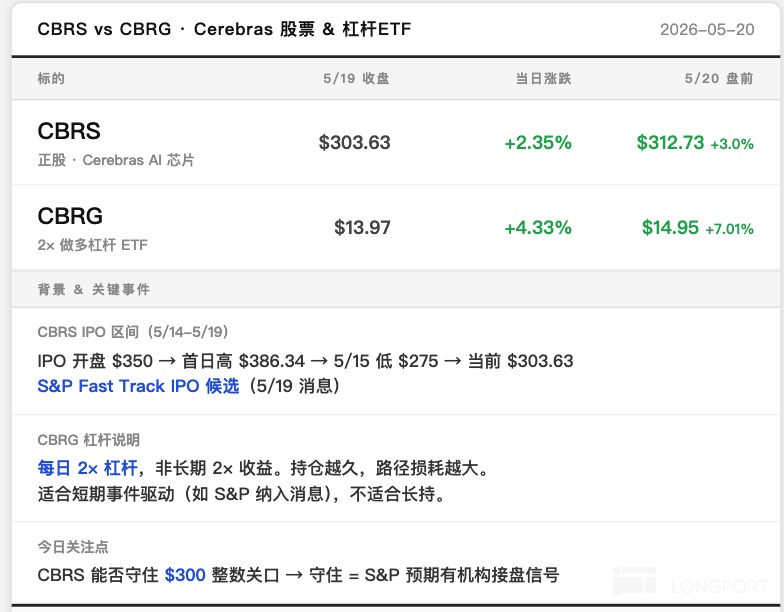
The IPO pace was a bit of a rollercoaster. It went public on 5/14, opened at $350, surged to a high of $386 that day, then continued to fall, hitting a low of $275 on 5/15, a drop of nearly -30%. It slowly recovered over the next few days, closing at $303.63 yesterday (5/19 EST).
Yesterday also brought important news: Cerebras was included in S&P's "Fast Track IPO" program for consideration, meaning if it meets the criteria, it could quickly enter the S&P 500 index. Once this news broke, the stock price immediately surged that day, with pre-market trading on 5/20 at $312.73, up another +3% from yesterday's close.
Alright, now let's talk about CBRG.
CBRG is a 2x leveraged long ETF that tracks twice the daily percentage change of CBRS. On 5/19: CBRS$Cerebras(CBRS.US) rose +2.35%, CBRG rose +4.33%, roughly double. Pre-market on 5/20: CBRS +3%, CBRG +7.01%, still double.
Here's the key—"daily double" and "holding for a year to double your money" are two very different things.
Leveraged ETFs rebalance daily based on that day's price movement. This creates an effect called volatility decay: if the stock price fluctuates back and forth, the leveraged ETF will fall more than you might think. For example: CBRS rises 10% on day one, falls 10% on day two, your net loss is -1%. But CBRG rises 20% on day one, falls 20% on day two, net loss is -4%. The greater the volatility and the longer you hold, the greater this decay.
CBRS has only been public for 5 trading days and is itself a high-volatility stock. CBRG's intraday amplitude reached a maximum of +34% over these 5 days (from a low of $12.41 to a high of $16.70). With this level of volatility, holding CBRG long-term is contributing to the ETF, not making money for yourself.
My view on these two: if you're bullish on Cerebras' sector and want to hold long-term, buy CBRS stock directly. Don't get slowly worn down by volatility decay. If you want to bet on the short-term event of S&P inclusion, CBRG is an effective tool. Event-driven, complete before inclusion is confirmed or rumors materialize, then exit.
Currently, pre-market on 5/20, I'm watching whether CBRS can hold the $300 psychological level—holding it suggests institutions are buying on the S&P rumor; failing to hold it means waiting and watching for the next catalyst.
Comments
@Options Newbie: Can you explain volatility decay again? I didn't quite get it.
Lao Xu's reply to @Options Newbie: It's the daily reset of leveraged ETFs. $100, up 10% becomes $110, down 10% is $99, a loss of $1. But a leveraged ETF goes up 20% to $120, down 20% is $96, a loss of $4. Each up-and-down cycle loses a bit more than an equivalent direct investment, accumulating significantly over time.
@Retail Investor Diary: CBRG only has a 3-day history. Are these new ETFs reliable?
Lao Xu's reply to @Retail Investor Diary: As long as the underlying asset has trading volume, the leveraged ETF mechanism itself is fine. But CBRS is a newly listed stock, hasn't passed the lock-up period yet, and liquidity and price discovery are in early stages—that's an additional layer of risk.
@Old Leek's Path to Shore: Is S&P 500 inclusion confirmed or just a possibility?
Lao Xu's reply to @Old Leek's Path to Shore: Currently a candidate for the "Fast Track" program, not confirmed yet. S&P adjusts its constituents quarterly. If it meets profitability and liquidity requirements, it will be included. CBRS just went public; whether it can be included depends on whether its financial data meets the standards—it's not automatic.
@Don't Understand AI: How big is the gap between Cerebras and NVIDIA?
Lao Xu's reply to @Don't Understand AI: The market cap difference is hundreds of times. CBRS is around $300 per share now—this is an AI chip challenger, not a competitor. The technology routes are different, the targeted niche scenarios are different, not the same weight-class opponent.
@Slacker Researcher: Why did the IPO first day go from $350 to $386 then crash to $275?
Lao Xu's reply to @Slacker Researcher: Normal for new IPOs. First day sees a lot of short-term speculative money come in, profit-taking after the hype, plus no short-sale lock-up period, so the pullback is fast. The key is whether the company's fundamentals are strong enough to support a reasonable range. CBRS is finding support around $300.
The copyright of this article belongs to the original author/organization.
The views expressed herein are solely those of the author and do not reflect the stance of the platform. The content is intended for investment reference purposes only and shall not be considered as investment advice. Please contact us if you have any questions or suggestions regarding the content services provided by the platform.
