

 Likes Received
 Posts
PostsBroadcom dropped 12%, but are institutions frantically buying calls in the market?

I've been keeping a close eye on $Broadcom(AVGO.US) lately, and the more I look, the more interesting it gets.
After the earnings report came out, the stock price directly crashed by 12.6%, evaporating $286B in market cap in a single day, making it the fourth-largest single-day market cap loss in U.S. stock history (and it's still falling in pre-market).
The reason for the crash isn't poor performance: Q2 revenue was $22.2B, up 48% year-over-year, AI revenue was $10.8B, next quarter guidance is $29.4B, and they're still holding about $30B in AI orders—the numbers are actually pretty strong.
I personally think the problem lies in two points: First, it only "reiterated" next year's $100B AI revenue target, didn't raise it. The market now wants "beat and raise," merely meeting expectations is disappointing. Second, the CEO himself admitted that market share in Google's TPU project is going to be lost to MediaTek. Macquarie estimates this share will drop from 95% in 2026 all the way to 65% in 2028, directly cutting the rating from Overweight to Neutral and slashing the target price from $513 to $437.
Looking at the options flow: When it crashed, institutions weren't running away, they were frantically buying Calls in the market—June $430 Call traded $2.06M (1721 contracts), July $430 Call was even more aggressive, with 11 trades totaling $8.18M (3485 contracts), plus $1.21M in 2027 $700 LEAPS. Net long position calculated to be $11.6M, only paired with one far-month $330 Put as insurance. This is a classic cross-period laddered Buy Call plus small hedge combination.
I'm thinking: What are the institutions betting on here? Short-term, they're definitely not betting on a rebound next week—after such a crash, sentiment needs time to repair. They're betting on Bernstein's line: "The story gets interesting again entering 2027," with the custom chip project ramping up in the second half of the year and the 2028 run-rate potentially significantly higher.
In other words, institutions are using near-term $430 Calls to bet on a mid-term bottom and 2027 LEAPS to bet on long-term reacceleration, treating the hole punched out by this earnings report as a buying opportunity.
The big banks are also fighting. Macquarie cut to $437, while BofA raised its target price to $530. When divergence is this large, it's often when the risk-reward starts to become favorable.
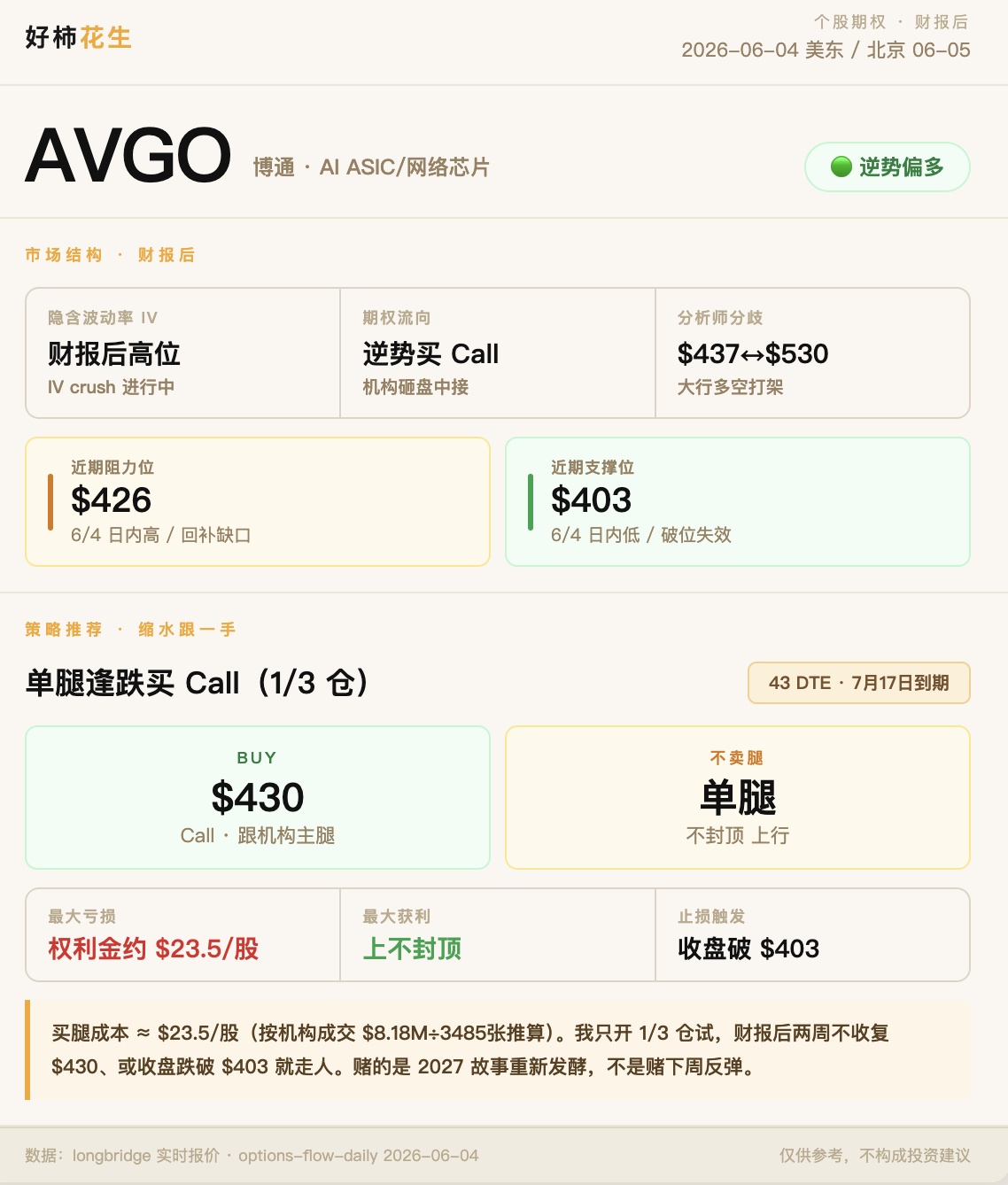
I followed with a reduced position: only opened 1/3 of a position, bought a single-leg July $430 Call, with cost estimated based on institutional trading price at about $23.5/share ($8.18M ÷ 3485 contracts). Maximum loss is this premium, no leverage, no naked selling.
I set two stop-loss conditions: If it doesn't recover $430 within two weeks after earnings, or if it closes below the intraday low of $403 on 6/4—whichever triggers first, I'm out. Of course, if Google market share is lost faster than expected, or gross margins continue to drop, the 2027 story needs to be discounted, then $430 is too optimistic. That's why I'm only using 1/3 position to test the waters, add if right, admit defeat if wrong 🙈 When catching falling knives, position sizing is always more important than direction.
The copyright of this article belongs to the original author/organization.
The views expressed herein are solely those of the author and do not reflect the stance of the platform. The content is intended for investment reference purposes only and shall not be considered as investment advice. Please contact us if you have any questions or suggestions regarding the content services provided by the platform.
