


【港股打新深观察】狂热褪去,港股打新步入 “破发时代”

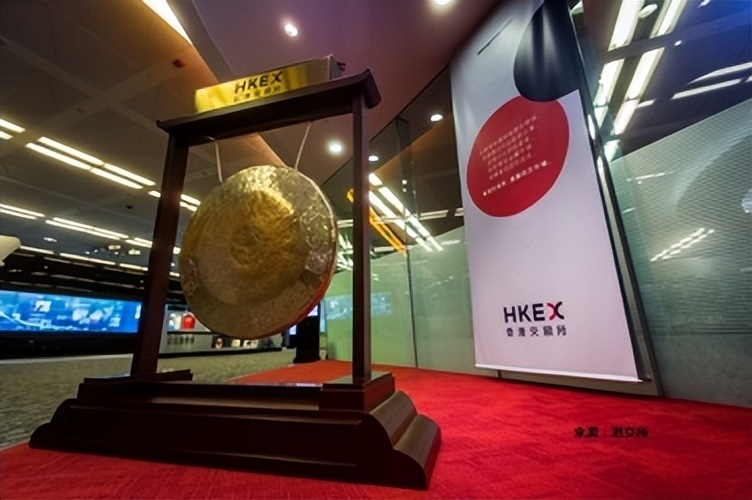
The trading hall of the Hong Kong Stock Exchange in July has never seemed as noisy as it is now.
On July 8th and 9th, a total of twelve companies crowded the bell-ringing ceremony within just two days. The spectacle of seven companies listing on the same day even approached a historical peak.
However, beneath this facade of prosperity marked by "multiple bells ringing together," the cooling sentiment of IPO subscription funds is undeniable. Except for Qiyunshan Food (02797.HK) which surged over 100% on its debut, the performance of other new listings was lackluster. Even the "white horse" from A-shares, $LUXSHARE ICT(02475.HK), encountered the embarrassment of breaking its issue price on its first day in Hong Kong.
Looking back six months ago, the market was a different scene. In the first half of 2026, Hong Kong IPO subscription experienced a round of mass euphoria. Sufficient unicorn supply, valuation premiums in the AI sector, and an average first-day gain of over 60% for new listings once made "making a sure profit from Hong Kong IPOs" a consensus among investors. However, entering July, the once-hot IPO market took a sharp turn for the worse: multiple listings on the same day became common, first-day price drops became normalized, several companies postponed or even canceled their listings, follow-on offerings from recent listings were frequent, a large wave of lock-up expiries loomed, and the Hong Kong market continued to underperform among major global indices. Multiple negative factors piled up, completely exhausting the profit-making effect in the primary-secondary market. It seems the era of blind subscription for Hong Kong IPOs is over.
Batch Listings of New Shares Intensify Market Divergence, Scarcity Premium Completely Evaporates
The unprecedented peak of new listings in early July directly diluted the limited subscription funds in the market and eroded the scarcity premium that new shares previously carried. This may be a key reason for the normalization of first-day price drops.
On July 8th, five companies simultaneously listed on the HKEX, covering sectors like autonomous driving, semiconductors, and new materials. The next day, July 9th, saw another seven companies ring the bell together. A total of 12 new shares began trading within just two trading days, a pace of concentrated issuance extremely rare in the recent Hong Kong market.
The batch listings did not bring a broad market rally; instead, the market showed extreme polarization. Qiyunshan Food was the only standout for the week, with its first-day gain exceeding 100% and another surge of over 100% on July 13th, bringing its cumulative increase from the issue price to 241.25%. Relying on the stable cash flow and low-valuation logic of the consumer sector became the sole bright spot for the week.
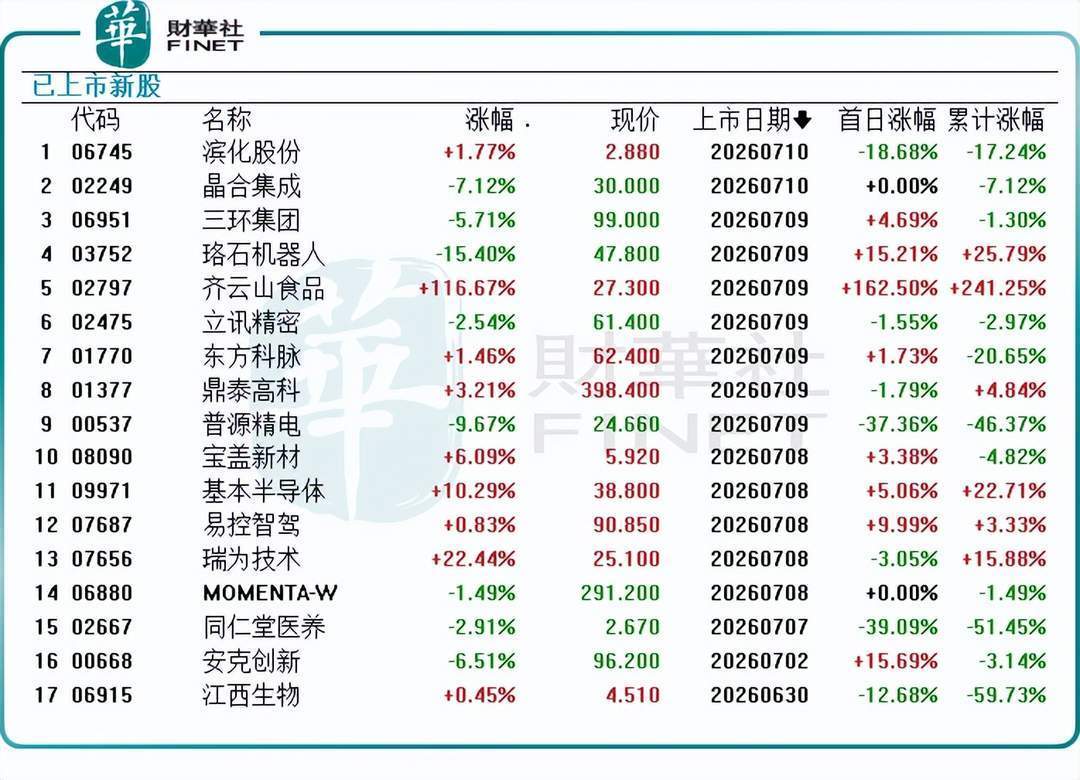
The performance of other new listings was weak across the board. Even Luxshare Precision (002475.SZ), the A-share leader widely recognized by the market, saw its H-share fail to escape. As a mega IPO raising HK$24.3 billion this year, Luxshare attracted 26 top-tier cornerstone investors. Its issue price was set at the upper limit of the offering range, with an A/H share discount of only 13%, suggesting an insufficient safety cushion. It opened below its issue price on its debut, with an intraday drop nearing 10%, and closed down 1.55%, shattering market expectations for gains from leading company IPOs.
Other listings performed equally poorly: Realtime Tech (07656.HK) plunged over 27% intraday, while Tongrentang Medical Care (02667.HK) and Rigol Technologies (00537.HK) saw significant first-day drops exceeding 37%. Even Basic Semiconductor (09971.HK), which received 4,812 times oversubscription in its public offering and operates in the currently hottest sector, saw its first-day gain limited to around 5%.
The direct impact of batch listings may be the significant fragmentation of investor funds. Funds from retail investors using multiple accounts for IPO subscriptions and institutional concentrated allocations are split among multiple new shares, making it difficult to form a concentrated buying force. Under the supply rhythm of 2-3 new shares per week in the first half of the year, funds could still band together to push up valuations. However, with several shares listing simultaneously on a single day in July, the market may have developed "IPO fatigue." Only listings with unique sectors and clear earnings prospects can attract funds, potentially leaving most new shares without a basis for speculation.
Sharp Increase in Price Drop Ratio; "Peaking on Debut" Becomes Common for New Listings
If concentrated listings were the trigger for short-term sentiment cooling, the persistently rising first-day price drop rate and the subsequent widespread pullback in performance may signal a fundamental loosening of the underlying profit logic for Hong Kong IPO subscriptions.
Data comparison clearly shows the market's shift from hot to cold. According to Wind data, as of July 10, 2026, 16 companies have conducted IPOs since July, with 6 of them dropping below their issue price on the first day, resulting in a first-day price drop rate of 37.50%. The average return of the closing price on the first day compared to the offer price was 7.29%.
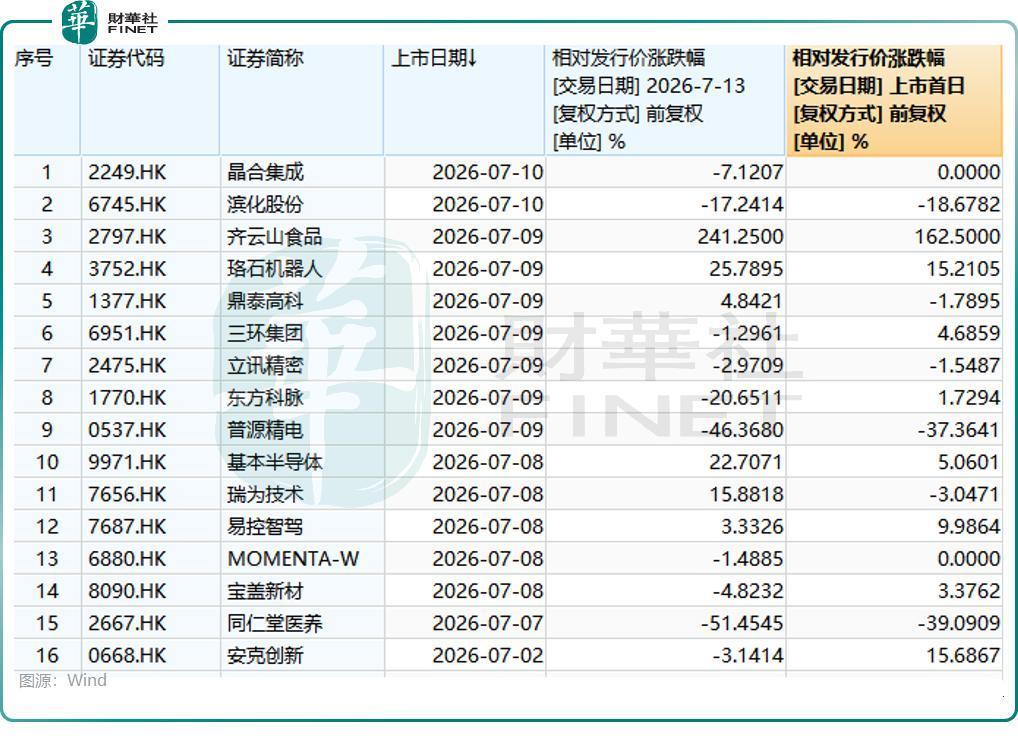
In contrast, 85 companies listed in the first half of this year, with 12 experiencing first-day price drops, resulting in a first-day price drop rate of 14.12% and an average first-day performance of 65.12%.
More alarmingly, price drops are no longer confined to the first day. Many new listings that completed their IPOs in the first half and experienced short-term surges are now seeing their secondary market prices continue to decline, generally falling below their issue prices. Recent listings that saw multi-fold gains earlier on AI hype are now seeing valuations digested as the hype fades and buying support dries up. New listings in traditional manufacturing, consumer goods, and hardware OEM sectors, lacking growth stories to support them, are experiencing shrinking turnover and declining stock prices post-listing.
Looking at subsequent performance, as of the closing price on July 13, 2026, 37 of the companies that IPO'd in the first half have now seen their stock prices fall below the issue price. Adding the 10 companies that listed in July and have already broken their issue price, the price drop rate for new listings this year may reach 46.53%. Overall, for the 101 IPOs so far this year, the average return since listing is approximately 52.64%.
The frenzied first half has ended, ushering in a deep test of liquidity and market trust. In the mid-article of this series, we will further analyze the multiple undercurrents of capital hidden beneath the iceberg and explore the deeper causes of this IPO cold spell. Stay tuned.
By: Wu Yan
The copyright of this article belongs to the original author/organization.
The views expressed herein are solely those of the author and do not reflect the stance of the platform. The content is intended for investment reference purposes only and shall not be considered as investment advice. Please contact us if you have any questions or suggestions regarding the content services provided by the platform.
