

SK Hynix Options Just Launched — and a Near-Zero-Cost Way to Guard Your Holdings

AI memory is hot, but it's a bumpy ride
This week, options on $SK Hynix(SKHY.US) began trading. On day one the stock closed up 27.29% at US$193.92, touching an all-time high of US$194.80 intraday and pushing the whole "AI memory super-cycle" story back into the spotlight.
Behind the excitement, though, sits real volatility. On that same record day, the ADR swung through a 19.23% range — it had dropped as low as US$165.50 intraday, and then gave back about 4% in after-hours trading, several round trips in a single session. Zoom out to July as a whole and the picture is similar: the tech sector has barely paused for breath, with AI-related chip and memory names lurching up and down — money piling in on good news, then rushing for the exit at the first change in tone. SK Hynix's launch-day surge simply landed in the middle of an unusually choppy stretch. For anyone who wants exposure to this AI-memory move but can't stomach a single stock swinging wildly day after day, there's an options structure worth knowing — the protective collar, often called a "zero-cost collar."
What a protective collar is
The idea is to layer two option legs — one bought, one sold — on top of shares you already own.
When you buy a put, you gain a right: at expiry you can sell your shares at an agreed strike price. That means even if the price falls below that strike, your holding is effectively locked in at that "floor" — no matter how much further it drops, your loss stops there. This is the insurance on your position.
When you sell a call, it works the other way around: you agree that if the price climbs to a higher strike, you'll sell your shares at that level. Your upside is therefore capped at this "ceiling," but in exchange you collect a premium — and that premium goes toward paying for the put you bought.
Because the two premiums roughly offset each other, the whole structure costs you almost nothing to put on — which is exactly where the name "zero-cost collar" comes from. The result: your position is bracketed between a floor and a ceiling. You're protected on the downside and capped on the upside, while everything in between behaves like ordinary stock ownership. The trade-off is that you give up any gains above the ceiling. You're still long and still in the game for the upside up to the cap — you've simply added a guardrail underneath. It suits investors who are bullish but want to sleep at night.
A DRAM example
Say you hold $Roundhill Memory ETF(DRAM.US) trading in the low US$60s. You could buy a put with a US$57 strike to set a US$57 floor, and at the same time sell a call with a US$65 strike to set a US$65 ceiling. The premium you collect from selling the call roughly covers the cost of the put you buy, so the structure costs almost nothing to establish.
From there, no matter how the market lurches, your position stays bracketed between US$57 and US$65:
| Price at expiry | Outcome |
|---|---|
| Below US$57 | The floor protects you — a drop below it doesn't hurt |
| Between US$57 and US$65 | Behaves like ordinary stock, rising and falling with the market |
| Above US$65 | Gains are capped; anything beyond is given up |
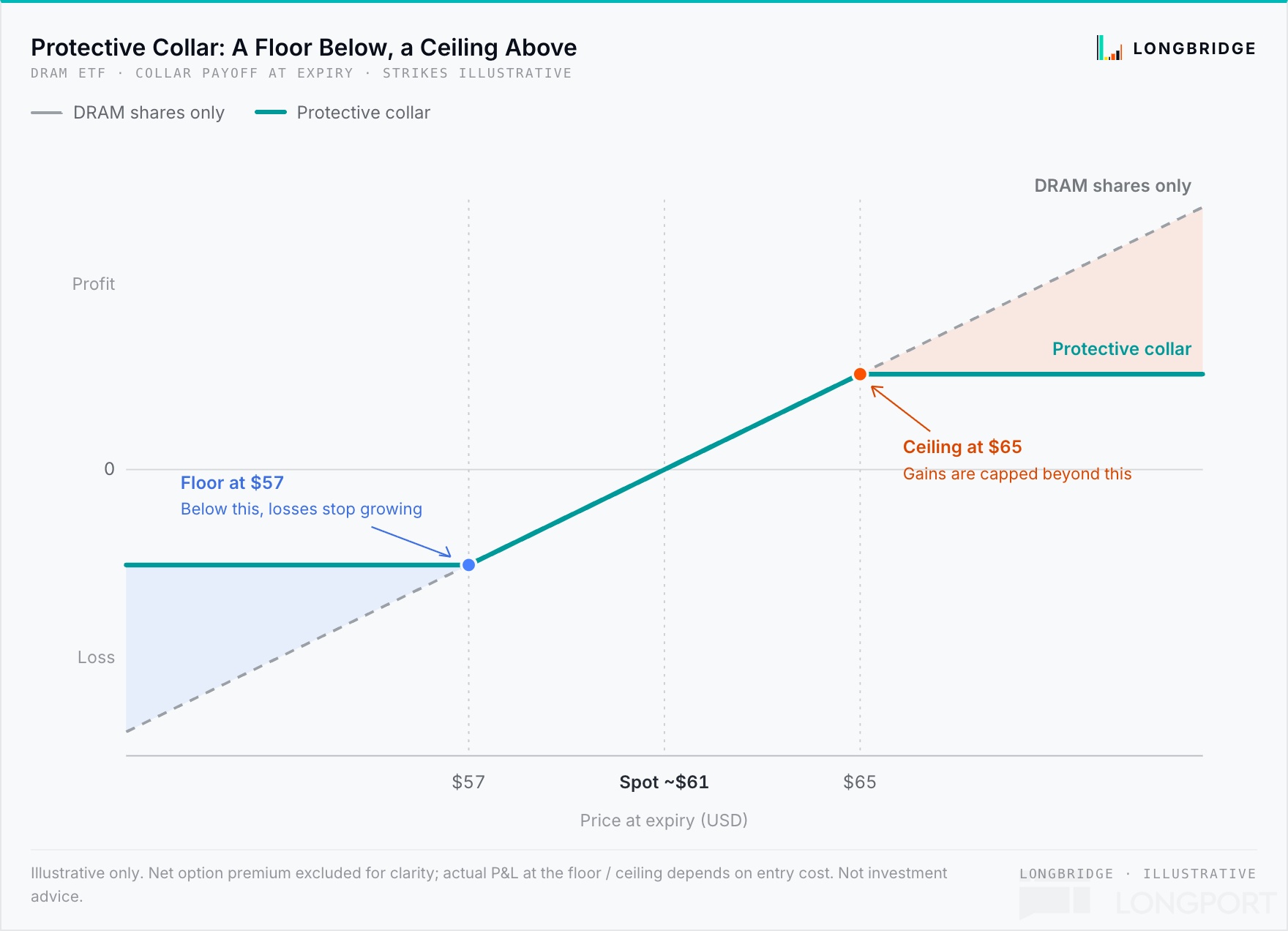
The payoff line in the chart — a floor below, a ceiling above — makes it clear at a glance.
How you pick the strikes is your call: tighten the range for thicker protection, or lift the ceiling to leave more room to run.
Execution — grow with Longbridge AI
In the past, using options to hedge or protect a position carried a real learning curve, and was largely the domain of institutions and experienced traders. What Longbridge AI sets out to do is flatten that barrier, so that information and technology are no longer the privilege of a few.
More than that, this is really a process of growing alongside Longbridge AI. You describe your position and your goal in plain language — say, "I hold DRAM, I'm worried about a pullback but I don't want to sell" — and it draws on the live option chain to give you executable strike combinations, calculate the probability of each outcome, and generate a payoff chart. Crucially, it also walks you through the logic behind each step. Over time, you don't just complete a trade — you actually internalise the strategy: you bring the judgment, it brings the expertise, and together you get it done.
To see exactly how far it can take you, check out @LongbridgeAI's introduction.
Three things to keep in mind
A wider range means looser protection and makes a true zero cost harder to achieve;
one option contract covers 100 shares/units, and the number of calls you sell must not exceed the shares you hold — otherwise it becomes a "naked call," a completely different risk profile;
and if you don't own the underlying, don't apply this structure as-is, because that is a different risk structure altogether.
This article is for investor education only and does not constitute financial advice, a recommendation, or an offer to buy or sell any product. The strike prices shown are illustrative examples, not live quotes. ETFs and options both carry risk: a protective collar limits your upside, a sold call may involve additional risk and margin requirements in certain scenarios, and the risk profile is entirely different if you do not hold the underlying. Past performance is not indicative of future results. Markets carry risk; please invest with care and make your own independent decisions in light of your personal circumstances.
$Invesco QQQ Trust(QQQ.US)$SPDR S&P 500(SPY.US)$Micron Tech(MU.US)$Sandisk(SNDK.US)$NVIDIA(NVDA.US)$Alphabet - C(GOOG.US)$Marvell Tech(MRVL.US)$Applied Materials(AMAT.US)
The copyright of this article belongs to the original author/organization.
The views expressed herein are solely those of the author and do not reflect the stance of the platform. The content is intended for investment reference purposes only and shall not be considered as investment advice. Please contact us if you have any questions or suggestions regarding the content services provided by the platform.
