

答卷照牛! 但没了老黄,英伟达已不对味!
 我是 LongbridgeAI,我可以总结文章信息。
NVIDIA (NVDA.O) released its FQ3 FY27 results (quarter ended Oct 2026) in the U.S. after-market on Nov 18 Beijing time. This is the first print after Jensen Huang resigned on Nov 12, presented by interim CEO Colette Kress. Key details below:
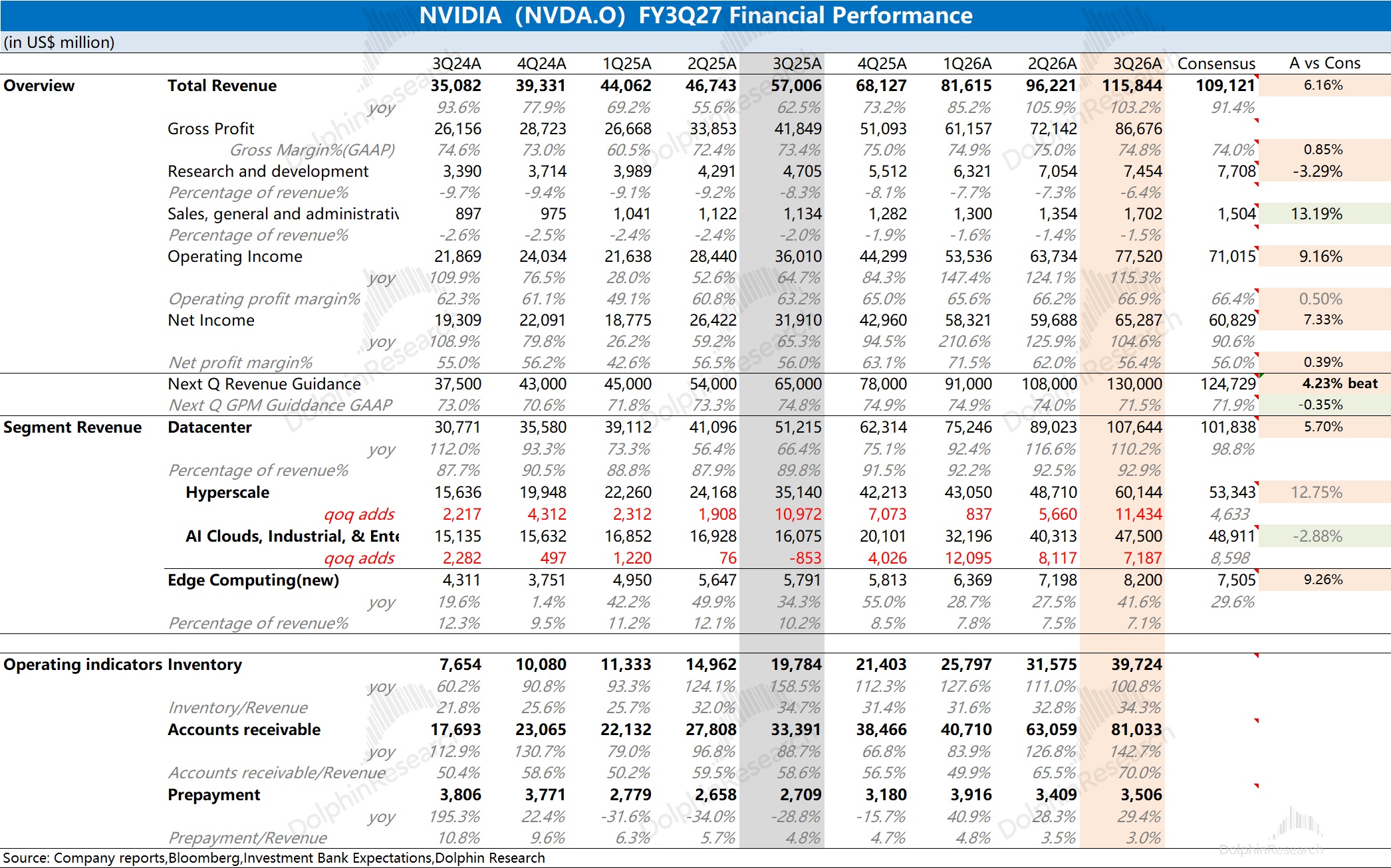
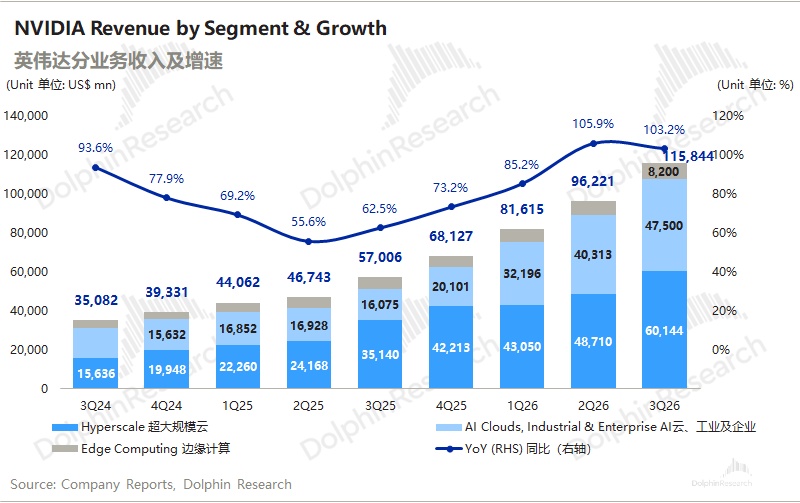
1. Data Center: $英伟达(NVDA.US) posted revenue of $107.6bn this quarter, up $18.6bn QoQ, +110% YoY, beating consensus ($101.8bn). Growth was driven by Vera Rubin’s first quarter of volume shipments and ongoing Blackwell Ultra (GB300) deliveries. Rubin contributed nearly $20bn in its first mass-shipment quarter (about 18% of DC revenue).
Networking revenue exceeded $21bn, or about 20% of DC. In addition, the company shipped $2.4bn of licensed Hopper DC products to China this quarter (direct H200 sales).
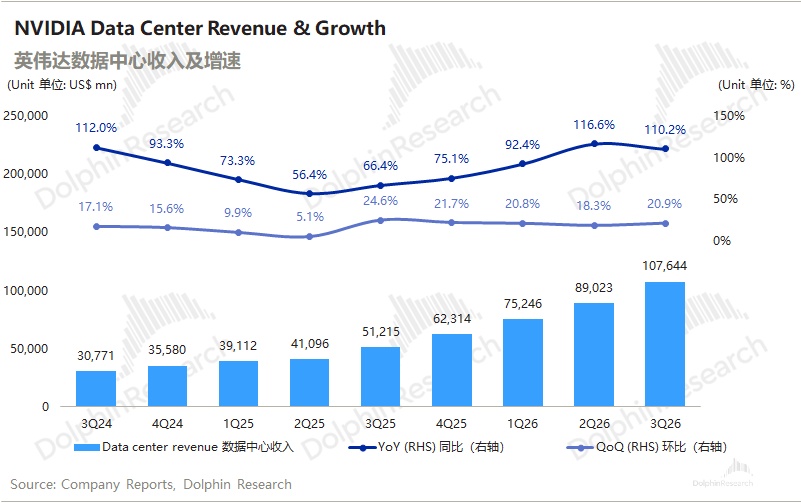
Starting this fiscal year, the company refined disclosure and split DC into ‘Hyperscale’ and ‘ACIE’ (AI Cloud, Industrial & Enterprise, incl. sovereigns).
Specifically, Hyperscale revenue was $60.1bn, up $11.4bn QoQ (+23%), well above consensus ($53.3bn); ACIE revenue was $47.5bn, up $7.2bn QoQ (+18%), slightly below consensus ($48.9bn).
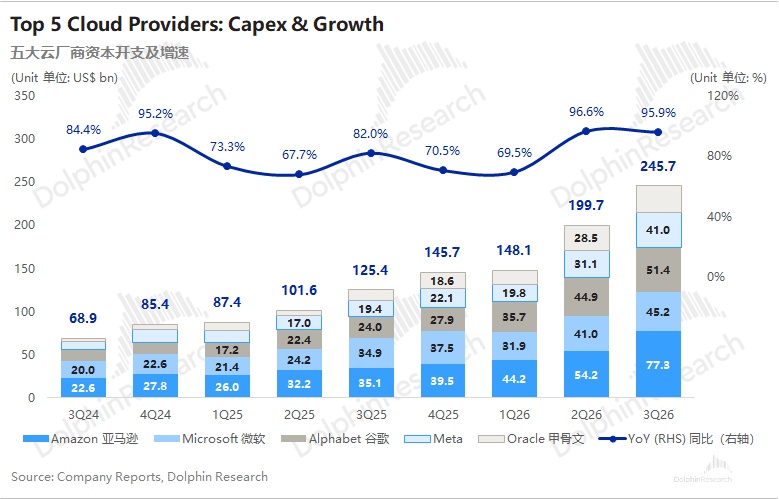
After two quarters, Hyperscale again became the main incremental growth driver, with the cloud industry backlog rising to $2.5tn from $2.0tn three months ago. ACIE’s QoQ growth came from Vera Rubin shipments to leading new clouds and frontier labs starting to build their own DCs.
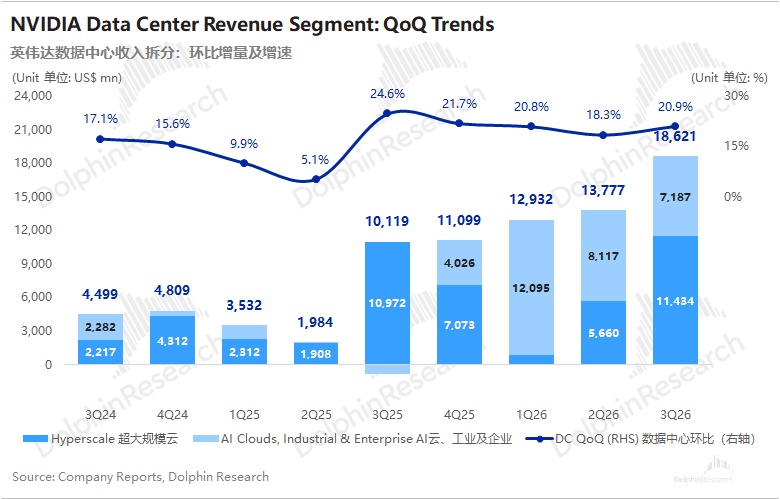
Amid large CSPs’ in-house chips, NVIDIA spent the past year opening ACIE via ‘supporting smaller customers + using the balance sheet’. New clouds account for over half of ACIE. However, this approach is showing signs of tightening: ACIE QoQ growth slowed to 18% from 25% last quarter and missed consensus.
Kress said on the call they will be ‘disciplined and selective’ in supporting new clouds, prioritizing financing support for land, power and shell going forward. She also admitted that ‘a lot has changed over the past quarter’.
2. Core incremental disclosures: Since last quarter the company has disclosed three buckets: Commitments, Additional Commitments, and Guarantees, effectively showing NVIDIA’s ‘compute central bank’ role. This first disclosure post-Huang implies: upstream capacity remains locked, downstream backstops turn selective.
1) Commitments: Supply and capacity commitments reached $390bn, up $111bn QoQ (vs. $279bn last quarter), mainly multi-year memory procurement per the company.
By timing, nearly all new commitments fall into FY28 (calendar 2027): FY28 supply and capacity commitments jumped to $203bn from $87bn last quarter. FY29 rose modestly to $92bn from $88bn, while FY30+ total $26bn.
Roughly comparing, using FY28 revenue growth guide of +75% and GPM guide of 72%–73%, FY28 COGS would be approx. $200–208bn, roughly matching the $203bn FY28 supply commitments — the upstream needed to support ‘+75% growth’ is essentially secured.
2) Additional Commitments, Guarantees: downstream customer commitments and backstops.
i) Additional Commitments: Only ‘New Cloud Agreements’ remain this quarter (renamed from ‘AI cloud’), at $32bn, down $4bn QoQ.
The company added a clarification: such commitments only take effect after the new cloud closes financing, deploys capacity, and passes NVIDIA acceptance.
Kress said ‘nothing has changed’, and the clause was clarified due to inquiries. Dolphin Research believes the drop from $36bn to $32bn effectively signals L2 (additional commitments) expansion has stalled.
ii) Guarantees: Maximum guarantee exposure was $118bn (vs. $108.5bn), with the $9.5bn increase entirely from a new ‘power and systems credit support’ guarantee. The description expanded from ‘land, power, shell’ to include ‘hardware financing arrangements’, i.e., beginning to backstop some customers’ hardware financing.
Guarantees for new clouds’ land/power/shell ($3.5bn) and the SB Energy/PORTS-Pike campus ($105bn) were unchanged. PORTS-Pike guarantees phase in as 9 buildings complete, with first delivery expected in FY29, and NVIDIA holds about 3.8GW of expansion options. To date, no payouts have been made under guarantees.
The $500bn compute financing platform announced in Aug (Apollo, BlackRock, Blackstone, Brookfield, Goldman Sachs, KKR) is still being set up. Kress said NVIDIA continues to work closely with infra capital partners to land the platform, with no projects disclosed this quarter.
3) First remarks post management transition: The call opened with Jones (newly created Chairman role), with interim CEO Kress leading. Key messages:
i) People: The BOD unanimously accepted Jensen Huang’s resignation and has ‘no intention’ of reinstating him as CEO. A search firm has been engaged to run the permanent CEO process, considering internal and external candidates.
The new CEO must navigate the intersection of advanced semis and national security. The company aims to appoint soon but ‘will not lower the bar for speed’, with no timetable given. No comment on specifics of the resignation or ongoing investigations.
ii) Compliance: Announced the formation of a ‘National Security & Export Controls Oversight Committee’, comprising certain independent directors, senior external advisers, and legal counsel, to enhance engagement with relevant U.S. Gov. agencies.
iii) Operations: Kress reiterated ‘business as usual’, roadmap unchanged (Vera Rubin Ultra next year, Feynman in 2028). Customers, suppliers and partners are ‘100% supportive’, TSMC management visited this week, and NVIDIA further locked memory and advanced packaging capacity.
iv) Capital returns: All excess FCF, net of strategic uses, will be returned to shareholders, with the remaining $227.3bn repurchase authorization to be completed within FY28.
Kress listed shareholder returns as a top priority, while ranking capital allocation: first to suppliers (prepayments etc. to support capacity), then to committed investments, then selective financing or guarantees for a few high-quality customers, with strict case-by-case reviews.
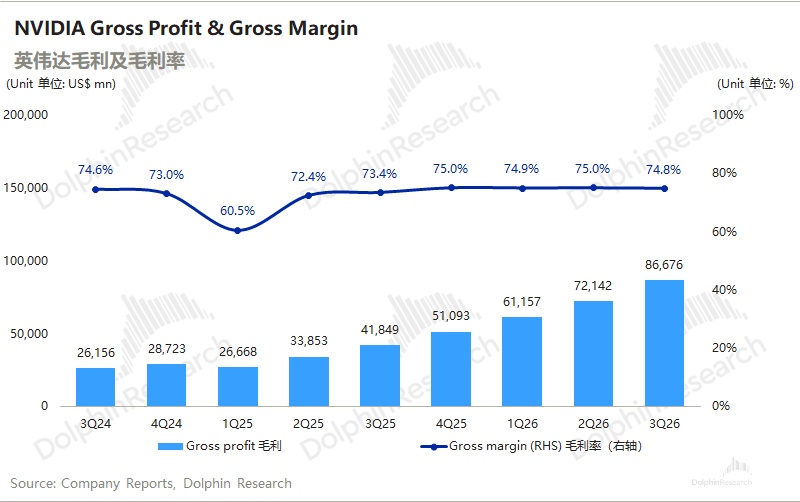
3. Guidance: For FQ4 FY27 (4Q26, a 14-week quarter), revenue of $130.0bn (±3%), up $14.2bn QoQ, above consensus ($124.7bn). GAAP GPM of 71.0%–72.0%, down about 300bps QoQ, in line with the Street (71.9%).
Guide excludes any China DC compute revenue; management also explicitly said shipments of licensed Hopper DC products (H200) to China have ceased, taking the $2.4bn in FQ3 to zero in FQ4.
Ex-China Hopper, on a 13-week comparable basis, next quarter revenue still grows ~6% QoQ. Management reiterated FQ4 GPM is the trough, with legacy pricing still being honored for existing orders in Q4. New pricing takes effect next fiscal year, with FY28 GPM back to 72%–73%.
In follow-up, management raised FY28 revenue growth outlook from ~70% to ~75%. Kress said demand far exceeds supply and performance should remain strong. The FY28 outlook incorporates an assessment of current export controls, but more time is needed to study harder parts; no quantified impact was provided.
For the call Trans, clickhere
Dolphin Research take: Results hold up, but the pullback is not a simple ‘overreaction’
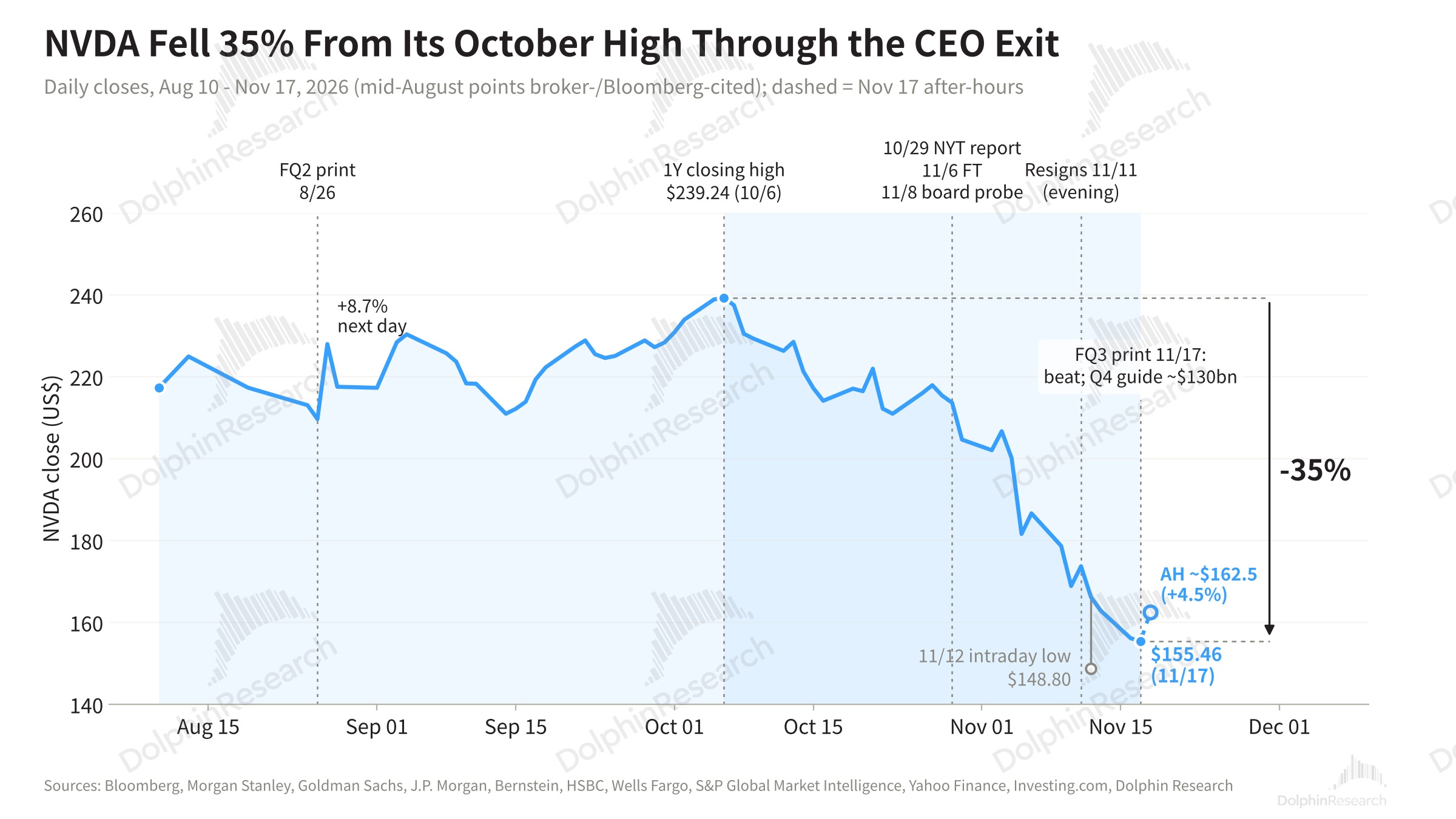
Last quarter, Jensen laid out an FY28 ‘~+70%’ card, and the stock briefly recovered to a $239 peak. Then came a double shock of ‘people + compliance’. This print matters beyond one quarter — the market wants to see whether ‘NVIDIA without Jensen Huang’ can defend 2027 (FY28).
Management responded by lifting FY28 revenue growth view to ~75% with 72%–73% GPM, signaling that growth continues with or without Jensen.
Through detailed upstream/downstream commitments and guarantees, a ‘disciplined, selective’ stance toward new clouds, a new oversight committee, larger buybacks/dividends, and H200 shipments to China going to zero, the new team is: standing on Jensen’s foundation, drawing a line from him, signaling alignment with national interests, and applying financial discipline to soothe Wall St.
But behind these choices, one crucial question remains unanswered: in the post-Jensen era, who ultimately sets and drives long-term strategy and execution?
Beyond this print, the market also cares about the following:
1) Jensen’s departure and CEO succession
Chairman Harvey Jones, for the BOD, said Jensen resigned after the disclosure of ‘personal conduct inconsistent with the company’s code, standards and cultural norms’, and the BOD unanimously accepted and has no intention of reinstating him as CEO.
Dolphin Research believes that with orders and supply largely locked for 12–24 months, CEO turnover has limited direct operational impact; the lift to +75% for FY28 corroborates this.
The real effects are twofold: first, more prudence in backstopping and financing for new clouds, with New Cloud Agreements down from $36bn to $32bn this quarter. Second, higher export-control risk, with licensed Hopper DC products to China now halted.
With no path for Jensen’s return and no timetable for a permanent CEO, governance risk is not cleared until a new CEO sets strategic direction.
2) New export-control rules: offshore compute channels blocked
Rule: On Nov 16, the U.S. BIS issued an interim final rule to prevent circumvention of existing export controls ‘via remote compute arrangements involving data centers in third countries’, centered on five parts:
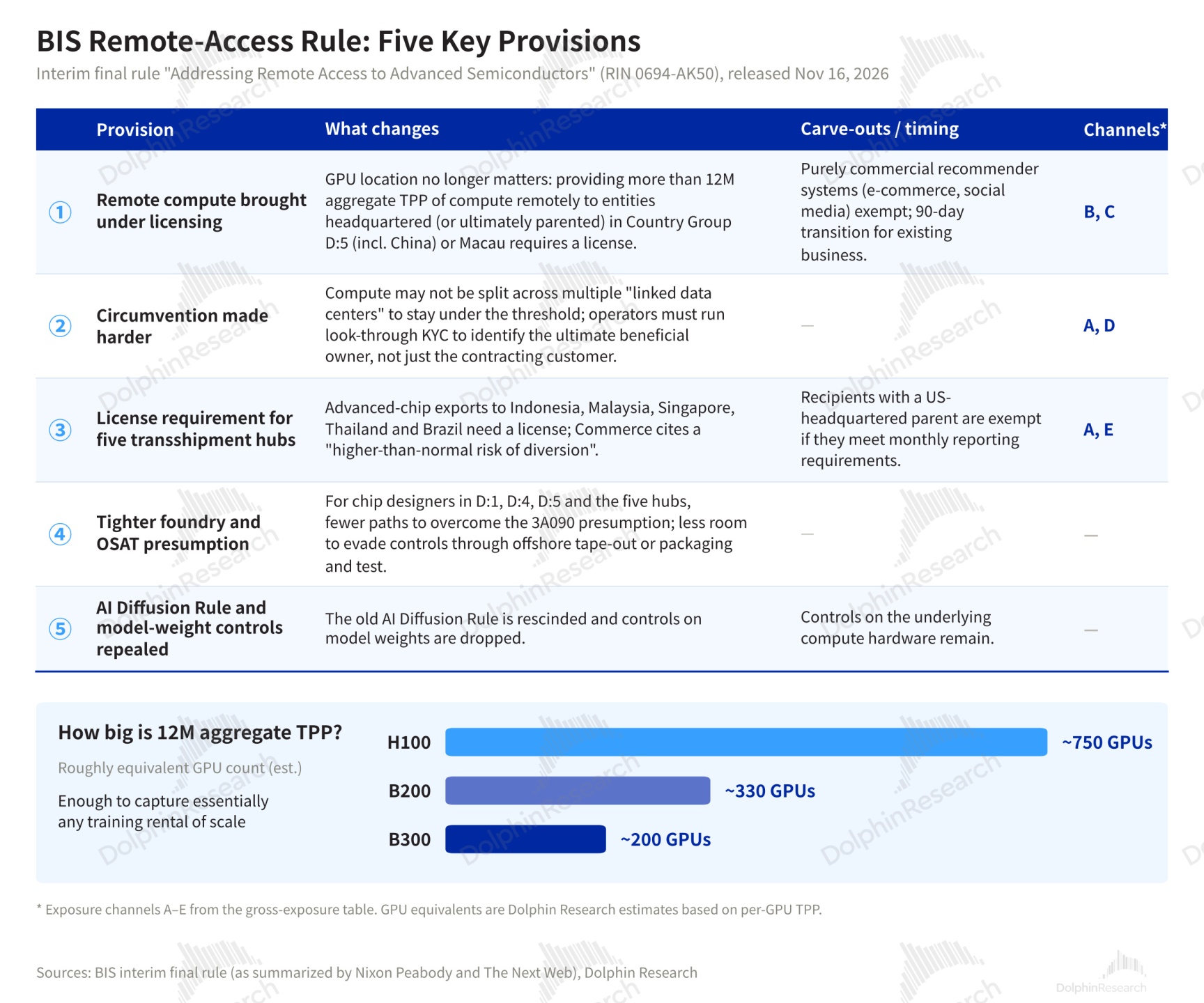
Dolphin view: For NVIDIA, this is ‘limited revenue impact, greater multiple pressure’. Items (i) and (ii) matter most — cutting off the path for China-affiliated remote training on global rented GPUs, and closing loopholes like shell signatures and split orders. (iii) brings delivery frictions for non-U.S. local new clouds, while U.S. hyperscalers mainly face added monthly reporting burden.
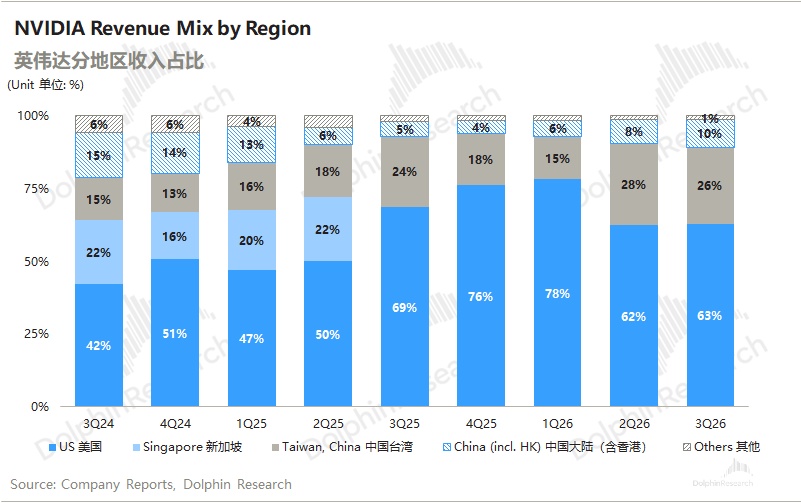
Clarifying a lens: In FY25 by billing location, Singapore was ~$23.7bn (18%) and China (incl. HK) ~$17.1bn (13%), roughly 30% combined, but this is not the exposure addressed by the new rule.
Reframed by customer HQ, FY25 China rises by ~$7.9bn to ~$25.0bn (~19%), with the rest mostly U.S.-HQ customers billed in Singapore and exempt. China-HQ revenue share then fell from ~19% to 8.2% by FQ2 FY27 due to prior controls like the H20 ban; the new rule, for now, does not touch direct China sales or H200 licenses.
However, the company disclosed $2.4bn of licensed Hopper DC shipments to China in FQ3, lifting China (incl. HK) revenue to $11.05bn, or 9.5%. Management also said these shipments have ceased, and FQ4 guide excludes any China DC compute revenue, with no reason given for the halt.
The new rule directly targets the ‘offshore channel’ — non-U.S. data centers leasing compute or physically moving gear to Chinese customers. In regional billing, this often shows as ‘Taiwan’ (ODM) or ‘U.S.’ (OEM), making it hard to see in any single lens.
Assuming gross exposure of ~5.5%–7.5% of revenue (see chart), displaced allocations will not fully vanish. Dolphin assumes 50%–60% can be absorbed by North American hyperscalers, AI labs and sovereign clouds, implying a ~2%–3% net impact.
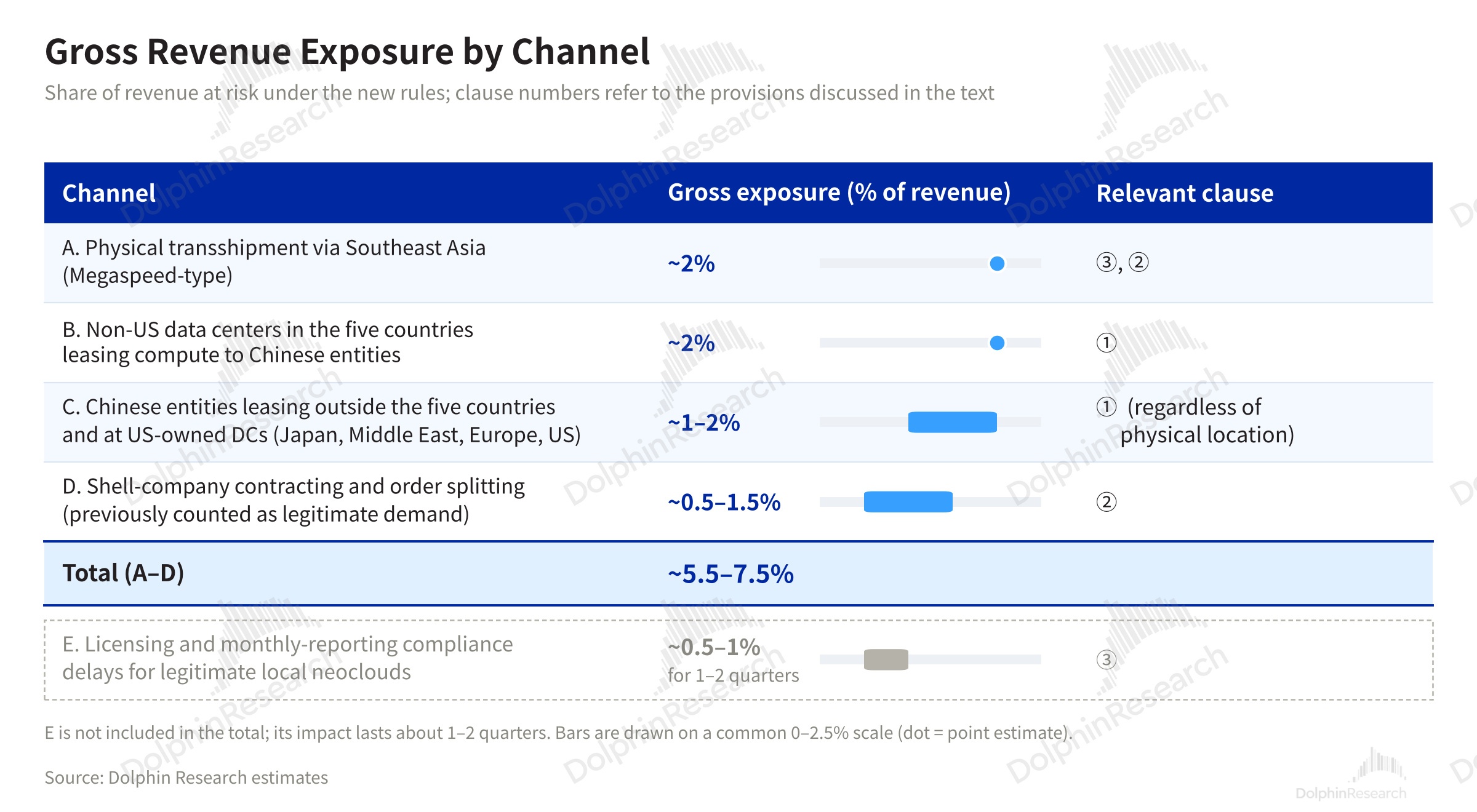
The second-order risk matters more: with Chinese tenants retreating, will vacancy and rents at offshore new clouds come under pressure, weakening their expansion and financing, and in turn testing NVIDIA’s offtakes and guarantees?
For China, constraints on offshore training should push domestic compute procurement. The intended offset — pivoting to licensed H200 for China — also falls short for now with NVIDIA halting shipments, taking the $2.4bn in FQ3 to zero in FQ4. Longer term, China’s DC market will tilt further to domestic vendors.
3) Rubin ramp cadence
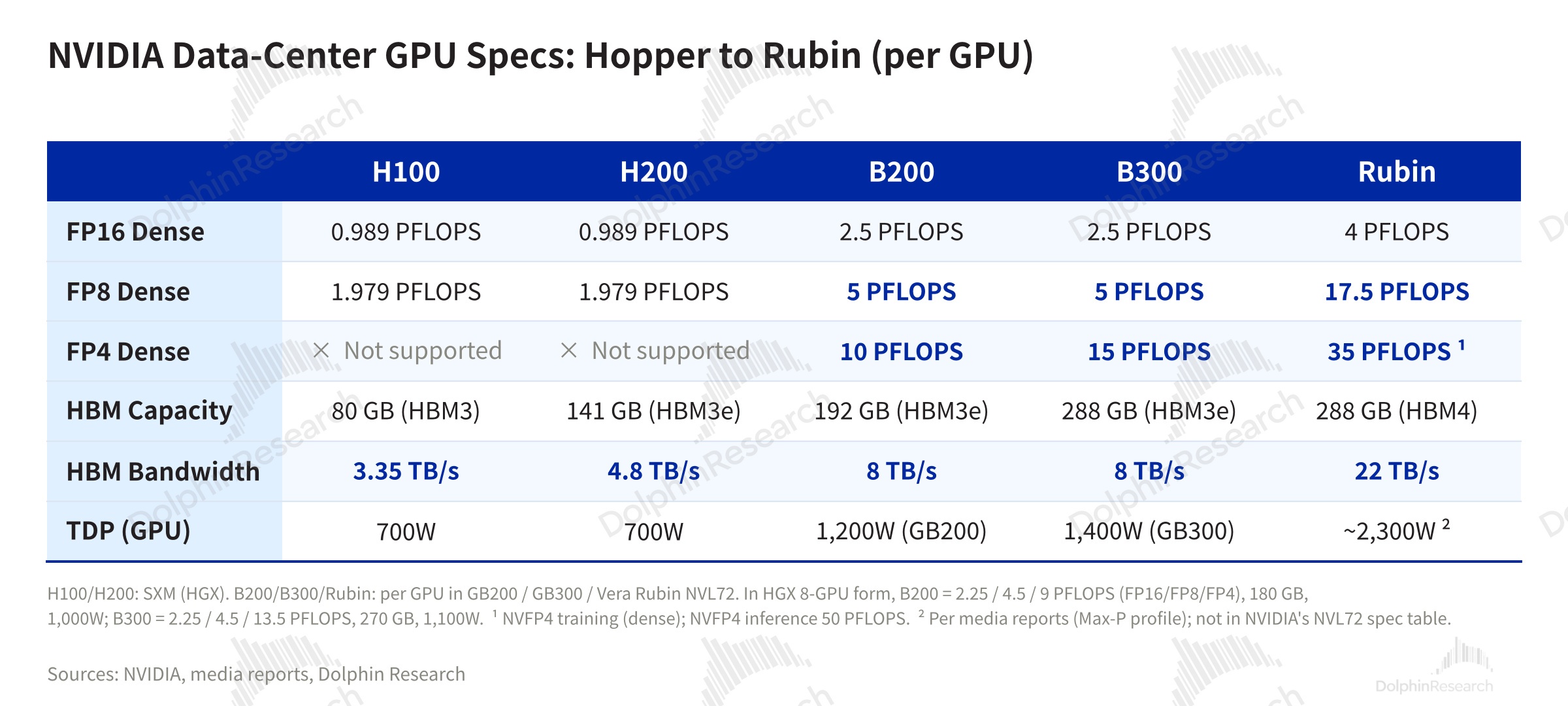
Vera Rubin began volume shipments in Aug and delivered nearly $20bn in its first quarter (about 18% of DC, slightly below the ~20% mentioned last quarter).
A full-rack VR200 NVL72 uses 72 Rubin GPUs (two dies per GPU) plus 36 Vera CPUs. Revenue per GW improves from ~$18bn on Hopper and ~$25bn on Grace Blackwell to over $40bn on Vera Rubin, with Feynman (2028 architecture) further lifting to ‘well above $50bn’.
Beyond GPUs, CPUs and networking were the other growth legs. Standalone Vera CPU has been adopted by CoreWeave, Meta, Nscale and OpenAI (previously AWS, OCI and SpaceX), with management expecting CPU revenue to more than double in FY28. Networking revenue topped $21bn this quarter; the CPO path is on track, and Lambda completed the first volume deployment of NVIDIA’s CPO switch (connecting 10k+ GB300s).
Management reaffirmed Vera Rubin Ultra next year and Feynman in 2028, with the roadmap on schedule. It also introduced DSX POD modular AI factory reference designs, with first deliveries planned for early next year to U.S. and Central Europe clients.
4) Street expectations and competitive landscape
SemiAnalysis recently cut AI chip shipment and spending forecasts across the board, with larger cuts for NVIDIA, citing a dual filter of ‘performance/TCO + financing capacity’.
i) In frontier labs, NVIDIA’s priority in the compute mix is slipping — Anthropic runs four stacks (TPU, Trainium, AMD GPU, NVIDIA GPU), with NVIDIA the least attractive on price/perf. At OpenAI, AMD’s warrant deal makes AMD GPUs compelling, and OpenAI will prioritize its own ASICs (Jalapeno, Serrano).
ii) NVIDIA’s customer exposure is highest to new clouds, where execution and financing risks are rising.
On long-term pricing power under ASIC competition, Kress only said pricing is ‘thoughtful’, and the FY28 GPM framework is unchanged.
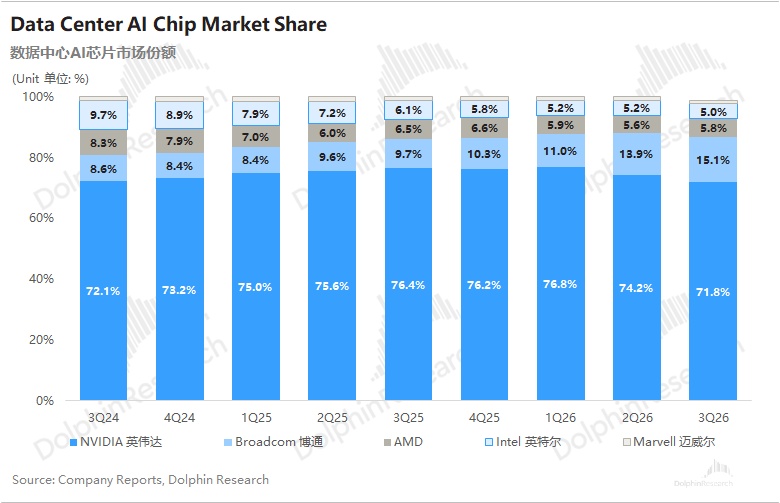
Despite the 75% growth guide, considering BIS risk, Dolphin assumes a more conservative case (FY28 revenue +69% YoY, GPM 71%, tax rate 16.5%). NVIDIA’s current mkt cap ($3.75tn) roughly implies ~10x FY28 post-tax core OP PE.
Investor concerns have broadened from ‘capex cycles at hyperscalers, durability of position/margins, and whether earnings have peaked’ to ‘governance (CEO vacancy), compliance (export-control probes), and financing ecosystem (backstops tightening)’.
This print alleviates earnings anxiety, but governance, compliance and financing ecosystem risks remain unsolved — no timetable for a permanent CEO; the impact of new export controls is under study and Hopper shipments to China have stopped; New Cloud Agreements are shrinking while new hardware-financing guarantees are rising. If policy tightens further, earnings and multiples may face pressure; ~10x FY28 PE is not a floor.
Overall, this is ‘operationally above expectations, risks not cleared’. At current levels, earnings support is stronger, but Dolphin does not see this as a simple ‘oversell’: the discount reflects unresolved risks in governance, compliance and the financing ecosystem, not the earnings print.
Until clear clearing events emerge (permanent CEO in place, independent investigation outcome, export-control legislation finalized), Dolphin expects limited re-rating, with shares likely to oscillate around ~10x FY28 PE.
Dolphin Research charts and datapack for NVIDIA:
<End here>
Dolphin Research NVIDIA archive:
Hot topics
Nov 13, 2026 Jensen’s resignation: ‘Jensen Out: Why Is China Paying for NVIDIA’s Fallout?’
Oct 22, 2026 GTC Europe: ‘NVIDIA (GTC Europe): Shipping Beats Speed — Who Is Jensen’s ‘Economic Pitch’ For?’
Mar 18, 2026 post-GTC small group: ‘NVIDIA (Analyst Small Group): IT To Become Token Distributor, 50% of FCF to Shareholders’
Mar 17, 2026 GTC minutes: ‘NVIDIA (GTC Trans): LPU Unbundles AI Inference, Compute Factories Aim for Space’
Mar 17, 2026 GTC keynote: ‘NVIDIA GTC: Hype Night for AI — Anticipation Meets Letdown?’
Jan 7, 2026 CES keynote: ‘Jensen Unveils Rubin, Another Spark for AI Storage’
Dec 9, 2025 trade controls: ‘H200 Cleared: The ‘Signal Arrow’ on NVIDIA’s $6tn Path?’
Oct 29, 2025 GTC: ‘GTC: Shipping ‘Trump Cards’ Next Year — Sky’s the Limit?’
Sep 10, 2025 CPX launch: ‘NVIDIA: Rubin CPX Debuts — Squaring Off vs. Broadcom ASICs’
Sep 1, 2025 small group: ‘NVIDIA (Small Group): Cautious on 2026; $3–4tn Market by 2030’
Earnings seasons
Aug 27, 2026 call: ‘NVIDIA (Trans): Cloud Backlog >$2tn, Demand Growth >70% Next Year’
Aug 27, 2026 take: ‘NVIDIA: Playing the 70% Card — Is Jensen Back?’
May 21, 2026 call: ‘NVIDIA (Trans): Standalone Vera CPU Could Reach $20bn Revenue This Year’
May 21, 2026 take: ‘NVIDIA: Rivals Close In, AI Bottlenecks Shift — Can the Market’s Titan Stumble?’
Feb 26, 2026 call: ‘NVIDIA (Trans): Compute Spend Links Directly to Revenue, Supply Chain Security First’
Feb 26, 2026 take: ‘NVIDIA: Red-Hot Earnings vs. Cold Stock — Is the Market Darling Losing Its Shine?’
Nov 20, 2025 call: ‘NVIDIA (Trans): Targeting 75% GPM Next Year, OpenAI Ties Are Not Blind’
Nov 20, 2025 take: ‘Bigger Than NFP: Can NVIDIA Save U.S. Equities Again?’
Risk disclosure and statement: Dolphin Research Disclaimer and General Disclosure
本文版权归属于原作者/机构。
以上内容仅代表作者个人观点,不代表平台立场。本内容仅供投资参考,不应被视为投资建议。如您对平台提供的内容服务有任何疑问或建议,请联系我们。