SGX ETF List: A Guide to ETFs Listed in Singapore
The SGX lists a wide range of ETFs across equities, REITs, bonds, and commodities. This guide covers the key funds, what they track, and how Singapore investors can access them.
TL;DR: The Singapore Exchange (SGX) lists a wide range of exchange-traded funds (ETFs) spanning equities, real estate investment trusts (REITs), bonds, and commodities. This guide covers the main categories of SGX-listed ETFs, the specific funds within each category, and how Singapore investors can access them.
Exchange-traded funds, commonly referred to as ETFs, have become a widely used way for Singapore investors to build a diversified portfolio. Rather than selecting individual stocks or bonds, an ETF allows you to gain exposure to an entire basket of assets in a single trade. The SGX ETF list spans a wide range of asset classes and geographies, making it possible to invest in Singapore blue-chip companies, Asian real estate, government bonds, and even physical gold — all from one exchange. This guide breaks down the major categories on the SGX ETF list, names the specific funds within each, and explains what each tracks so you can better understand what is available.
What Is an Exchange-Traded Fund?
An exchange-traded fund is an investment fund that is listed and traded on a stock exchange. According to MoneySense, the financial education initiative of the Singapore government, an ETF pools money from investors and invests it according to a stated objective, typically tracking a specific index. Like a share, you can buy and sell ETF units throughout the trading day.
Passive vs Active ETFs
Most ETFs on the SGX are passively managed, meaning they aim to replicate the performance of a specific index rather than beat it. A smaller number are actively managed, where portfolio managers make allocation decisions. Passive ETFs tend to carry lower costs because they do not require the same level of ongoing research and management.
Cash-Based vs Synthetic ETFs
ETFs can also be structured in two ways. A cash-based ETF invests directly in the actual assets that make up an index. A synthetic ETF uses financial derivatives, such as swaps, to replicate the index's performance without holding the underlying assets. The Singapore Exchange notes that many SGX-listed ETFs involving derivatives are classified as Specified Investment Products (SIPs), which means investors must meet certain eligibility requirements before purchasing them.
Tip: Before investing in any ETF, check whether it is classified as a Specified Investment Product on the SGX. SIPs require you to pass a Customer Knowledge Assessment or have relevant trading experience.
Types of ETFs Listed on the SGX
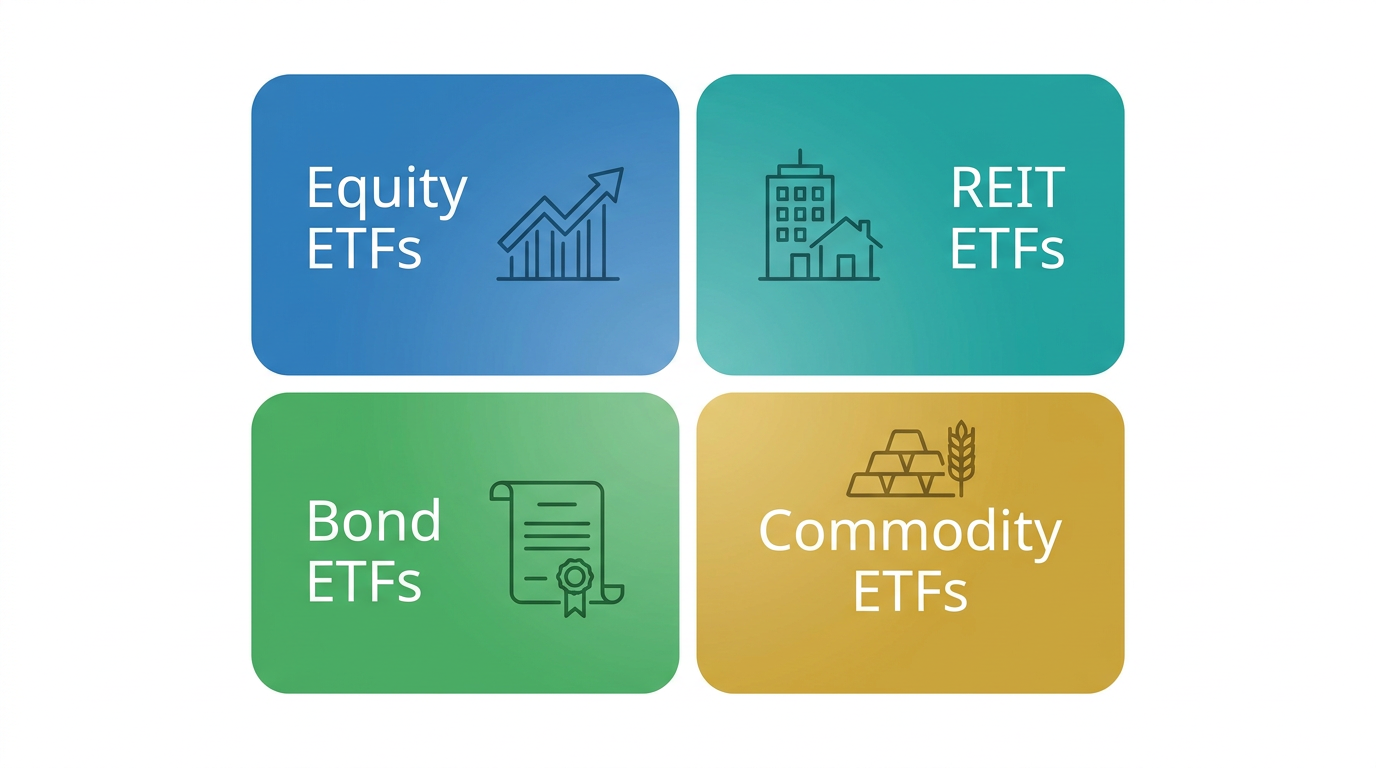
The SGX ETF list spans four main asset classes: equity ETFs that track stock indices, real estate investment trust (REIT) ETFs that hold baskets of REITs, bond ETFs that invest in government or corporate debt, and commodity ETFs that provide exposure to physical assets such as gold. Each category serves a different purpose within a portfolio, from growth and income through to diversification and stability.
SGX ETF List by Category
The following sections detail the key ETFs currently listed on the SGX, organised by asset class. Ticker symbols are included to help with identification on the exchange.
STI ETFs: Tracking Singapore's Blue-Chip Index
The Straits Times Index (STI) is Singapore's benchmark equity index, comprising the 30 largest and most liquid companies listed on the SGX. Two ETFs track this index:
| ETF Name | Ticker | Notes |
|---|---|---|
| SPDR Straits Times Index ETF | ES3 | Distributing; semi-annual cash distributions |
| Amova AM Singapore STI ETF | G3B | Distributing; formerly Nikko AM Singapore STI ETF |
| Amova AM Singapore STI ETF (SGD Acc) | GAB | Accumulation class; distributions reinvested |
Both ES3 and G3B track the same underlying index. ES3 was listed on the SGX in April 2002, making it one of the longest-standing equity ETFs on the exchange. The accumulation class GAB reinvests distributions rather than paying them out, which may suit investors focused on long-term compounding.
REIT ETFs: Accessing Real Estate Through the Exchange
Singapore has a well-established REIT market. Several ETFs on the SGX provide access to this sector:
| ETF Name | Ticker | Focus |
|---|---|---|
| Lion-Phillip S-REIT ETF | CLR | Singapore REITs |
| Nikko AM-StraitsTrading Asia ex Japan REIT ETF | CFA / COI | Asia ex-Japan REITs |
| CSOP iEdge S-REIT Leaders ETF | SRT | Tracks the iEdge S-REIT Leaders Index |
| Phillip SGX APAC Dividend Leaders REIT ETF | BYJ / BYI | Asia-Pacific REITs |
The Lion-Phillip S-REIT ETF (CLR) is dedicated solely to Singapore REITs, covering industrial, retail, and commercial properties. The Nikko AM-StraitsTrading Asia ex Japan REIT ETF broadens exposure to REITs across Hong Kong, India, and South Korea. The CSOP iEdge S-REIT Leaders ETF (SRT) tracks the iEdge S-REIT Leaders Index, which screens S-REITs by size and liquidity criteria.
For investors interested in dividend-focused investing, explore further reading on dividend ETFs and building passive income from Singapore.
Bond ETFs: Fixed Income on the SGX
Bond ETFs offer a way to gain exposure to debt markets without purchasing individual bonds:
| ETF Name | Ticker | Index Tracked |
|---|---|---|
| ABF Singapore Bond Index Fund | A35 | iBoxx ABF Singapore Bond Index |
| Nikko AM SGD Investment Grade Corporate Bond ETF | MBH | iBoxx SGD Non-Sovereigns Large Cap Investment Grade Index |
| iShares USD Asia High Yield Bond ETF | O9P | Barclays Asia USD High Yield Diversified Credit Index |
The ABF Singapore Bond Index Fund (A35) was first listed in 2005 and tracks high-quality bonds issued by the Singapore government and quasi-government bodies such as the Housing and Development Board (HDB). The iShares USD Asia High Yield Bond ETF (O9P) targets higher-yielding bonds from Asian issuers, which typically carry higher credit risk in exchange for higher stated yields.
Commodity ETFs: Gold on the SGX
The SGX currently lists gold ETFs as the primary commodity exposure available to investors:
| ETF Name | Ticker | Currency |
|---|---|---|
| SPDR Gold Shares | O87 | USD |
| SPDR Gold Shares | GSD | SGD |
| LionGlobal Singapore Physical Gold ETF | GLS | SGD |
| LionGlobal Singapore Physical Gold ETF | GLU | USD |
The SPDR Gold Shares ETF is backed by physical gold and tracks the spot price of gold, trading in both USD (O87) and SGD (GSD) counters on the SGX. The LionGlobal Singapore Physical Gold ETF, listed in March 2026, is backed by investment-grade physical gold bars vaulted in Singapore, trading under GLS (SGD) and GLU (USD).
Regional and Sector Equity ETFs
Beyond STI-tracking funds, the SGX also lists ETFs providing access to other markets and sectors:
| ETF Name | Ticker | Exposure |
|---|---|---|
| Lion-OCBC Securities Hang Seng TECH ETF | HST | 30 largest tech companies listed in Hong Kong |
| United SSE50 China ETF | JK8 | 50 largest companies on the Shanghai Stock Exchange |
| iShares MSCI India Climate Transition ETF | QK9 / I98 | Indian equities with climate transition tilt |
| CSOP iEdge Southeast Asia+ TECH Index ETF | SQQ / SQU | 30 largest tech companies across India and Southeast Asia |
| Lion-OCBC Securities Singapore Low Carbon ETF | ESG | Singapore companies with sustainability focus |
The Lion-OCBC Securities Hang Seng TECH ETF (HST) gives Singapore investors access to major Hong Kong-listed technology companies. You can also read about how to invest in the Hang Seng Index from Singapore for broader Hong Kong market access.

CPF and SRS Eligibility
Some SGX-listed ETFs are eligible for the Central Provident Fund Investment Scheme (CPFIS) and the Supplementary Retirement Scheme (SRS). This allows investors to use funds from these accounts to purchase approved ETFs. US-listed and UCITS ETFs are generally not accessible through CPF or SRS, making SGX-listed ETFs particularly relevant for investors looking to utilise these schemes. For more detail on using SRS for fund investments, see this guide on SRS investment options and tax-advantaged funds.
Tip: Check the SGX website or your broker's platform to verify which ETFs are approved for CPFIS or SRS before making a purchase.
How to Access SGX-Listed ETFs
SGX-listed ETFs trade in the same way as ordinary shares on the exchange. Investors need a brokerage account and, for SGX-listed securities, a Central Depository (CDP) account to hold their units. Trades can be placed during SGX market hours.
Longbridge is a digital-first online brokerage licensed by the Monetary Authority of Singapore (MAS), providing access to Singapore market products including SGX-listed ETFs, REITs, and stocks. You can explore the available investment products on Longbridge or track market performance using Longbridge's market data services. The Longbridge Academy also provides educational resources for investors at all experience levels.
Frequently Asked Questions
How many ETFs are listed on the SGX?
The Singapore Exchange lists a broad range of ETFs, and the number changes over time as funds are listed or delisted. The SGX ETF Screener on the SGX website provides a continuously updated list filtered by asset class, geography, and other criteria.
What is the difference between ES3 and G3B?
Both ES3 (SPDR Straits Times Index ETF) and G3B (Amova AM Singapore STI ETF) track the Straits Times Index. The main differences lie in the fund manager, expense ratio, and distribution history. G3B also offers an accumulation class (GAB) for investors who prefer to reinvest distributions automatically.
Are SGX ETFs eligible for CPF or SRS investment?
Some SGX-listed ETFs are approved for use under the CPFIS and SRS. Eligibility varies by fund, so investors should verify approved fund lists on the CPF or SRS websites before investing.
What is a Specified Investment Product (SIP) in the context of ETFs?
A Specified Investment Product is a classification applied by SGX to more complex financial products, including certain ETFs that use derivatives. Investors must demonstrate sufficient knowledge or experience before they are permitted to buy SIPs, to ensure they understand the associated risks.
Conclusion
The SGX ETF list gives Singapore investors access to a broad range of asset classes — from STI equity funds like ES3 and G3B, to REIT ETFs such as CLR and SRT, to fixed income options like A35 and gold ETFs. Regional and sector-focused ETFs extend exposure further into Hong Kong technology, Chinese equities, Indian markets, and Southeast Asian growth themes.
Understanding what each ETF tracks, how it is structured, and whether it qualifies for CPF or SRS investment can help you navigate these options more effectively.
The choice of financial instruments depends on your investment objectives, risk tolerance, market outlook, and experience level. Regardless of the method selected, it is essential to fully understand its mechanics, risk characteristics, and execution rules, while maintaining a robust risk management plan. You can learn more about investment strategies through the Longbridge Academy or by downloading the Longbridge App.