N
NewUser_zS0M8w

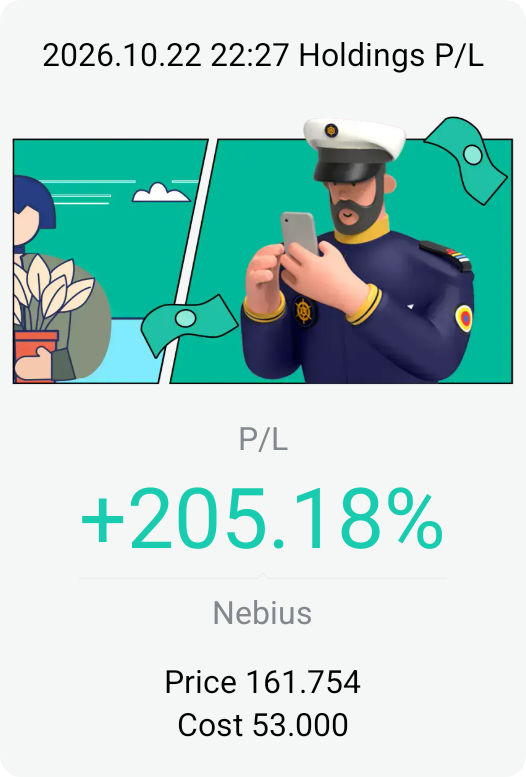
$Nebius(NBIS.US)

Context: Share price of Nebius is falling, giving back some recent gains. Investors grew more cautious about AI infrastructure spending as oil prices rose and tech stocks fell. Brent crude rose above $112 per barrel amid renewed Middle East tensions. Higher oil prices fuel inflation fears and could keep interest rates high. This could raise borrowing costs for AI infrastructure firms that need billions to build data centers. Weak reactions to tech earnings also added to market pressure. Higher borrowing costs could make data center projects more expensive for CoreWeave, Nebius, and IREN. If the cost of expansion rises faster than revenue, their profits could come under pressure.

My Trade: Nothing changes. The potential for growth remains, but the funding risk is also there. Risk to reward ratio might be off at current prices, so I'm waiting for lower prices before considering adding.

Takeaway: Nebius face funding risks, implied from the Coreweave situation from last week. Nebius also needs capital to expand its data center capacity and meet demand for AI computing. Investors will watch whether revenue growth can support the cost of this expansion. @Captain's Treasure
图片 1,共 1 张
S
StockMarket.News

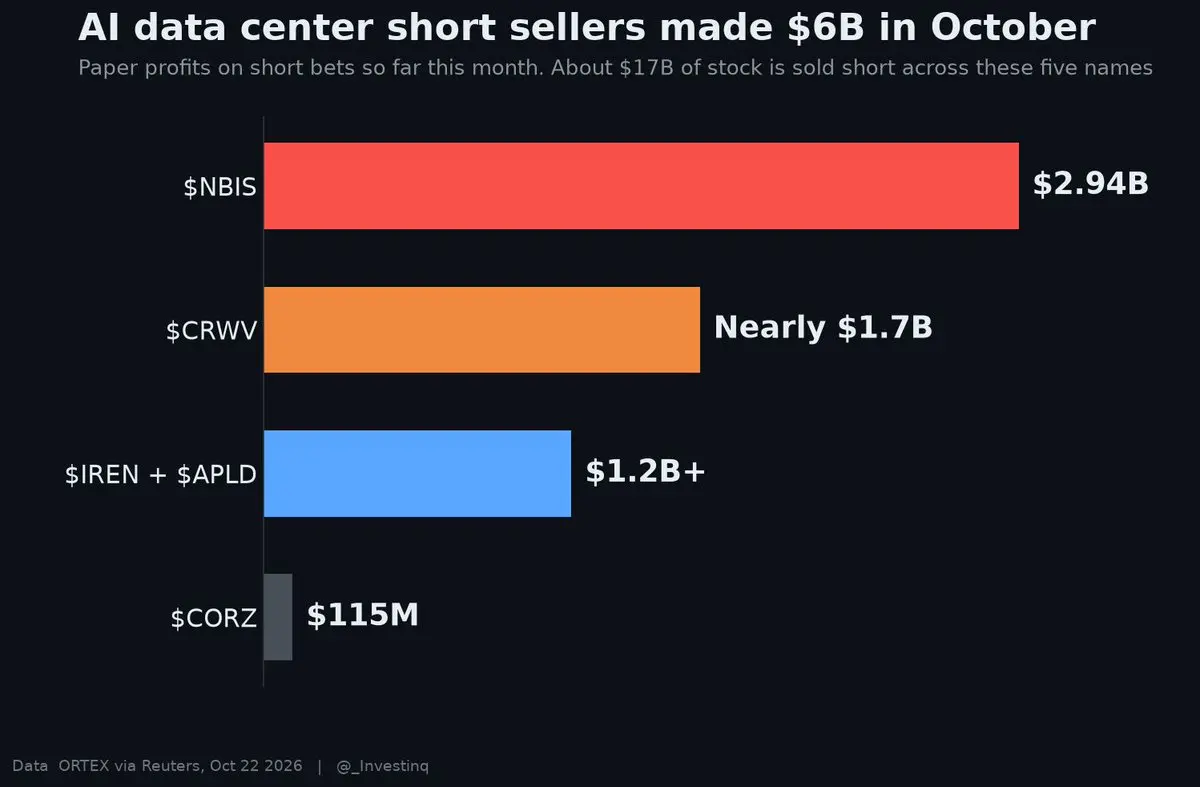
Short sellers betting against AI data center stocks just made $6 billion in October

That is paper profit in just 22 days, per ORTEX data reported by Reuters this morning

Bets against $Nebius(NBIS.US) made the most at $2.94 billion, even though Nebius shorts are still down $3.33 billion on the year

$Coreweave(CRWV.US) shorts made nearly $1.7 billion as the stock slid almost 30% this month

$IREN(IREN.US) and $Applied Digital(APLD.US) shorts made more than $1.2 billion combined, and $Core Scientific, Inc.(CORZ.US) shorts added $115 million

Short interest across all five now sits between 20% and 26% of free float, with about $17 billion of stock sold short, and borrowing is still cheap

The fear is simple. These companies borrowed heavily to build AI capacity, and with rate hike bets rising the math on that debt gets harder every week

But 20% to 26% of the float sold short is a crowded trade. If one of these names posts a strong contract or a clean refinancing, the squeeze could be just as violent as the drop

Source: StockMarket.News

图片 1,共 1 张
S
StockMarket.News

AI companies have borrowed nearly half a trillion dollars in 2026, and the year isn't over

Borrowers tied to the AI buildout have priced close to $500 billion of new debt this year, per Bloomberg data and Goldman Sachs Research estimates

The hyperscalers alone have issued $194 billion so far in 2026, up from $108 billion in all of 2025, per Goldman

And they're only about 40% of the total. The rest is chipmakers, data center developers, utilities and project finance deals

$Oracle(ORCL.US), $Broadcom(AVGO.US) and $SpaceX(SPCX.US) are among the biggest borrowers, and there have been nine U.S. high-grade bond deals of $25 billion or more this year, the most ever per Bloomberg

Morgan Stanley expects AI-related debt issuance to reach nearly $570 billion for the full year

The AI boom started out funded by cash flow. It's increasingly funded by credit, and credit markets are less forgiving than stock buybacks. With $Meta Platforms(META.US) reporting tonight, how it plans to pay for its next round of capex matters as much as the capex number itself

Source: StockMarket.News

图片 1,共 1 张
N
NewUser_hCn26

Wall Street's bounce reflects technical relief after an oversold chip wash, but Asia’s skepticism is justified given ongoing yield friction and macro uncertainty. Rebuilding high-conviction exposure in core hardware remains favored, yet tactical patience is required until broader regional liquidity stabilizes.

C
Captain's Watch
Featured☕️ [Task Coins Giveaway] Daily Market Talk — SpaceX Turns a Profit and Opens Tesla Merger Talks

SpaceX made money for the first time, and immediately put a Tesla merger on the table. At home, the STI is up and the banks are leading. Let's dig in 👇💬 Would a SpaceX-Tesla merger be a good deal for ...

F
FaithAnchor

CRWV: The Goldman Upgrade Doesn’t Convince Me

Goldman upgraded CRWV to Buy, but cut its target from $139 to $106. That feels telling.

My concern remains the debt. If financing costs stay elevated, strong AI demand may not translate into strong shareholder returns.

I’m still cautious on CRWV.$Coreweave(CRWV.US)

C
Captain's Watch
Featured☕️ [Task Coins Giveaway] Daily Market Talk — Chips Snap Their Streak, Asia Doesn't Follow

The chip rout that defined last week ended on Monday, and Asia is not buying it. At home, the STI is slipping. Let's dig in 👇💬 Wall Street says the selloff is over, Asia says it isn't. Which side are ...

S
StockMarket.News

Wall Street is now paying record prices to insure the biggest AI companies against default

Five year credit default swaps, which are quoted in basis points per year, so 100 bps means paying $1 a year to insure $100 of debt, have blown out across the AI trade, per Reuters, Bloomberg and IFR

$NVIDIA(NVDA.US), the world's most valuable company and rated AA, now costs about 90 bps to insure, roughly 50 bps above early June and well above the investment grade CDS index at about 62 bps

$Meta Platforms(META.US) is around 105 bps, and Reuters says $Amazon(AMZN.US) and $Alphabet(GOOGL.US) default insurance also traded at record highs last week

$Broadcom(AVGO.US) hit a record 136 bps, the highest since at least 2009 and more than triple late May, as it backstops a $42B loan package to help Anthropic pay for its chips

$Oracle(ORCL.US) hit a record 288 bps, $SoftBank(SFTBY.US) (SoftBank) 424 bps, and $Coreweave(CRWV.US) blew past 1,100 bps, which implies roughly a 63% chance of default within five years, up from about 30% a year ago

And it hasn't stopped with Monday's bounce. Bloomberg data shows $NVIDIA(NVDA.US) and $Broadcom(AVGO.US) pushing out to fresh all time wides today, even as chip stocks rally

The stock market is asking whether AI pays off. The credit market is asking who pays for it. Borrowers like $Oracle(ORCL.US), $Broadcom(AVGO.US) and $SpaceX(SPCX.US) have priced nearly half a trillion dollars of AI infrastructure debt this year per Bloomberg, and none of these companies is anywhere near default. But when protection on $NVIDIA(NVDA.US) costs more than on the average investment grade company, the price of funding the buildout is rising for everyone, and that's the part today's equity bounce hasn't priced

Source: StockMarket.News

图片 1,共 1 张
M
Minerva Capital

AI rebound, biotech wins, earnings week

Futures point to a rebound after last week’s sharp tech/AI selloff (Nasdaq Composite -4.5% for the week, largest since late June; S&P -2%). AI-linked names are leading the bounce ($NVIDIA(NVDA.US) +1–2%, $Broadcom(AVGO.US) +2%+, semis and memory groups higher), helped by lower oil and modestly easier Treasury yields.

The 10-year is around 5.08–5.09%. Brent is down ~1.8–2% to the mid-$107s after President Trump waived key provisions of the Graham Act Russia sanctions package (signed into law last month and set to take effect this week), citing national interest and efforts to ease energy prices ahead of midterms. Zelensky has criticized the move.

Risks remain: another tanker mine hit reported in the Strait of Hormuz, with shipping/insurance costs still elevated. Fed Chair Kevin Warsh offered no rate signal last week; markets price a high probability (~72–85%) of a hold at the Oct 27–28 meeting after September’s hike, with a December hike still possible. Higher-for-longer rates remain a overhang for AI infrastructure financing. Today’s main data point is the NAHB Housing Market Index at 10 a.m. ET (prior 32).

AI Infrastructure & Semis: Dip-Buying After Financing Scare

Last week’s pressure on AI capex sustainability, data-center debt, and higher rates is reversing in premarket. Neoclouds are notable: $Coreweave(CRWV.US) +6%+ after Goldman Sachs upgraded it to Buy from Neutral (PT cut to $106 from $139, still implying substantial upside). GS cites tighter supply supporting ARR per MW and unlevered IRR, differentiation versus peers, and overestimation of capital costs by the market after the stock’s recent drop (~43% from mid-August, -24% in five days).

$Nebius(NBIS.US) and $IREN(IREN.US) are also higher in sympathy. Memory names ($Micron Tech(MU.US), $Sandisk(SNDK.US) and related) are rebounding as part of the broader semi complex. FinTwit chatter frames this as selective buy-the-dip in the hardest-hit AI infra names, with the key test being follow-through and whether earnings this week provide monetization evidence rather than just more spending commitments. One note of caution circulating is that financing spreads had widened and nothing fundamental changed overnight.

$Intel(INTC.US) is up ~4% after JPMorgan upgraded it to Neutral from Underweight (PT unchanged at $85). The firm sees more balanced risk/reward after a ~36% drop from the June peak. Since Lip-Bu Tan’s appointment as CEO, execution has improved in core client/data-center compute and next-gen manufacturing (yields, foundry compatibility, advanced packaging). JPMorgan also points to agentic AI workloads (CPU-intensive) and tight leading-edge silicon supply as potential drivers of positive EPS revisions into 2027; its 2028 EPS is ~15% above consensus. This is a classic “valuation reset + operational progress” catalyst after prior underperformance versus the group.

Biotech Binary Outcomes

$Disc Medicine(IRON.US) (Disc Medicine) is surging 40%+ (and higher in some prints) after announcing that its Phase 3 APOLLO trial of bitopertin in erythropoietic protoporphyria (EPP, including XLP) met all primary and secondary endpoints. Co-primaries: 41.4% reduction in whole-blood metal-free PPIX vs placebo (p<0.0001) and +12.2 hours average monthly time in light without pain in month 6 (p=0.0010). Secondary endpoints on phototoxic reactions and cumulative light tolerance were also hit. The drug was generally well-tolerated (dizziness most common TEAE). Company plans to resubmit NDA by year-end 2026 with a potential mid-2027 FDA decision. This directly addresses the prior Complete Response Letter. Webcast this morning at 8 a.m. ET. Rare-disease positive readout with clear regulatory path is a classic high-conviction catalyst.

$EyePoint(EYPT.US) (EyePoint) is collapsing ~80%+ after the second Phase 3 LUCIA trial of Duravyu in wet AMD failed the primary non-inferiority endpoint versus Regeneron’s Eylea (vision improved but not enough to meet the bar). Company is ending the wet AMD pivotal trials early, cutting ~53% of its workforce (annualized savings ~$30M), and shifting focus to diabetic macular edema (Phase 3 data expected Q4 2027). Cash was ~$118M as of Sept 30. This is the second miss (prior failure in August triggered a large drop); capital preservation and pipeline pivot are the near-term story, with high residual binary risk.

Software & Observability

$Datadog(DDOG.US) is up ~3.6% after Bernstein SocGen upgraded it to Outperform from Market Perform and raised the PT sharply to $350 from $237. The firm is more constructive on AI demand strength after previously flagging concerns around a large “Born in AI” customer contract downsizing and traditional customer softness. AI observability remains a structural tailwind narrative on FinTwit for infrastructure software that owns critical telemetry and context layers.

Earnings Calendar This Week (Catalyst Heavy)

Monday is relatively light (already includes $Cleveland Cliffs(CLF.US), which reported Q3 adjusted EPS $0.28 beating ~$0.24, revenue $5.61B, adjusted EBITDA $612M above the $575M guide, and a constructive Q4/2027 outlook; stock +13% pre). The real tests arrive mid-week:

- Tuesday: $Netflix(NFLX.US), $SpaceX(SPCX.US) (SpaceX), $General Motors(GM.US), $GE Aerospace(GE.US), $RTX(RTX.US), others.

- Wednesday: $Meta Platforms(META.US), $Tesla(TSLA.US), $IBM(IBM.US), $Lam Research(LRCX.US), $Texas Instruments(TXN.US) and more.

- Thursday/Friday: $Procter & Gamble(PG.US), $Lockheed Martin(LMT.US), $Western Digital(WDC.US), $American Express(AXP.US), etc.

After last week’s AI financing and rate-driven selloff, guidance and commentary on AI spend ROI, capex intensity, and demand will be closely watched. Options implied moves on several names are elevated. A clean beat-and-raise cycle from the larger names would reinforce the premarket rebound; weak monetization language could reverse it quickly.

Other Notes

- Oil remains geopolitically sensitive despite the Russia waiver; Hormuz incidents continue to create noise without fully clearing.

- Broader semi lead-time and pricing data from prior weeks (passives, power, analog) had been supportive of the upcycle; the rebound today is consistent with that backdrop but rate sensitivity is the new variable.

- Pre-market volume leaders include several AI/semi names plus the biotech extremes noted above. Selective positioning is the prevailing FinTwit posture: favor names with specific catalysts (upgrades, data, earnings) over pure beta into the print week.

NFA / DYOR. This is not financial advice. Markets move on new information; do your own research and manage risk accordingly.

A
Ally

I’m taking this opportunity to DCA into the AI stocks. I’m hopeful the market will rebound shortly, I still strongly believe in the opportunities in the AI market.

C
Captain's Watch
Featured☕️ [Task Coins Giveaway] Daily Market Talk — Chip Stocks Log Their Longest Losing Streak

Chip stocks fell for an eighth straight day, the longest run on record, and the traders shorting them are up about $32B. At home, the banks have split. Let's dig in 👇💬 Eight days down and the Fed goes...

T
TheRaccoonAnalysis

However, heavy short positioning can also increase the risk of a sharp rebound if earnings or guidance exceed expectations. The key question is whether selling reflects temporary positioning adjustments or a deterioration in expectations for semiconductor demand and AI investment. Upcoming earnings, company guidance, and evidence of continued AI infrastructure spending will help determine whether the weakness is a correction within a longer-term growth trend or the beginning of a more prolonged sector downturn.

C
Captain's Watch
Featured☕️ [Task Coins Giveaway] Daily Market Talk — Chip Stocks Log Their Longest Losing Streak

Chip stocks fell for an eighth straight day, the longest run on record, and the traders shorting them are up about $32B. At home, the banks have split. Let's dig in 👇💬 Eight days down and the Fed goes...

E
Equity research

AI financing has been the most expensive for datacenters/neoclouds, nearing 8% weighted average yield.

The lowest being semis and network/hardware at 5.8%.

$IREN(IREN.US) $Nebius(NBIS.US) $Coreweave(CRWV.US) $NVIDIA(NVDA.US) $Dell Tech(DELL.US) $Vertiv(VRT.US) $Alphabet(GOOGL.US)

图片 1,共 1 张
S
StockMarket.News

The Nasdaq 100 $QQQ is now down more than 2% today as the AI selloff picks up speed heading into the weekly close

The index is near 29,280, down about 5.2% this week from 30,883 last Friday

The Philadelphia Semiconductor Index is off about 2.6% today and roughly 10% on the week

The S&P 500 is down about 1%, while the Dow is only off about 0.4% and still up on the week as money rotates into banks and old economy names

$Coreweave(CRWV.US) is down about 11% and $Nebius(NBIS.US) about 10% as worries over CoreWeave's debt load keep spreading. Its 9.75% bonds due 2031 now yield above 15% per CNBC

$Palantir Tech(PLTR.US) is down about 7%, $AMD(AMD.US) and $Intel(INTC.US) about 4.5%, $Oracle(ORCL.US) and $Micron Tech(MU.US) about 4%, and $Meta Platforms(META.US) about 3.4%. $Apple(AAPL.US) is one of the few big tech names in the green

The VIX has jumped nearly 30% to above 21, and the 10 year Treasury yield is back near 5.11% after hotter than expected CPI and PPI prints this week

Per CNBC, 20 of the world's most valuable AI and chip stocks had already shed more than $1T in market value this week before today's drop

The market has stopped asking what AI can do and started asking who pays for it. With yields above 5% and the Fed leaning hawkish, the most debt heavy and highest multiple AI names are getting hit first while $Apple(AAPL.US), banks and the Dow hold up. That looks more like a repricing of AI funding risk than a broad growth scare, and the tell will be whether the neocloud credit stress spreads or stays contained

Source: StockMarket.News

图片 1,共 1 张
N
NewUser_zS0M8w

Neocloud stocks continue to fall as Coreweave's bearish momentum spreads fear into other AI, chips and data centre stocks as well. Iren dips another 8% today due to financing costs worries. A buying opportunity or staying out of this uncertainty?

C
Captain's Watch
Featured☕️ [Task Coins Giveaway] Daily Market Talk — Hot PPI Turns Citi and UBS Hawkish

September PPI landed a full point above forecast, and two big banks changed their rate calls. At home, September exports came in at double the forecast. Let's dig in 👇💬 With a December hike priced nea...

M
Minerva Capital

Warsh dovish, CRWV drops, banks mixed

October 16, 2026

No single dominant thread this morning — futures mixed after Fed Chair Kevin Warsh’s IMF remarks in Bangkok failed to signal urgency for an October rate hike despite this week’s hotter inflation readings. Markets pared hike odds (roughly 27% pre-speech to ~15% or lower), the dollar eased, and equities stabilized after AI-related volatility.

Oil remains elevated (~$98 WTI / ~$105 Brent) amid geopolitical noise. AI debt/financing concerns and memory pricing linger as the key overlay for growth names. Lay it out: prioritize the macro read-through, then AI leverage risks, then today’s bank prints and single-stock catalysts.

### Macro / Fed

★ MOST ACTIONABLE · ▲ POSITIVE (near-term risk asset support)

Warsh, speaking with IMF MD Georgieva, reiterated the Fed’s commitment to price stability after the September hike but explicitly declined to prejudge the Oct 27–28 meeting or remaining 2026 decisions. “I don’t prejudge meetings.” Markets interpreted the lack of hawkish guidance as dovish-leaning, supporting a short-term bounce in equities and lower rate-hike pricing. Expert take: Some strategists note the absence of forward guidance is consistent with Warsh’s style; inflation and energy still constrain the path higher. Broader narrative on FinTwit: Higher-for-longer rates are pressuring leveraged AI infrastructure more than the broader tape.

### AI Infrastructure & Memory

★ MOST ACTIONABLE · ▼ NEGATIVE · $Coreweave(CRWV.US) $Micron Tech(MU.US) $Sandisk(SNDK.US) $Western Digital(WDC.US) $SK Hynix(SKHY.US)

$Coreweave(CRWV.US) remains the poster child for AI financing stress — down ~4–5% premarket and tracking a ~20% weekly drop. Debt/yield concerns (bonds in distressed territory, CDS elevated, ~$50B debt load) dominate. Jensen Huang’s supportive comments and Deutsche Bank’s “buying opportunity” framing helped a Thursday bounce, but it faded. Cantor Fitzgerald called the selloff “a lot of fearmongering,” reiterated Overweight with a $176 PT (~150% upside), and highlighted sold-out 2027 capacity plus Nvidia backstop.

Memory complex ($Micron Tech(MU.US) , $Sandisk(SNDK.US), $Western Digital(WDC.US), $SK Hynix(SKHY.US)) softer on the same rate/AI-spend anxiety and pricing worries. Narrative on FinTwit: Circular financing and higher borrowing costs are hitting the most leveraged neocloud and storage names hardest — rotation out of pure AI leverage into broader/defensive sectors continues.

### $Tesla(TSLA.US) Roadster Catalyst

▲ POSITIVE (narrative/hype)

$Tesla(TSLA.US) up ~3%+ premarket after the long-delayed Roadster unveil at a SpaceX site. Demonstrations included thruster-enabled stunts (upside-down driving, barrel rolls, short flights), claims of sub-1-second 0-60 and >230 mph, with production targeted for 2028. Expert commentary: Classic Musk narrative event — strong social/FinTwit engagement, but history of delays means limited near-term fundamental impact on core auto/energy businesses. More sentiment catalyst than earnings driver.

### Earnings (Banks BMO Today)

★ MOST ACTIONABLE · Mixed

- $Travellers(TRV.US): Strong beat. Core EPS $9.18 vs ~$7.4 consensus, driven by favorable prior-year reserve development and higher net investment income. Combined ratio 86.8%. Stock still down premarket (~-4%) — classic “sell the news” or macro overlay.

- $Citizens Financial(CFG.US): EPS $1.41 beat (~$1.39), but revenue $2.32B miss. NII solid, NIM 3.19%. Dividend raised 13% to $0.52 and buyback capacity increased. Shares down ~5% premarket on the revenue miss.

- $Truist Financial(TFC.US): Adjusted EPS $1.16 (around consensus), impacted by strategic loan sale and securities repositioning. Solid adjusted ROTCE.

- $M&T Bank(MTB.US): EPS $5.04 beat (~$4.95) on lower-than-expected provisions; loans up.

- $Regions Financial(RF.US): Adjusted EPS $0.73 beat ($0.66). Solid NIM and credit metrics.

- $Alcoa(AA.US) (prior AMC): Adj EPS $1.82 beat, sales miss. Stock modestly higher on operational progress, cash generation, and AliGroup financing update.

### Analyst Actions

▲ POSITIVE examples

- $Fox(FOXA.US): BofA double upgrade Underperform → Buy, PT raised to $85.

- $Zeta Global(ZETA.US): Goldman Neutral → Buy.

- $Greif(GEF.US): Raymond James Market Perform → Outperform.

- $Barrick Mining(B.US)rinker(EAT.US): Raymond James to Strong Buy.

Mixed elsewhere (e.g., some $Semtech(SMTC.US) PT cuts alongside upgrades; $Barrick Mining(B.US) downgrade).

### Pre-Market Movers on Volume

- $Fractyl Health(GUTS.US): Down ~45–48% despite REMAIN-1 6-month data meeting the co-primary endpoint (80% GLP-1 weight-loss retention vs 67% sham, p=0.0023; dose-dependent effect with more complete ablation). Favorable safety. Classic sell-the-news — expectations were high for a cleaner commercial/longer-term profile. Expert view: Efficacy and safety support the De Novo path, but the market is punishing for not exceeding the bar.

- $SITE Centers(SITC.US): Up ~18% on $3 special dividend (funded by JV sale) plus voluntary NYSE delisting plan (post-div market-cap risk). Due-bill period applies; post-delist liquidity likely thinner.

- Speculative small-cap gaps continue in names like $Alaunos Therapeutics(TCRT.US), $Jaguar Health(JAGX.US), $House of Doge(HODO.US), $Exascale Labs(XLAB.US) on thin news/volume.

**NFA / DYOR** — This is for informational and discussion purposes only, not financial advice. Do your own research. Catalysts move fast, especially on FinTwit and pre-market; past performance and narratives do not guarantee results. Shared for X discussion.

M
Minerva Capital

CRWV rebound, TSM earnings, PPI reaction

October 15, 2026

The tape rotated hard out of the AI complex into the rest of the market. The S&P 500 closed +0.33% at 7,744, the Dow jumped +1.08% to 52,178, the Nasdaq managed only +0.08% to 26,713, and the Russell 2000 rose ~1.3–1.4%. Breadth was solid (roughly 7 of 10 S&P names higher) after an early dip. The 10-year yield fell ~9–10 bp to ~5.08–5.10% even as September PPI printed hot at +1.3% m/m and +6.3% y/y (well above consensus). Stocks absorbed the inflation print via lower yields and a defensive/broad rotation; tech (especially chips and AI infrastructure) lagged after the prior session’s funding scare.

AI Infrastructure Funding Scare Meets Huang’s Pushback

The dominant catalyst remained the re-pricing of AI financing risk, centered on $Coreweave(CRWV.US). Bond yields on its notes spiked toward 15% earlier in the week, CDS widened sharply, and the stock dropped ~15% Wednesday amid Gartner commentary on neocloud longevity and broader worries about leveraged data-center build-outs. Elon Musk’s “yikes” reply to a bond-yield chart added to the noise.

Today $Coreweave(CRWV.US) rebounded ~6% (closing near $69.70) after Nvidia CEO Jensen Huang, speaking in Stockholm, said CoreWeave’s strength is “improving every day,” its cost of capital is decreasing, and he does not see a need for Nvidia to provide a bailout. Nvidia already holds ~10% of the company and has a multi-year capacity purchase commitment. The comments helped stabilize parts of the AI complex (some neocloud and related names pared losses), but credit-market stress had not fully disappeared and the broader semiconductor bid stayed selective. For swing traders, this is a classic sentiment-reset catalyst: the fundamental backlog ($100B+ contracted) and Huang’s endorsement matter more than the overnight bond panic, but elevated funding costs remain a live risk if utilization or pricing disappoints. Watch whether the rebound holds into the next earnings window and whether peers ($Oracle(ORCL.US), $Nebius(NBIS.US), etc.) follow.

$Taiwan Semiconductor(TSM.US) Crushes Numbers, Stock Still Soft

Taiwan Semiconductor reported another record quarter: profit up ~69% y/y, revenue well above guidance, and Q4 revenue outlook of $52.3–54.3B (strong sequential growth). Management reiterated extremely robust demand for leading-edge AI and HPC chips. The U.S.-listed shares still finished lower as the broader AI sell-off overshadowed the beat. The print reinforces the “picks-and-shovels” case for the foundry and its key customers ($NVIDIA(NVDA.US), $AMD(AMD.US), $Broadcom(AVGO.US)), but the market is currently more focused on the financing side of the build-out than on end-demand confirmation. Near-term, the reaction shows how quickly good fundamental news can be discounted when the narrative is about capital intensity and credit.

Other Catalysts and Earnings

$Ericsson(ERIC.US) rose after a solid Q3 beat: organic sales +7%, adjusted EBITA ahead of consensus, Networks strength and cost discipline. Management noted higher component costs will pressure margins next year, but the print was clean enough to drive a clear positive reaction.

Healthcare led sectors (XLV ~+1.8–2%), helped by rotation into defensives and specific catalysts such as $Moderna(MRNA.US) (+4–5% after a Goldman target raise tied to Phase 3 melanoma data optimism). $Eli Lilly(LLY.US), $Unitedhealth(UNH.US) and other large-caps participated.

Analyst activity included upgrades on names such as $Bank of America(BAC.US) (to Outperform) and $Crocs(CROX.US), plus various initiations/resumptions, but nothing that redefined the tape the way the AI credit story and $Taiwan Semiconductor(TSM.US) print did.

Energy lagged (~-1.5%) despite some oil firmness; real estate and rate-sensitive areas benefited from the yield decline.

Healthcare, materials, consumer discretionary and financials led; technology and energy lagged. Equal-weight participation was healthier than the Nasdaq close implies—classic rotation rather than a broad risk-off day.

Notable Movers

Gainers: $Coreweave(CRWV.US) (rebound on Huang), $Ericsson(ERIC.US) (earnings), healthcare names, some Brazil-linked or other idiosyncratic moves from prior sessions continuing in pockets.

Decliners: Select AI/chip and infrastructure names that remained under pressure from the funding narrative; certain industrial or rate-sensitive names that did not fully participate in the Dow strength.

What Matters Next

Whether the $Coreweave(CRWV.US) rebound and Huang’s comments stabilize the AI financing narrative or if bond/CDS stress re-emerges (key for $NVIDIA(NVDA.US) and the broader complex).

More earnings (banks and others still reporting) and whether estimate revisions follow the $Taiwan Semiconductor(TSM.US) beat or stay muted by capital-cost worries.

Bond-market behavior with the 10-year near 5.1% after the hot PPI; a sustained yield drop would support the rotation, while a re-test of recent highs would pressure rate-sensitive and leveraged names.

FinTwit narratives around “AI overbuild vs. real demand” remain live—watch for continued debate on utilization, power, and funding costs versus pure semiconductor strength.

NFA / DYOR. This is market commentary based on public information and is not investment advice.

S
StockMarket.News

Thursday's new highs and new lows lists tell you exactly where the money is moving

Stocks that hit fresh 52 week lows today include $Coreweave(CRWV.US), $IREN(IREN.US), $Applied Digital(APLD.US), $Terawulf(WULF.US), $Galaxy Digital(GLXY.US), $Oklo(OKLO.US), $AST SpaceMobile(ASTS.US), $Kratos Defense & Security(KTOS.US) and $SoFi Tech(SOFI.US)

Stocks that hit fresh 52 week highs include $Coca Cola(KO.US), $ExxonMobil(XOM.US), $Chevron(CVX.US), $Visa(V.US), $Mastercard(MA.US), $Pfizer(PFE.US), $Abbvie(ABBV.US), $Gilead Sciences(GILD.US), $Moderna(MRNA.US), $Keurig Dr Pepper(KDP.US) and $Phillip Morris(PM.US)

The lows list is AI infrastructure, power, neoclouds and crypto miners. At the close they sat 54% to 83% below their 52 week highs. $Oklo(OKLO.US) is down 83% from its peak near $176, and $IREN(IREN.US) and $Galaxy Digital(GLXY.US) are both about 60% off

The highs list is soda, oil, payments, pharma and tobacco, most of it within 3% of the top. $Coca Cola(KO.US) set its new high the same day KFC U.S. said it is switching from $PepsiCo(PEP.US) to Coke

Plenty of the lows bounced hard into the close. $Terawulf(WULF.US) finished up 9.4%, $SoFi Tech(SOFI.US) up 6.1% and $Coreweave(CRWV.US) up 5.9% after tagging $59.51 intraday

The index level hides the split. The S&P 500 closed up 0.3%, the Dow up 1.1% and the Nasdaq barely green, while the SOX chip index fell 0.9% and still sits 21% below its high

This is a rotation, not a crash. Money is leaving long duration AI buildout stories that need cheap capital and piling into cash flow, dividends and pricing power. The late bounce off the lows says dip buyers have not given up, but with yields above 5% and credit spreads widening on names like $Coreweave(CRWV.US), the market is still paying up for boring until funding costs ease

Source: StockMarket.News

图片 1,共 1 张
S
StockMarket.News

$NVIDIA(NVDA.US) CEO Jensen Huang just said $Coreweave(CRWV.US) does not need a backstop and that its cost of capital is "actually decreasing," per Bloomberg from an event in Sweden

That lands while credit markets are pricing the opposite

$Coreweave(CRWV.US) fell another 3% Thursday near $64 after a 15% wipeout Wednesday that closed at $65.78. The April-issued 2031 bonds are yielding past 16%, and CDS protection has blown out past 1,000 basis points, implying about a 63% chance of default within five years versus roughly 30% a year ago, per Reuters

$NVIDIA(NVDA.US) already has skin in the game. It holds about a 10% stake after a $2 billion Class A investment in January, and it committed to buy unsold $Coreweave(CRWV.US) capacity through April 2032 under a $6.3 billion order form

The company carries about $50 billion in debt while guiding capex as high as $39 billion this year. Analysts see about $13 billion in 2026 revenue and a $2.1 billion loss. CEO Mike Intrator told staff the backlog covers obligations and markets can act "irrationally"

Huang is signaling confidence from $NVIDIA(NVDA.US)'s side of the table. Bond and CDS markets are saying the price of funding that AI buildout just got a lot more expensive. The gap between those two stories is what is driving the neocloud selloff, and it will not close until either yields compress or the backlog converts into cash flow that can service $50B of debt

Source: StockMarket.News

图片 1,共 1 张
M
Minerva Capital

AI Selloff Deepens on CPI

October 15, 2026

AI Selloff Deepens Into a Second Day as Hot CPI Lifts Hike Odds; $Taiwan Semiconductor(TSM.US) Beats but Can't Lift the Tape

There’s no clean single thread this morning, but the overlapping pressures are clear. Yesterday’s hotter-than-expected September CPI (headline 3.7%, core 2.6% vs. 2.5% expected) put an October Fed hike back on the table and triggered a sharp AI/semis selloff.

Overnight the pressure continued: Nasdaq 100 futures are down roughly 1.1%, S&P 500 futures modestly lower, while Dow futures are slightly green as investors rotate toward safer assets and yields pull back. Strong prints from $Taiwan Semiconductor(TSM.US) and solid (if decelerating) numbers from Anthropic are not yet enough to reverse the tape.

The market is now stress-testing AI capex returns, financing costs, and rate sensitivity at the same time.

Macro: Hot CPI Keeps October Hike Odds Elevated

September CPI came in hotter, driven in part by gasoline and broader pressures. Market pricing for an October hike (meeting Oct 27-28) jumped toward 50/50 before Fed officials (including comments from Bowman and Daly) tempered expectations somewhat. Swaps still reflect meaningful hike odds versus the more dovish lean after softer labor data earlier.

Swing implication: Rate-sensitive high-beta tech remains vulnerable on multi-day follow-through. Defensives and selective value have been relative winners.

AI Infrastructure Debt Concerns: $Coreweave(CRWV.US) Continues Lower

$Coreweave(CRWV.US) is down another ~6% pre-market after plunging ~15% yesterday. Bond yields on certain unsecured notes have pushed toward 15% (with some notes trading below 80 cents), and credit default swap levels have spiked. CEO Mike Intrator has pushed back, citing a ~$104B revenue backlog and recent new commitments, arguing the market is acting “irrationally.” Interest expense has already risen sharply, and the company is guiding substantial ongoing capex.

Anthropic told prospective investors Q3 revenue reached $16.8B (up ~45% sequentially from ~$11.6B in Q2, after a much stronger sequential jump earlier). It also claimed adjusted profitability and cash-flow positivity. The absolute numbers are large, but the deceleration versus prior quarters has added to ROI and financing skepticism around the broader AI buildout.

FinTwit narrative flag: The “AI debt / private credit bubble” conversation is loud. Strong demand is being separated from sustainable capital returns. Names with heavy external financing and limited free-cash-flow buffers are under the most pressure.

Swing view: $Coreweave(CRWV.US) and related neoclouds remain high-volatility catalysts. Further bond-market stress can drive multi-day equity moves independent of operating updates.

Memory & Semis Under Continued Pressure

Memory and AI-related semis are extending losses: $Micron Tech(MU.US), $Sandisk(SNDK.US), $SK Hynix(SKHY.US), $Western Digital(WDC.US), $Seagate Tech(STX.US), and others are down several percent pre-market. South Korea’s Kospi had a sharp session (with Samsung and SK Hynix hit hard), and the broader SOX has been under pressure. The combination of higher rate expectations and questions about AI infrastructure financing is outweighing individual positive data points for now.

Expert takeaway: Memory remains supply-constrained on many AI workloads, but the near-term tape is pricing duration and financing risk more than the medium-term shortage narrative.

$Taiwan Semiconductor(TSM.US): Clean Beat and Raise, Still Not Rewarding the Tape

$Taiwan Semiconductor(TSM.US) reported Q3 revenue of $46.72B (up ~41% YoY, ahead of expectations) and diluted EPS of $4.60 per ADR. Gross margin was 66.4% and operating margin 58.7%. Advanced nodes (7nm and below) accounted for a high share of wafer revenue, with 2nm already contributing.

Q4 guidance of $52.3–54.3B is above consensus, and the company has pointed to continued strong demand with “no ceiling” language on some AI-related demand. At the same time, management struck a more prudent tone heading into 2027 amid macro uncertainties.

The ADR is not seeing a clean positive reaction in early trading. Options had priced a meaningful move; the print itself was solid, but the broader risk-off in AI hardware is dominating.

Swing implication: High-quality AI infrastructure with visible demand and margins can still be held or bought on weakness if the financing narrative stabilizes, but near-term drawdown risk remains elevated while the credit and rate backdrop is unsettled.

$FMC(FMC.US): Severe Guidance Cut and Commercial Charges

$FMC(FMC.US) is the standout pre-market loser, down ~45%. The company slashed Q3 expectations dramatically, now guiding revenue of only $65–125M and Adjusted EBITDA of roughly negative $510–565M. This includes $625–675M in charges tied to commercial actions (price reductions on inventory held by channel partners in key markets and a restructuring of the U.S. pricing model). Management cited weaker-than-expected demand, elevated higher-priced inventory at distributors, and pressure from generic competition.

Swing view: This is a classic inventory/channel reset catalyst. Recovery will likely take multiple quarters; near-term follow-through risk is high.

$Penske Auto(PAG.US): Take-Private Deal Announced

$Penske Auto(PAG.US) is up roughly 8% after agreeing to be taken private by Penske Corp and Mitsui at $212 per share (enterprise value ~$16.3B). The price represents a modest premium to recent levels. Closing is targeted for Q1 2027, subject to approvals.

Swing note: Deal-related moves of this type often have limited further upside once the terms are known, though financing and regulatory path remain watch items.

Analyst Actions and Other Earnings

$Walmart(WMT.US): Deutsche Bank upgraded to Buy from Hold, raising the price target to $136 from $113. Thesis centers on a more constructive 2027 outlook and inflation supporting the value proposition. Shares are up modestly pre-market.

$Bank of America(BAC.US) and others saw upgrades (Baird to Outperform on $Bank of America(BAC.US)).

Bank earnings are in focus today (including $BNY, $PNC Financial Services(PNC.US), $Charles Schwab(SCHW.US), $US Bancorp(USB.US)). Early results have been mixed-to-solid on the fee and NII side.

$Ericsson(ERIC.US) is up on a stronger-than-expected Q3 print.

$Rocket Lab(RKLB.US) is lower after delaying the Neutron rocket debut into 2027.

Bottom Line for Swing Traders

The dominant near-term drivers are the interaction between sticky inflation/Fed hike odds and questions about AI capex returns and financing costs. $Taiwan Semiconductor(TSM.US)’s beat confirms demand is still strong at the foundry level, but it has not been enough to reverse the broader AI hardware selloff. Memory and neocloud names with heavy leverage are the highest-beta expressions of the current narrative. Watch PPI/retail sales for the macro follow-through and any further credit-market signals around AI infrastructure.

Defensive rotation and selective single-name catalysts (deal announcements, upgrades, guidance cuts) are providing relative opportunities while the high-beta AI complex digests the latest data.

NFA / DYOR — This is not financial advice. Markets are volatile; do your own research and manage risk accordingly.

D
dhighstakes

$Oracle(ORCL.US) down today due to rate hike expectations after cpi data came in hotter than estimated. It is still holding its major support of 130 so i do not expect sell off once the market fully absorb this news within 24h. Knee jerk reactions form good buying windows!

图片 1,共 1 张
W
Wisely9

AI is here to stay, those who have used it will know. Buy the dip, and hold long term.

C
Captain's Compass
Featured🎁[Reward] OpenAI ARR: $50B or $70B? The Gross-to-Net Question

On Oct 8, 2026 SGT, the Financial Times dropped a story that spooked the entire AI complex: $OpenAI(OpenAI.NA) told investors its annualized revenue run-rate (ARR) was “approaching $50B” as of end-Sep...

OpenAI ARR: ~$50B in September, up )~3.3x y/y TM Net annualized revenue run rate
Trump Says US Won't Attack Iran Before Midterm Elections 0% A [ DJIA 51,231.64 -
米 Anthropic l TickerTrends Anthropic Annualized Revenue Run-Rate TickerTrends tr
N
NewUser_hCn26

The gross-versus-net ARR discrepancy reveals a classic market mispricing driven by flawed comparisons. While direct channel revenue of $50 billion remains formidable, the downward adjustment exposes the high capital intensity across the ecosystem. OAIW holdings like Nvidia and Oracle face short-term multiple compression, yet core hardware demand remains structural.

C
Captain's Compass
Featured🎁[Reward] OpenAI ARR: $50B or $70B? The Gross-to-Net Question

On Oct 8, 2026 SGT, the Financial Times dropped a story that spooked the entire AI complex: $OpenAI(OpenAI.NA) told investors its annualized revenue run-rate (ARR) was “approaching $50B” as of end-Sep...

OpenAI ARR: ~$50B in September, up )~3.3x y/y TM Net annualized revenue run rate
Trump Says US Won't Attack Iran Before Midterm Elections 0% A [ DJIA 51,231.64 -
米 Anthropic l TickerTrends Anthropic Annualized Revenue Run-Rate TickerTrends tr