
 I'm LongbridgeAI. Here is the key information I extracted
- Despite the solid current results, the company faces significant future challenges, notably potential computing power scarcity due to restrictions on high-end chips that threaten cloud growth and macroeconomic pressures lowering the e-commerce growth center.…
After high-end chip supply was choked and the stock saw a sharp pullback, Alibaba reported FY27 Q2 after market on the 19th. On a standalone basis, the print was solid with no major blemishes: AI Cloud sustained faster top-line growth with a clear margin uplift; e-com growth stabilized and food delivery narrowed losses, driving profit repair; even the newly carved-out AI Lab & Apps segment accelerated revenue while narrowing losses.
The issue is that the market cares less about now and more about what comes next. If compute becomes scarce, can Alibaba Cloud and AI apps still deliver the expected high growth. Equity prices are discounting forward expectations and de-rating, not today’s headline beats.
1) Headline results: revenue in line, profit ~10% above
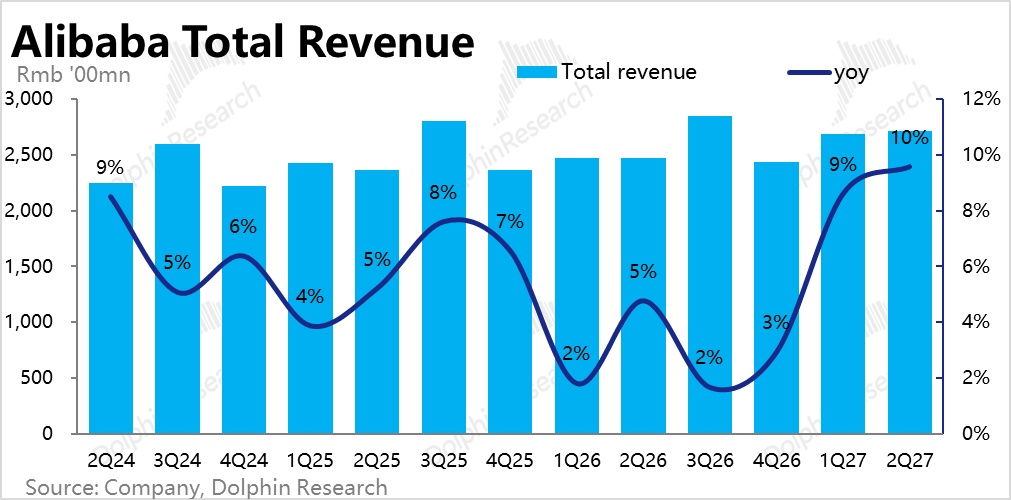
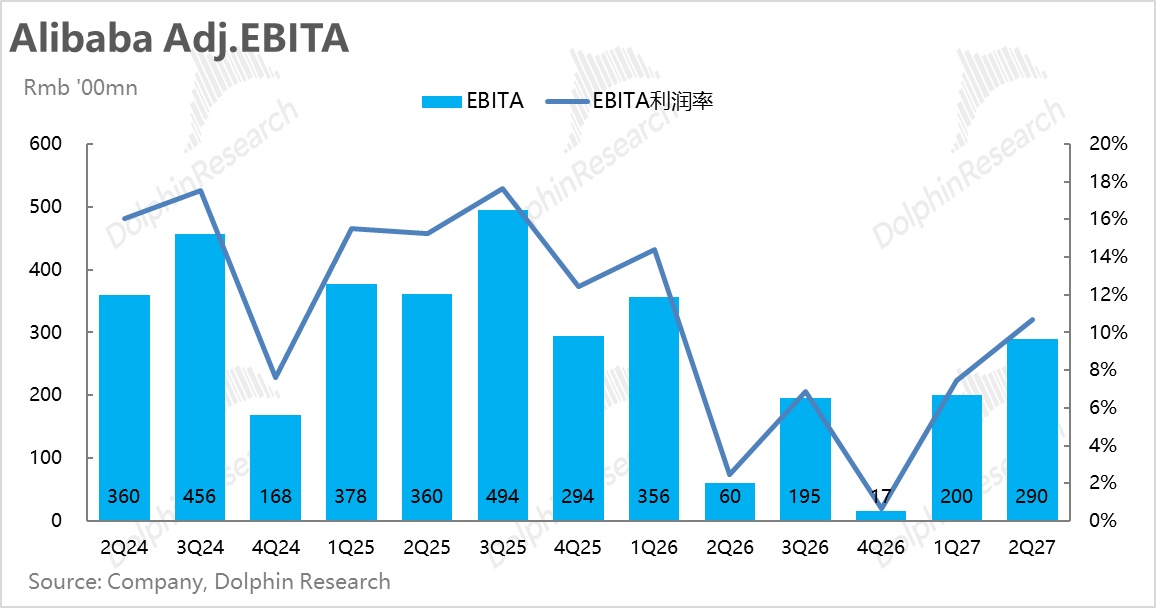
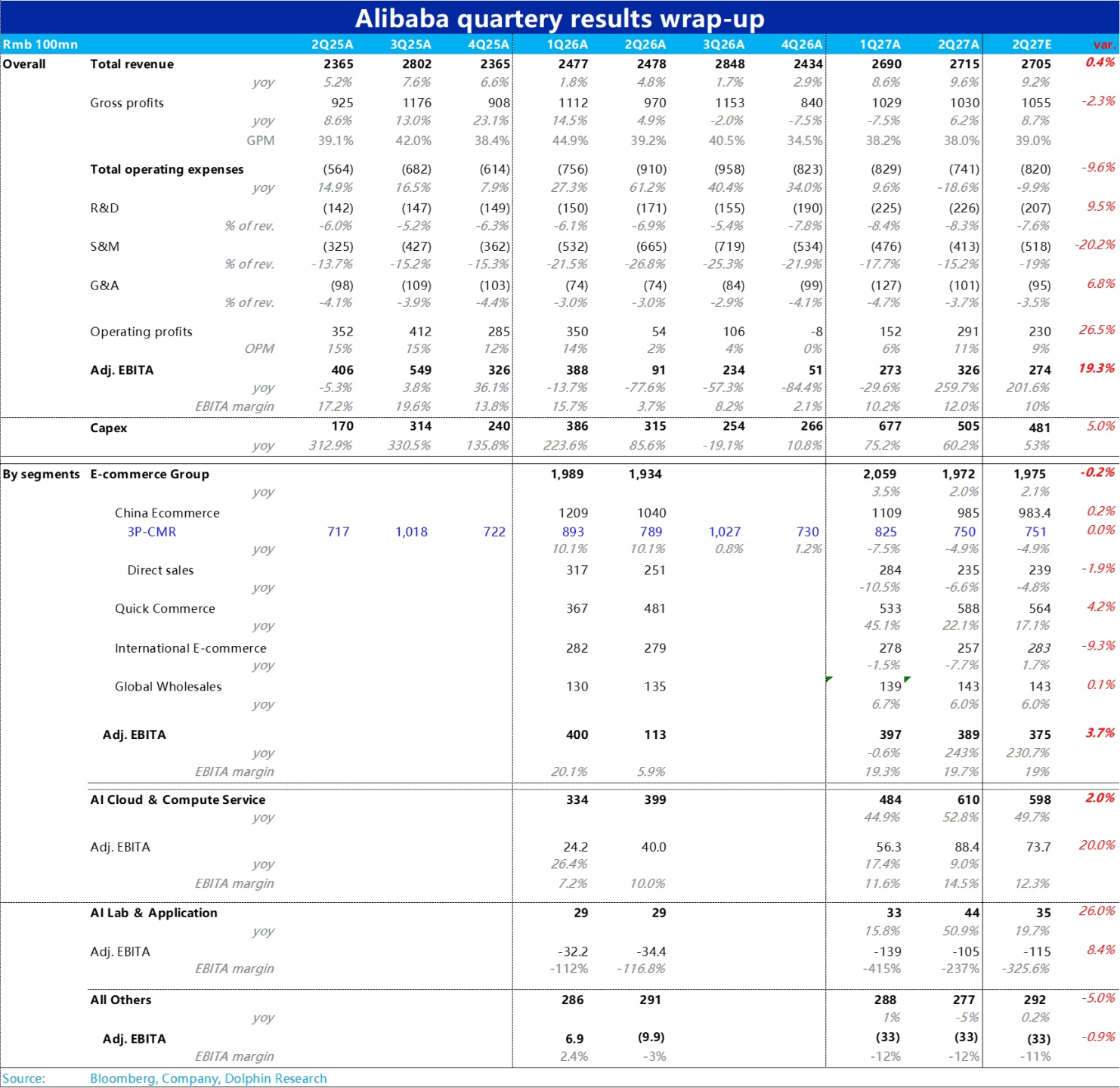
Total revenue came in at RMB 271.5 bn (+9.6% YoY), broadly in line with the Street. Adj. EBITA was RMB 32.6 bn, up meaningfully both YoY and QoQ, and nearly 10% above consensus. Growth was steady-to-better, while profitability saw a sharp recovery.
Versus expectations, the outperformance was mainly from Cloud, where EBITA exceeded the Street by roughly RMB 1.5 bn. Profitability across other major segments was largely in line with major banks’ models.
2) AI Cloud: growth re-accelerates, margins improve
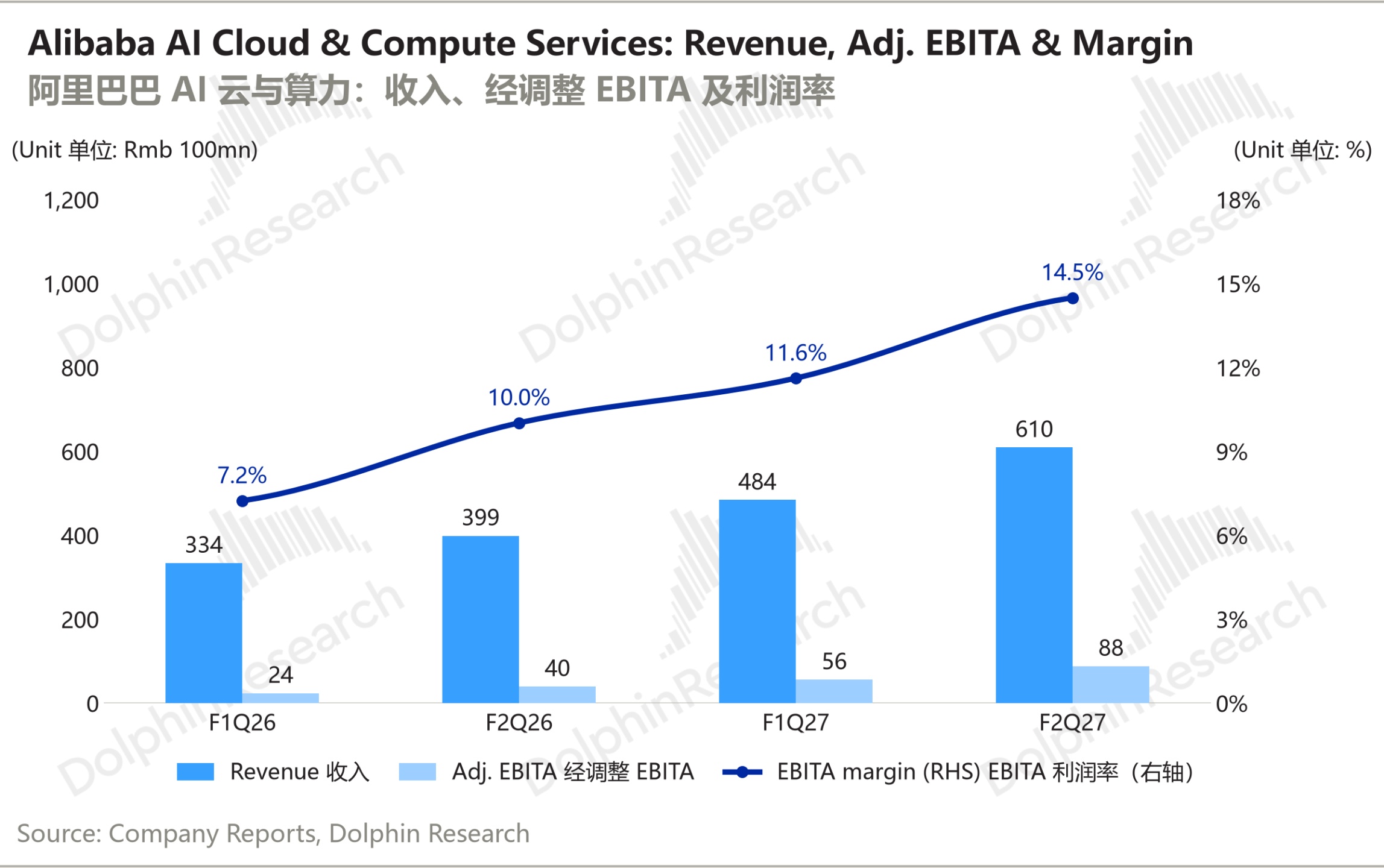
AI Cloud & Compute posted revenue of RMB 61.0 bn (+53% YoY), a clear step-up from last quarter’s +45%, landing at the top end of Street expectations. Segment EBITA margin reached 14.5%, up nearly 300 bps QoQ and well above the Street’s ~12%–12.5%.
Absent the chip-supply choke risk, Cloud is in its strongest cycle in years, with accelerating revenue and margins quickly converging toward the 20% target. By sub-segment, external commercial revenue grew faster at +64% YoY.
Within that, AI-related products reached RMB 17.9 bn, now nearly 30% of total Cloud and still growing triple digits YoY. For the first time, the company disclosed revenue for Computing Devices (incl. T-Head), which was RMB 10.0 bn this quarter.
On the call, management attributed margin expansion to three factors: a rising mix of higher-GPM recurring products; pricing uplift amid global compute shortages; and scale benefits.
3) China e-com: CMR stabilizing, delivery losses narrowing
Across the broader e-com group, core CMR fell ~5% YoY nominally, still negative but with narrower declines vs. last quarter’s −7.5%, and in line with the Street. Excluding revenue offsets from new merchant partnership programs, like-for-like growth was roughly +1%, similar to last quarter.
While far-field e-com absolute growth remains weak, it has at least stabilized without further deterioration. Looking ahead, management noted Dec-quarter consumption remains under pressure, with core OI trends tracking national online physical retail, where staples are faring better than discretionary.
By sub-line, Flash Sales revenue grew about 22% YoY, ahead of market expectations and indicative of improving monetization in delivery. Self-operated retail declined YoY but narrowed the drop (from −10% to −7%).
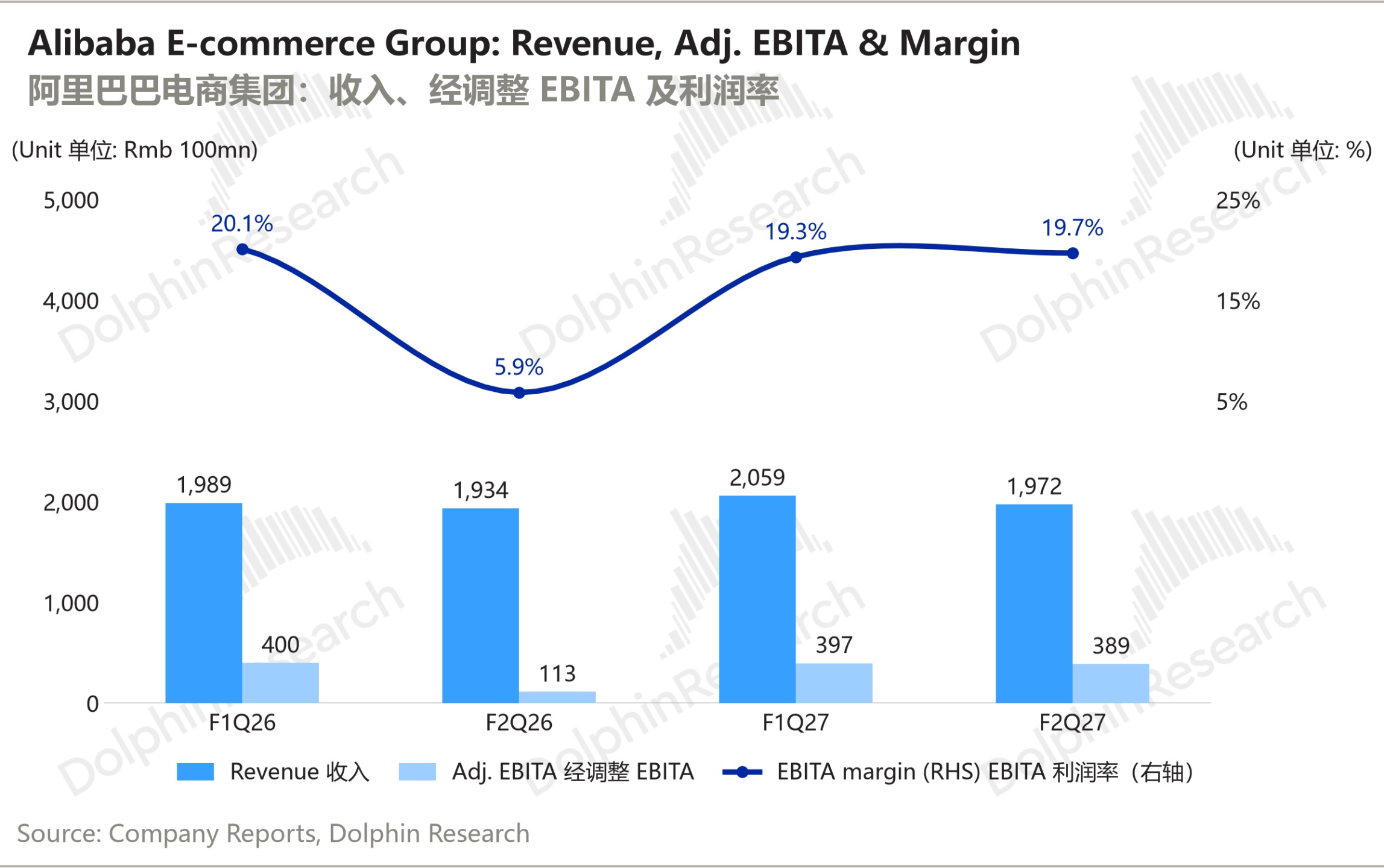
On profitability, Alibaba’s e-com group Adj. EBITA was RMB 38.9 bn, 3.4x last year and largely in line with the Street. The company cited unit economics improvement in delivery and steady growth in far-field e-com as key drivers.
Per company commentary, far-field e-com profit was roughly flat YoY, while Intl showed smaller losses, implying Flash Sales lost around RMB 9.5 bn this quarter, broadly in line with market expectations. Absolute losses narrowed only modestly vs. last quarter’s RMB 10–11 bn range, but given summer peak order volumes, UE per order still improved meaningfully.
Management added on the call: in the Sep quarter, on-demand retail non-restaurant GTV grew 40%+ YoY, with rapid expansion of self-run front warehouses. Delivery UE improved as expected, share was stable, and AOV continued to rise.
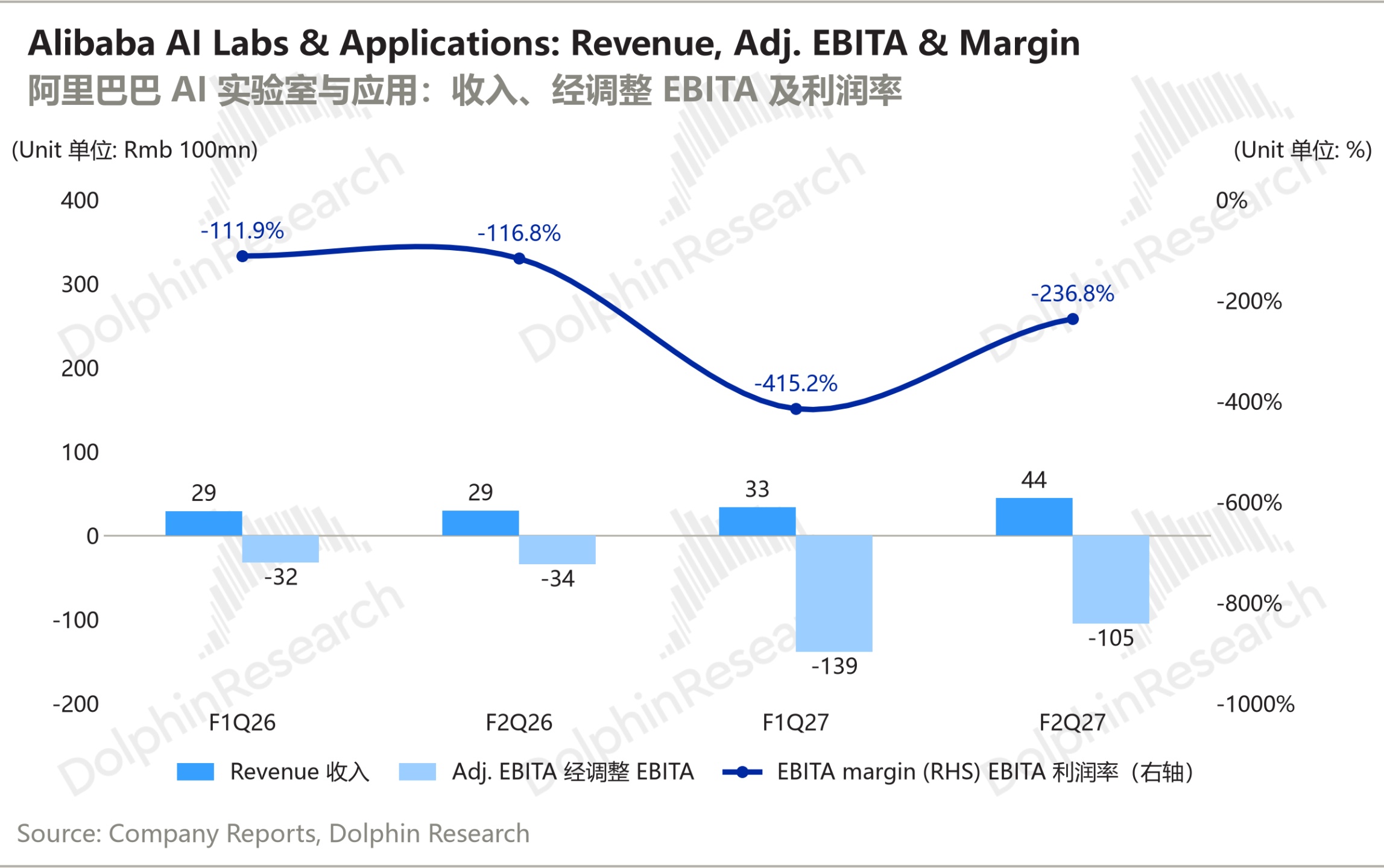
4) AI Lab & Apps: faster revenue, narrower losses
The newly separated AI Lab segment, comprising foundation model R&D and Qwen’s 2B/2C apps, delivered revenue of RMB 4.4 bn (+51% YoY), a sharp acceleration from ~16% last quarter and well ahead of the Street. Segment loss was RMB 10.5 bn, narrower vs. RMB 13.9 bn last quarter.
Accelerating top-line with tightening losses marks a solid trajectory. Management attributed revenue growth to rising enterprise demand for agent products, while the narrower QoQ loss reflected higher training efficiency and better marketing efficiency for the Qwen app.
Third-party data show the Qwen app had 158 mn MAUs in Sept, down vs. Jun. But Qwen Office’s desktop share rose from 15% in Jun to 22% in Sept, indicating B-end adoption is offsetting C-end softness and monetization remains B-led.
5) Capex still elevated; FCF negative but narrowing outflow
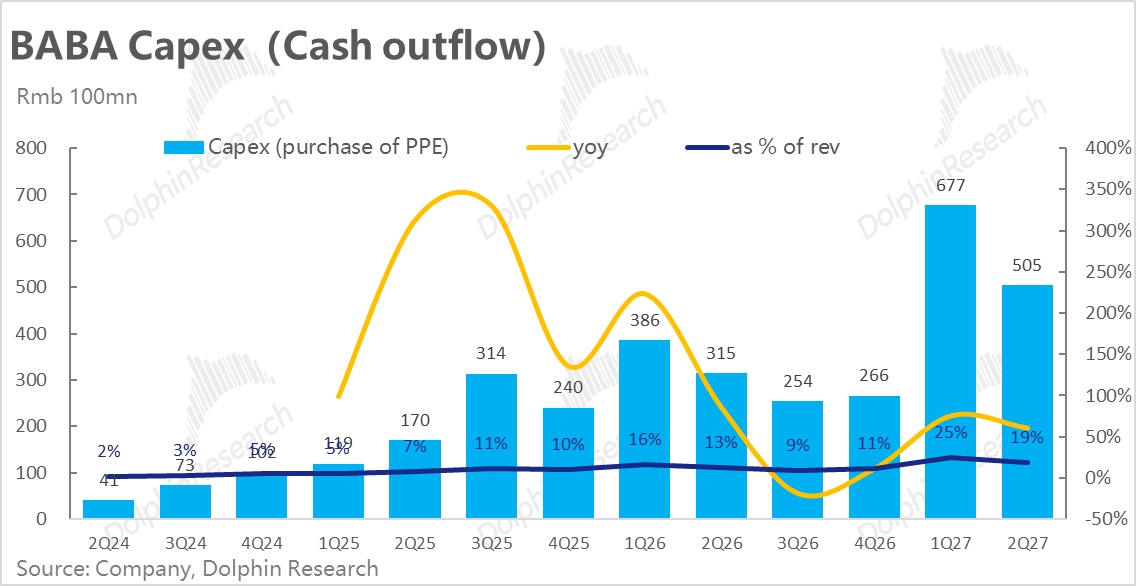
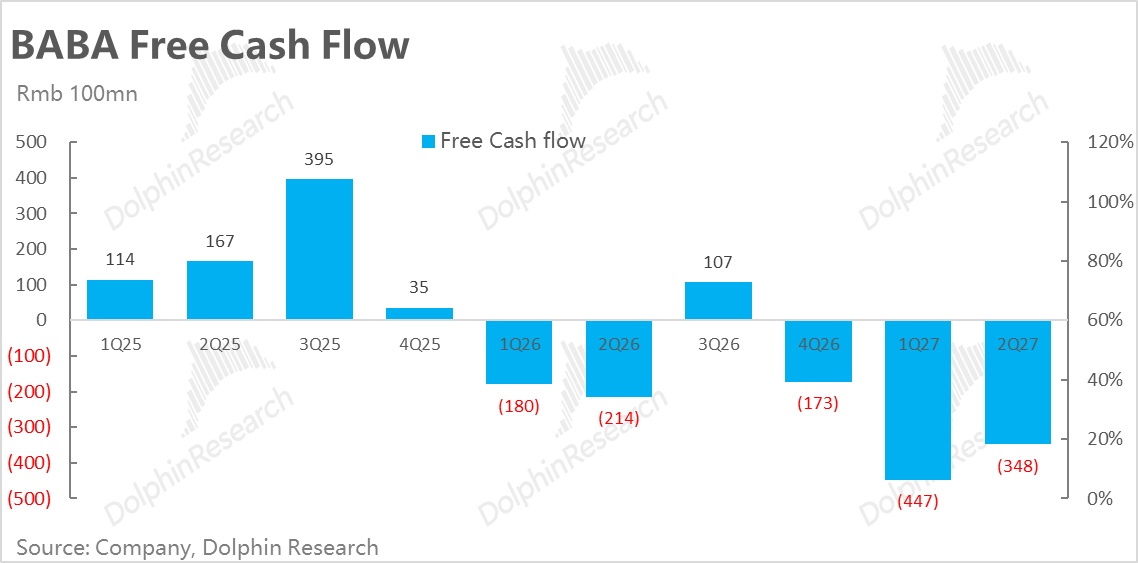
Capex was RMB 50.5 bn, still high but down from RMB 67.7 bn last quarter and below most Street estimates. Operating cash flow was RMB 15.7 bn and FCF was about −RMB 34.5 bn, still negative but narrower QoQ.
Overall, while elevated Capex still pressures cash flow, the margin of pressure is easing. In a market that dislikes perceived spendthrift behavior, lower Capex is not a bad signal.
Management had cautioned last quarter against linearly extrapolating Capex, and reiterated that the QoQ decline mainly reflects procurement cycle swings. Looking ahead, management expects 2027–28 to be the peak investment phase (in-house chip ramp), with overall cash flow turning positive in 2H28.
6) Other segments: Intl e-com dragged by EU customs fines
In other businesses, Intl e-com revenue was RMB 25.7 bn (−8% YoY), primarily weighed by EU customs surcharges, though losses continued to narrow. Global wholesale revenue reached RMB 14.3 bn (+6% YoY), broadly consistent with last quarter and the Street.
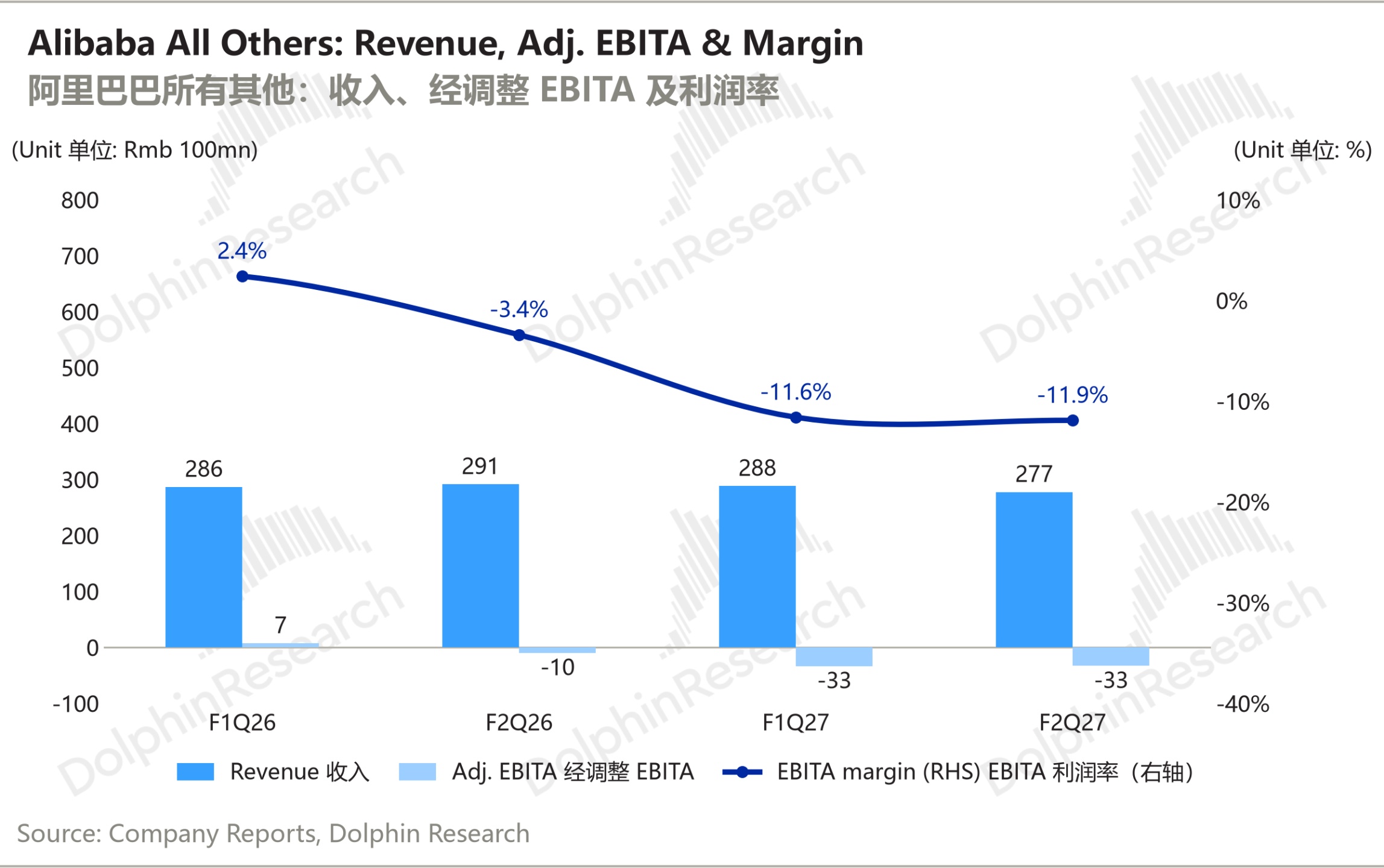
Other businesses including Cainiao, Amap (Gaode) and others posted revenue of RMB 27.7 bn (−5% YoY), mainly dragged by Cainiao. Segment loss was about RMB 3.3 bn, roughly flat QoQ, at least not widening.
7) GP and opex: slight GPM dip; big cut in marketing
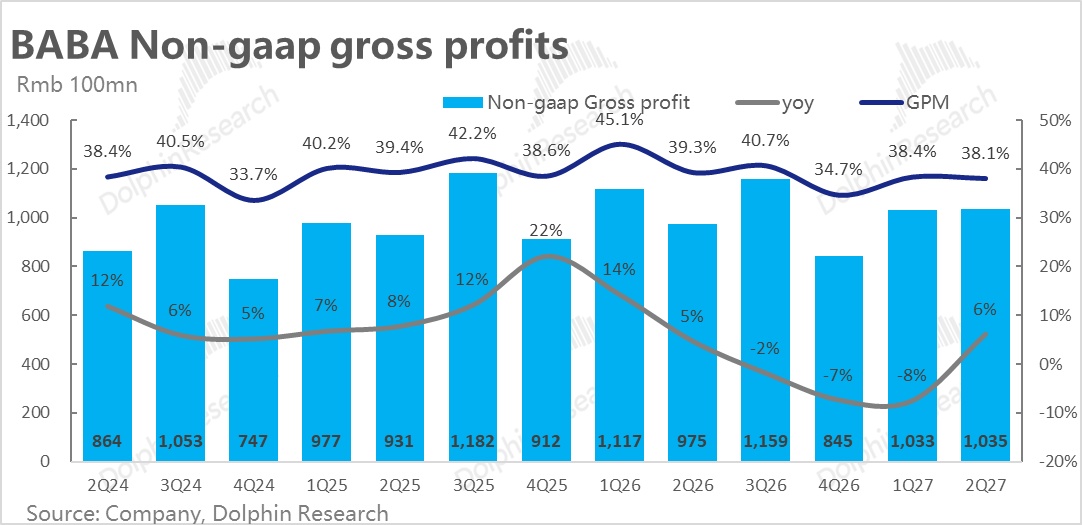
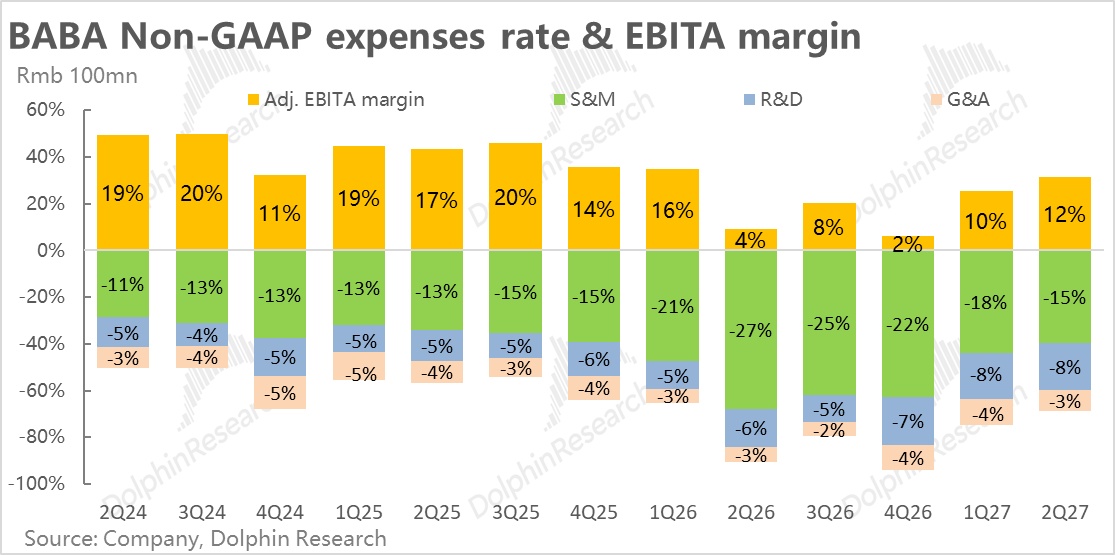
Gross margin was 38.0%, down about 120 bps YoY, mainly due to a higher revenue mix from Cloud and tech as well as revenue offsets tied to new merchant partnership programs. Sales & marketing was RMB 41.3 bn, down meaningfully both YoY and QoQ, with opex ratio −~300 bps QoQ.
This reflects lower spend in delivery and AI apps, and a reclassification of some subsidies from S&M to revenue offsets. R&D was RMB 22.6 bn, up ~32% YoY, unsurprising given continued ramp in AI and other tech investment.
8) Key disclosures; earnings call recap in the link
Dolphin Research views:
1) No major weak spots this quarter, but clouds ahead
On a single-quarter basis, Alibaba delivered a strong print with no major holes. On the AI side, Cloud’s growth and profit both moved higher, and the new AI Lab & Apps showed revenue growth with narrowing losses; on the e-com side, CMR stabilized and profit repair was driven by narrower delivery losses and steady far-field e-com margins.
However, the market focus is not this quarter’s beat. Guidance and medium-term outlook matter more, and both e-com and Cloud/AI face notable challenges.
(1) Cloud & AI: chip choke risks imply lower growth and multiple
Given soft prospects for broad e-com, Cloud and AI are now the main drivers of earnings and valuation. Recent Remote Access and AI Overwatch rules have effectively shut domestic firms out of U.S. chips, creating a real risk that today’s hot Cloud/AI businesses face a severe compute shortfall and a growth cliff.
Ahead of earnings, Dolphin Research published a deep dive assessing the potential loss of compute under the new rules and the possible impact on Alibaba Cloud growth. Key takeaways are summarized below.
a) Post-implementation, Alibaba’s available compute could be 19%–27% below plan, with the heaviest impact in FY27, forcing a trade-off between in-house model training and external commercial demand. From FY29, domestic chip ramp should offset most of the lost capacity.
b) From FY27, T-Head and other domestic chips will take the lion’s share of Alibaba’s incremental compute, with total capacity rising from ~1.4 GW at end-FY26 to 9.5 GW by FY30. c) Assuming internal workloads are prioritized and depending on whether the new rules fully bite in Apr vs. Sept, Alibaba Cloud’s external revenue growth in FY27 could be cut from 50%+ to just ~20%–35%.
In FY28, growth may settle around ~35%–40%. d) Even with internal priority, the inability to access high-performance GPUs like the B-series could still impede iteration of top-tier domestic models.
Two variables will ultimately determine the outcome: the timing and severity of U.S. rule enforcement, and the capacity/performance ramp of domestic chips to fill the gap left by U.S. parts. On the call, management confirmed Dolphin’s expectation to prioritize internal training: post-2027, incremental compute will be mainly in-house chips, first serving internal model training, then key clients.
Management sounded somewhat more upbeat: they expect Cloud revenue growth next year could be guided to 30%–45% (still under assessment, and unclear if this refers to external only). Our base case is more conservative (we assume 80% of overseas compute is cut), so a brighter company view is not surprising. Once domestic compute scales in CY28, growth could re-accelerate to 50%+.
Long-term targets were reiterated: external Cloud revenue of $100 bn and margin above 20% by 2030. That said, management likely cannot precisely gauge future dynamics and will need to adjust as they go.
(2) E-com: drags faded, but growth baseline drifting lower
The two major drags on Alibaba e-com over the past year have mostly passed: delivery losses keep narrowing, and last year’s high base from state subsidies and incremental monetization has been digested. This underpins CMR stabilization and profit repair this quarter.
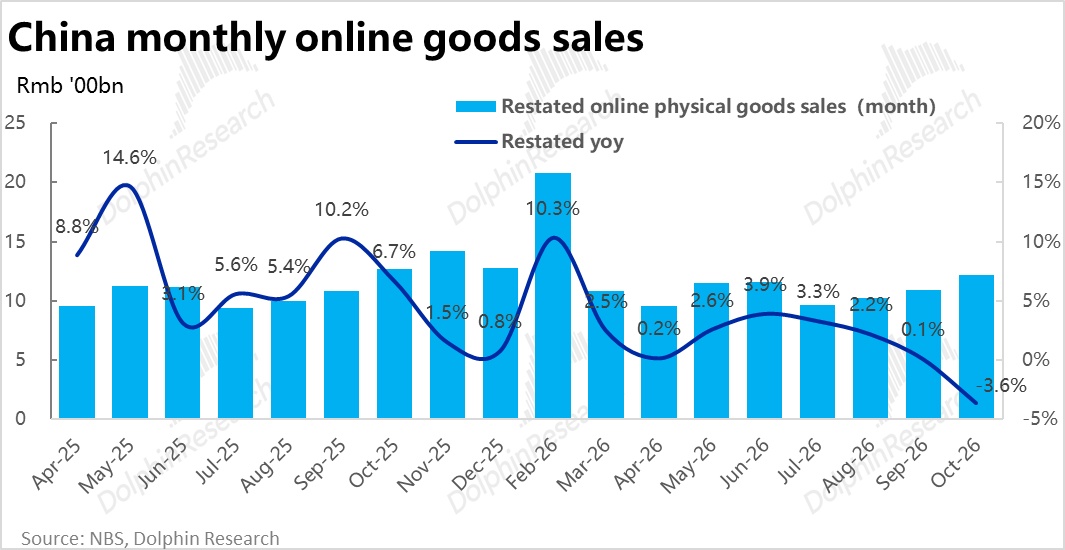
Looking ahead, the challenge shifts from company-specific issues to industry headwinds. Recent retail sales have weakened, with online physical goods also soft: Oct retail sales were +0.4% YoY, online physical goods growth neared zero in Sept and fell 3.6% YoY in Oct.
Moreover, with AI’s capability gains making labor substitution more visible, and corporates tightening belts amid heavy Capex, AI’s impact on employment and household consumption may still be in its early stage. Combining these, Dolphin sees the domestic broad e-com growth baseline trending lower.
For Alibaba, broad e-com is more about stabilization than re-acceleration. A marked upside inflection looks unlikely near term.
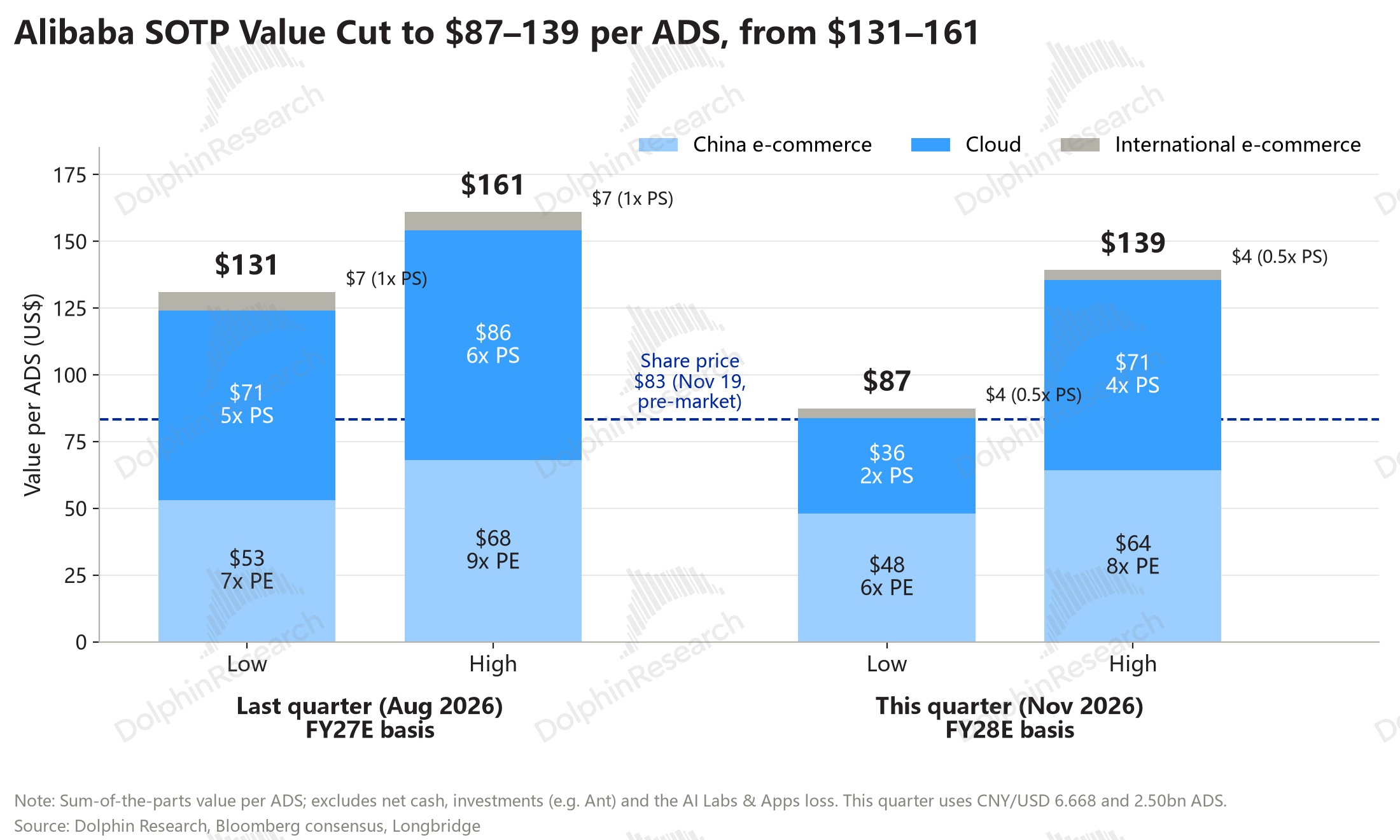
2) Valuation: neutral band cut to $87–$139; shares near the low end
Dolphin continues to use SOTP, rolling to FY28. For the e-com group, given the downward shift in the domestic growth baseline, we model FY28 far-field e-com (ex on-demand) EBITA down ~1.5% YoY to ~RMB 191.0 bn.
On-demand delivery losses fall by half per management cadence to ~RMB 20.0 bn, implying after-tax profit of ~RMB 134.0 bn. We assign 6–8x PE (vs. 7–9x last quarter), or about $48–$64 per share.
For Alibaba Cloud, we keep our base-case under the new rules rather than the more optimistic management view: FY28 revenue of ~RMB 298.0 bn (+~23% YoY). Given slower growth and compute uncertainty, we cut the multiple from 5–6x PS to 2–4x PS; at a 20% LT margin, this equates to ~10–20x PE, or about $36–$71 per share.
Intl e-com is valued at 0.5x FY28 revenue (vs. 1x prior), or about $4 per share. Together, these three core pieces imply a value range of $87–$139.
At ~$83 pre-market on Nov 19, the stock trades ~5% below the low end, with ~67% upside to the high end. Even under our more conservative assumptions vs. management, the current valuation already reflects the potential compute shortfall shock.
Downside from here looks limited on valuation alone. That said, uncertainty remains high: our base case assumes meaningful output from T-Head and other domestic chips, but HBM supply and overseas foundry capacity at Samsung/TSMC could also be constrained.
Whether the expected domestic chip capacity materializes is still uncertain. For higher margin of safety, investors may wait for policy risk visibility to improve before making a call.
<End>
Risk disclosure and statements: Dolphin Research Disclaimer and General Disclosures
Past Dolphin Research on [Alibaba]:
Earnings season:
Aug 21, 2026 read-through ‘Alibaba’s heavy AI spend: building the China Google?’
Aug 20, 2026 call recap ‘Alibaba (Trans): AI Capex payback in 3 years’
May 14, 2026 call recap ‘Alibaba (Trans): e-com stabilizes, AI goes all-in’
May 14, 2026 read-through ‘Bleeding for AI surge?’
Mar 19, 2026 call recap ‘Alibaba (Trans): Flash Sales RMB 1 tn in 2 years; AI + Cloud RMB 700 bn in 5 years’
Mar 19, 2026 read-through ‘E-com under pressure; AI is the savior’
Hot topics:
Nov 19, 2026 ‘BIS rules ‘choke’ overseas compute: can Alibaba Cloud sustain high growth?’
Aug 24, 2026 ‘Alibaba’s $8 bn financing: market pays for delivery subsidies, AI is the real future?’