

SE (Trans): Shopee profit flat in 2026?---
Below is Dolphin Research's Trans of $Sea.US FY25 Q4 earnings call. For the earnings take, see 'SEA: Crazy cash burn for future — is Southeast Asia's mini Tencent falling into a new pit?'.
1) Key Results Recap
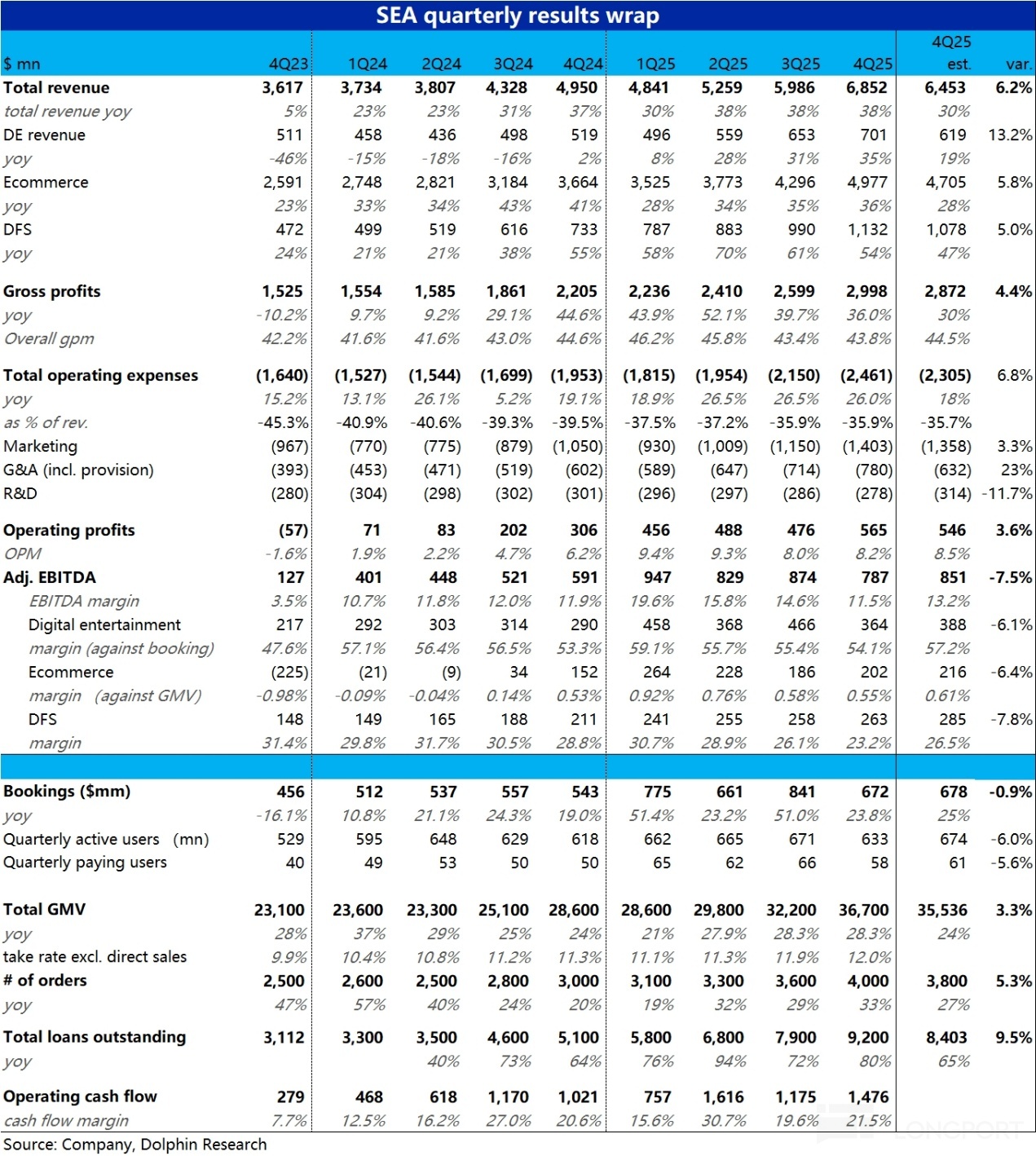
Details from the Earnings Call
2.1 Management Highlights
1) Strategy & Outlook
Success in 2025 stemmed from choosing the right strategy and executing well. We will carry this through 2026 with the same strategy, doubling down on operational excellence to drive strong growth with healthy profits.
2) Shopee Progress & Outlook
2025 review: We drove strong GMV growth and improved profitability via better discovery, category expansion, and broader logistics coverage. Monetization strengthened, with take rate up over 80bps YoY and ad revenue up more than 20% YoY.
2026 goals & strategy: Target approx. 25% YoY GMV growth, with full-year Adj. EBITDA not below 2025. This is designed to optimize long-term profitability. Investment areas: continue investing in logistics, Shopee VIP, and the content ecosystem to serve more users and deepen engagement.
Key differentiators:
SPX Express handles over 30 mn parcels per day, with ongoing speed and cost efficiency gains. We are expanding instant/same-day delivery (basket sizing approx. 15% higher) and economy shipping. Fulfillment services have rolled out in multiple markets, and we aim to double fulfillment order penetration by end-2026.
Shopee VIP: now live across all Asian markets, with more than 7 mn subscribers at year end. VIP members spend significantly more (approx. +30% to +40%), and in some markets contribute over 15% of GMV. We plan to launch in Brazil in the coming months.
Content ecosystem: deeper partnerships with YouTube (orders up 3x YoY) and Meta (over 3 mn affiliate-linked accounts). These efforts make product discovery more engaging.
Focus markets:
Taiwan: a large Shopee pickup network (over 2,800 points) adds convenience, lowers cost, and reinforces market leadership. This enhances both customer experience and unit economics.
Brazil: our fastest-growing market in 2025, delivering strong GMV growth and share gains while remaining profitable. Low-cost structure and fast delivery attracted new brands (Shopee Mall GMV more than doubled); in 2026, we will accelerate fulfillment capabilities to serve more high-value categories and lift basket size. We see durable momentum as we scale.
Thailand: GMV growth accelerated to double digits. Shopee has become the clear e‑commerce leader.
3) SeaMoney Progress & Outlook
2025 growth drivers:
New user acquisition: pivoted to broader applications including BNPL and personal cash-flow products, adding sizable cohorts with positive unit economics. This supported high-quality growth.
Deeper engagement: higher limits, longer tenors, and differentiated pricing for prime users; avg. outstanding loan per user rose 27% YoY to approx. $240. We continue to refine segmentation and pricing.
Use-case expansion: extended credit beyond Shopee into offline scenarios (e.g., integration with national QR systems; electronics and two-wheelers). Offline SPayLater grew 300%+ YoY, now over 15% of BNPL loans (Malaysia near 30% outside shopping).
Risk management: 90-day NPL ratio held at 1.1%. Credit performance remains resilient.
Outlook: many initiatives are still early, leaving sizable runway. We are also making progress in non-credit offerings such as digital banking and insurance, and expect SeaMoney to be a key long-term profit contributor.
4) Garena Progress & Outlook
2025 review: bookings rose 37% YoY, driven mainly by Free Fire. Free Fire delivered >30% bookings growth for two consecutive years, with DAUs still up YoY at very large scale.
Why Free Fire works: continued high-impact content and collabs (e.g., with 'Naruto Shippuden') bring communities together; esports saw strong engagement with a large global finals. These results reflect long-term planning and disciplined execution started over two years ago.
Portfolio updates:
EA Sports FC mobile: strong performance since the Oct launch, among the most downloaded mobile games. Localized fan events showcased our ability to localize global brands.
Delta Force: the new title shows solid momentum. We will keep building the pipeline.
Outlook: foundations are set for the next phase of Free Fire, including growth into 2027. Garena enters 2026 with strong momentum and will continue delivering high-quality content and experiences to its global player community.
2.2 Q&A
Q: For Shopee, how will you deliver approx. 25% GMV growth in 2026 while keeping EBITDA in absolute terms not below 2025? What are your assumptions on competition? Where will you invest and over what cycles?
A: Our 2026 growth plan centers on increasing wallet share of core users and expanding the buyer base. We will invest across several areas to drive this: first, continuously upgrading logistics, improving speed and reliability, expanding instant/same-day, and building a larger fulfillment network to enable forward stocking, shortening delivery times and improving service reliability.
Second, we will deepen the VIP program, not only by improving native services but also by partnering with OpenAI and ChatGPT to offer VIP-only benefits that lift wallet share. We will keep rolling out pricing initiatives to maintain price competitiveness.
Additionally, the content ecosystem is a key focus, now already over 20% of GMV and still rising. We will deepen collaboration with YouTube and Facebook, and explore more external content providers.
These investments are cyclical in nature: building fulfillment, expanding instant fleets, and scaling VIP take upfront costs, but then optimize the cost structure. On profitability, EBITDA margin improved YoY in Q4 2025, and we expect margin expansion by end-2026, maintaining a long-term trajectory toward 2%–3% EBITDA margin.
On competition, most markets look relatively stable, with no material change vs. last quarter. We will stay disciplined and focused on ROI.
Q: SeaMoney's loan book grew over 80% YoY by year end. What drove that, and how do you view 2026 growth and EBITDA margin trends?
A: Multiple factors: different markets are at different stages, with earlier markets like Indonesia leading; Taiwan and Malaysia are in catch-up mode; and our newest market, Brazil, is also in a high-growth phase. This staggered rollout supports sustained growth.
Second, product expansion: most markets started with BNPL, then added personal cash loans. Even within BNPL, we introduced differentiated products for higher-income segments with longer tenors and slightly lower rates, leaving ample room to grow.
Penetration continues to rise both on and off Shopee; for example, offline BNPL in Malaysia is already about 30% of its total. On margins, quarterly fluctuations will reflect market mix, product mix, and acquisition pace, but the foundation is stable risk management, evidenced by steady NPLs.
We keep upgrading models, leveraging AI on long-sequence data and ecommerce signals to reach previously underserved users, enabling prudent portfolio growth. We remain focused on quality and returns.
Q: For Shopee, you outlined multiple investment areas. How long are these cycles, how should we think about 2027 margins, and when will deeper AI collaboration with Google show up in product?
A: Cycles vary by project and market, so it is hard to generalize. Our priority is to ensure 2026 EBITDA in absolute terms exceeds 2025. On margin levels, we believe full-year margins in 2026 and beyond will not be worse than Q4 2025 and should rise year by year.
While we have not provided 2027 guidance, the long-term 2%–3% EBITDA margin target is achievable, depending on our balance between growth and profit levers. The Google collaboration is still in product development; we do not expect it to take long, and will share when ready. This extends our longstanding work with Google Shopping, Google Ads, and YouTube.
Q: For Garena, what's the bookings growth outlook for 2026, and any new IP collabs to share?
Garena is currently expected to deliver double-digit growth in 2026. On IP, encouraged by the success with 'Naruto', we plan to continue IP collabs, with the next one tentatively slated for Q3 based on the current timeline. We are also actively discussing other potential IPs.
In addition, with the World Cup year, the global overlap between football and gaming communities is high. We will roll out extensive football-related promotions during the World Cup.
Q: For Shopee VIP, can you share retention and renewal metrics? How does VIP affect purchase frequency and category mix? Any cross-country behavioral differences, and how do they impact strategy?
A: The VIP program grew significantly in recent months, with VIPs contributing over 15% of GMV in some markets; we believe this can double or even triple over time. Retention is healthy. Historically, a key regional challenge was renewal payment success given low credit card penetration; tight collaboration between Shopee and SeaMoney has streamlined payments and resolved this.
In Indonesia, renewal rates have improved from 40% to 70% over recent quarters, a major step in sustaining VIP cohorts. VIPs purchase more frequently and often with higher basket sizes, spending 30%–40% more than non-VIPs overall. Behavior is broadly similar across markets, with differences mainly in local preferences, so we tailor VIP benefits to each market.
Q: On AI, how do you prioritize investments between ecommerce and AI, and how do you leverage synergies across the three businesses to strengthen moats and ecosystem value?
A: SeaMoney is already very profitable, with most new-user growth initiatives showing positive LTV and positive ROI on each investment. In ecommerce, we invest heavily in AI with clear ROI, notably in search, recommendations, and ads, which have lifted ad take rate.
That includes AI-generated product descriptions for better understanding, expanded user queries to capture intent, and recently launched multimodal search where users search with images plus long text. We also deploy AI tools for sellers, including customizable AI chatbots to cut staffing costs and improve conversion, and tools to create product videos and copy, all delivering attractive ROI to the ecosystem.
On synergies, there is substantial interplay between ecommerce and financial services. Financial services leverage Shopee behavioral data for risk assessment, and SeaMoney has significant room to penetrate the Shopee base beyond credit into banking, insurance, and payments. SeaMoney payments also support Garena, while Shopee collaborates with Garena on merchandising and user acquisition.
Q: In Brazil, with increased fulfillment investments, will GMV growth accelerate this year? How will this impact basket size? Is our basket still about one-third of the market leader, and how much gap can fulfillment close?
A: Brazil delivered very high growth in 2025, and we expect that to continue in 2026. We do not provide country-specific growth guidance, but overall we see healthy growth, and we believe Brazil will outgrow the group average. Basket size should rise over time; while a gap with competitors will remain, it should gradually narrow.
Q: What is Shopee PayLater's penetration in Brazil today, and will it rise meaningfully this year?
BNPL penetration in Brazil remains very early, despite significant growth, similar to early-stage penetration in other markets. We expect Brazil's BNPL penetration to keep rising in 2026, in line with trends in Asian markets.
Q: On the content ecosystem in ASEAN, when do you see content commerce reaching a plateau? How do our unit economics compare to shelf-based ecommerce? What's the market share trend?
We do not think content commerce has plateaued on our platform; there is room for further growth over the next few quarters. Unit economics have improved steadily for years; while there can be minor quarterly fluctuations, the trend is up.
The gap in unit economics between content commerce and shelf-based ecommerce is narrowing over time. We expect them to be broadly similar eventually.
<End of text>
Risk Disclosure & Statement:Dolphin Research disclaimer and general disclosure
