

Meituan: Three Headwinds — Will Food Delivery Stay Down? ---

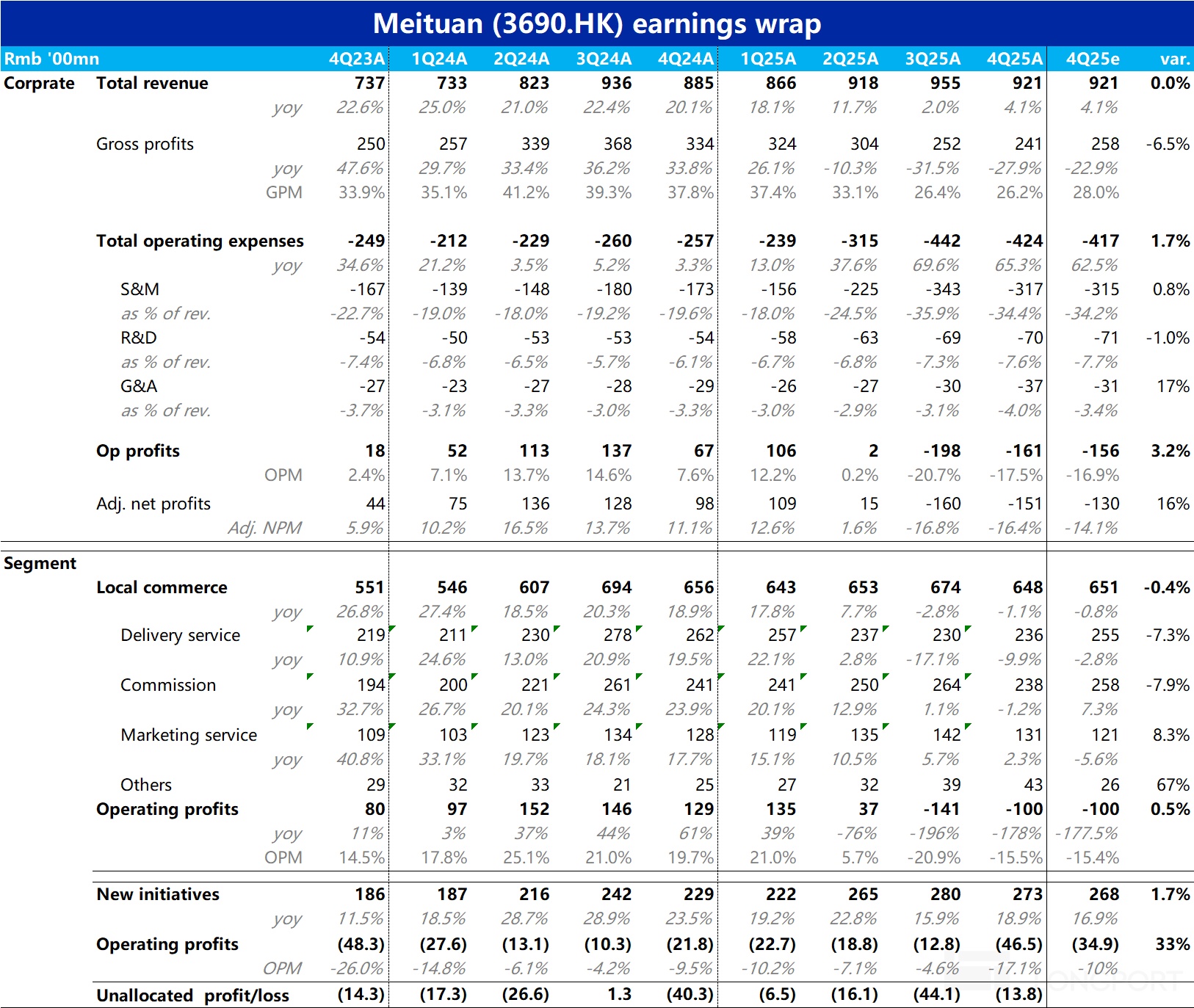
After the Mar 26 HK close, the last major name in the Hang Seng Tech 'food-delivery cohort'—$MEITUAN(03690.HK)—released its Q4 FY25 results. With a prior profit warning in place, losses at Core Local Commerce and the group level were largely flagged and came in broadly in line. However, underlying profit was softer than expected as wider losses in New Biz offset most of the savings from narrowed losses in Core Local Commerce, specifically:
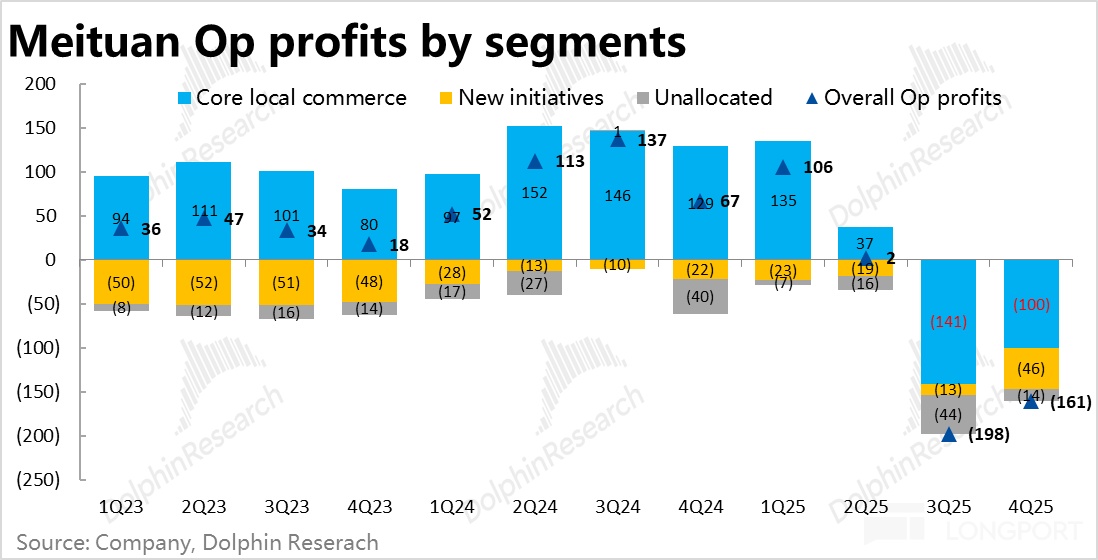
1) Savings given back via wider New Biz losses: Starting with the headline issue, Core Local Commerce OP loss was about RMB 10 bn this quarter, in line with guidance. On Dolphin Research estimates, in-store OP was ~RMB 4.2 bn, implying total at-home (food delivery + on-demand retail) losses slightly above RMB 14 bn, an improvement of less than RMB 5 bn QoQ.
As expected, all players in the delivery battle are cutting losses, but Meituan’s absolute reduction was smaller than Alibaba’s QoQ improvement of RMB 11 bn+. Based on our math, Meituan’s per-order UE loss for delivery + flash commerce narrowed from ~RMB 2.5 to ~RMB 2.0, while Alibaba’s went from just over RMB 5 to around RMB 3.5 per order, indicating a shrinking gap that is a mixed signal for Meituan.
However, New Biz losses jumped to RMB 4.6 bn, well above the market’s ~RMB 3.5 bn expectation and roughly RMB 3.4 bn wider QoQ. As a result, most of the narrowing in Core Local Commerce losses was given back by New Biz.
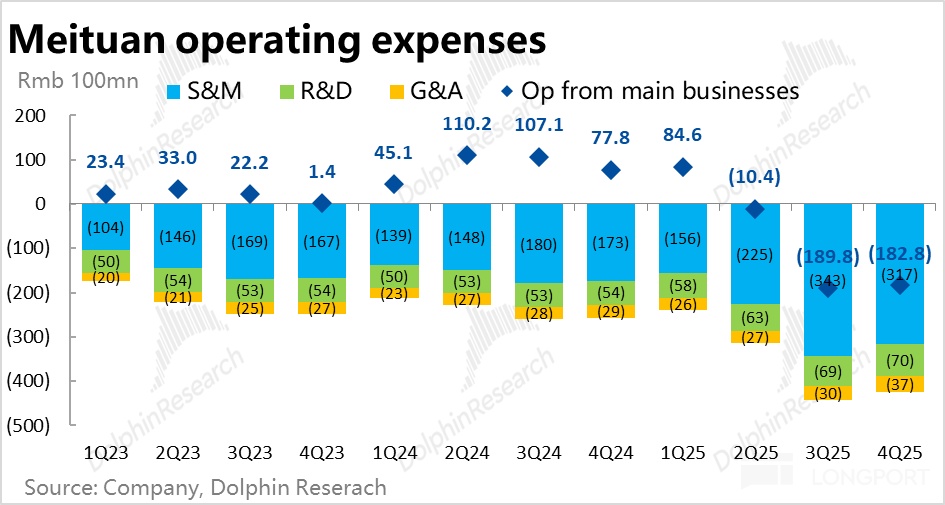
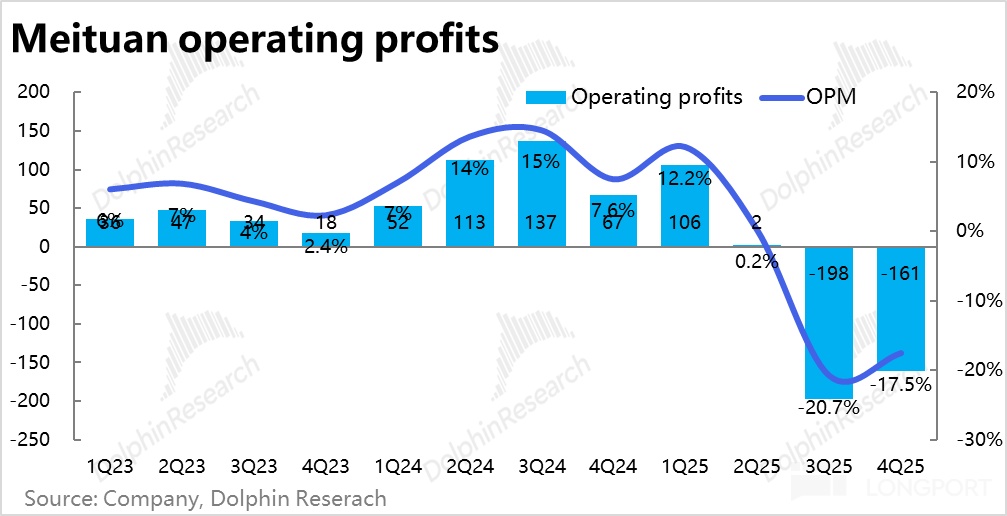
Despite higher-than-expected New Biz losses, group OP roughly matched street estimates due to ~RMB 2.2 bn gains from changes in financial assets and other non-operating items this quarter. On a core basis (GP less operating opex), losses were close to RMB 18.3 bn vs. ~RMB 19.0 bn last quarter, implying only limited improvement.
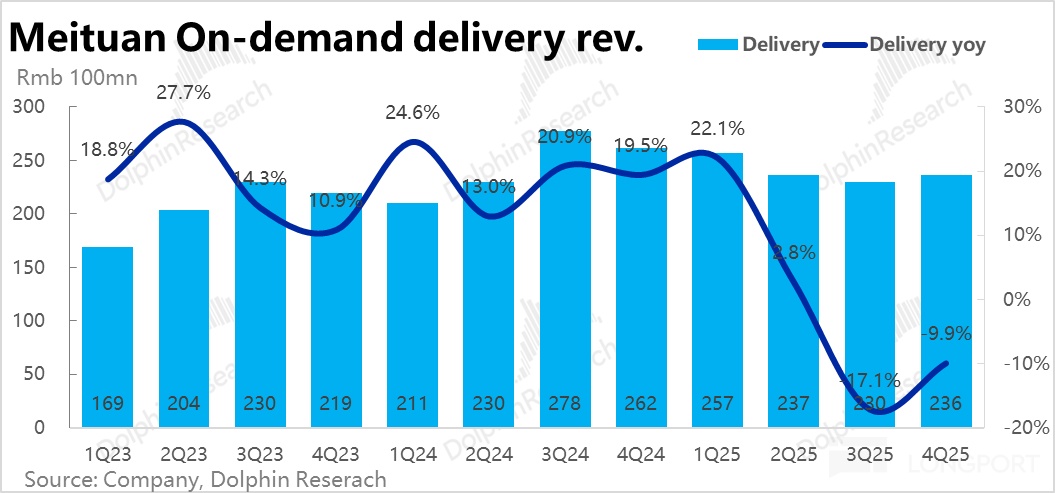
2) At-home past the worst; in-store still in a trough: Delivery-linked revenue, tightly tied to at-home, saw its YoY decline narrow to ~10% from 17% last quarter. This points to a reduced drag from freight subsidies booked as revenue offsets, consistent with lower investment and narrowing losses across delivery.
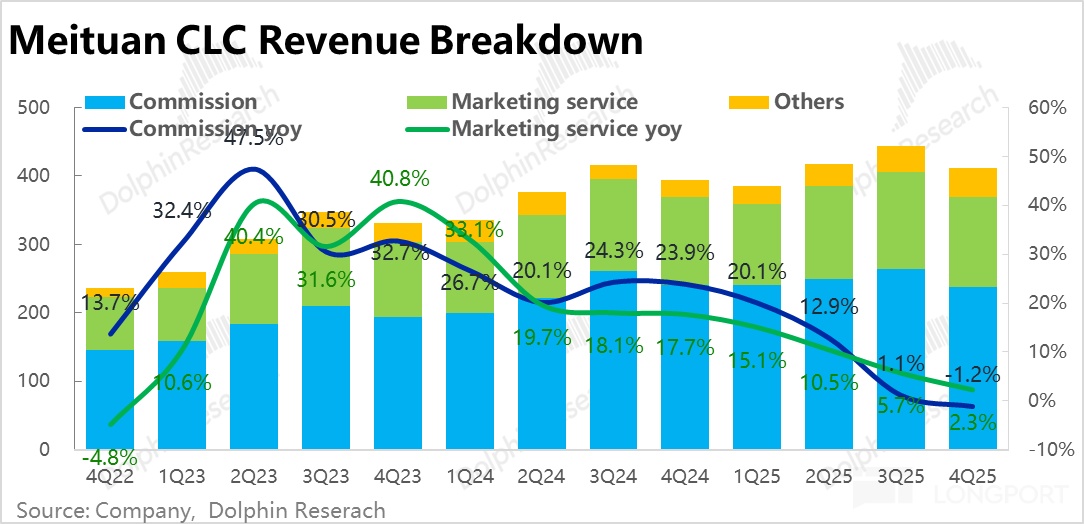
Unlike at-home’s bottoming and partial rebound, commission and advertising growth kept slowing, with commission turning down 1.2% and ad growth easing from 5.7% to 2.3%. Management also indicated that as in-store GTV growth slowed in Q4, revenue growth would lag GTV, implying a continued decline in blended monetization.
Coupled with Douyin’s renewed in-store push (reported GTV growth 60%+), competition is meaningful for Meituan’s in-store. Even so, Core Local Commerce revenue (in-store + at-home) was RMB 64.8 bn, down 1.1% YoY and broadly in line with Bloomberg consensus, suggesting the in-store deceleration sat within market expectations.
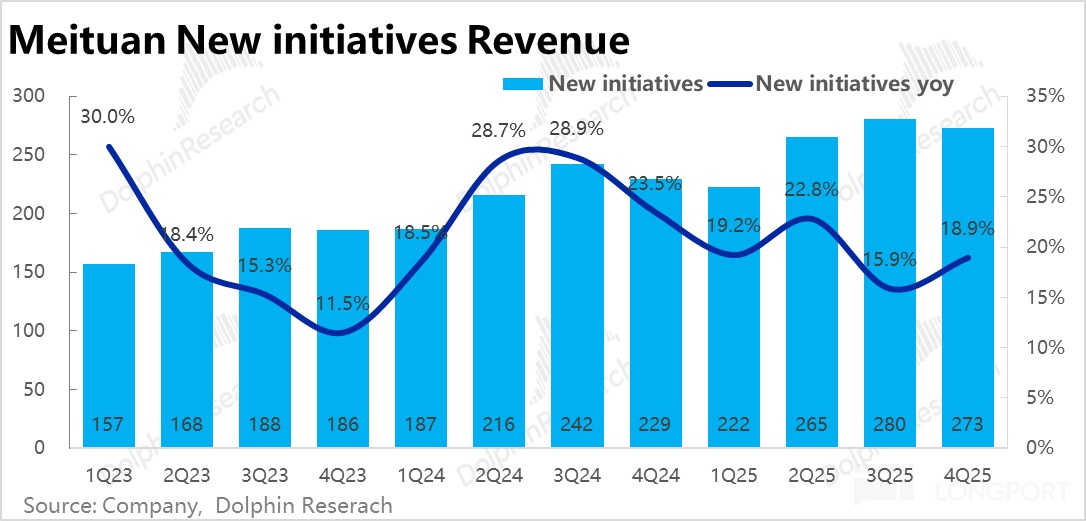
4) New Biz growth re-accelerates, Keeta ramping: New Biz revenue growth accelerated to 19% YoY vs. 16% in Q3. Within that, commission-based revenue rose ~115% YoY while self-operated revenue growth ticked up to ~15%, pointing to strong traction for Keeta in the Middle East and LatAm, which also aligns with the wider New Biz losses this quarter.
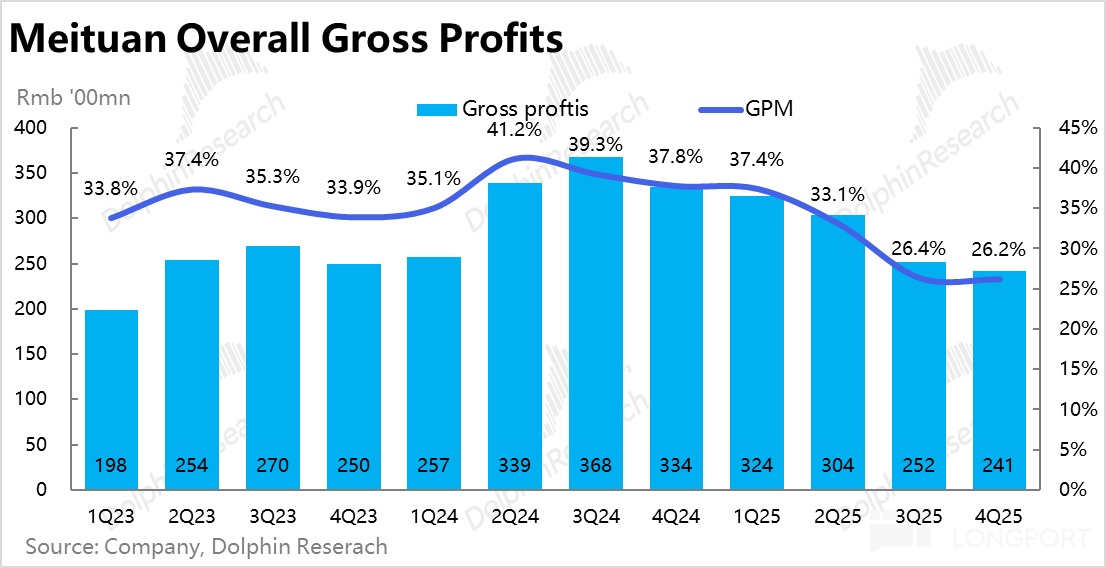
5) GP and opex view: GPM was just 26.2%. Even with a narrower impact from delivery subsidies, GPM still fell by ~20 bps QoQ, likely on winter seasonality and New Biz drag.
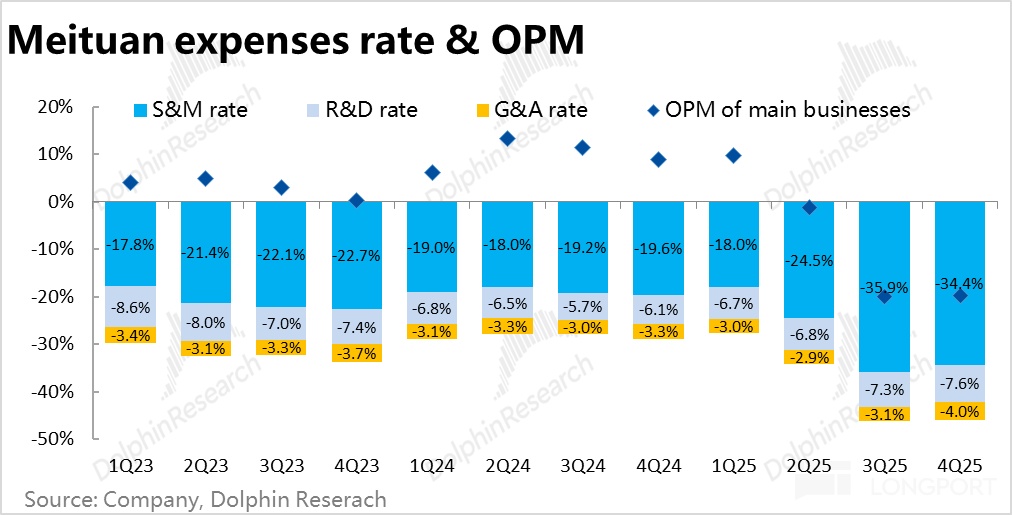
On costs, total opex was ~RMB 42.4 bn, up 65% YoY and broadly in line with the street. Marketing expense was RMB 31.7 bn, down ~RMB 2.5 bn QoQ, clearly reflecting reduced delivery subsidies.
R&D and G&A rose 30% and 24% YoY, likely due to AI feature investment and Keeta’s expansion. Overall, given sizable losses, spending did not look restrained, and group losses therefore did not narrow much.
Dolphin Research view:
Given the earlier profit warning, the quarter held few surprises aside from larger New Biz losses; most metrics were in line with the street. Overall, this reads as a neutral-to-slightly-weak print with some blemishes.
Beyond the expectation gap, the quarter signals several trends. First, on at-home, Meituan is cutting losses in step with peers, and per-order UE loss narrowing to ~RMB 2 is broadly as expected.
Second, while loss-cutting is positive for all, Alibaba narrowed losses faster and the UE gap with Meituan is closing, raising the question of whether Alibaba can sustain a longer battle in on-demand retail. Third, Meituan is effectively fighting on two fronts as in-store GTV growth has been slowing, revenue growth lags GTV, and in-store OPM keeps falling, reflecting Douyin’s renewed push and likely YoY profit pressure.
Fourth, driven mainly by Keeta, New Biz losses widened even as the core remains deeply loss-making with only marginal improvement, suggesting Meituan’s investment stance is not conservative. All in, Meituan faces significant internal and external challenges; the aggressive investment may show resolve, but it is hardly comforting from a shareholder’s perspective.
2) Outlook and trendlines:
1) On-demand retail competition: The clear trend is that all three delivery contestants are optimizing subsidies and UE, with total losses narrowing. This broad trajectory of loss reduction is highly likely to continue.
The debate is how fast and by what path loss reduction will occur, and where UE will settle in equilibrium. On this issue, public stances diverge.
a. From the company angle, Alibaba’s tone has been firm. It previously targeted No.1 share in on-demand retail, later slightly softening but still calling it a long-term strategic focus and guiding to break-even again by FY29 in on-demand retail.
This implies Alibaba is not in a rush to cut losses and will keep investing with a tilt toward share and scale. Meituan would prefer an earlier truce, but the power to end the battle proactively sits more with Alibaba than Meituan.
b. Another actor that could theoretically end the fight is the regulator. Recent commentary from authorities has criticized wasteful price wars and unhealthy competition, pointing to a clear inclination that the delivery war should at least cool down.
c. That said, beyond guiding tone and public opinion, the odds of a hard administrative stop to delivery subsidies are low in our view. Authorities mainly target predatory promotions like near-free offers, compulsory merchant participation, or practices that harm merchants’ economics.
They lack the mandate or incentive to halt normal, voluntary platform subsidies, so regulation may accelerate subsidy normalization but is unlikely to end competition structurally. Therefore, subsidies and losses are likely to remain a drag for participants for an extended period.
d. Crucially, Alibaba has motives to sustain a protracted contest. On-demand retail is both offense and defense; not doing it risks near-field encroachment by Meituan, and walking away after heavy investment and share gains to revert to a 70:30 split is unlikely absent major pressure.
Moreover, delivery investment links to far- and near-field retail, at-home and in-store, and AI Agent-enabled fulfillment, making it more than simply stopping delivery subsidies. Our take: subsidies and losses will keep narrowing but largely through participants’ self-optimization, not sudden regulatory edicts, implying a drawn-out normalization path.
2) In-store is not risk-free either: Beyond delivery, Meituan faces intensifying competition from Douyin in in-store. A clear sign is Douyin’s launch of a standalone in-store app, Dou Shengsheng, which blurs the traditional flow/grass-seeding vs. search/transaction divide and directly targets Meituan/Dianping’s search-led stronghold.
Survey work suggests Douyin’s in-store GTV grew 60% YoY in Q4 vs. 50% in Q3, with a 2026 target of at least ~30% growth. Research also indicates Douyin’s 2026 in-store focus is on scale and merchant monetization rather than profit.
This suggests 2026 will be an investment-led expansion year for Douyin in-store, aiming to capture share and merchant ad budgets. For Meituan, pressure on the in-store battlefield will likely persist.
3) For New Biz, media reports indicate Keeta’s overseas rollout is rapid, now in five Middle East markets (Saudi Arabia, UAE, Kuwait, Qatar, Bahrain) and recently moving into LatAm led by Brazil, entering a high-growth phase.
However, Middle East operations could face disruptions from regional tensions, and reports suggest Brazil’s incumbent iFood’s deep merchant ties may pose headwinds for Keeta. Visibility remains limited, and we await clearer guidance from management.
That said, management’s spending stance appears unrestrained given this quarter’s signals and the >US$700 mn purchase of Dingdong, suggesting New Biz losses may not narrow meaningfully in the near term.
4) On valuation, near-term loss-cutting speed matters less than the steady-state UE level. With per-order loss at RMB 2.5 vs. RMB 0.5 still unvalued in DCF-like terms, the key is the new UE equilibrium post-stabilization, so we frame scenarios instead.
In a conservative case, assume Alibaba keeps tight share parity while joint subsidy retreat removes ‘bubble orders’ and offsets natural order growth, keeping daily orders at ~80 mn. With per-order profit at RMB 0.5, at-home OP would be ~RMB 14.6 bn.
Given in-store faces Douyin’s heavy competition, assume FY26 revenue growth within 15% and a slight margin decline, implying ~RMB 20 bn OP. After tax and at 12x PE, we get HKD 65/sh (HKD 76 without tax).
In a base-to-bull case, assume steady-state at-home orders +15% vs. now in ~two years, per-order UE back to RMB 1, and in-store unchanged, for ~RMB 53.5 bn total OP. At 15x PE post-tax, fair value is ~HKD 127/sh, implying ~46% upside vs. pre-print levels.
Overall, since regulatory signaling is unlikely to end the delivery tug-of-war, in-store faces Douyin’s offensive, and New Biz investments may keep losses elevated, a durable re-rating likely awaits clearer signs of delivery breakeven. Any shift toward the mid-to-bull case may be more sentiment-driven and hard to sustain near term.
Detailed takeaways from the results:
I. Delivery revenue decline narrowed—i.e., smaller delivery subsidy drag
Delivery-linked revenue, tied to at-home (delivery + flash commerce), saw its YoY decline narrow from 17% to ~10% this quarter. As noted last quarter, rider subsidies are netted against revenue, and with street order-growth assumptions, implied per-order delivery revenue decline narrowed from ~40% YoY to ~30% (for reference only).
II. In-store growth keeps slowing—still crossing the valley
Unlike delivery revenue’s bottoming, commission and ad revenue growth in Local Commerce kept worsening, with commission down 1.2% and ad growth dropping to 2.3% from 5.7%. Given at-home’s drag likely eased this quarter, the incremental slowdown points to weaker in-store momentum.
Management has noted in-store GTV growth is slowing (partly on a higher base) and revenue growth lags GTV, implying declining blended monetization. Combined with strong Q4 growth for Douyin in-store (GTV 60%+), this corroborates rising competition as a negative signal.
Still, Core Local Commerce revenue (in-store + at-home) was RMB 64.8 bn, -1.1% YoY and broadly in line with Bloomberg consensus, indicating the slowdown was largely anticipated.
III. New Biz growth accelerates—Keeta looks solid
New Biz revenue was RMB 27.3 bn, with YoY growth accelerating to 19%. Despite Meituan largely exiting community group-buying (Meituan Youxuan), revenue still accelerated, pointing to robust Keeta growth in the Middle East and LatAm, with Xiaoxiang Supermarket also contributing.
Other revenue within New Biz (mainly gross-sales-based businesses like Xiaoxiang Supermarket) saw growth tick up to ~15% YoY, while commission-based revenue (reflecting Keeta and similar) surged ~115% YoY, consistent with Keeta-led growth and wider New Biz losses.
IV. Delivery loss cuts fund New Biz—Meituan still searching for the second curve
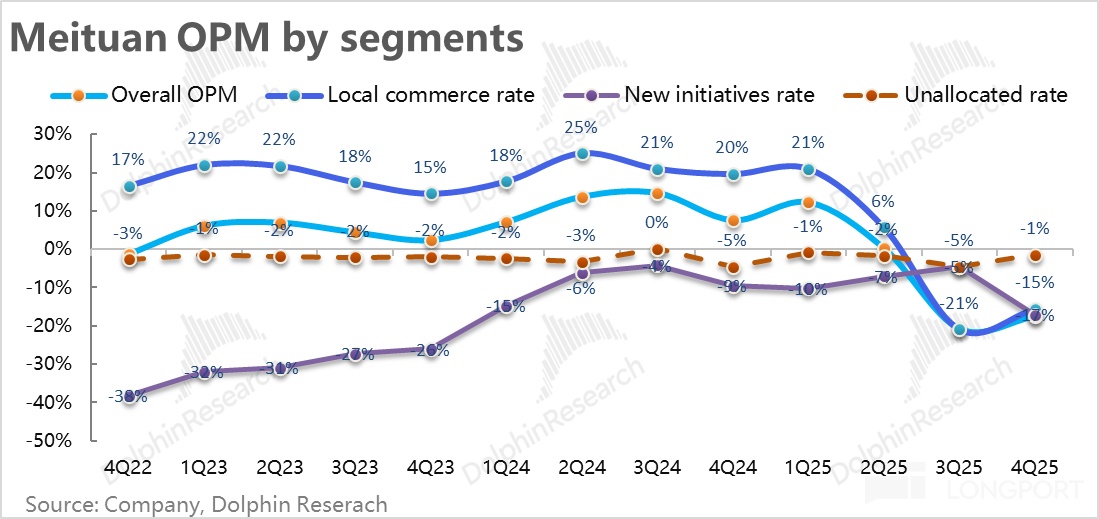
Per prior guidance, Core Local Commerce OP loss was ~RMB 10 bn this quarter, in line with the warning. With in-store revenue growth slowing and margins slipping, we estimate in-store OP at ~RMB 4.2 bn this quarter.
This implies total at-home losses of ~RMB 14 bn+, an improvement of less than RMB 5 bn QoQ. Both Alibaba and Meituan are indeed cutting losses, though Meituan’s absolute reduction is smaller than Alibaba’s ~RMB 11 bn+ QoQ, which is not surprising.
On our math, Meituan’s per-order loss for delivery + flash commerce narrowed from ~RMB 2.5 to ~RMB 2.0, while Alibaba’s fell from just over RMB 5 to ~RMB 3.5–3.6. In absolute and relative terms (gap from RMB 2.5 to ~RMB 1.5; ratio from >2x to ~1.8x), the gap is narrowing.
As both sides cut absolute losses, the UE gap is also shrinking, which is a two-sided signal for Meituan. In addition, New Biz losses rose above expectations, leaving group profit a bit below where it could have been, with New Biz at RMB 4.6 bn vs. ~RMB 1.3 bn last quarter and ~RMB 3.5 bn expected, roughly RMB 3.4 bn worse QoQ.
Hence, most of the savings in Core Local Commerce were offset by New Biz again. Also note the unallocated loss of ~RMB 1.4 bn looked narrower QoQ largely due to ~RMB 2.2 bn gains from revaluation of financial assets and other items this quarter.
V. GPM dip narrowed; spending not restrained
From the cost and expense lens, underlying profitability was also a touch below expectations. GPM was only 26.2%; despite a smaller subsidy impact from delivery, GPM still fell ~20 bps QoQ, with winter seasonality also a factor, driving GP down nearly 28% YoY and notably below market expectations.
Total opex was ~RMB 42.4 bn, +65% YoY and broadly in line with the street, with marketing at RMB 31.7 bn, down ~RMB 2.5 bn QoQ, clearly reflecting lower delivery subsidies. However, R&D and G&A were up 30% and 24% YoY, likely tied to AI development and Keeta’s expansion.
Given the harsh competitive backdrop and large losses, spending remained anything but restrained, which helps explain why group losses did not narrow much despite sizable delivery loss cuts. Group OP aligning with the street despite higher New Biz losses was mainly due to the ~RMB 2.2 bn asset revaluation gains noted earlier.
On a core basis—GP less the three operating expenses—loss was ~RMB 18.3 bn this quarter, little changed from ~RMB 19.0 bn last quarter, consistent with our prior view that true profitability fell short of expectations.
<End of text>
Dolphin Research on Meituan (archive)
Earnings reviews:
Nov 28, 2025 Trans: Meituan (Trans): Q3 losses peaked, but Q4 to remain in the red
Nov 28, 2025 review: Meituan: Nearly RMB 20 bn loss! Did Alibaba pull off a surprise raid?
Aug 27, 2025 review: Hundreds of millions burned in the warm-up! Is Meituan’s ‘wolf is coming’ moment real?
Aug 27, 2025 Trans: Meituan (Trans): Guarding against surprise raids, big loss next quarter
May 26, 2025 review: Meituan: Sunshine before the storm? Delivery war clouds looming
May 26, 2025 Trans: Meituan (Trans): Winning at all costs, Q2 profit to fall sharply YoY
Mar 21, 2025 review: Meituan: The first war calms, now comes the hunt for a second curve
Mar 21, 2025 Trans: Meituan (Trans): Overseas plans beyond Saudi not yet set
Nov 29, 2024 Trans: Meituan: Can growth stay strong?
Nov 29, 2024 review: Meituan: The heaviest China ADR finally gets the last laugh?
Aug 28, 2024 call: How did Meituan deliver growth against the wind?
Aug 28, 2024 review: Back to ‘sweetheart’ status—is Meituan the real anchor?
Deep dives:
Jun 2, 2023: Facing Douyin, Meituan must not repeat Alibaba’s mistakes
Dec 16, 2022: With reopening finally here, can Meituan reclaim the crown?
Sep 22, 2022: Have Alibaba, Meituan, JD, and PDD all accepted fate? Still betting on luck
Apr 22, 2022: Why do Meituan and JD outperform amid stock-fight dynamics?
Apr 13, 2022: As the cycle ‘decays’, how much value do Alibaba and Tencent still hold?
Oct 22, 2021: Fines paid and social security added—how much faith is left in Meituan?
Risk disclosure and disclaimer: Dolphin Research disclaimer and general disclosure
The copyright of this article belongs to the original author/organization.
The views expressed herein are solely those of the author and do not reflect the stance of the platform. The content is intended for investment reference purposes only and shall not be considered as investment advice. Please contact us if you have any questions or suggestions regarding the content services provided by the platform.
