

 Likes Received
 Posts
Posts$Intel(INTC.US) taught me an important lesson this year.
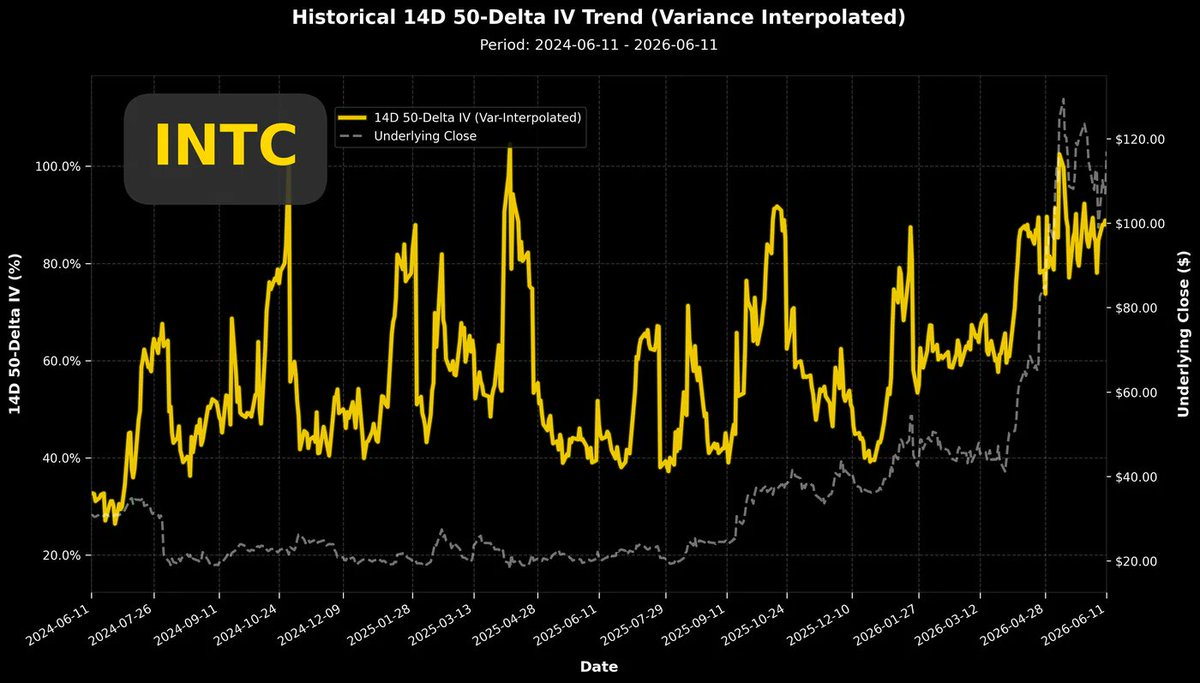
After the January earnings report, the implied volatility of $Intel(INTC.US) did not drop back to its previous benchmark (~40%). At the time, I didn't fully understand it and only warned in my analysis that the trading heat was still maintained. This unusual behavior caught my attention, but I couldn't just assume that the stock price would subsequently surge.
The implied volatility has been oscillating at a significantly higher new level since the January earnings report, maintaining this state for over a month. During this month, the stock price remained in a flat, range-bound oscillation. As you all know, what happened later was that the stock price sharply rose from around $50 to touch $120.
The most recent earnings report was on 04/23. After this report, the volatility simply did not decline; there was no benchmark value to speak of. The volatility after the 04/23 report has been oscillating near the peak level of the earnings report.
Therefore, absolutely do not short it! I would even suggest that if you have a large position in the underlying stock and you're itching to sell covered calls, that's certainly possible given the exceptionally high volatility. However, keep the size of the position you sell small, and make good use of the high volatility by selling short-term, deep out-of-the-money options.
The current observation is that $Intel(INTC.US)'s stock performance has been quite good over the past week, but the oscillation of volatility remains within a normal range, which is a good thing.
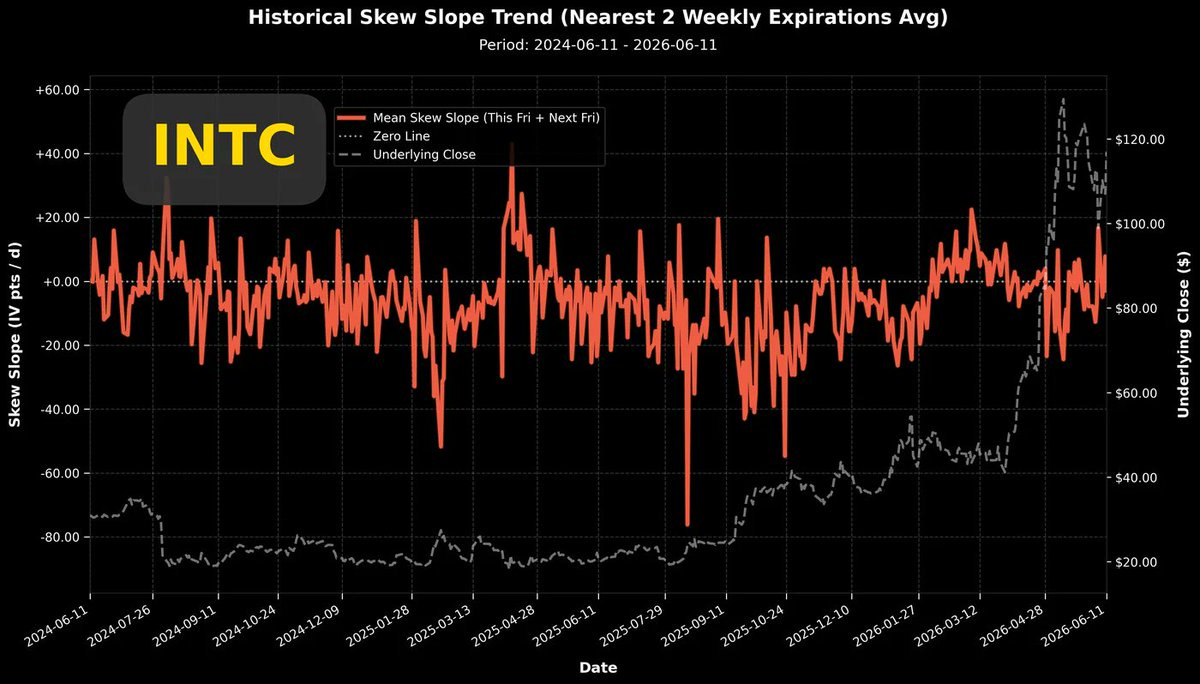
The top-right chart shows the Put/Call volatility spread over the past two years. This chart reveals that $Intel(INTC.US)'s volatility spread has often stayed below the zero line over the past two years; this is its fundamental characteristic. So, unless the volatility spread adjusts to below -20, we should not view it as "long crowding," as historical data from the past two years shows that $Intel(INTC.US) participants just like to crowd in and join the excitement.
The current volatility spread is even in a relatively conservative state, hovering near the zero line.
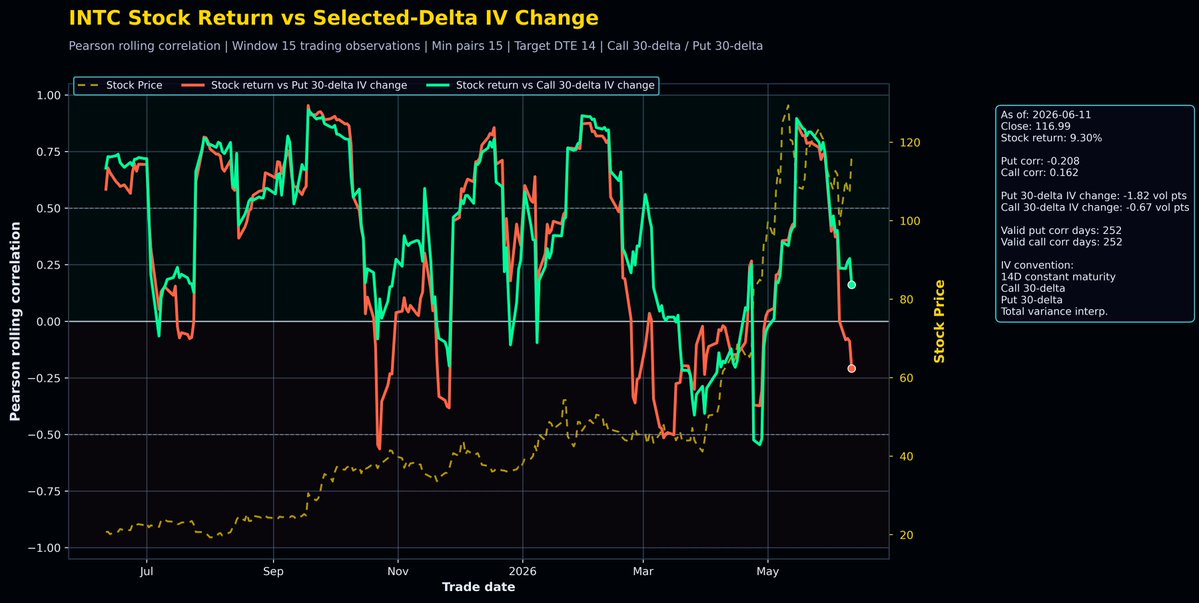
The bottom-left chart is an analysis of the correlation coefficient between stock price returns and volatility. This chart made my pupils dilate!
Since May, $Intel(INTC.US)'s stock price has been consolidating at high levels, once briefly dipping below $100 for a very short period. However, just this level of price correction has already driven the correlation coefficient downward, with the red line (Put) falling even lower. Even though $Intel(INTC.US)'s stock price has risen significantly over the past week, it hasn't immediately pushed the correlation coefficient back up to its peak. If this week's trading causes $Intel(INTC.US)'s correlation coefficient to continue downward and touch -0.5, it will complete a very healthy consolidation pattern. This is quite remarkable: to cool down and even reverse trading sentiment while the stock price decline is limited, creating the background conditions for the next price increase once such a pattern is completed.
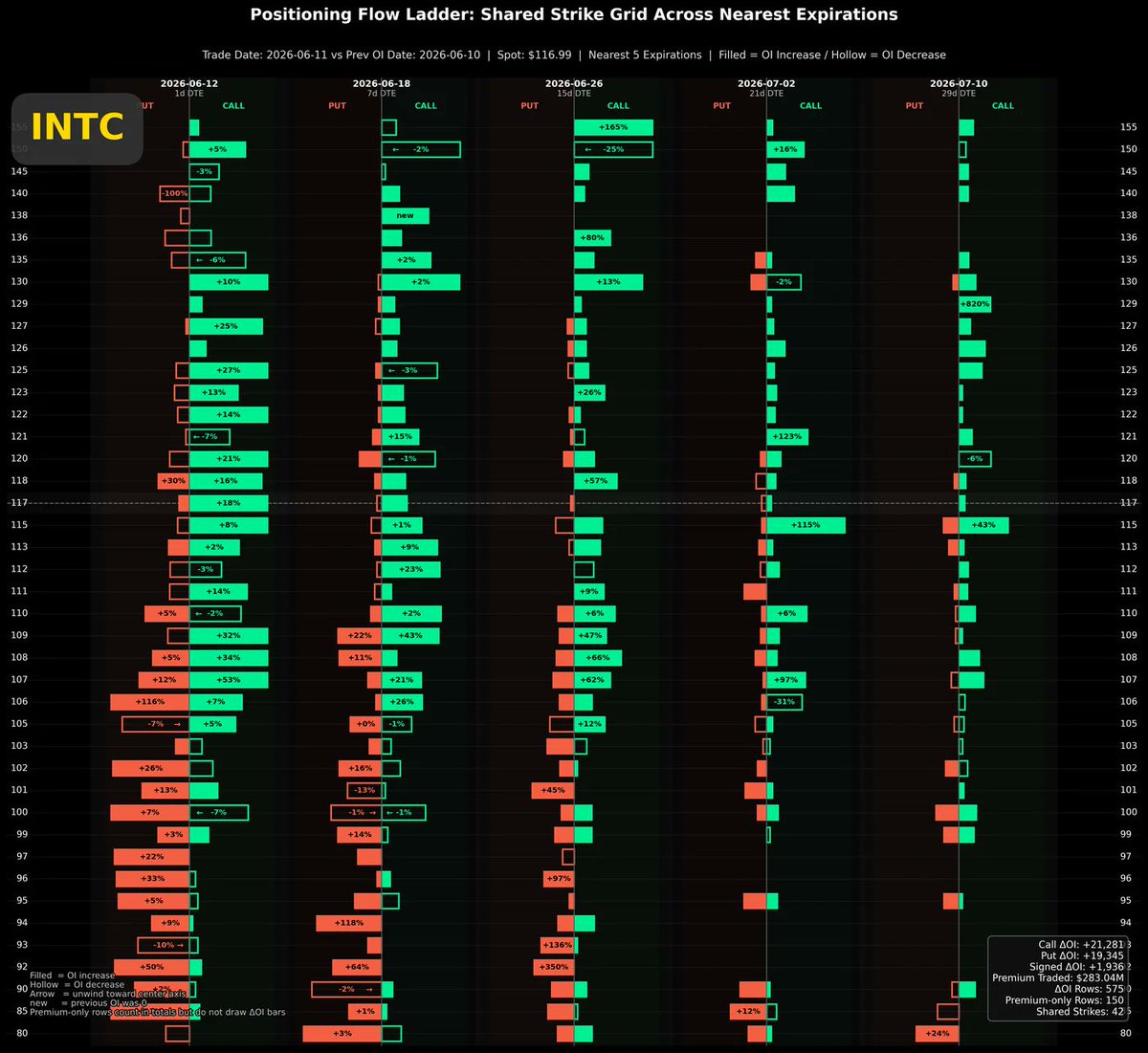
The bottom-right chart shows the intraday options position change chart. Call option building has been more active, and because $Intel(INTC.US)'s basic stock nature involves the habit of chasing prices to buy calls, a certain level of new call option positions is maintained even without special news.
Summary: $Intel(INTC.US) is close to completing a high-level consolidation where the price decline is limited, but trading sentiment has reversed. Whether it can be completed will be revealed in this week's trading. Once $Intel(INTC.US)'s stock price completes its consolidation at high levels, it creates favorable conditions for the next rise.
The copyright of this article belongs to the original author/organization.
The views expressed herein are solely those of the author and do not reflect the stance of the platform. The content is intended for investment reference purposes only and shall not be considered as investment advice. Please contact us if you have any questions or suggestions regarding the content services provided by the platform.
