
F
FaithAnchor

$Frasers Cpt Tr(J69U.SG)

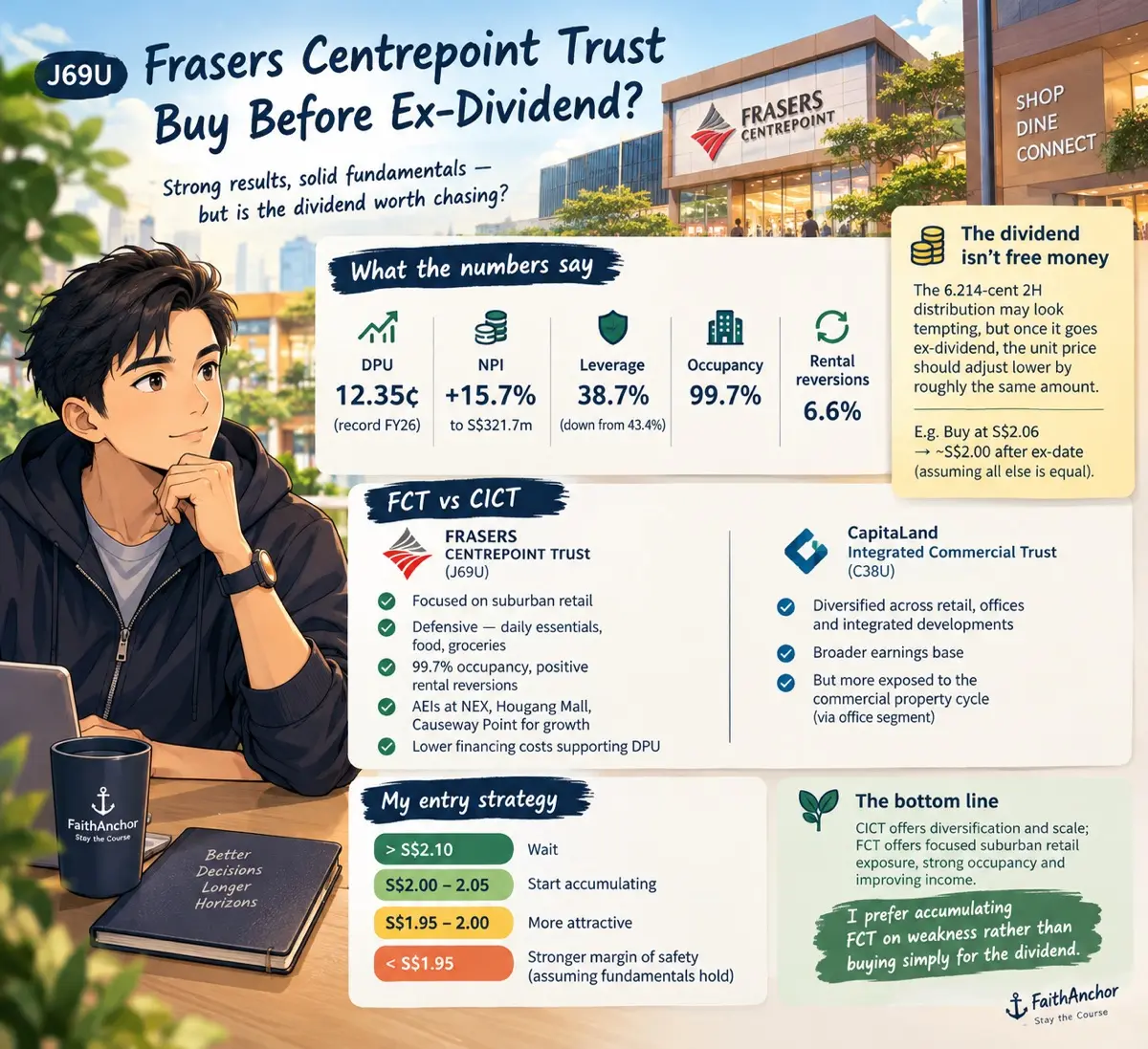
Frasers Centrepoint Trust (J69U) delivered a strong FY26. DPU reached a record 12.35 cents, NPI grew 15.7% to S$321.7 million and leverage fell to 38.7%.

At around S$2.06, that works out to roughly a 6% yield. Occupancy is also an impressive 99.7%, while 6.6% rental reversions suggest there is still room for income growth.

But would I rush in before the ex-dividend date?

No.

The 6.214-cent 2H distribution looks attractive, but investors should remember that the dividend isn’t free money. Once FCT goes ex-dividend, the unit price should theoretically adjust lower by roughly the distribution amount.

The bigger question is what investors are paying for the underlying REIT.

This is where FCT becomes interesting against CapitaLand Integrated Commercial Trust (C38U).

CICT offers greater diversification across retail, offices and integrated developments. That gives it a broader earnings base, but its office exposure also makes it more sensitive to the commercial property cycle.

FCT is much more focused on suburban retail. That means less diversification, but its malls benefit from recurring daily spending such as groceries, food and essential services. Its 99.7% occupancy and positive rental reversions reinforce that defensive quality.

FCT also has potential growth from AEIs at NEX, Hougang Mall and Causeway Point, while lower financing costs are helping support DPU.

At S$2.06, I don’t think investors need to chase the dividend. I would rather wait for the post-ex-dividend adjustment.

Around S$2.00 becomes more interesting, while S$1.95 or below would provide a better margin of safety, assuming fundamentals remain intact.

Bottom line: CICT offers diversification and scale; FCT offers focused suburban retail exposure, strong occupancy and improving income. I prefer accumulating FCT on weakness rather than buying simply for the dividend.
图片 1,共 1 张
T
TheInvestingIguana
Featured

Iggy’s Journal: Frasers Centrepoint Trust’s Income Rose 8.2%, Its Payout Per Unit Rose 2.0%

Friday 23 Oct 2026 | Morning

The Numbers

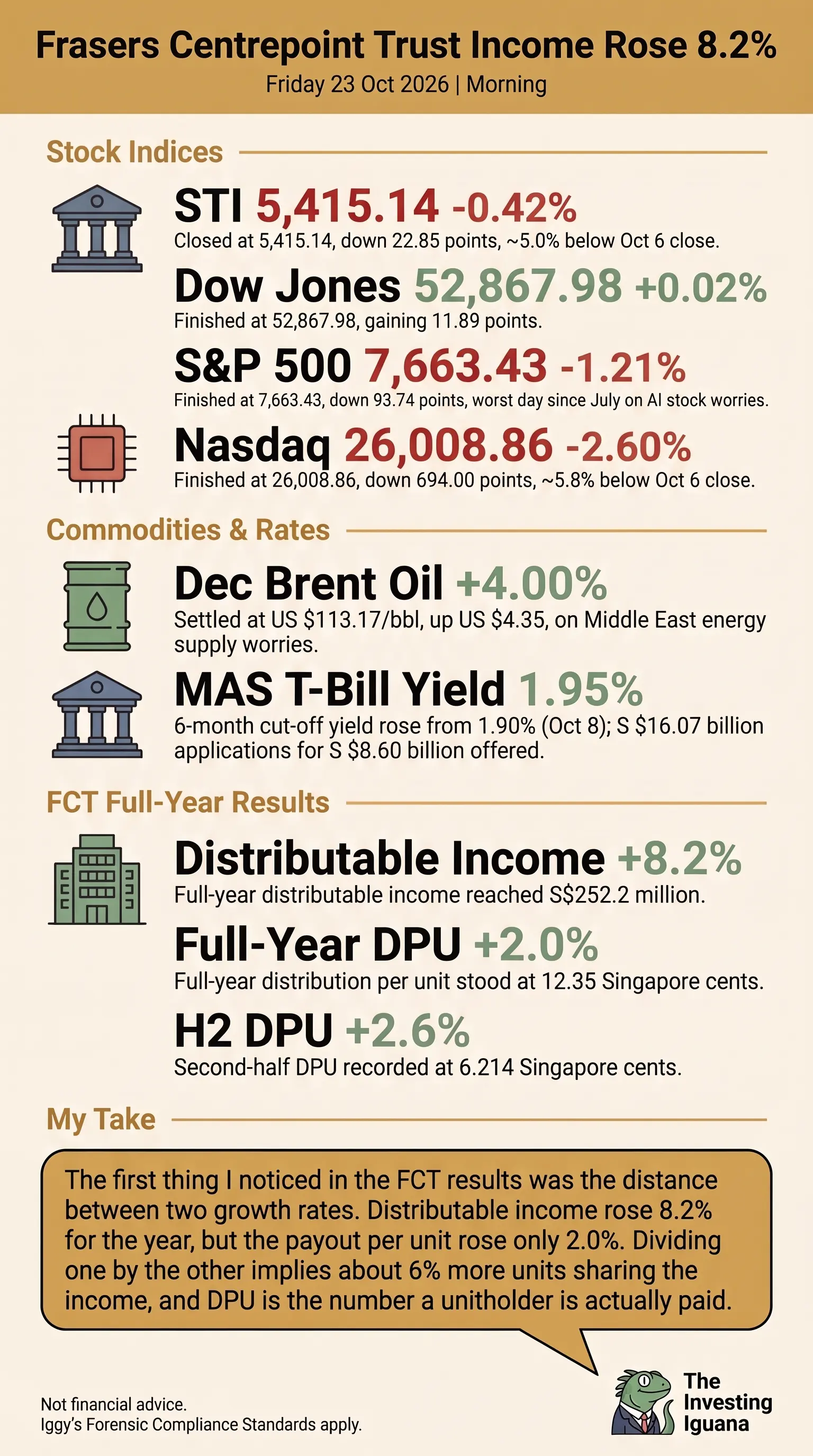
STI: Thursday’s close was 5,415.14, down 22.85 points or 0.42%, according to Singapore Business Review citing SGX data. That is about 5.0% below the 6 October close of 5,701.54.

Wall Street on Thursday, in sessions that ran after SGX had closed: the Dow finished at 52,867.98, up 11.89 points or 0.02%. The S&P 500 finished at 7,663.43, down 93.74 points or 1.21%. The Nasdaq finished at 26,008.86, down 694.00 points or 2.60%. The Associated Press called it the S&P 500’s worst day since July and tied the fall to AI stocks, on worry that elevated interest rates threaten the AI boom. The Nasdaq is now about 5.8% below its 6 October close of 27,599.89.

Oil: December Brent settled at US$113.17 a barrel, up US$4.35 or 4.00% (ICE Futures via Xinhua; Dow Jones Market Data shows the same figure). Xinhua attributes the rise to worry over the transport of Middle East energy supplies.

Rates: the MAS 6-month T-bill cut-off yield was 1.95% at Thursday’s auction, up from 1.90% on 8 October. Applications were S$16.07 billion for S$8.60 billion offered.

Frasers Centrepoint Trust results, announced on 22 October: full-year distribution per unit (DPU) of 12.35 Singapore cents, up 2.0%. Second-half DPU of 6.214 cents, up 2.6%. Full-year distributable income of S$252.2 million, up 8.2%.

My Personal Take

The first thing I noticed in the FCT results was the distance between two growth rates. Distributable income rose 8.2% for the year, but the payout per unit rose only 2.0%. Dividing one by the other implies about 6% more units sharing the income, and DPU is the number a unitholder is actually paid. Wall Street’s fall came after SGX closed on Thursday, so Singapore meets it at 9am today. Next I want to see the gearing line in the FCT release. I will do a deep dive soon on FCT.   $Frasers Cpt Tr(J69U.SG) 

Cheers, Iggy 🦖

图片 1,共 1 张Long image
L
LazyCat

Context

⭐ $Frasers Cpt Tr(J69U.SG) reported record-high full-year FY2026 results. Gross Revenue rose 14.2% YoY to SGD444.9m, Net Property Income (NPI) grew 15.7% YoY to SGD321.7m, and full-year DPU reached a record 12.350 cents (+2.0% YoY).

👍 Significant Balance Sheet Deleveraging: Aggregate leverage improved substantially to 36.8% (down from 40.4% in 3Q FY26), creating strong debt headroom well below the 50% MAS regulatory limit.

💰 Cost of Debt & Coverage: All-in average cost of debt declined to 3.2% (down from 3.8% in FY25), with 68.6% fixed-rate hedged and an improved Interest Coverage Ratio (ICR) of 4.37x.

🍏 Robust Operational Essentials: Portfolio committed occupancy remained near-full at 99.7%, supported by positive rental reversions of +6.6% and successful asset recycling (divestment of White Sands at an 8.4% premium).

My Trade:

* Position Action: Maintaining current vested position in FCT (SGX: J69U) and holding through the earlier market sell-down.

* Investment Rationale: Lower interest burden, significant balance sheet deleveraging (sub-37% gearing), and resilient suburban retail cash flows validate holding the stock as a dependable income component without needing to panic-sell or over-allocate at current levels.

Takeaway:

* Quality & Resilience: FCT’s necessity-driven heartland retail portfolio demonstrates steady organic growth, high occupancy, and positive rental reversions regardless of broader economic volatility.

* Lowered Financial Risk: Active capital management and rate cuts have reduced borrowing costs and gearing, improving DPU distribution visibility (2H DPU of 6.214¢ payable on 27 Nov 2026).

图片 1,共 1 张
P
Pingu

$Lion-phillip S-Reit(CLR.SG)

Context:

I noticed that S-REIT prices were dropping, and I saw it as a potential opportunity to add to my existing position at a lower price. Since I was already interested in S-REITs for their potential distribution income and long-term growth, I thought that buying more at the lower price could help reduce my average cost. However, I understood that the price decline could be caused by factors such as interest-rate expectations, rising financing costs or weaker market sentiment, so I wanted to take advantage of the lower price while keeping a longer-term perspective.

My trade:

I added to my S-REIT position because I wanted to lower my average purchase price and increase my exposure to the sector. Rather than buying at a higher price, I saw the market decline as an opportunity to accumulate more units at a potentially more attractive valuation. My intention was to improve my overall entry price while continuing to benefit from potential distribution income and future capital appreciation. However, I remained aware that buying at a lower price does not necessarily mean the investment has become cheaper in fundamental terms, and further price declines could still occur.

Takeaway:

Next time, I would evaluate the reasons behind the price decline and check the REIT's fundamentals before adding more units, rather than focusing mainly on lowering my average cost.

图片 1,共 1 张
I
investingguru

$Keppel DC Reit(AJBU.SG)

Context: Keppel DC REIT has benefited from the strong data centre theme, but even a good sector doesn’t mean the share price will keep going up. At some point, need to look at whether the valuation still makes sense.

My trade: I decided to sell and take profit first. Rather lock in what I’ve earned than get too greedy and end up giving back my gains. Can always look for another entry if the price becomes attractive again.

Takeaway: I still believe data centres have long-term potential lah, just not every stock needs to be held forever. Sometimes taking profit and keeping cash ready is also a strategy. Money in the pocket first, opportunities can come again.

2026.10.0114:14:03Sell orders
Filled timeQtyPriceDirection
2026.10.01
14:14:03
7002.16Sell
A
Ally

SREITS still has abit more room for share prices to go up. Several SREITS are far below their book Net Asset Value

C
Captain's Watch
Featured☕️ [Task Coins Giveaway] Daily Market Talk — SpaceX Turns a Profit and Opens Tesla Merger Talks

SpaceX made money for the first time, and immediately put a Tesla merger on the table. At home, the STI is up and the banks are leading. Let's dig in 👇💬 Would a SpaceX-Tesla merger be a good deal for ...

P
Pingu

$Lion-phillip S-Reit(CLR.SG)

Context:

I noticed that the prices of S-REITs were falling, and I saw this as a potential opportunity to add to my existing position at a lower price. My thinking was that buying more units during the price decline could help lower my average cost and potentially improve my overall returns when the market recovered. Since I was investing with a longer-term perspective, I was willing to tolerate some short-term price fluctuations as I believed S-REITs could still provide relatively stable distribution income and opportunities for capital appreciation. However, I was also aware that falling prices could reflect concerns about interest rates, financing costs or the REITs' underlying performance, so I understood that the price decline did not necessarily mean the investment had become more attractive.

My trade:

I added to my existing S-REITs position as I wanted to take advantage of the lower prices and reduce my average purchase cost. Rather than committing a large amount of capital at once, I chose to add gradually so that I could manage my risk while maintaining exposure to the sector. My main reason for adding was the belief that the lower entry price could improve my potential returns over the longer term, while allowing me to continue receiving distributions from my investment. At the same time, I recognised that averaging down would increase my overall exposure to S-REITs, and that further price declines could result in additional losses.

Takeaway:

Next time, I would assess whether the price decline is driven by temporary market conditions or weakening fundamentals before averaging down, while setting clearer limits on my position size and checking that the REIT's distribution sustainability and financial health remain sound.

图片 1,共 1 张
L
LazyCat

Context: $Mapletree Ind Trust(ME8U.SG)is currently trading at a depressed price near multi-year lows around S1.75–S1.80, offering a high dividend yield of ~7.0%.

1. Key Drivers Behind the Price Weakness:

* US Data Center Non-Renewals: MIT’s North American portfolio includes legacy powered shell data centers. Tenant non-renewals and vacancies in these older assets create an income drag, while upgrading them to accommodate dense AI workloads requires heavy capital expenditure.

* Rising Financing Expenses: Low-cost interest rate hedges are expiring, reducing fixed-rate debt coverage to ~73%. Refinancing at prevailing rates drives debt costs toward 3.5–3.6%, squeezing Distributable Income.

* Distribution Contraction: Expected annual Distribution Per Unit (DPU) is moderating to 11.5–11.8 cents. Ongoing divestments of non-core properties aim to reduce leverage but leave temporary income gaps before proceeds are redeployed.

2. What the Market is Pricing In:

* Structural DPU Repricing: Investors require a ~7.0% yield, accepting ~11.5 cents as the new DPU baseline.

* Hybrid Industrial Discount: The market no longer prices MIT as a high-growth AI tech play, treating it as a traditional industrial REIT balancing US headwinds with stable Singapore assets.

* Execution Risk: Markets are taking a cautious stance on management's plan to sell SGD500M–600M in non-performing assets.

Investor Verdict

3. Scenarios to consider (Takeaway):

* 🐻 Bear Case: Elevated refinancing costs and lingering US vacancies drag DPU lower.

* 🐂 Bull Case: The 7% yield prices in worst-case downside; successful asset divestments could trigger a valuation re-rating.

4. My trade: I am still holding onto MIT for the bull case and accepting its lowered contribution to my cash flow. However, I may divest part of it to pursue a good option when one presents itself.

图片 1,共 1 张
P
Pingu

$Lion-phillip S-Reit(CLR.SG)

Context:

I noticed that S-REIT prices were dropping, so I saw this as a potential opportunity to add to my existing position at a lower price. My thinking was that buying more units during the price decline could help lower my average cost and improve my potential returns over the longer term if the market recovered. Since I was investing in S-REITs for their distribution income and potential capital appreciation, I viewed the price drop as an opportunity to strengthen my position rather than focusing only on short-term market movements. However, I was also aware that prices could continue to fall due to interest-rate uncertainty, rising financing costs or weaker market sentiment.

My trade:

I added to my S-REIT position as I wanted to take advantage of the lower prices and reduce my average purchase cost. Instead of committing a large amount of capital at once, I chose to add gradually so that I could manage my risk and retain some funds for future opportunities. My main reason for buying more was to improve my entry price while maintaining exposure to the potential distribution income and long-term growth of the real estate sector. At the same time, I recognised that averaging down would increase my overall exposure to S-REITs, so I needed to ensure that the additional investment remained within my planned portfolio allocation.

Takeaway:

Next time, I would assess whether the price drop was caused by temporary market sentiment or a deterioration in the REIT's fundamentals before averaging down, while setting clearer limits on my position size and total exposure to the sector.

图片 1,共 1 张
も
ももさん

$CapitaLandInvest(9CI.SG)

Context: Real estate investment managers face continued valuation testing as regional rate expectations consolidate and macro market sentiment remains cautious.

My trade: Holding shares of CapitaLandInvest (9CI) at an average cost of 2.500 SGD, managing an unrealized drawdown of -6.40% as the market price trades at 2.340 SGD.

Takeaway: Next time, I will set pre-planned tiered entry limits around major technical support levels to rebalance cost basis without over-allocating capital.

图片 1,共 1 张
T
TheInvestingIguana
Featured

Iggy’s Journal: SGX Opens Today After Friday’s US Drop

Mon 19 Oct 2026 | Morning

The Numbers

The STI closed Friday 16 Oct at 5,415.53, up 12.03 points or 0.22%, before the US session opened. The US then fell. The Dow closed at 52,002.41 (down 0.34%), the S&P 500 at 7,659.44 (down 1.09%) and the Nasdaq at 26,140.03 (down about 2.1%). The Associated Press attributed the fall to selling in technology and semiconductor shares, on concern about how long AI infrastructure spending can continue without squeezing earnings. Today is the first SGX session since that drop, and it opens at 9am.

Business Times headlines this morning include S-REITs starting their Q3 earnings season with interest rates in focus, DBS remaining analysts’ pick ahead of Q3 earnings after the banks’ share slump, and AI funding fears puncturing a rally in Asia’s picks-and-shovels stocks. I have read the headlines only.

My Personal Take

The first session after a big overseas fall is a noisy one, so I will watch the three banks rather than the index. DBS, UOB and OCBC dividends are what many heartland households live on, and a slump in the shares lifts the yield only if the dividend holds. That question belongs to the Q3 results, not to a Monday morning. On Friday I said this was the session I would check first, and the bank prices at the open are where I start.

Cheers, Iggy 🦖

Not financial advice. Iggy’s Forensic Compliance Standards apply.

图片 1,共 1 张Long image
T
TheInvestingIguana

Iggy’s Journal: Nasdaq Falls 2.15% on Friday and Passes the STI’s Drop Since 6 October

Sat 17 Oct 2026 | Morning

The Numbers

The STI closed Friday at 5,415.53, up 12.03 points (0.22%) from Thursday’s 5,403.50 (SGX Nifty board data; Trading Economics rounds it to 5,416).

Wall Street fell after SGX had closed. The Dow ended at 52,002.41 (-175.28, -0.34%), the S&P 500 at 7,659.44 (-84.62, -1.09%) and the Nasdaq at 26,140.03 (-572.99, -2.15%). AP attributes the fall in the S&P 500 and the Nasdaq to a sell-off in technology and semiconductor shares, as concerns deepened over how long heavy spending on AI infrastructure can continue without squeezing corporate earnings. US markets are closed for the weekend, so Monday 19 October is the first SGX session after it.

Enterprise Singapore reported that non-oil domestic exports rose 68.4% year on year in September, after 46.1% in August. Electronic shipments rose 107.6% and non-electronic shipments 54.2%.

Business Times headlines that DBS remains analysts’ pick ahead of its third-quarter earnings after the Singapore banks’ share slump, that Deluge shares closed 6.7% higher on their first day of mainboard listing, and that the Middle East war affected September bunker sales. I have read the headlines only.

My Personal Take

On Thursday I noted that the STI’s fall since 6 October was larger than any US index’s. Friday reversed that. From the 6 October closes to Friday’s, the STI is down 5.0%, from 5,701.54 to 5,415.53, and the Nasdaq is down 5.3%, from 27,599.89 to 26,140.03. A S$10,000 position that tracked the STI would be about S$500 lower over that stretch, before dividends. Exports up 68.4% describes September, and the share prices describe this fortnight. Monday’s session is the first one I will check.

Not financial advice. Iggy’s Forensic Compliance Standards apply.

图片 1,共 1 张Long image
P
Pingu

$Lion-phillip S-Reit(CLR.SG)

Context:

I noticed that the prices of S-REITs were falling, and I saw this as a potential opportunity to increase my position at a lower price. Since I already had exposure to the sector, I wanted to take advantage of the price decline to lower my average cost per unit. I believed that the lower prices could provide a more attractive entry point for long-term investment, especially given the potential for distribution income and future capital appreciation. However, I was also aware that falling prices could reflect concerns about interest rates, financing costs or the overall property market, so I wanted to remain mindful of the risks involved.

My trade:

I added to my S-REITs position as the price declined, with the aim of lowering my average cost and improving my potential returns over the longer term. Rather than committing too much capital at once, I increased my holdings gradually so that I could manage my risk while maintaining exposure to the sector. My decision was based on the belief that the lower price could offer better value, provided the underlying fundamentals of the REITs remained sound. I also hoped that the additional units would increase my potential distribution income as I continued to hold the investment.

Takeaway:

Next time, I would assess whether the price decline is justified by the REIT's fundamentals before adding to my position, rather than focusing mainly on lowering my average cost.

图片 1,共 1 张
T
TheRaccoonAnalysis

September’s producer price inflation significantly exceeded expectations, with annual PPI rising 6.3% against 5.3% forecast and monthly growth reaching 1.3% versus 0.5%. The upside surprise reinforces concerns that inflationary pressures remain persistent, prompting Citi to anticipate a December rate hike and UBS to project another in March. However, the Dow’s 1.1% gain alongside a 7-basis-point decline in the 10-year Treasury yield suggests markets may be weighing factors beyond inflation, including earnings optimism, positioning or expectations about future growth. The divergence could also reflect uncertainty over how sustained the inflation shock will be and whether tighter policy is fully priced in.

C
Captain's Watch
Featured☕️ [Task Coins Giveaway] Daily Market Talk — Hot PPI Turns Citi and UBS Hawkish

September PPI landed a full point above forecast, and two big banks changed their rate calls. At home, September exports came in at double the forecast. Let's dig in 👇💬 With a December hike priced nea...

S
Shyon

I would rather wait for tonight’s CPI results before making any major moves. With several Fed officials signalling that another rate hike may be necessary, inflation remains a key risk for the market. I prefer to keep some cash available instead of chasing prices, especially when volatility could increase quickly.

For S-REITs, I see the recent weakness as a potential opportunity, but I would not rush to buy just because prices have fallen. Higher interest rates mean higher refinancing costs and potentially lower distributions, so I would focus on REITs with strong balance sheets, manageable debt maturities, and sustainable distributions. I would rather accumulate gradually on further weakness than commit too much capital at once.

For Singapore banks, I am still watching their earnings outlook and price action after the recent correction. MAS holding steady provides some stability, but it does not eliminate market risks. My approach remains the same: stay diversified, buy quality at reasonable valuations, and keep enough cash to take advantage of better opportunities. Consistency and patience matter more to me than trying to predict every market move.

C
Captain's Watch
Featured☕️ [Task Coins Giveaway] Daily Market Talk — Tonight’s CPI Decides the Fed’s Next Move

Three Fed officials backed another rate hike on the same day, hours before tonight's CPI. At home, MAS surprised every analyst by holding. Let's dig in 👇💬 If tonight's CPI runs hot, do you add to rate...

F
Fattycat
Featured

🚀 Why Data Centre S-REITs Are Under Pressure - Even With Booming AI Demand

Keppel DC REIT (AJBU) and NTT DC REIT USD (NTDU) are trading near 52-week lows despite strong structural demand.

Here is what is happening 👇

📉 Macro & Interest Rate Headwinds

• Yield competition: Higher US Treasury yields mean risk-free bonds look more attractive, pulling capital away from dividend stocks.

• Refinancing costs: Older, cheaper debt is maturing and being replaced at today’s higher rates. This directly reduces distributable income.

🏢 What Affects Each One

• NTT DC REIT (NTDU): Still finding its footing post-IPO, plus US dollar currency swings on SGX.

• Keppel DC REIT (AJBU): Higher overall borrowing costs and market caution around specific asset allowances in Guangdong.

💡 The Key Insight

• Business remains strong: Occupancy stays above 98%, and AI plus cloud growth keeps pushing rental income higher.

• It’s pricing, not performance: The drop reflects higher capital costs across the sector, not weakening demand from tenants.

🤔 With prices at these levels, are you adding to your positions or waiting for more clarity?

Not financial and investment advice. Do your own due diligence ☺️.

$NTT DC REIT USD(NTDU.SG)$Keppel DC Reit(AJBU.SG)

图片 1,共 1 张
L
LazyCat

Have been holding my horses and observing CFA and CLR REIT ETFs. One of them is steadily approaching the levels which I am interested.

C
Captain's Watch
Featured☕️ [Task Coins Giveaway] Daily Market Talk — Micron Leads a $108B Memory Rout

Memory was the best trade of the AI boom until Monday, when Micron, SanDisk and SK Hynix shed about $108B between them on news that a Chinese rival is closing the technology gap. At home, the early ba...

F
Fattycat
Featured

🚀Stronger Singdollar: What It Means for Your S-REITs

MAS is widely tipped to tighten policy on 14 October by steepening the S$NEER policy band slope. What does a stronger Singapore dollar mean for our REIT portfolio?🤔

📉 REITs With Overseas Assets (Facing Headwinds)

• Lower Distributions: Rental income earned overseas converts into fewer Singapore dollars, pulling DPU down.

• Valuation Impact: Foreign assets revalue lower in SGD terms. This pushes net asset value down and gearing ratios higher on paper.

🛡️ Pure Singapore REITs (Naturally Protected)

• Cost Savings: A stronger SGD helps fight imported inflation. It keeps utility, cooling and maintenance expenses in check.

• No Currency Risk: With all assets based in Singapore there is zero translation loss. Plus SORA rates stay lower than US rates, a helpful bonus.

📌 In Short

Where a REIT owns its assets matters most during an MAS tightening cycle. Pure-play domestic REITs offer much stronger resilience against currency swings and operational cost pressure.

See the full details in the infographic! 🖼️

Not investment or financial advice. Do your you due diligence ☺️.

Source: Economists expect MAS to tighten monetary policy again in October, though some see room for a pause- Business times 12 Oct 2026.

图片 1,共 1 张
N
NewUser_ThinkSwim

Generally investors would be worried about the high debt or usage of debt to make the growth of companies which is one of the topics in the news recently. As earnings are upcoming, the weeks ahead will be volatile for all companies. The companies with high free cash flow and low operating costs will be favoured and those with negative cashflow may correct downwards even more than those consistent steady companies.

C
Captain's Watch
Featured☕️ [Task Coins Giveaway] Daily Market Talk — SpaceX's $8B Spectrum Deal Sinks Telcos

SpaceX is paying about $8B for nationwide spectrum, and US telcos got repriced in one session: AT&T -9.8%, T-Mobile -13%. At home, the banks are bouncing after last week's 5% STI slide. Let's dig in 👇...

F
Fattycat

The Singapore government appears keen to support mid and small-cap stocks.

Over recent years I have noticed that MAS and MOF have rolled out several targeted measures. Their aim was to address the structural valuation discounts and poor liquidity on our local exchange. And they focus falls heavily on mid and small-cap counters. 🤔

Measures include capital injections under the Equity Market Development Programme or EQDP, plus grants for liquidity and research coverage.

Could now be the time to consider small to mid -cap stocks?

Screen shot from CNA finance news.

Commentary: Liquidity fix for small and mid-caps on SGX requires more to be done
C
Captain's Watch
Featured☕️ [Task Coins Giveaway] Daily Market Talk — SpaceX's $8B Spectrum Deal Sinks Telcos

SpaceX is paying about $8B for nationwide spectrum, and US telcos got repriced in one session: AT&T -9.8%, T-Mobile -13%. At home, the banks are bouncing after last week's 5% STI slide. Let's dig in 👇...

T
TheInvestingIguana
Featured

Iggy’s Journal: Your Share Fell Ex-Dividend. Did You Actually Lose Money?

Mon 12 Oct 2026 | Morning

The Numbers

An illustration from the episode: a S$4 share with an 8-cent dividend. The 8 cents is 2% of the S$4 price. On the ex-dividend date the share may adjust to about S$3.92, a fall of 8 cents. The share no longer carries the dividend entitlement from that date, but the 8 cents is not paid that day. It is due on a separate payment date. The adjustment may be close to the dividend, but it is rarely exact, because other price moves can happen on the same day.

My Personal Take

A price chart shows one number for the day. It cannot separate the dividend from everything else that moved the price. If the same S$4 share closed at S$3.95 on its ex-dividend date, the price would be 3 cents above the S$3.92 adjustment, and the chart alone could not show why. In the episode I go through which dates and which payment type on the notice matter, and how I compare the price fall with the declared rate.

📺 YouTube: https://youtu.be/TMH6fhhQidk

📩 Substack: https://investingiguana.com/p/the-share-fell-when-it-went-ex-dividend

Not financial advice. Iggy’s Forensic Compliance Standards apply.

- YouTube

- YouTube

YouTube 上盡享你喜愛的影片和音樂、上載原創內容,並與親友和世界各地的人分享。

youtu.be
图片 1,共 1 张Long image
谋
谋定后动

Featured[Mou Weekly] Interest expenses exceed 1 trillion, can the US government no longer sustain it? (Week 41 of 2026 | Total Issue 291) In the absence of a recession, the deficit remains

Last Tuesday, the S&P 500 closed at 7,818.93, marking its first closing record high since August 13, with a weekly gain of 1.2%. On Wednesday, the 10-year U.S. Treasury auction cleared at 5.30%, a 24-year high. On Thursday, the Congressional Budget Office released its fiscal year 2026 ledger: revenue of $5.40 trillion, spending of $7.40 trillion, and a deficit of $1.99 trillion; net interest of $1.14 trillion, which is $227 billion more than defense spending. The deficit stands at 6.2% of GDP, unemployment is at 4.2%, with no wars on home soil and no recession...

图1:美国联邦财政收支对比(FY2025决算,FY2026初步决算,单位:万亿美元) 项目 FY2025 FY2026 同比 增减额 占比 总收入 5.24 5
图2:多收的和少收的,源头都是AI 联邦收入各项目的同比变动,2026财年 200 +1,880亿美元 个人:工资、奖金、股票收益都在交税 企业:2025年税改
图4:微软2026财年的联邦税单:法定21%,实缴2.4% 资本开支1,159亿,同比增八成,三分之二买的是服务器和GPU 140 120 1,159亿 1,0
国库的两扇门 国库 先建数据中心 税以后再交 个人所得税 企业所得税 工资、奖金、股票收益 +1,880亿 -700亿 三目 S $ T 一次性费用化 一 个人+3
T
TheInvestingIguana

A Fed Hike Moved Singapore Home Loan Quotes, but MAS Changed No Rule

Sat 3 Oct 2026 | Podcast

The Numbers

Today's podcast starts from a Fed hike that pushed Singapore bank quotes higher without MAS changing any rule. The three-month swap rate is 1.59% while compounded SORA is 1.23%, a gap of 0.36 percentage points. HDB loans stay at 2.6% through end-December. Most bank floating packages were between 1.5% and 1.8% at end-September, and a 0.2 percentage point rise costs about S$83 a month in interest on a S$500,000 loan. The episode explains why a home loan has two parts, and why only one of them moved.

My Personal Take

This morning I wrote that I wanted a Monday SGS print to see whether Singapore follows the US move down. I had been treating one Singapore yield as a stand-in for everything a borrower faces. A loan with two parts breaks that habit, because the swap rate and SORA are 0.36 points apart on the same day. I do not yet know which of the two a given household feels first. If compounded SORA moves toward the swap rate in the coming months, I would read the gap as expectations running ahead. If it does not, I would question how I read the swap rate. 🦖

📺 YouTube: https://youtu.be/OlSjK3I0ZUo

📩 Substack: https://investingiguana.com/p/your-home-loan-rate-has-two-parts

Not financial advice. Iggy's Forensic Compliance Standards apply.

- YouTube

- YouTube

YouTube 上盡享你喜愛的影片和音樂、上載原創內容,並與親友和世界各地的人分享。

youtu.be
图片 1,共 1 张Long image
T
TheInvestingIguana
Featured

Maybank Reiterates BUY on CSE Global at S$2.25 After S$190.5 Million of US Contracts

Wed 30 Sep 2026 | Analyst Update

$CSE Global(544.SG) 

The Numbers

Maybank Research reiterated its BUY on CSE Global with a S$2.25 target price after two new US contracts worth a combined S$190.5 million. The first covers power-distribution centres and integrated electrical and control systems for the Calcasieu Pass 2 LNG expansion in Louisiana, executed from 2026 to 2028. The second is a follow-on for the Cheyenne Power Hub in Wyoming, supplying power-distribution infrastructure for an adjacent data centre in 2026 to 2027.

Maybank expects a stronger 2H26 as CSE's new facility reaches a monthly run rate of US$20 million to US$23 million, and says resolving the copper-supply bottleneck could potentially double that run rate. It also forecasts capacity more than tripling by 2027 to 2028, another data-centre customer by 1Q27, and an AWS order of roughly US$250 million to US$350 million for FY27, which it expects could arrive by December. The contracts are secured. The AWS order and the new client are Maybank forecasts, not company-announced orders.

My Personal Take

My first reaction to S$190.5 million was that it was the news. What I almost missed is that the forecast in the same note is larger: the low end of Maybank's AWS range, US$250 million, is about S$320 million at Tuesday's 1.2780 USD/SGD, and no company has announced it. It took me a while to keep the signed and the forecast apart in my head, because both sit under one BUY. A company announcement of the AWS order would change how I weigh this, and so would December passing without one. 🦖

Not financial advice. Iggy's Forensic Compliance Standards apply.

图片 1,共 1 张Long image