D
May 28 at 12:03 AM
MRVL (Trans): FY2028 guide $16.5bn; upside ahead
Below is Dolphin Research’s transcript summary of Marvell (MRVL) FY27Q1 (FQ1 2027, period ended May 2, 2026) earnings call. For our earnings take, see 'Marvell: Another AI interconnect leg — can it finally justify the 'mini-AVGO' dream?'.
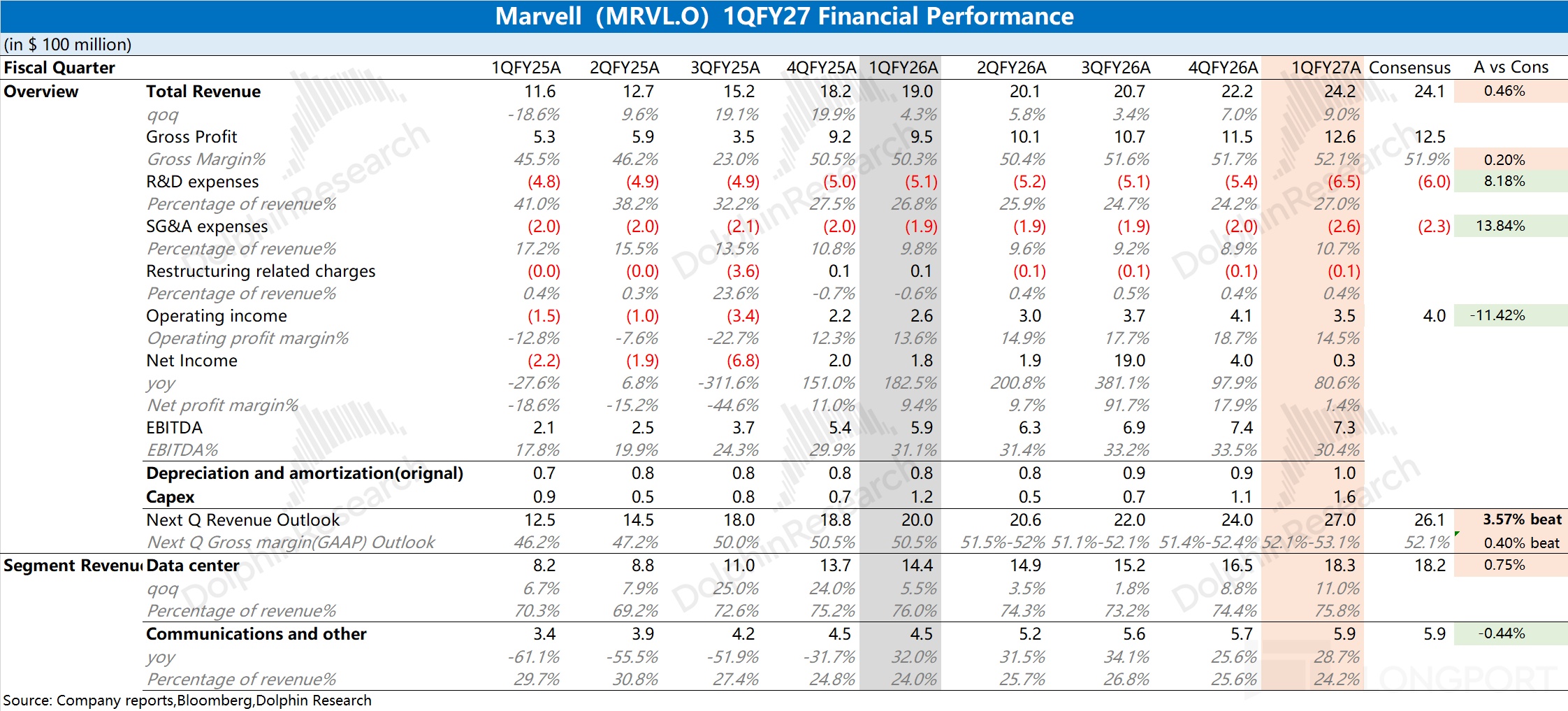
I. MRVL earnings highlights recap
1. Capital return: Repurchased $200 mn of shares this quarter under the ongoing capital return plan and returned $54 mn in cash dividends. The company plans to continue buybacks to manage share-count dilution.
2. Guidance (FY27Q2): Revenue around $2.7 bn (±5%), up ~12% QoQ and ~35% YoY. GAAP GPM 52.1%–53.1%, non-GAAP GPM 58.25%–59.25%; GAAP Opex ~$960 mn, non-GAAP Opex ~$600 mn; non-GAAP tax rate 11%; diluted shares ~915 mn. GAAP EPS $0.32–$0.42; non-GAAP EPS $0.88–$0.98.
3. Guidance (FY27/FY28 full-year): Raised FY27 revenue outlook to ~$11.5 bn (~+40% YoY), driven by DC up ~50% and interconnect up >70% (prev. 50%); comms and other end-markets ~+10%. FY28 revenue outlook raised to ~$16.5 bn (~+45% YoY), ~+$1.5 bn vs. prior guide, with DC up ~55% and custom more than doubling YoY. FY27 outlook is up by >$500 mn vs. last quarter.
4. Key FY27Q1 metrics: Revenue $2.418 bn (+28% YoY, +9% QoQ), a record and above the guide midpoint; DC was 76% of total. GAAP GPM 52.1%, non-GAAP GPM 58.9%; GAAP OPM 14%, non-GAAP OPM 35%. Non-GAAP EPS $0.80 (+29% YoY), $0.01 above the midpoint; GAAP EPS was $0.04 below guidance due to purchase accounting and earn-out impacts from Celestial AI and XConn acquisitions, with normalization expected in Q2. GAAP net income has been positive for six straight quarters; Op. cash flow hit a record $639 mn, and ending inventory was $1.4 bn (roughly flat QoQ).
5. Capital structure and capacity commits: Ending total debt $4.96 bn; total debt/EBITDA 1.44x and net debt/EBITDA 0.32x. FY27 non-GAAP Opex expected at ~$2.45 bn (incl. Celestial AI and XConn); FY28 non-GAAP Opex to grow mid- to high-teens YoY, well below the ~45% revenue growth, supporting the 38%–40% target OPM ceiling during FY28. To secure capacity, MRVL expects to prepay suppliers by about $1.0 bn in FY27 (first tranche in Q2), to be credited against future materials.
II. Marvell earnings call details
2.1 Management commentary
1. Interconnect (largest DC biz.)
a. Demand keeps accelerating, and FY27 growth outlook is raised to >70% YoY, also the key driver behind the FY28 company-wide upward revision.
b. In scale-out PAM, 800G demand remains strong; the 200G/lane 1.6T solution ramped in 2H FY26 and will scale fast this year, then step up again in FY28. MRVL has kept first-to-market cadence across PAM4 generations and plans to lead the next node at 400G/lane (first demo at OFC in Apr 2025).
c. Beyond DSPs, broadband analog, TIAs and drivers are ramping fast. TIA and driver revenue is expected to reach a $1 bn annualized run rate within the next few quarters.
d. Coherent light: initial shipments of first-gen 200G/lane 1.6T solutions have begun for 2–20 km in-DC links with ultra-low power. A next-gen product with integrated MACsec security is rolling out.
e. DCI: scale-across networks are boosting demand for pluggable DCI modules, with aggregate bandwidth needs projected to be >10x front-end and today’s DCI. Traditional 400G is moving to 800G, and scale-across will adopt 1.6T quickly; MRVL supplies DCI to all five US hyperscalers. The industry’s first secure 1.6T ZR/ZR+ module based on a 2nm coherent DSP is expected to sample this year, and DCI module revenue could reach a $1 bn annualized run rate in FY28, roughly 2x FY26 (~$500 mn).
f. Acquired Polariton (high-speed, low-power plasmonic silicon photonics); its plasmonic modulator has demonstrated >1 THz bandwidth, ~10x current silicon photonics and thin-film lithium niobate. This will feed into the DCI and coherent light roadmap and extend to 3.2T and beyond.
2. Scale-up optical interconnect (new strategic focus)
a. MRVL offers a broad silicon photonics platform across MZM, EAM and MRM modulators, and is investing in micro-LED and other emerging options. It has shipped over 1 mn silicon-photonics DCI modules over the past decade and accumulated 15 bn+ field hours over four silicon-photonics generations.
b. Deep co-development with multiple Tier-1s on third-gen 6.4T light engines for NPO/CPO.
c. The Celestial AI acquisition adds photonic fabric tech (incl. EAM modulators and industry-leading low-power analog SerDes); a Tier-1 cloud selected the solution for next-gen XPU scale-up networks. MRVL is also advancing an MRM solution with TSMC on its COUPE platform.
d. With multiple NPO/CPO programs progressing, scale-up optical revenue is expected to ramp materially next year. It is now projected to more than double from the prior ~$150 mn outlook (then based only on Celestial), with management indicating ~ $300 mn in Q&A.
3. DC switching
a. 12.8T demand remains solid and 51.2T next-gen switch silicon is ramping strongly. 51.2T and 100-class platforms are seeing broad wins across new and existing customers; engineering teams are executing on a 200T Ethernet switch roadmap.
b. Scale-out switching FY27 revenue is expected to exceed $600 mn (2x vs. FY26) and could reach a $1 bn+ annualized run rate in FY28.
c. Scale-up switching is an emerging market where MRVL is investing organically and via XConn. PCIe fan-out and bandwidth limits will drive rapid shifts toward high-bandwidth fabrics such as UALink, ESUN and NVLink; MRVL supports all scale-up protocols via in-house UAL/ESUN switches and NVLink Fusion collaboration with NVIDIA. It is working with multiple Tier-1s, and each program represents multi-bn lifetime revenue opportunities.
4. Other DC growth drivers
a. AEC: the golden-cable program has been designed in at three US Tier-1 clouds and several others, and retimers are seeing strong traction. Combined AEC+retimer revenue is expected to more than double in FY27 and grow rapidly again in FY28.
b. The XConn acquisition adds PCIe and CXL switching; PCIe Gen6 and CXL 3.1 are drawing strong interest. MRVL can offer end-to-end reference designs combining PCIe switch+retimer or CXL switch+memory expander.
5. Custom
a. FY27 revenue is still expected to grow >20% YoY, led by a flagship XPU program that should drive multi-gen growth. Multiple XPU-attach programs such as CXL and NIC will ramp in FY27.
b. FY28 custom revenue is expected to more than double (above prior outlook), driven by three factors: (1) continued growth in existing custom (incl. flagship XPU); (2) 10+ XPU-attach programs entering higher volumes with demand ahead of plan, especially NIC and CXL memory attach (lifted by inference KV-cache needs); (3) a new Tier-1 XPU program ramping, with next-year demand fully secured.
c. Several new design wins since last quarter, with new sockets typically contributing revenue after ~2 years of development. MRVL maintains its long-term target of >$10 bn custom revenue in FY29.
6. Comms and other end-markets
a. FY27Q1 revenue was $585 mn (+29% YoY, +3% QoQ); this market has largely recovered from customer inventory digestion.
b. FY27Q2 is guided to decline mid single-digit QoQ and grow high single-digit YoY; FY27 full-year ~+10%, and FY28 to grow low single-digit.
7. Expanded collaboration with NVIDIA: Three pillars — (1) optics, extending from long-standing DSP/TIA/driver supply into silicon photonics to enable scale-up networks; (2) NVLink Fusion integration, where MRVL custom and networking silicon plugs seamlessly into NVIDIA infra, giving hyperscalers flexible mix-and-match options; (3) AI-RAN, enhancing OCTEON base-station processors with NVIDIA GPUs so operators can run 5G/6G and high-performance AI apps on a single SDN platform.
2.2 Q&A
Q: Can you confirm the goal of >$10 bn from custom XPU in FY29? (Implies stepping from a little over $4 bn in FY28 to $10 bn, i.e., +$5–6 bn per year.)
A: Yes, you heard that right. On the >$10 bn for FY29: back in Apr 2024 we set a long-term target through calendar 2028 (our FY29). We identified a DC custom-silicon market where, based on then-current sizing and a 20% share, we saw about $8 bn for MRVL; by Jun 2025, we said the TAM had grown — if we reach our share target in FY29, it points to >$10 bn. That was a ~$55 bn TAM and 20% is ~$11 bn, and we continue to execute against that. Two years ago it looked like a steep climb, but we are clearly making progress; between existing programs, new ramps, and a large set of XPU-attach programs that have grown in scope since we won them, we see a credible path to the goal. We are simply updating investors on the journey.
Q: When will you be more comfortable discussing the large new customer and program? Do you expect an exclusive position, and when should investors start giving MRVL more credit?
A: The program is progressing well and hitting all milestones. As noted in our prepared remarks, we see growing demand across all custom programs next year; as the year progresses we will gain confidence in ramp scale, and it is a key piece of next year’s plan. But it is not the only driver; it still represents roughly one-third of our expected custom growth next year, and the entire custom portfolio (XPU and attach) is on a very strong growth trajectory from FY27 to FY28, FY29 and beyond.
Q: With inference workloads evolving fast, XPU offload engines (e.g., LPU processors) are opening up. MRVL has deep SRAM-IP capabilities (industry’s first 2nm SRAM IP) — are you leveraging this, and do you see rising interest in SRAM-class XPU offload ASICs with designs in flight?
A: Yes. We dedicated a full session to our industry-leading SRAM design and IP at the Jun 2025 custom-silicon event, rooted in historical investments going back through the Avera acquisition to the GLOBALFOUNDRIES and IBM teams. The tech has evolved from networking into AI, and with inference you can see that trend in the market; it remains central to our IP stack and part of why we win XPU-attach. But it is one piece of a broader strategy — from advanced packaging and leading high-speed I/O to co-developing aggressive time-to-market solutions with customers, leveraging our manufacturing expertise and capacity. It is an important piece, and we do see the trend.
Q: On customer breadth — beyond existing XPU, added XPU customers, and a third XPU-attach, rumors suggest you might enter compute TAM (the largest custom compute market). Is that embedded in your outlook, or upside?
A: First, we have said we have custom engagements with all US hyperscalers — some XPU, some XPU+attach, some attach-only. This has been true for some time and was reflected in the broad pipeline shown last summer at the AI custom-silicon event; all our targets — >20% growth this year, more than doubling next year, and a path to the long-term goal — are based on already-won and locked-in designs, even dating back to last summer. Some newer wins since then could contribute to FY29 if they complete in ~2 years, but they are not required; think of them as insurance. Overall, we are very confident in the custom trajectory without any incremental assumptions. More broadly, our platform is highly competitive, and we are bidding for the world’s most important sockets daily; that will contribute later. Over the past ~6 months, we have seen pronounced demand around our high-speed I/O, SerDes performance, die-to-die, and high-density integration across XPU, switching, and attach — only us and perhaps one or two others can integrate at the required performance levels, which is spawning a wave of new opportunities. Design activity at MRVL is off the charts across the board, including custom silicon.
Q: Any more color on the new XPU/custom program (accelerator or chip type)?
A: No further details for now. This is another data point for the market — we continue to close deals from the 50+ opportunities outlined in Jun last year, and the pipeline keeps expanding in both socket count and dollars. Every project we looked at a year ago looks bigger a year later; we will provide a fuller update at the right time. For now, revenue lines are moving in the right direction, validating our capabilities.
Q: How real is the CXL opportunity, and how do you think about CXL content per accelerator?
A: It is very real. We entered the business a few years ago when use cases were more about traditional x86 servers and have since shifted to AI; we have discussed taking XPU-attach to $1 bn+ over the next few years, and that target keeps expanding as we broaden the customer base. Concerns in today’s memory cycle are driving more CXL-based designs; memory architecture is central to next-gen infra deployment, and we are bringing mature CXL solutions to the table. The trend line is up — benefiting from CapEx, higher penetration due to memory constraints, and increasing use in inference.
Q: How are you handling capacity constraints (incl. prepayments)? Is the raised outlook due to more supply secured, or higher confidence in customer forecasts that were not fully embedded before?
A: (Matt Murphy) Our supply-chain team and suppliers have done a terrific job responding to upside, and we feel good about delivering. (Chris Koopmans) I have run operations since 2020/2021 and we have not been in a non-constrained environment; anything AI-related has been constrained from the start. We manage this by building very tight relationships with a small set of key suppliers, giving them 5-year demand forecasts, and always delivering on our commitments — that helps a lot in securing supply. Only a handful of companies are building this AI infra TAM, and part of it is the prepayments Willem mentioned — backing our forecasts with cash and conviction ultimately supports revenue delivery.
Q: Interconnect growth has accelerated from ~30% to ~50% to now >70%. Beyond conservatism, why would FY28 moderate to near — but still above — cloud CapEx growth, and is this just prudence?
A: That is where we are today. Since about last Sep, as CapEx moved up, our interconnect attach increased and new businesses ramped, growth kept lifting — this has been the star performer. Looking to next year, a bottom-up model shows significant upside bias: traditional DSP steps up with 1.6T (higher content), DCI is ramping, retimers and AEC are growing, and scale-up optics are roughly penciled at ~$300 mn and mark the start of a major NPO/CPO cycle. So there is a lot of optionality; overall, we are comfortable with $16.5 bn, but the bias is up and trends are intact.
Q: Focusing on scale-up within interconnect — copper, optics, NPO, CPO are all moving. Which upside surprised you most in recent months?
A: The good news is we touch all of the technologies you listed (and many you did not), which is a unique advantage — the industry’s broadest scale-up and scale-out interconnect portfolio. Everything has upside bias, but the most active area is integrating the Celestial team with our strong optics team — a home run that lets us present an end-to-end stack from XPU to switching, any interface, and any optical or copper link a customer envisions. So next year both Celestial’s and MRVL’s own scale-up optical products will ramp. In Gen 1 especially, the two ends must be paired — the same photonics integrated on the XPU and switch sides — and we can demonstrate capability across switching, XPU integration or self-built XPU, and the optical elements in between. This is not slides or concepts: we have four gens of silicon photonics, 15 bn device hours, production 224G SerDes, production die-to-die, and have shipped multiple reticle-size, high-yield switch chips — some of the most complex work in semis — and we deliver.
If there is one theme, it is helping customers build future-proof scale-up networks — Gen 1 is the starting line, and there is ample room ahead. We are investing heavily to win, sometimes backing multiple standards or technologies so we do not miss, and we will pivot at the right time to follow customers and the market. Customers appreciate that we do not push a single agenda; we bring the tech they need — real engineering, proven silicon, and real PoCs.
Q: On switching — scale-out doubles this year and could hit a $1 bn run-rate next year. From scale-out to scale-up (ESUN, NVLink, UALink) looks even larger and greenfield; how do you see FY28 and beyond?
A: Yes. Scale-out is a large, mature market where we are a newer player; hitting $1 bn next year would be a huge milestone, considering Innovium was essentially pre-revenue six years ago with a $100–150 mn line of sight then. Those assets and capabilities now flow directly into scale-up, especially ESUN on Ethernet. Scale-up, in our view, is the bigger opportunity because share is not yet set; there are major architectural debates, and it is not just the switch — you need broad capabilities and a track record to earn the bet. Barriers are higher as we keep seeing CPO/NPO more firmly and stickily adopted within scale-up networks, implying more TAM for MRVL; switch ASPs are roughly similar, but this is a nascent segment with no established leader. Given our assets and strategy, we should do well. Importantly, scale-up switching is barely included — if at all — in the $16.5 bn; there might be some contribution the year after, but it has not been in our Analyst Day numbers or discussions. So it is all ahead of us and all upside, potentially very meaningful long term.
Q: Among the three FY28 custom growth drivers (existing expansion, XPU attach, new Tier-1), which is largest and how do you size them?
A: Last quarter we said roughly one-third each — existing, attach, and new — and that still holds. The change is that we now say 'more than double', so all three have scaled up; every custom program (and there are many with attach) looks bigger, and everyone wants to be bigger next year. So think more than a double, with similar proportions; as we lock production plans and capacity for next year, we will know more, but for now everything wants more, and we expect to more than double from this year to next with similar incremental contributions.
<End of text>
Risk disclosure and statements:Dolphin Research Disclaimer & General Disclosure
Login to unlock18,125characters for free
This content is only available to signed-in users. Sign in to your Longbridge account to read the full post.