
D
May 28 at 03:12 AM
CRM: No growth, no profit — is the 'AI story' still compelling?
 I'm LongbridgeAI, I can summarize articles.
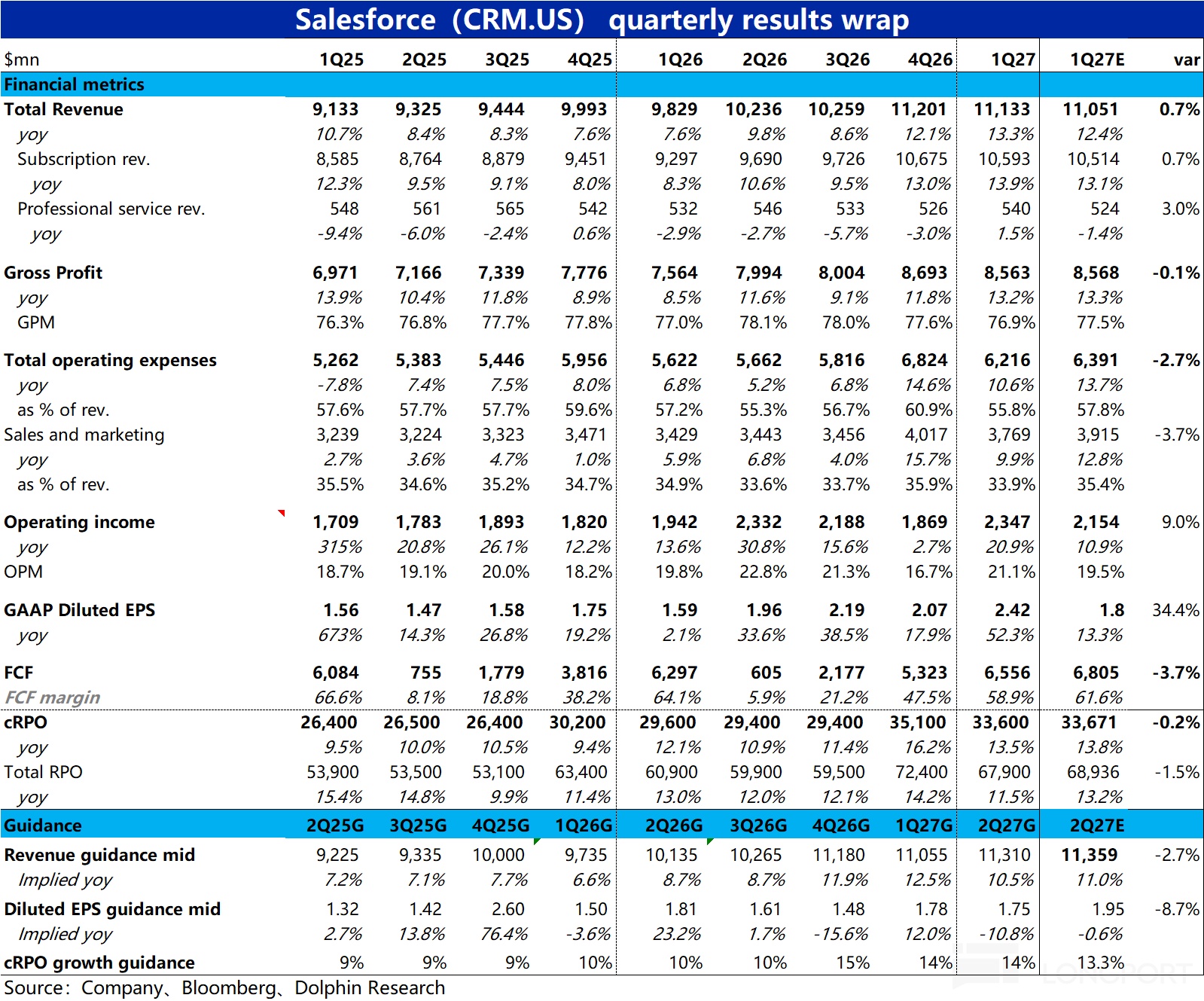
Under the 'AI displacement' narrative, Salesforce (CRM) — a traditional SaaS bellwether under pressure — reported FY27 Q1 (through Apr) after the US close on May 28, with a largely uneventful print. The quarter was fine, with most metrics close to consensus and no catalyst to flip the narrative. Guidance skewed soft: with no clear revenue acceleration, the company trimmed its margin outlook. Specifically:
1) Growth remains unremarkable: Core subscription revenue was approx. $10.6bn, +12% YoY in cc, a modest 100bps acceleration vs. last quarter. However, excluding Informatica consolidation effects, underlying growth was broadly unchanged vs. last quarter.
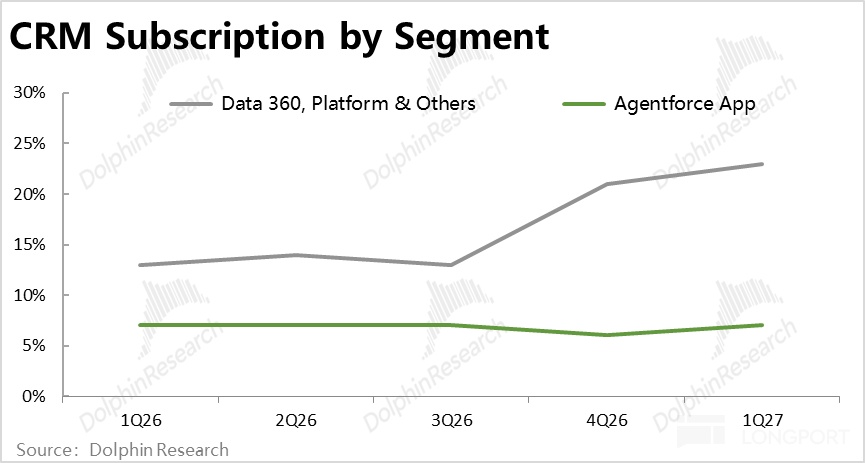
By line of biz, the company revamped disclosures into two buckets: (1) Agentforce Apps, its more traditional applications, grew 7% in cc, unchanged vs. recent quarters. (2) The more PaaS-leaning Data & Platform segment grew 23% in cc, up ~200bps QoQ, which looks solid.Yet stripping out Informatica, the underlying growth is only around 10%, suggesting a much more muted picture.
Across angles, AI has yet to show a meaningful lift to consolidated revenue growth.
2) AI skews upstream; ARR up steadily: Agentforce & Data AI ARR reached $3.4bn this quarter, up $0.5bn QoQ, a modest step-up. Roughly one-third comes from app-side Agentforce, with two-thirds from data/platform layers.This aligns with the notion that AI benefits upstream/mid-layer more visibly, while the lift to end apps is limited or even negative.
AI-related revenue accounted for 8% of total, vs. 6.8% last quarter, inching higher. However, unless AI translates into faster overall growth, the benefit is limited and looks more like internal cannibalization of non-AI revenue.
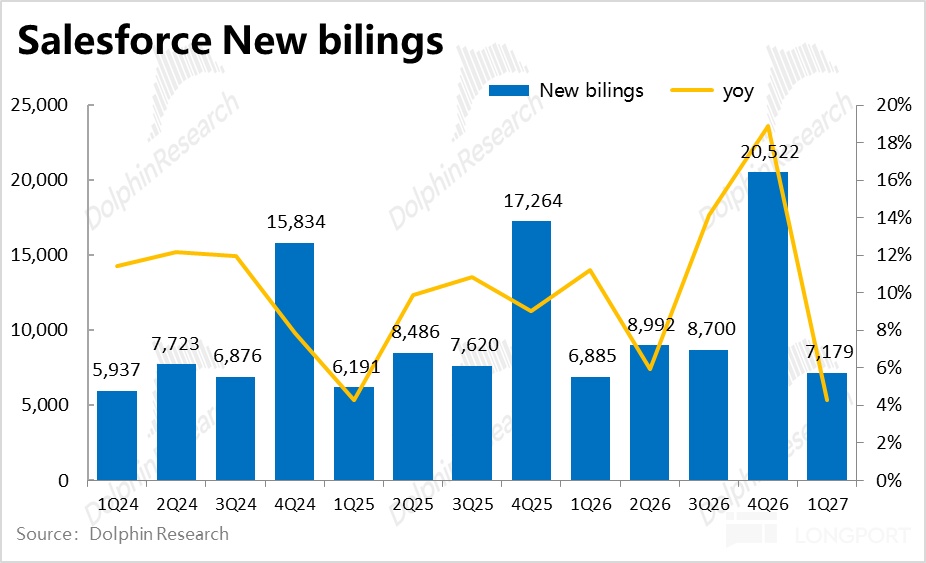
3) Leading indicators also middling: cRPO was $33.6bn, +13% YoY in cc, identical to last quarter's growth. However, new bookings were only about $7.2bn, a cliff drop from $20.5bn last quarter; new bookings grew just 4% YoY, the weakest pace since 1Q25 over the past two years.
This likewise indicates that despite rolling out AI & Agent features, customer demand for Salesforce offerings remains tepid.
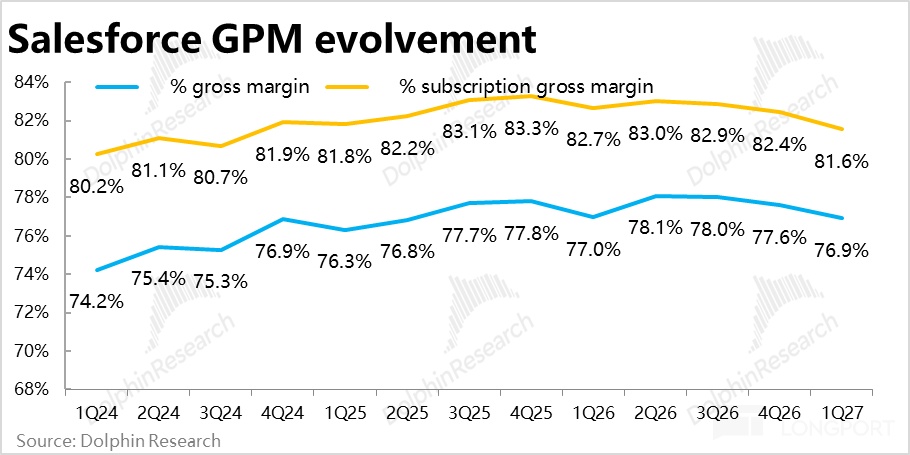
4) GPM continues to trend down: With revenue growth still lackluster, GPM continued to decline. Overall GPM was 76.9%, down sequentially for four straight quarters, and down 10bps YoY.Core subscription GPM fell more, at 81.6%, down 110bps YoY. This implies AI margins are lower than legacy products (unsurprising given higher compute costs), which means even if AI scales, profit may not rise proportionally.
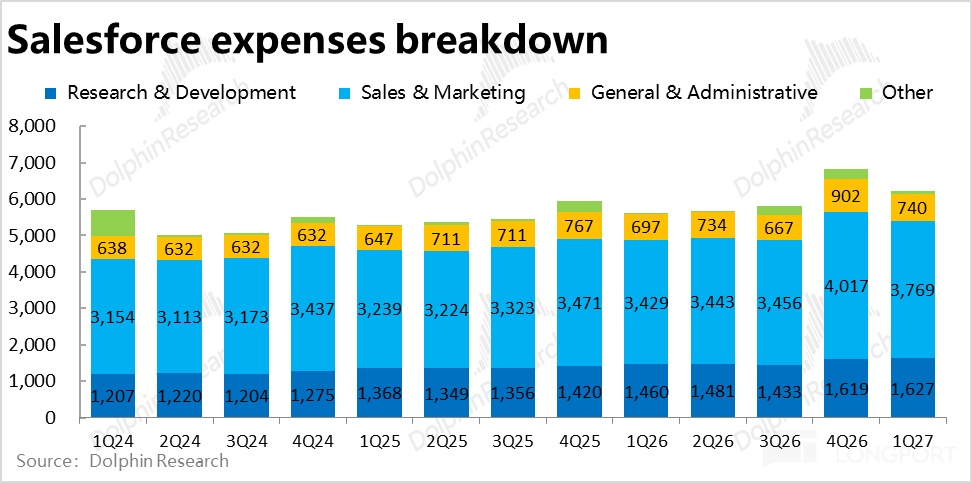
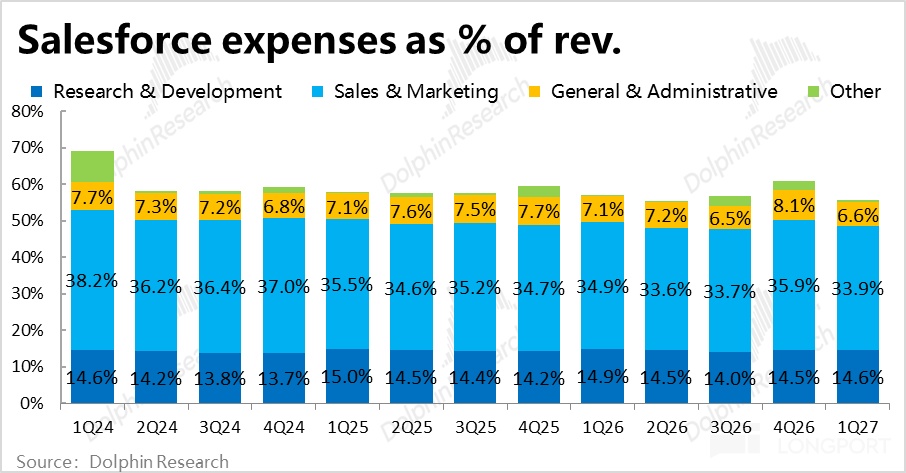
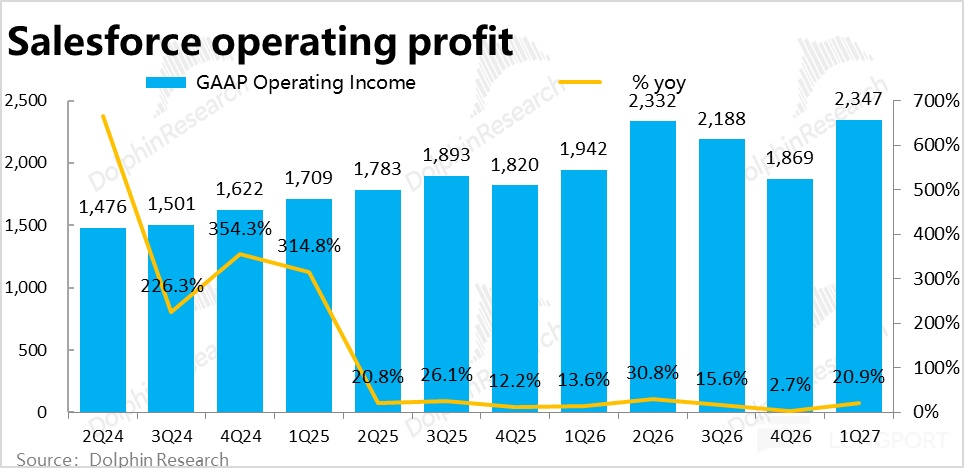
5) Cost control preserved profit, but cash flow was soft: Positively, opex discipline was solid at ~$6.2bn (+10.6% YoY), below revenue and GP growth. Notably, S&M grew less than 10%, under the 12% street view.As a result, despite ~10bps YoY GPM compression, a 140bps drop in opex ratio lifted GAAP OPM YoY, driving OP of ~$2.35bn (+~21% YoY), ~9% above estimates. Operating profit was decent.
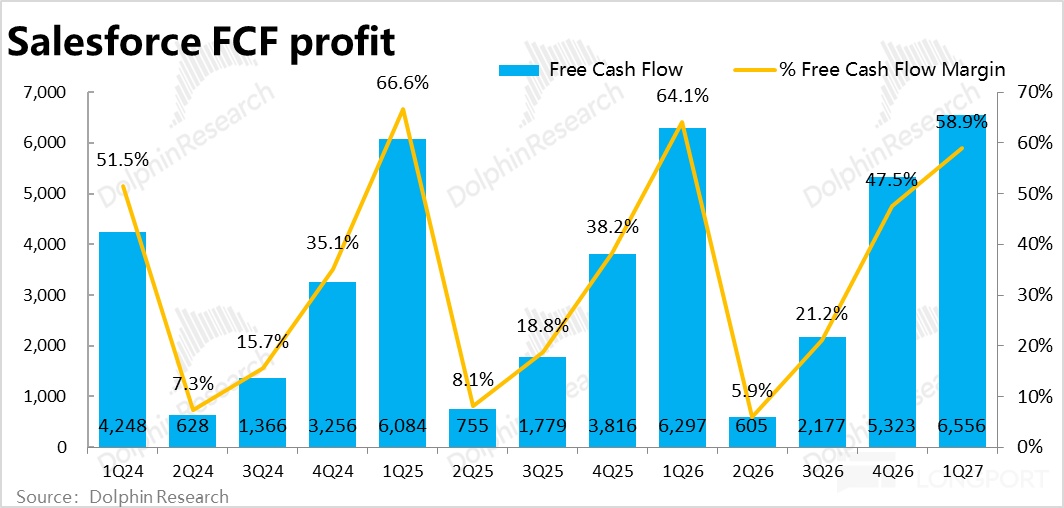
However, FCF grew only 3% YoY, well below the ~8% expected. The gap vs. OP growth stems from light new bookings, with revenue recognition more from consuming prior deferreds, which does not bring in cash.
6) Massive shareholder returns: As we have noted, with growth stuck, capital returns remain a key lever to sustain investor appeal. The company spent $25bn on shareholder returns this quarter alone, vs. just $14.3bn for all of FY26.About $27.1bn went to buybacks, cutting total share count by ~10% YoY this quarter, and less than $0.4bn went to dividends. While unlikely to be the norm, against a ~$145bn market cap, the quarterly shareholder yield was ~17%.
Dolphin Research view:
1) As discussed, Salesforce's results remain lukewarm with few highlights. Key takeaways:
a) Ex-FX and M&A, underlying revenue growth hovers just above 10%, essentially stagnant. This reflects that AI-driven revenue has not materially accelerated overall growth; the data/platform layer logically benefits more, but the actual lift is limited.
b) Meanwhile, higher AI costs pressure margins; with muted top-line progress and declining GPM, profits come under pressure early. Together this is a double whammy of no growth and weaker profitability.
2) Guidance and outlook:
Near term, management guides next-quarter revenue growth of 10% in cc, 200bps slower than this quarter and below consensus. Of that, >4pts come from consolidation, implying organic growth under 6%. cRPO growth is guided at 13% YoY (cc), unchanged vs. this quarter.
Taken together, AI still does not drive a clear re-acceleration next quarter.
On profit, guided GAAP diluted EPS midpoint is $1.75, implying >10% YoY decline, well below the market's roughly flat expectation. Again, growth lacks a step-up while profit remains pressured.
Midterm, for FY27, the company nudged up the low end of revenue guidance, but implied growth remains only 10%–11%, suggesting growth will slow in coming quarters. This mainly reflects the absence of consolidation tailwinds by Q4, though management indicates ex-M&A organic growth may pick up in FY27.
The FY27 changes center on profit, with GAAP OPM guided down from 20.9% to 20.6%. FCF growth guidance was cut sharply from 9%–10% to 4%–5%, implying continued margin pressure from AI investments.
3) Valuation and investment view: per the prior long-term guide to FY30, GAAP after-tax operating profit is around $18bn; applying a 15x PE for a mature steady state implies ~$270bn market cap and ~$290/share, making the current sub-$180 price look quite cheap.That said, with AI evolving rapidly, the achievability of the long-term plan is highly uncertain. On a conservative FY27 view, with 10%–11% revenue growth and 20.6% GAAP OPM, GAAP OP just above $9bn implies about an 18x PE on today's market cap; guided FY27 FCF implies a sub-10x P/FCF.
All in, Salesforce's advantage remains a reasonable valuation, plus outsized buybacks that buttress the downside. Pure derating room seems limited from here.However, both the latest quarter and channel checks suggest muted customer interest in Salesforce's AI and other products. Reasons include: overall IT budgets are mostly flat with incremental dollars going to AI, crowding out spend on SaaS like Salesforce; on Agents, some enterprises prefer more flexible tools like Claude Code over third-party customized agents; and pricing for products, especially mid-layer Platform services, is not particularly compelling.
Thus, while the stock looks cheap, the lack of clear upside keeps us on the sidelines.
Core charts and biz overview:
I. Scope tweak, greater focus on the mid-layer
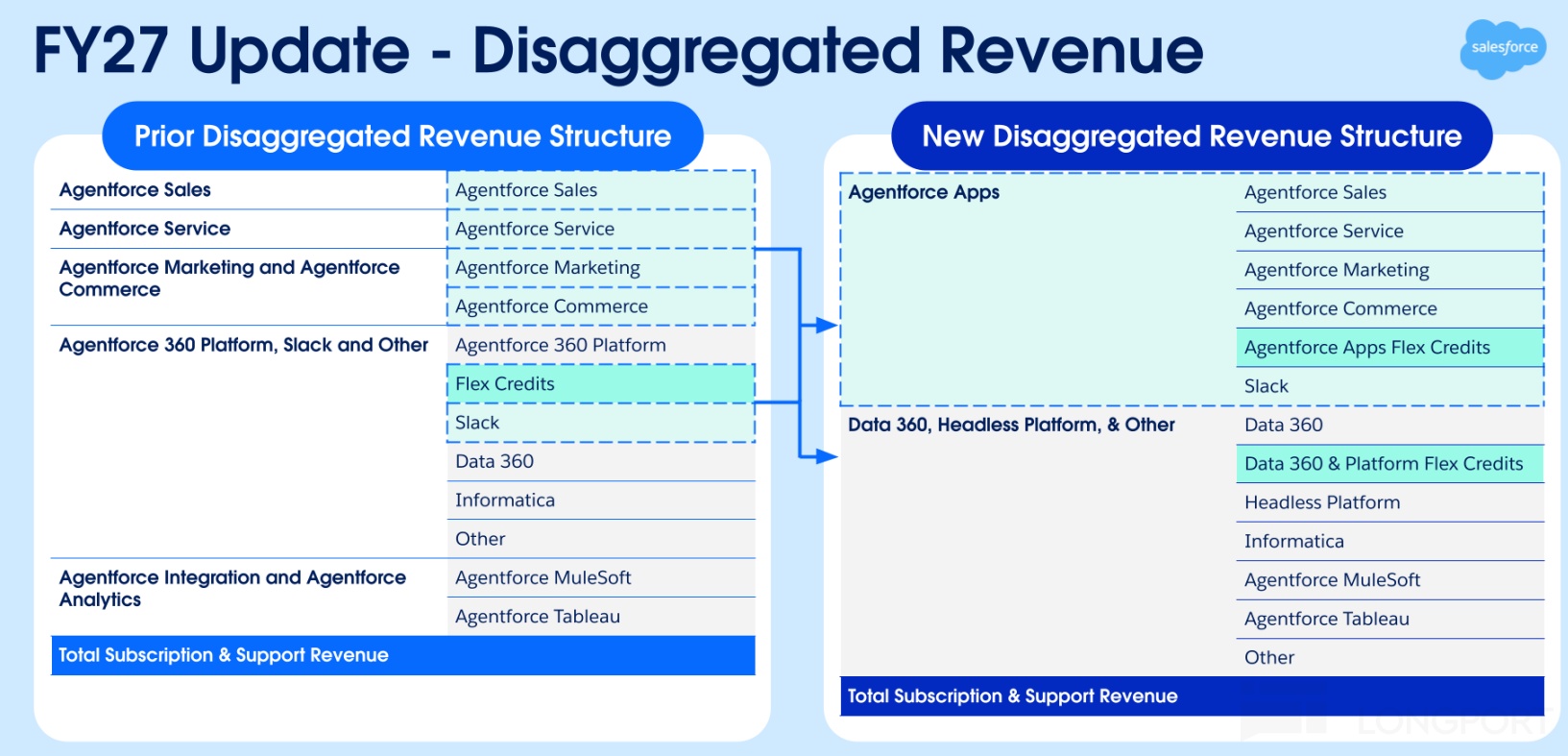
Starting FY27, Salesforce made small changes to segment disclosure. The core subscription revenue breakout shifted from five lines — Sales, Service, Marketing & Commerce, Platform, Analytics — to two buckets: Agentforce Apps and Data 360 & Platform & Others.
Specifically, Agentforce Apps are more SaaS-like, end-user-facing applications including Sales, Service and Slack. Data 360 & Platform skews PaaS, providing platform/data services including Data 360, the new Headless Platform, and acquired businesses such as Informatica and MuleSoft.
Dolphin Research believes the change helps separate slower-growing, more traditional SaaS apps from faster-growing data/platform businesses in the AI era, guiding investor focus to the latter.
II. Revenue growth still stagnant; AI uplift not visible
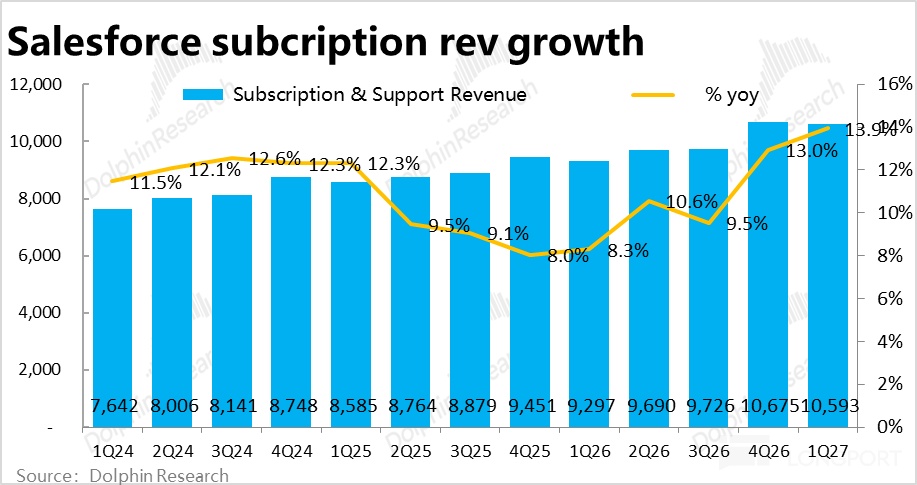
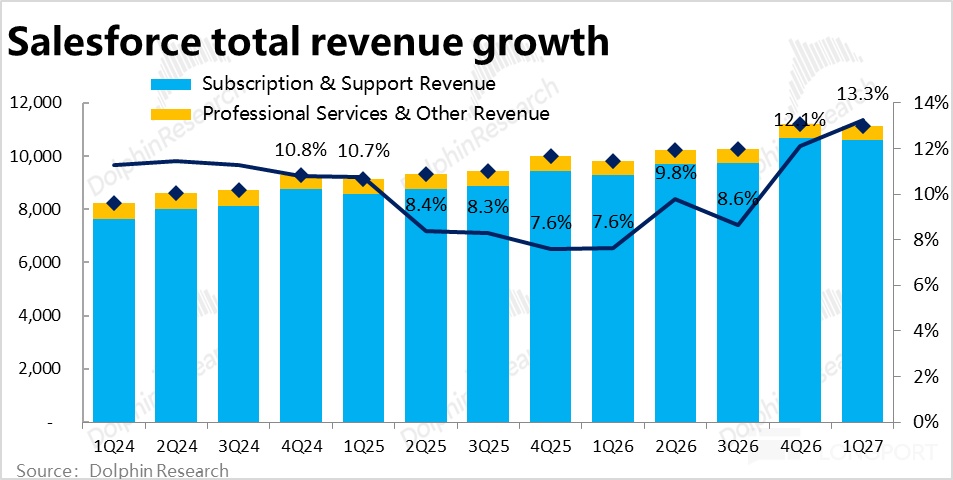
On growth, Salesforce's core subscription revenue was ~$10.6bn, +12% YoY in cc, a 100bps acceleration vs. last quarter. But management indicated Informatica provided a bigger lift this quarter than last, so ex-consolidation growth is roughly flat.
As noted, under the new split, the app-leaning Agentforce Apps grew 7% in cc, essentially unchanged vs. prior quarters, so AI/Agents are providing only minimal lift to legacy apps.
The more PaaS-oriented Data & Platform segment grew 23% YoY in cc, up from 21% last quarter and continuing to accelerate slightly. However, excluding Informatica, the underlying growth is only about 10%, again showing no clear AI-driven acceleration.
Including ~$0.54bn of professional services, total revenue was about $10.6bn, +12% YoY in cc, up 100bps vs. last quarter. Ex-consolidation growth was ~9% vs. ~8% last quarter.
III. New bookings growth hits a new low
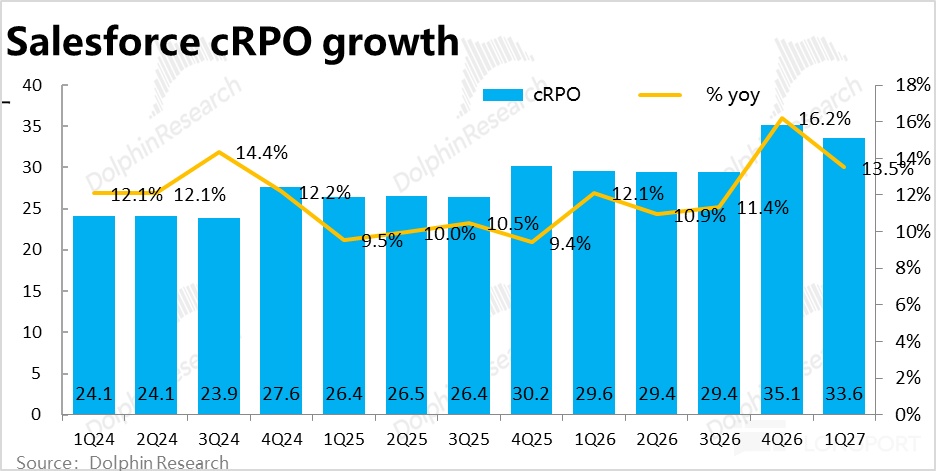
On leading indicators, cRPO was $33.6bn, +13% YoY in cc, identical to last quarter. However, new bookings were only ~$7.2bn, plunging from $20.5bn in the prior quarter; YoY growth was just 4%, the lowest since 1Q25, again pointing to soft demand.
III. No growth pickup, and GPM under pressure
With limited revenue acceleration and likely a higher AI revenue mix, GPM continued to slide. Overall GPM was 76.9%, marking a fourth straight sequential decline and a 10bps YoY dip.
Core subscription GPM fell more (pro services' gross loss improved), reaching 81.6%, down 110bps YoY. We think AI's lower margin and rising mix are the drivers, with higher compute costs and pricing that has not fully shifted from seat-based to usage-based, creating a revenue-cost mismatch.
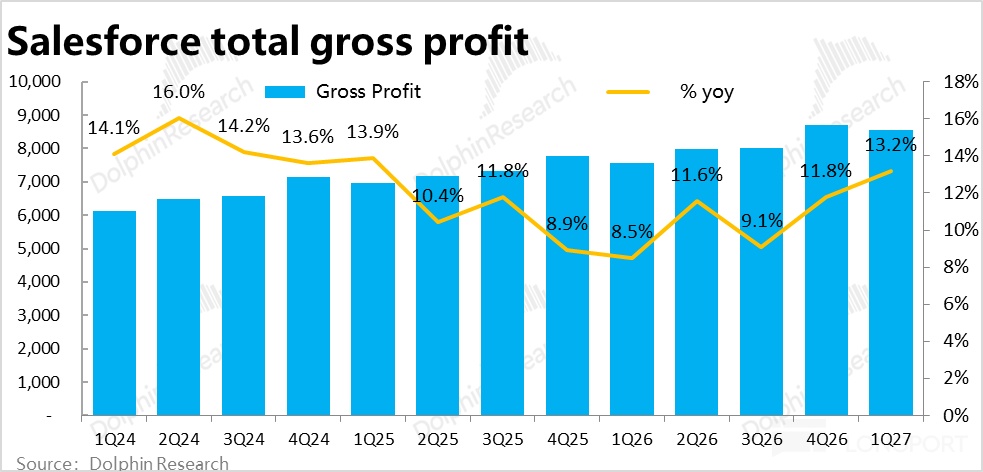
As a result, total GP was ~$8.56bn, +13.2% YoY, slightly below the Street.
IV. Cost control protects profit, but cash flow lags
Encouragingly, total opex was about $6.2bn (+10.6% YoY), below revenue and GP growth. S&M rose nearly 10%, under the 12% market view; G&A grew ~6%, and R&D rose 11.4%.
Aside from R&D, which runs higher to fund new AI features, other opex lines were restrained.
Thus, despite ~10bps YoY GPM pressure, a 140bps drop in opex ratio lifted GAAP OPM by ~130bps YoY. OP was ~$2.35bn, +~21% YoY and ~9% above expectations.
However, FCF grew only 3% YoY, well below the ~8% expected, largely because light new bookings meant limited cash inflows, as in-quarter revenue relied more on consuming deferred revenue.
<End of text>
Past Dolphin Research on Salesforce:
Earnings reviews:
Sep 4, 2025 review ‘Salesforce: Is AI a savior or a death knell?’
Sep 4, 2025 transcript ‘Salesforce (Trans): AI is an assistant, not a killer; SMEs are the new growth vector’
Sep 4, 2025 review ‘Salesforce: Is AI a savior or a death knell?’
Sep 4, 2025 transcript ‘Salesforce (Trans): AI is an assistant, not a killer; SMEs are the new growth vector’
May 29, 2025 review ‘Salesforce: Is the AI agent dream still out of reach?’
May 29, 2025 transcript ‘Salesforce: SME demand strong; doubling down on Agentforce’
Feb 27, 2025 review ‘Salesforce: Agents must spend first to earn later?’
Feb 27, 2025 transcript ‘Salesforce (Trans): The ‘holy trinity’ of apps, data and agents’
Deep dives:
Jan 15, 2025 Initiation II ‘Salesforce: Can a legacy SaaS sprout new growth?’
Jan 7, 2025 Initiation I ‘Will ‘AI’ replace ‘human’? How much can Salesforce benefit?’
Risk disclosure & statement: Dolphin Research disclaimer and general disclosure

The copyright of this article belongs to the original author/organization.
The views expressed herein are solely those of the author and do not reflect the stance of the platform. The content is intended for investment reference purposes only and shall not be considered as investment advice. Please contact us if you have any questions or suggestions regarding the content services provided by the platform.