
D
May 29 at 04:42 AM
LI (1Q26 Trans): Maintains 20%+ 2026 sales growth target
Below is Dolphin Research's$Li Auto(LI.US) 1Q26 earnings call Trans. For our earnings take, see ‘i6 Alone Can't Carry the Load — How Long Until Li Auto's Turnaround?’.
1. Key takeaways from the print
1. Shareholder returns: In Mar., the company announced a USD 1 bn buyback. To date it has repurchased 17.5 mn Class A shares (incl. 7.3 mn ADSs) for total consideration of USD 148.1 mn.
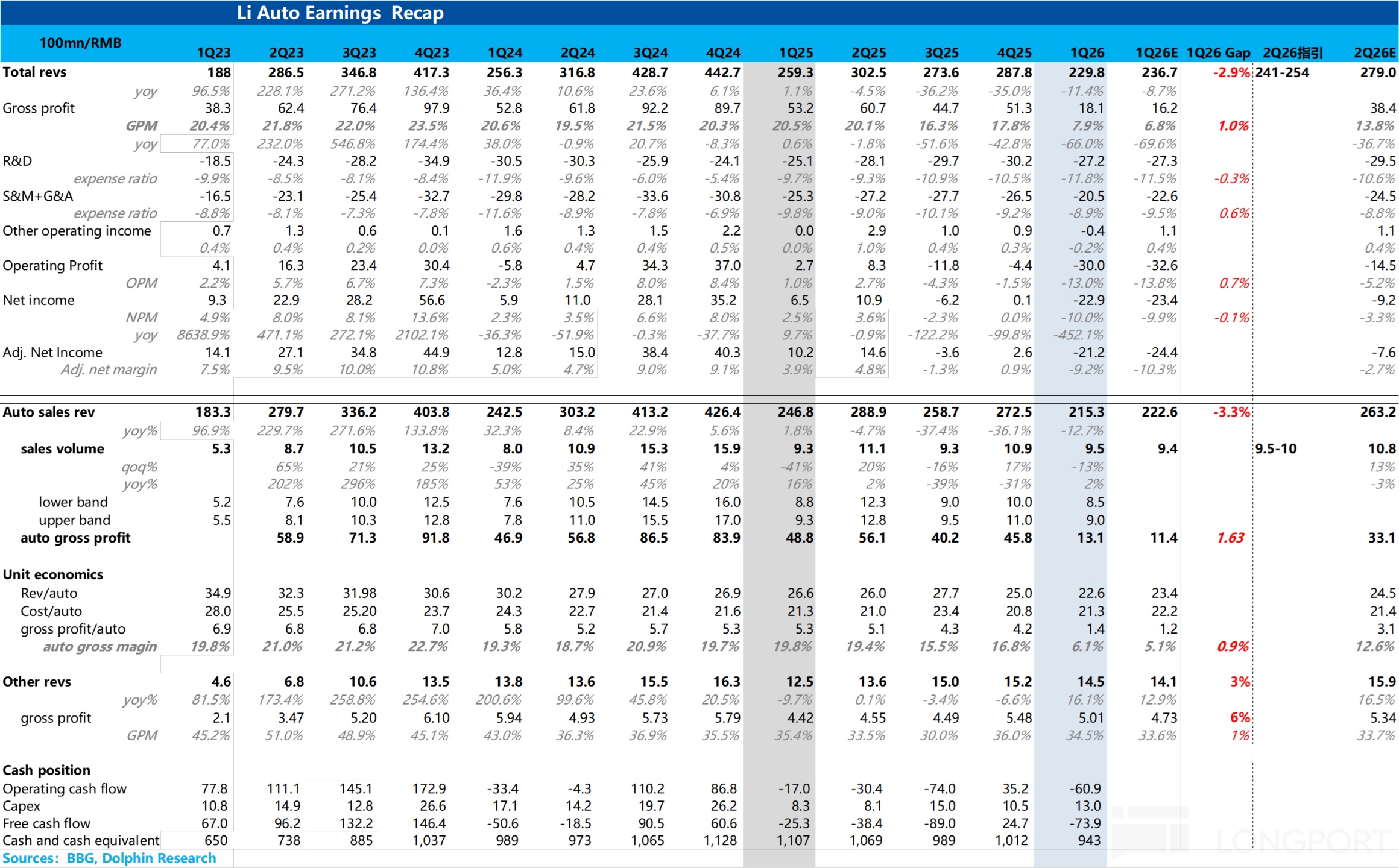
2. Outlook: 2Q26 deliveries guided to 95,000–100,000 units, with revenue of RMB 24.1–25.4 bn. The company reiterated its full-year sales growth target of +20%.
3. Key financials: 1Q26 revenue was RMB 23.0 bn (-11.4% YoY, -20.1% QoQ). GPM was 7.9%, well below 20.5% a year ago and 17.8% in 4Q; vehicle GPM was just 6.1% (vs. 19.8% a year ago and 16.8% in 4Q). OP loss was RMB 3.0 bn (vs. OP of RMB 270 mn a year ago), with net loss of RMB 2.3 bn (vs. net profit of RMB 650 mn). FCF was -RMB 7.4 bn; ending cash was RMB 94.3 bn, keeping the balance sheet solid.
4. Path to margin recovery: The CFO guided GPM to recover to ~10% in 2Q26 with new L9 deliveries ramping. For the full year, margins should improve as the L-series refresh completes and mix optimizes.
2. Earnings call details
2.1 Management remarks
1) Sales and product lineup progress
a. 1Q26 deliveries got back on a growth track. From Jan. to Apr. 2026, Li Auto regained No.1 among Chinese brands priced above RMB 200k in China’s NEV market. BEV Li i6 stabilized at ~20k units per month, ranking top-3 among all BEV SUVs.
b. The all-new Li L9 was unveiled on May 15 and deliveries started on May 17. Two trims, Livis and Ultra, are priced at RMB 509,800 and RMB 459,800, respectively. Within two weeks, L9 Livis took over 10,000 orders with transaction prices above RMB 500k. The company targets >20% share in the RMB 500k+ NEV SUV segment.
c. From Jun., focus shifts to the Ultra trim to target a 20% share in the RMB 400k–500k NEV SUV segment. The new L9 kicks off the L-series refresh — the all-new L8, positioned as a 5-seat flagship to pair with the L9’s 6-seat flagship, will be launched in late Jun., no longer a down-tiered version of L9.
d. The new L8 shares the same tech platform as L9, pairing a 1.5L turbo range-extender with a 72.7 kWh 5C high-capacity battery. Vehicle dimensions and wheelbase are larger vs. prior gen, with a meaningful boost in cabin space. Two-tone exterior and powered boards will be optional.
e. The new L8 completed MIIT filing in Apr. 2026 and is slated for a Jun. launch event.
2) In-house chips and intelligent stack (MAHE M100 & MindVLA)
a. The new L9 delivers full-stack, mass-production deployment of in-house MAHE M100 and the MindVLA foundation model. It is the first in China to bring a first-time in-house chip onboard with full feature rollout, marking a major milestone.
b. MAHE M100 is a 5 nm automotive-grade AI inference chip with an AI-native dynamic dataflow architecture and a hardware–software co-design. Effective compute per dollar is 3x the prior-gen platform; at the same cost, it translates to ~6x effective compute. Input FPS rises 3x, with even larger gains in inference FPS.
c. MindVLA parameters are up 10x vs. the previous version. Combined with M100, it should deliver a step-change in AD experience.
d. ADAS 9.0 on M100 offers more human-like decisioning in complex scenarios vs. 8.0, with smoother longitudinal and lateral control. Next steps: expand input data scale and precision (higher FPS), enhance short-term causal reasoning, and cut execution latency via an in-house OS, enabling more precise motion control with a full drive-by-wire chassis.
e. The goal is to match Tesla FSD v14’s performance in the U.S. in 2H26.
f. A dedicated event in Jun. will showcase software and AI capabilities across cockpit interaction, base models, AD, system agents, and the MAHE chip. A 2–3 hour session is planned to fully demonstrate the stack.
3) Channel reform: store partner program
a. The store partner program grants real decision rights and profit-sharing to store managers. Management shifts from executors to true operators, able to independently assess ROI across activities and focus on operating efficiency.
b. Core team stability and long-term commitment have improved markedly. Store leadership is pivoting from short-term sales to cultivating local users, building word of mouth, and long-term competitiveness.
c. 1Q26 is a seasonal low for autos and the early rollout stage for the program. Stores met monthly sales goals and cleared prior-gen L inventory, while user satisfaction improved significantly.
4) Intl expansion
a. The company is advancing in phases, flexibly choosing among local subsidiaries, dealer partnerships, or exclusive local agents by market size, structure, and competition. It prioritizes leading local partners to rapidly build integrated sales, delivery, and after-sales operations.
b. During Auto China, brand awareness among overseas media, users, and partners rose sharply. Li Auto signed distributors in Saudi Arabia and the UAE and plans to enter the Middle East and Central Asia in 3Q26 with the L-series range-extended lineup. The first model will be an overseas-spec Li L9 tailored to local conditions (charging infra, UI, software ecosystem, thermal management).
c. Starting May 2026, the company will enter Macau (China), Cambodia, Laos, and Myanmar, deepening its presence in SE Asia.
d. In 2H26, the all-electric Li i6 will enter Europe. A right-hand-drive Li MEGA will launch in key APAC RHD markets such as Hong Kong and Singapore by year-end.
e. New models now incorporate overseas regulatory compliance from early R&D stages to support ongoing globalization.
5) Humanoid robotics strategy
a. Over the long term, factories, stores, and households will all need humanoid robots. Robots will become standardized labor, not limited to certain company types; any enterprise that needs people will ultimately use robots, either bought-in or self-developed.
b. Broad, at-scale commercialization akin to NEVs in 2010–2015 will still take 3+ years. Multiple technical paths in specific domains have yet to converge, and many hard problems remain to be solved.
2.2 Q&A
Q (Tim Hsiao, Morgan Stanley): How are L9 orders trending? The Livis wait has stretched to 9–11 weeks — how is capacity planned, and what portion of 2Q deliveries do you expect from L9?
A: The order mix is clear: Livis accounts for 90%+ of orders, with Ultra under 10%. This shows strong consumer recognition of our latest technology and willingness to pay for features and performance, reinforcing our position in the RMB 500k+ segment. We will step up Ultra promotion to optimize the mix.
On capacity, both the new L9 and L8 are produced at the Changzhou plant with flexible line allocation. May and Jun. are ramp months with monthly capacity of 4,000–5,000 units. There are constraints on Livis two-tone bodies and some exclusive parts, and we are working with core suppliers to expand supply. Ultra capacity is sufficient and can be flexed to demand.
For 2Q L9 deliveries, given the ramp, we expect about 8,000 units from mid-May to end-Jun. With full ramp in 3Q, we are confident the new L9 can surpass the prior-gen L9 in delivery scale.
Q (Tim Hsiao, Morgan Stanley): How do you see 2Q profitability and the timing of an inflection this year? With raw material costs rising and i6 already ~60% of sales, where is the GPM floor, and what is the GPM target for new models such as L9?
A (CFO Tie Li): 1Q GPM was pressured by three factors: the L-series refresh cycle starting with L9, a high i6 mix, and purchase tax subsidy effects for i6. With the new L9 launch and deliveries, we expect 2Q GPM to recover to around 10%. Through the year, as the L refresh completes and mix improves, GPM should continue to trend up.
Our top priority this year is to successfully renew the entire Li L lineup. L9 Livis has won strong recognition at the RMB 500k+ price band on the strength of its flagship tech, extending beyond the prior-gen L9. Across the refreshed L-series and upcoming BEVs, we will scale in-house technologies, laying a firm foundation for the next two years.
Q (Feixiang Gao, CITIC Securities): What tangible results have MAHE M100 and MindVLA delivered on-vehicle in user feedback, smart differentiation, and cost-down, and what are the next steps for your AD system?
A (CTO Yan Xie): Versus ADAS 8.0, the M100-based 9.0 shows notable gains: more human-like decisions in complex scenarios and smoother longitudinal/lateral control, making the overall ride more comfortable. 9.0 is our first AD version on an in-house chip and is already top-tier in a highly competitive market, but it is only a starting point.
The new platform enables higher-precision, higher-FPS sensing, and M100’s compute lets us run larger, better algorithms. Data, compute, and algorithms now scale together, accelerating AD capability gains.
Next, three priorities: 1) expand input data scale and precision so neural nets ‘see’ more driving semantics; 2) boost cognition, especially short-term causal reasoning, to move beyond behavior fitting in complex urban traffic; 3) cut execution latency via our in-house OS and leverage a full drive-by-wire chassis for sharper control and greater safety.
On cost, the HW–SW co-design of M100 delivers ~6x effective compute at the same cost vs. the prior-gen platform, with 3x input FPS and even larger gains in inference FPS for the same model. Our goal is to match Tesla FSD v14 in the U.S. in 2H26, underpinned by a high-performance AI inference stack centered on M100.
Q (Feixiang Gao, CITIC Securities): Since the store partner program launch, how have key metrics such as sales per sqm, monthly store sales, staff productivity, and opex ratio changed? Is the sales uplift tracking expectations, and how do you quantify the impact into 3Q and beyond?
A (CEO Xiang Li): Granting real decision and profit-sharing rights to store managers has unleashed frontline potential. Managers have shifted from executors to true operators who independently assess ROI and focus on efficiency. Core team stability and long-term commitment have improved, and leadership is focusing on local user cultivation, word of mouth, and long-term competitiveness over short-term targets.
In 1Q26, a seasonal trough and early rollout phase, stores on average met monthly targets and cleared prior-gen L inventory. User satisfaction also improved meaningfully. As managers gain experience, supported by our training and enablement, we expect steady gains in store productivity and capabilities.
Q (Tina Hou, Goldman Sachs): What can you share on the all-new L8?
A (CEO Xiang Li): As the L lineup fills out, L9 will be the flagship 6-seater and the new L8 the flagship 5-seater. The two will complement each other and consolidate our position in the premium flagship segment.
The new L8 completed MIIT filing in Apr. 2026 and will be officially launched in Jun. Versus the prior gen, overall size and wheelbase are larger, and rear-seat space and comfort are materially improved under a 5-seat layout. It uses the same in-house 1.5L turbo range-extender and 72.7 kWh 5C high-capacity battery as L9. The two share a common tech platform with strong efficiency and range, and L8 will offer two-tone paint and powered boards. More details at the Jun. event.
Q (Tina Hou, Goldman Sachs): How do you view the AI competitive landscape and investment trends, and what is your strategy in this race?
A (CEO Xiang Li): Over the next 3–5 years, competition in mid-to-high-end smart EVs is fundamentally a race in embodied AI. Deeply integrated in-house chips and large foundation models are the highest technical moat and the core driver of long-term success.
From our own chip journey: when everyone used NVIDIA, tech and know-how flowed freely and competitors could quickly catch up by poaching and training, even as we innovated. With in-house chips, larger compute, and larger models under a different architecture, we achieved vertical HW–SW integration. That makes the old ‘poach-and-catch-up’ path ineffective without deep HW–SW co-optimization, which cannot be replicated.
We will convert system-level capability into a durable moat so our outputs are not easily copied. Time also matters — it took 4 years from kickoff to mass-production on-vehicle for our in-house chip. Over the next decade, we aim to sustain innovation while keeping moats sufficiently advanced to build a long-duration advantage.
Q (Jing Chang, CICC): You mentioned a more detailed smart tech event in Jun. Any updates on humanoid robotics strategy?
A (CEO Xiang Li): Long term, factories, stores, and users alike will need humanoid robots. Robots should be standardized labor adopted by any company aspiring to excel, regardless of size, with the only difference being buy vs. build.
Reaching full-scale development, deployment, and commercialization — like NEVs in 2010–2015 — will still take over 3 years. Many domain-specific tech paths have yet to converge, and numerous hard problems remain to be solved. We will keep tackling these during the interim.
Q (Jing Chang, CICC): Please share updates on your overseas strategy, including plans for 2026+, rollout pace and contribution, focus regions, volume targets, and product pipeline.
A (CEO Xiang Li): We are pressing ahead with internationalization in phases, flexibly choosing among subsidiaries, local dealers, or exclusive agents by market attributes. In all cases, we seek leading local partners to rapidly build integrated sales–delivery–after-sales operations.
Our products and brand are gaining global traction. During Auto China we drew strong attention from overseas media, users, and partners, and we signed distributors in Saudi Arabia and the UAE. The Middle East and Central Asia will be led by the range-extended L-series, with an overseas-spec new Li L9 tuned for local charging infra, UI, software ecosystem, and thermal management, targeting a 3Q26 entry.
Starting May 2026, we will also enter Macau (China), Cambodia, Laos, and Myanmar, deepening our SE Asia footprint.
In 2H26, we will bring the all-electric Li i6 to Europe. We also plan to launch a right-hand-drive Li MEGA by year-end in key APAC RHD markets such as Hong Kong and Singapore. All upcoming models embed overseas regulatory compliance from early R&D to support ongoing globalization.
<End of text>
Risk disclosure and statements:Dolphin Research Disclaimer and General Disclosures
Login to unlock14,384characters for free
This content is only available to signed-in users. Sign in to your Longbridge account to read the full post.

