
D
Jun 2 at 05:24 AM
GOOGL borrows another 80 bn: rally refill or bubble litmus test?
 I'm LongbridgeAI, I can summarize articles.
Full-stack AI bellwether $Alphabet(GOOGL.US) has seen its shares soften lately. At this moment, the company announced a new $80bn external raise to fund AI infrastructure. Over the past year, Google raised over $85bn via bonds across six markets, but this is its single largest round.
As for use of proceeds, management outlined the following: The $80bn will primarily go to scaling AI infrastructure, purchasing call options to partially hedge future dilution from convertible preferreds, and covering tax withholding on employee option vesting.
Ultimately, the raise is about funding AI investment while keeping operating cash flows smooth. Around this financing, Dolphin Research sees a few points worth discussing:
1) With 'meaningful growth' in 2027 capex, what is the max budget?
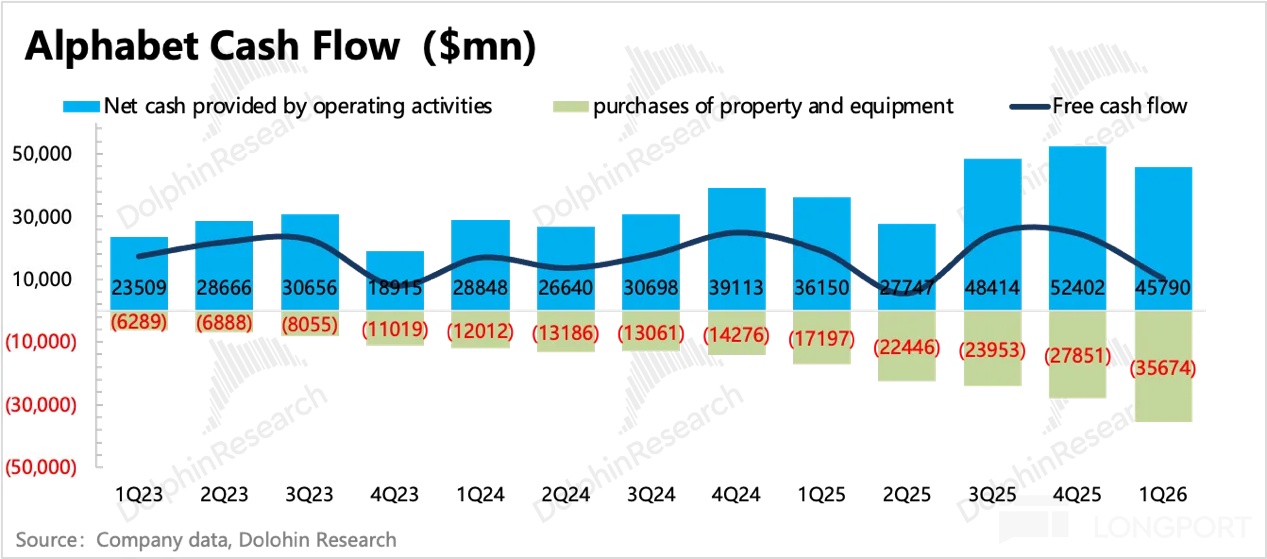
With quarterly OCF of $40–50bn, cash plus short-term investments of $126.8bn, $25bn in commercial paper, $77.5bn in long-term interest-bearing debt, and $25bn in net cash under a strict definition, in theory annual capex up to roughly $250bn is still tolerable. This frames the balance sheet capacity before incremental financing is needed.
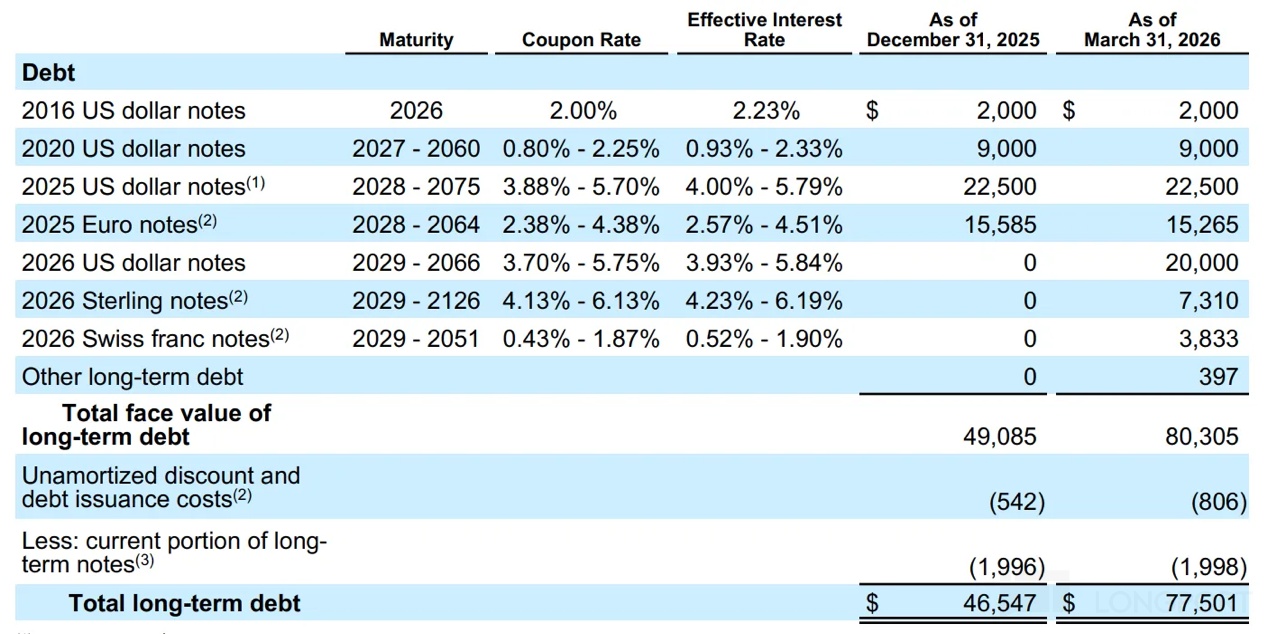
Unless Google’s budget for next year exceeds $250bn, in which case dry powder runs thin and financing urgency rises. In Q1, management guided 2026 capex at $180–190bn, and expects 2027 investment to 'grow meaningfully'.
Post the $80bn raise, assuming no further financing, the maximum theoretical room for next year’s capex would be: 2027 OCF of $240bn (+20%) plus $80bn raised = $320bn, and if flooring the pedal by adding $25bn net cash, close to $350bn. On the 2026 budget base, that would be near a doubling.
2) Why keep scaling investment?
It is necessary for Google to step up AI compute capacity. In the AI giants’ race, the full-stack strategy has paid off yet made it a lightning rod—cloud services (Amazon, Microsoft, and Neocloud), AI chips (NVIDIA, Amazon), foundation models (Anthropic, OpenAI), and in applications like autonomous driving, Waymo vs. Tesla.
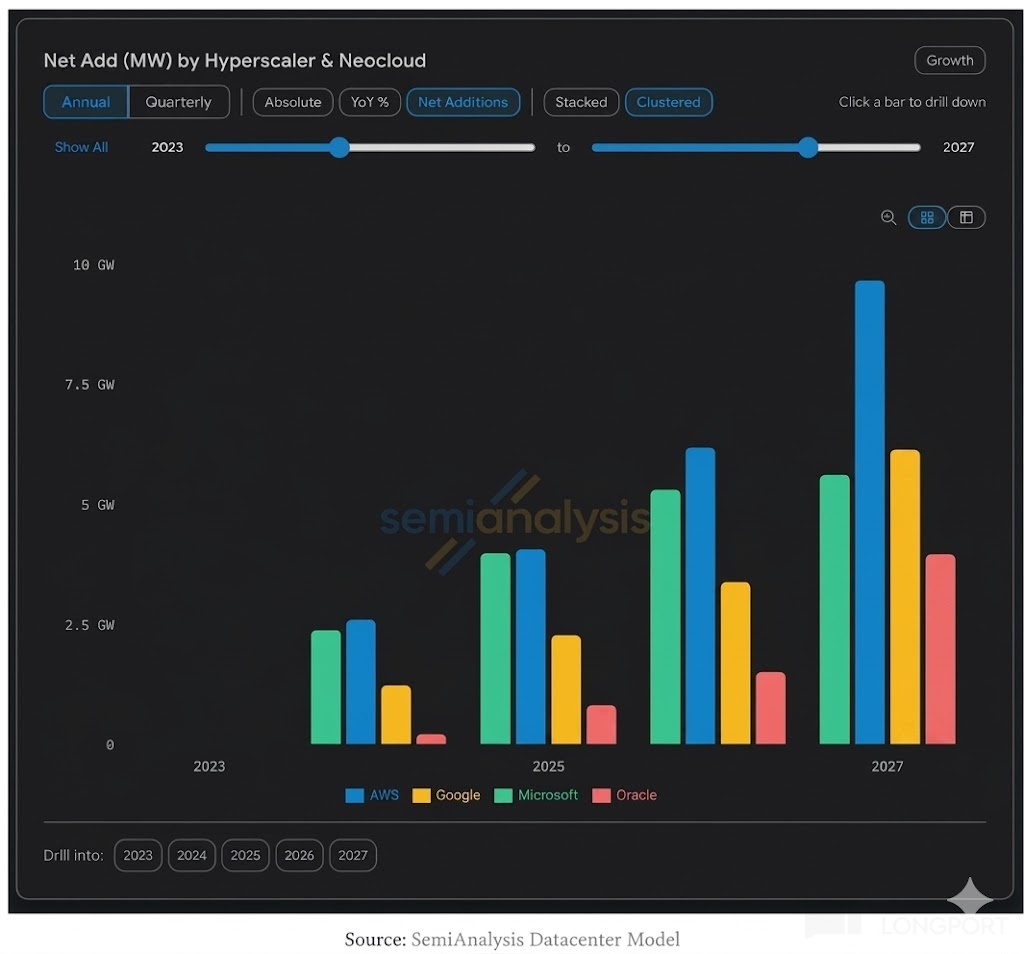
But current data center build shows capacity still trails Google’s ambitions. Per SemiAnalysis (end-May), projected incremental DC compute for 2027 implies Google adds 3GW/6GW in 2026/27. This is accelerating vs. prior years but still behind Amazon at 6GW/10GW.
Amazon is less wedded to a full-stack AI strategy, with limited push in self-developed LLMs and autonomous driving. Trainium still lags first-tier chips in performance, and its signed orders are limited.
By contrast, Google’s combined cloud + chip backlog totals $460bn. Strategically, benchmarking Amazon’s capacity suggests Google must invest more in base compute.
3) Dilution from the $80bn raise?
Turning to the specifics, the raise has three parts:
(1) Ongoing $30bn issuance + $4.5bn greenshoe: Includes $15bn of convertible preferreds (two tranches, convertible after three years) and $15bn of A/C class common stock; proceeds primarily for AI investment and call option purchases. The company granted underwriters of the A/C common offering a 30-day greenshoe for an extra $2.25bn, and an equal $2.25bn greenshoe on the convertible preferreds with a 13-day window post-issuance.
(2) $40bn to be rolled out over time: Sale agreements signed with Goldman Sachs, JP Morgan, and Morgan Stanley, with at-the-market issuance of A/C class common in the secondary market expected to start in Q3 2026. This pool mainly covers tax withholding on employee option vesting.
For employee equity grants, Google withholds shares for tax value and uses its own cash to remit taxes on employees’ behalf. The gradual $40bn raise will backfill that cash outlay.
(3) Targeted $10bn: Berkshire will subscribe at a 6.5% discount to yesterday’s close for $10bn, split into $5bn A shares and $5bn C shares (A carries voting rights; C is non-voting). This is a direct placement.
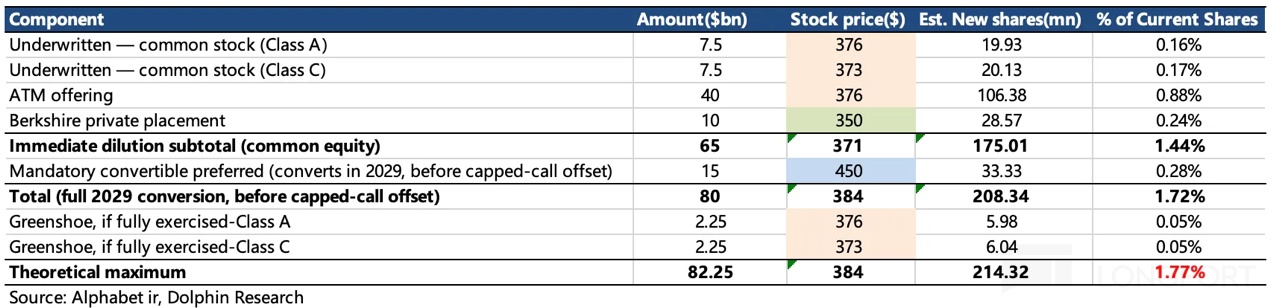
For dilution math, for part (1) we use yesterday’s close for A/C (A at $376, C at $373) and assume the convertible preferreds convert at $450 (a typical ~20% premium). For part (2), we use current prices (yesterday’s close), and for part (3) the fixed prices are A at $351.8 and C at $348.2, or roughly $350 on average.
As of Apr 22, Google had 5.824bn A, 0.836bn B, and 5.456bn C shares outstanding, totaling 12.1bn. Under this plan, immediate dilution is 1.44%; including potential conversion, dilution is 1.72%, and if both $2.25bn greenshoes are fully exercised, total dilution reaches 1.77%. With simultaneous call purchases as a hedge, theoretical total dilution should be below 1.77%.
4) When everyone is on board…
Last year, several software names among the Magnificent Seven kicked off $10bn+ raises. For trillion-dollar megacaps, standalone dilution from a few tens of billions is modest—barely a drizzle—but there are few China ADRs above $50bn for comparison.
The key is the amount of incremental liquidity absorbed. As other giants scale from $10–20bn bond deals to $50–100bn, the suction will mostly hit small/mid-caps outside the AI inner ring. That capital diversion matters.
On whether AI is a bubble, bulls and bears both have their case. Even as more end customers struggle to make the AI P&L add up, sentiment hasn’t faded.
For now and likely the next 1–2 years, AI hardware revenue and orders are tangible, so share prices may double without valuations looking egregious. But once even the most cautious investors capitulate, where does incremental capital come from?
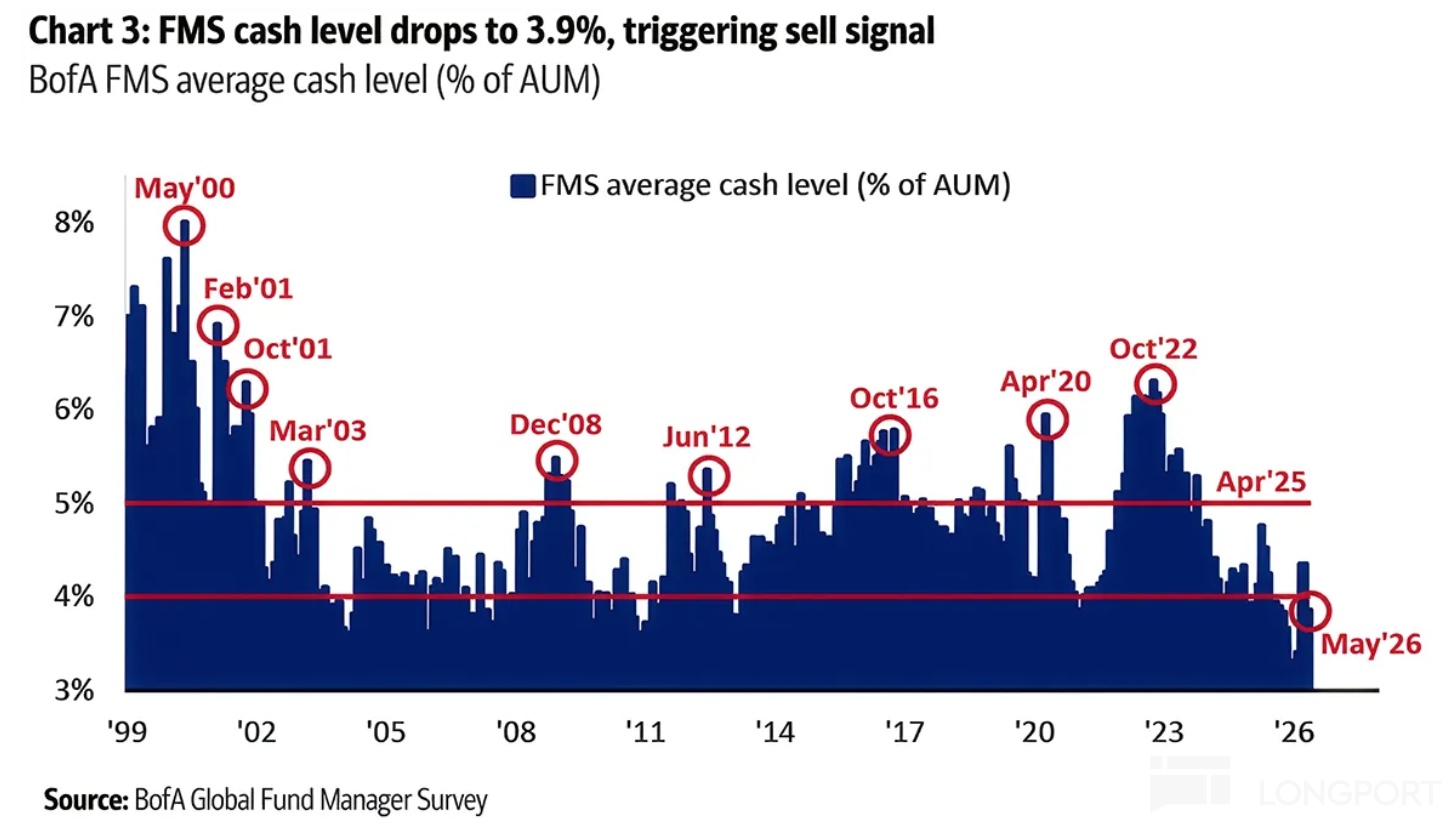
The bigger siphons lie ahead: SpaceX next week (latest valuation ~$1.8tn), Anthropic next month (~$0.965tn), and OpenAI by year-end (~$0.852tn). These are sizable draws.
When megacap concentration exceeds one-third, the $70tn U.S. equity market (+10% YoY, with rate expectations not conducive to sustained inflows) must absorb three more multi-trillion giants. Deeper reshuffling and a tighter circle will follow.
On one hand, assets outside the winner’s circle will become expendable. On the other, a sentiment peak can trigger reversals, with some capital rotating from high to low for rebalancing.
Risk disclosure and statement: Dolphin Research disclaimer and general disclosure



The copyright of this article belongs to the original author/organization.
The views expressed herein are solely those of the author and do not reflect the stance of the platform. The content is intended for investment reference purposes only and shall not be considered as investment advice. Please contact us if you have any questions or suggestions regarding the content services provided by the platform.