
D
Jun 16 at 03:35 AM
SOFI in Muddy Waters' Crosshairs: Fintech Newcomer or High-Tech Hype?
 I'm LongbridgeAI, I can summarize articles.
$SoFi Tech(SOFI.US) has been public for five years, cycling through labels from the next Lending Club to a growing digital bank, and even a high-volatility financial meme stock. Since its 2021 listing, the share price has repeatedly stumbled, hitting as low as 60% of its IPO valuation at the trough in 2022.
Even after clawing back, SoFi has stayed in the headlines. In Mar., Muddy Waters launched a short attack, and while its thesis is not baseless, we will unpack it in the next piece. Regardless of the allegations, management frames SoFi as a membership-based one-stop financial platform, with sustained user growth (albeit with a broad definition) as its backbone, and meaningful upside from product expansion and cross-sell over time. The CEO bought $500k of stock on the day the short call was announced, adding to a $1mn purchase in early Mar., a clear show of confidence.
Years of capital-intensive growth and a founder scandal meant that for a 15-year-old platform, a full decade of evolution was essentially indistinguishable from a lender. Only in the past five years, as acquired SaaS capabilities, platform monetization, the resumption of student-loan repayments, and new borrowing caps for federal student loans under the 'Biden plan' kicked in, has SoFi been able to tell a more compelling growth story.
As a result, questions linger over whether SoFi deserves Fintech-level multiples. At the same time, its high penetration among middle-income households is notable, and viewed through an LTV lens, the core user value SoFi captures has clear long-term potential.
In this first installment, Dolphin Research begins coverage of SoFi, focusing on its biz. model and operating logic. The follow-up will dissect potential risks via a walkthrough of the Muddy Waters report and culminate in a fair value view.
I. Killer Move: Targeting HENRYs
As a next-gen Fintech name in the vast yet hyper-competitive U.S. market, SoFi’s entry point and expansion path are distinctive. In short, it cherry-picks high-potential young users via student loans, rides the digital wave, and secured critical licenses early, carving out a lane in a red-ocean market. Founded in 2011, it has grown into a lending-centric one-stop platform with over 14mn members in 15 years.
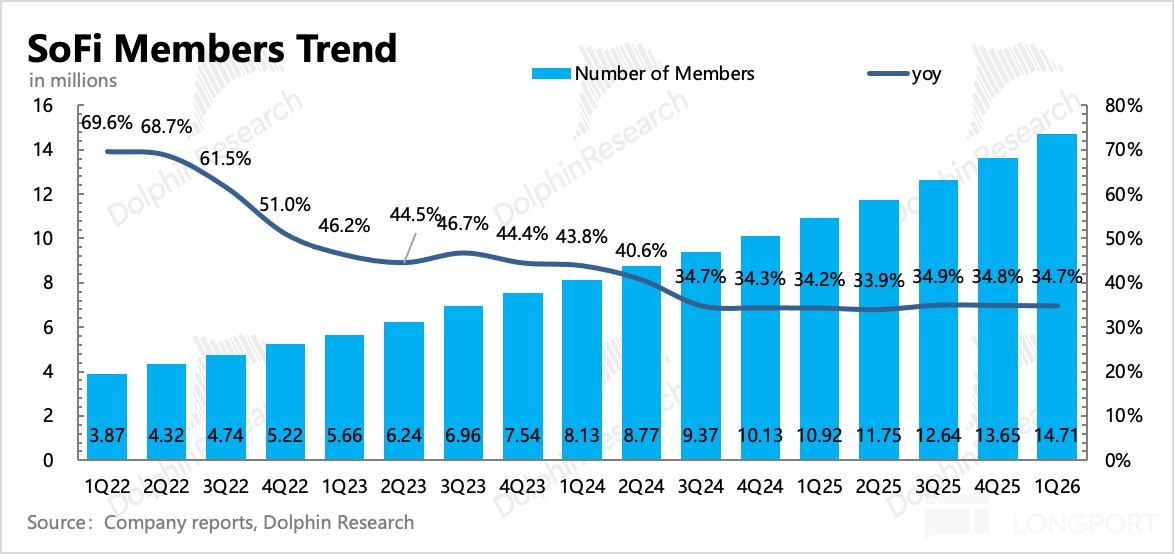
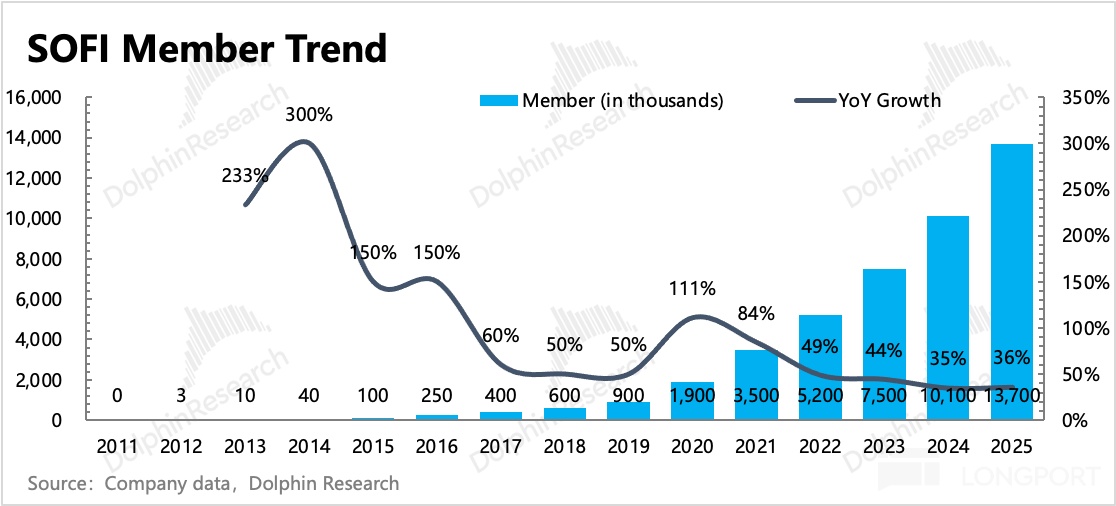
Member growth is SoFi’s best talking point. While financials fluctuate across cycles and phases, the core growth engine—member count—has remained on a strong trajectory. Helped by pandemic-era online tailwinds and brand lift from the IPO, SoFi has delivered a 40% 5-yr CAGR in members.
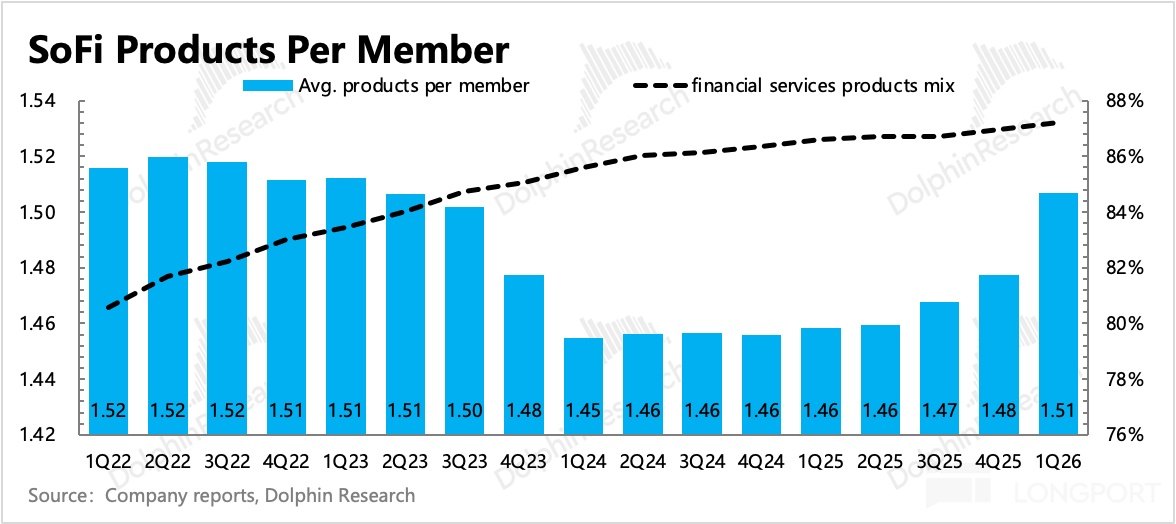
That said, the 13.7mn member tally is inflated by a loose definition (sign-up counts without funding or borrowing), and still trails leaders, suggesting part of the growth reflects a low base. Even so, with lending still the primary, lower-frequency use case (higher-frequency services like investing and payments remain early and sub-scale), SoFi has grown fast while maintaining stickiness, pointing to brand mindshare: (1) products per user have held steady as the base scaled, with higher-frequency financial services used more per capita; (2) 30–40% of new feature sales come from cross-sell to existing users.
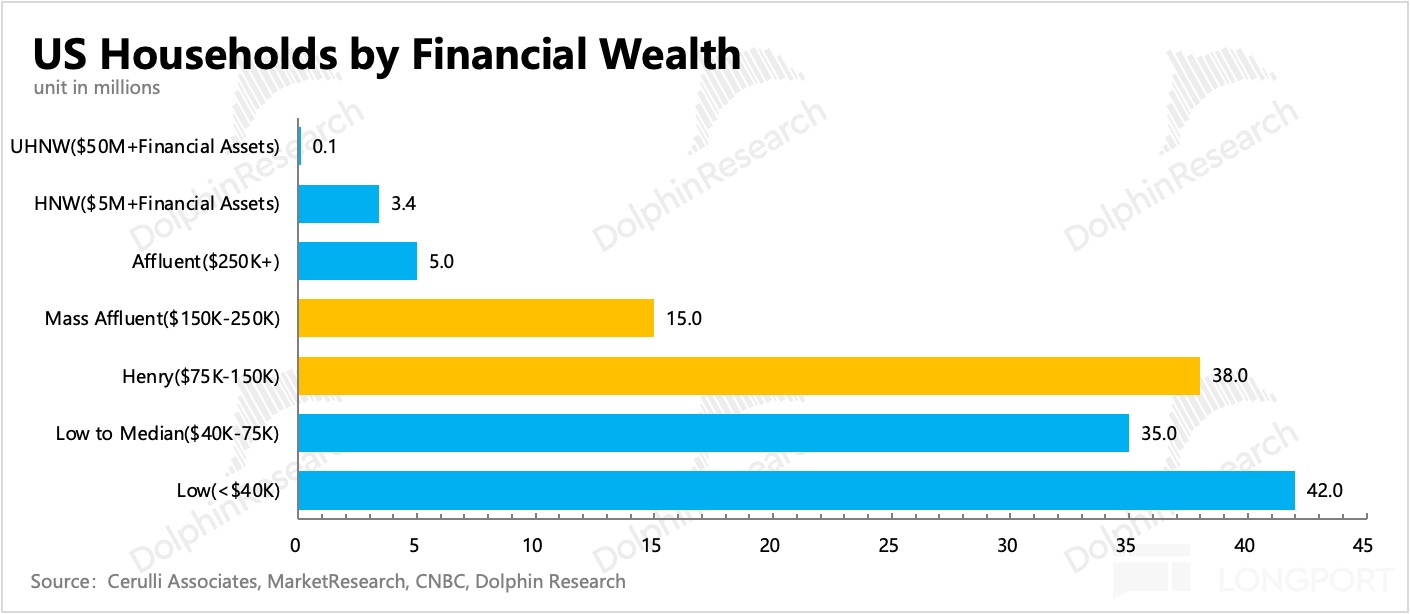
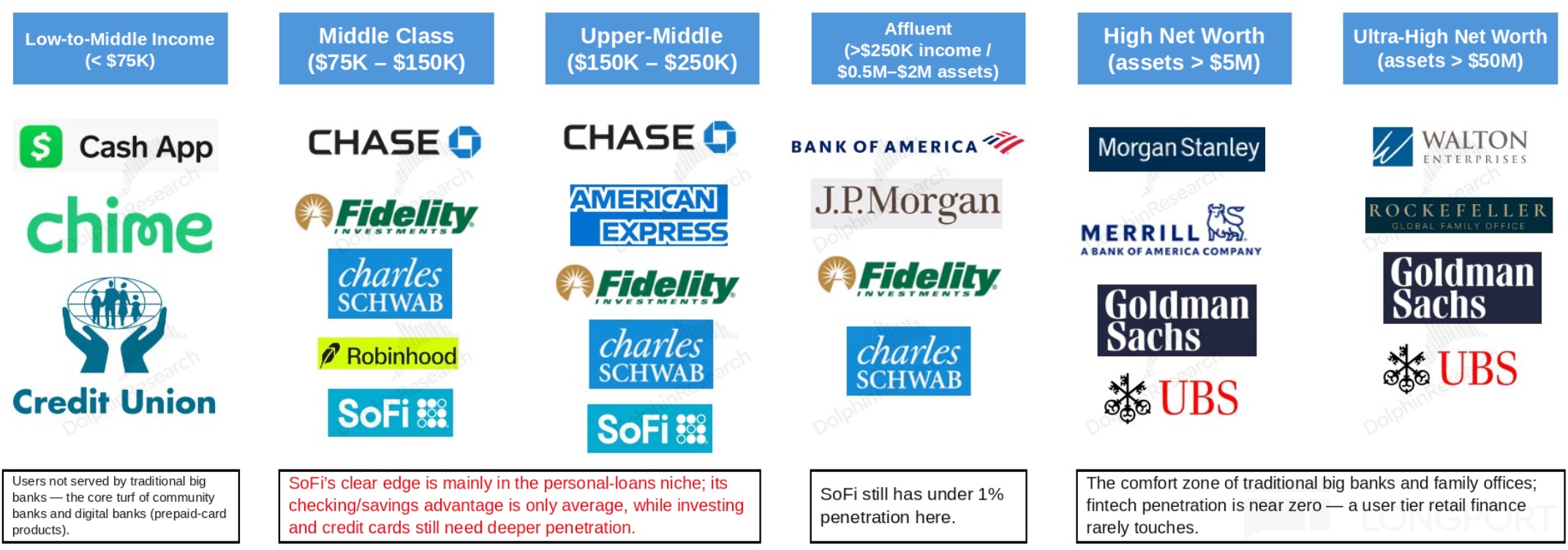
Management guides to 30% member growth in 2026. If achieved, the year-end base would approach 18mn. Assuming these users are concentrated in the targeted middle-income cohort (U.S. households earning $75k–$250k), implied penetration would reach 26%.
In the U.S., to maximize user value, lenders typically expand into adjacencies after initial acquisition to drive cross-sell, lower marginal CAC, and raise efficiency and moats. For users, once habits form, switching is rare. According to JD Power, the annual churn rate for U.S. financial institutions is under 10%, so segmenting by user cohorts rather than product lines better reflects the competitive landscape over time.
SoFi’s focus cohort—the 'entry-level affluent'—are households with higher income but limited assets, often young professionals in high-paying fields like finance, law, CS, and medicine. They are known as HENRYs—'High Earners, Not Rich Yet'.
Lacking collateralizable assets, they struggle to secure favorable mortgage rates from traditional banks. They also prefer digital products, and legacy players are slow to iterate, leaving unmet demand for Fintechs like SoFi and Upstart to capture.
Among peers, SoFi stands out for broader product coverage and relatively attractive rates, while targeting borrowers with stronger FICO scores. This yields a higher-quality book by design.
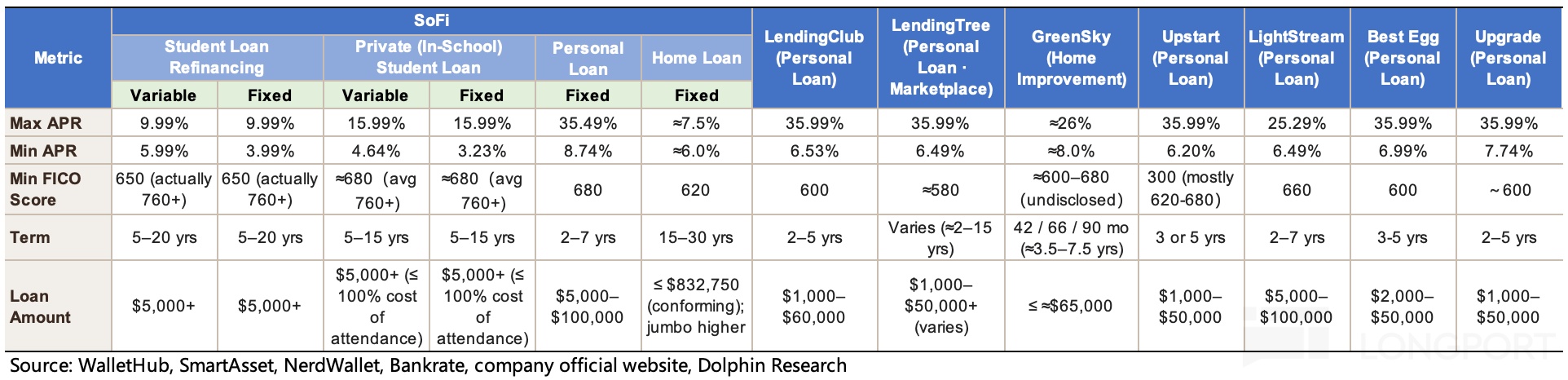
As more players—especially incumbents—move on this attractive segment, SoFi will face stiffer competition if it aims to reach a 50% penetration by year-end. Specifically: (1) Within HENRYs, cards, checking, brokerage, and personal loans see direct competition from Chase, Bank of America, Fidelity/Schwab, Robinhood, LightStream, Upstart, among others.
(2) For broader expansion, down-market SoFi runs into Chime, Cash App, and community banks, while up-market it faces Schwab, Bank of America, and JP Morgan. Before assessing future winners, we first review SoFi’s prior playbook to surface core advantages.
II. From the Ivory Tower to a One-Stop Finance Platform
- Origins: Fixing federal-loan pain points + community-led operations
SoFi began as a tuition-loan fund for Stanford GSB students, crowdsourced from 40 alumni (later from private credit and user deposits). It offered rates 1–2ppt below federal loans and leveraged alumni ties for internships, effectively running a club model for lending. The model quickly scaled to Harvard, MIT, and others, creating an elite, networked ecosystem with social capital.
Higher-ed costs are a heavy burden for typical U.S. families. Over the past three decades, sticker prices climbed for 20 straight years, roughly tripling to quadrupling. Even in real terms, average tuition for 2-yr/4-yr public and private non-profit colleges rose ~48%/~74%/~100%, while real disposable income grew only 26%.
For the 2025–2026 year, average public university tuition is ~$30k per annum, vs. a median household income of ~$80k, exceeding 30% of income. Private tuition is often double that, raising the burden further.
As a result, ~50–60% of undergrad and grad students take loans, and many years post-graduation, nearly 40% of balances remain outstanding. Borrowers aged 40+ account for 40%+ of total federal student loan balances.
Student loans now rival auto loans in outstanding balances among U.S. consumer credit categories.
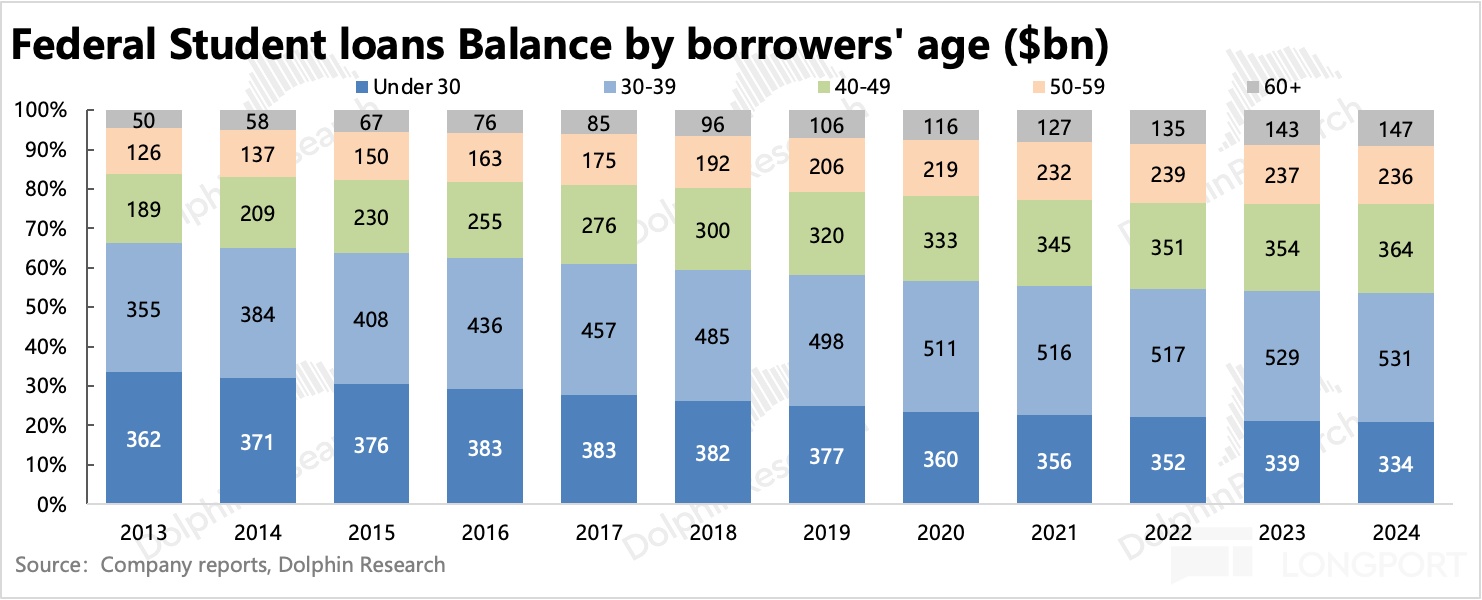
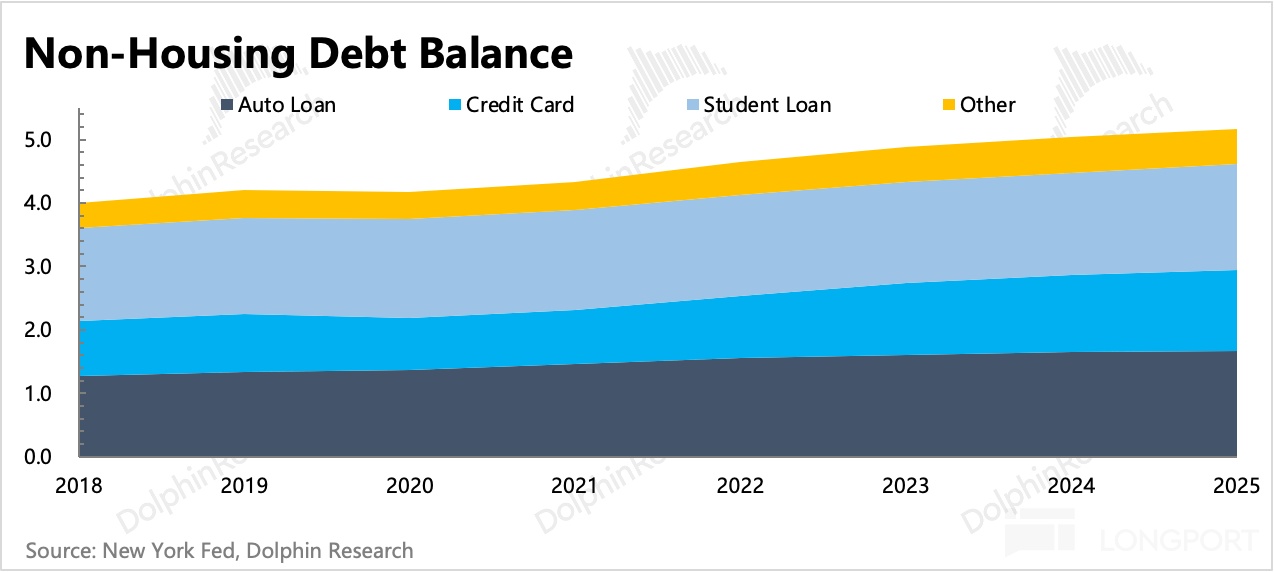
Federal student loans are effectively a paid subsidy to all higher-ed students, with no underwriting hurdle and uniform rates. This one-size-fits-all approach breaks with basic lending economics—interest compensates for default risk and funding costs, so prime borrowers should not subsidize higher-risk ones.
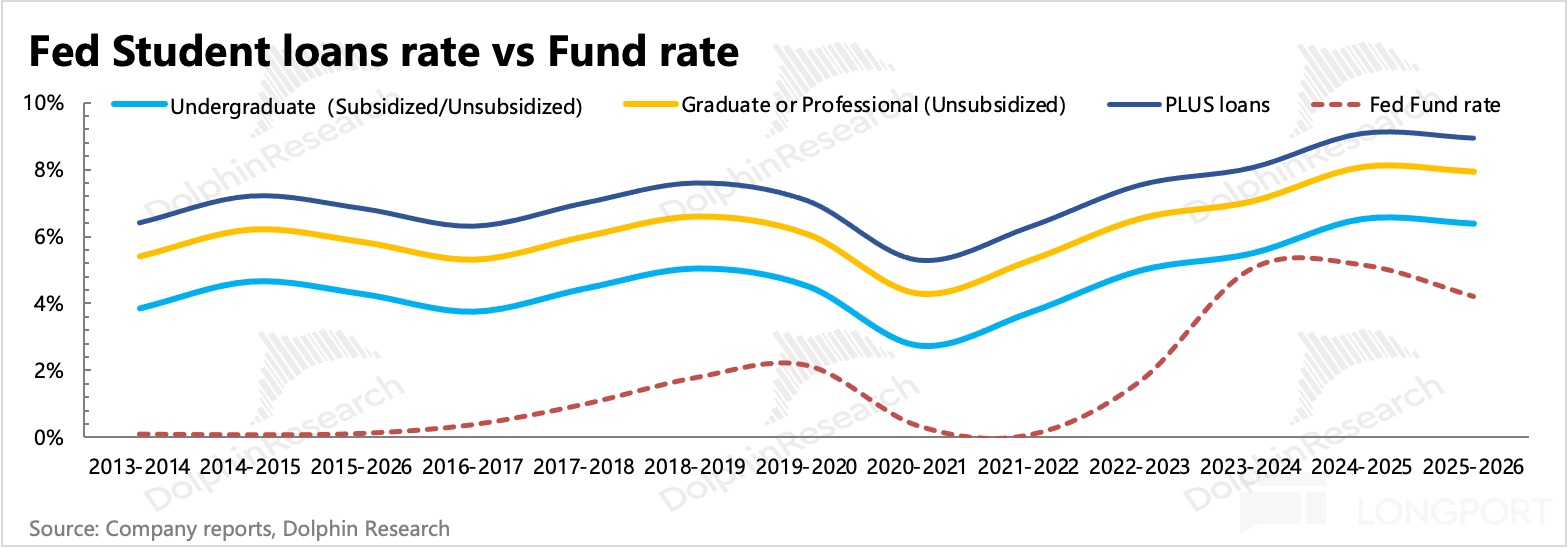
Refinance lenders like SoFi entered to offer lower-rate unsecured loans to graduates from top schools with high-paying offers, to refinance their federal loans. Versus private student lenders, SoFi’s edge has been access to high-quality borrowers with superior profiles (higher FICO, elite schools, etc.).
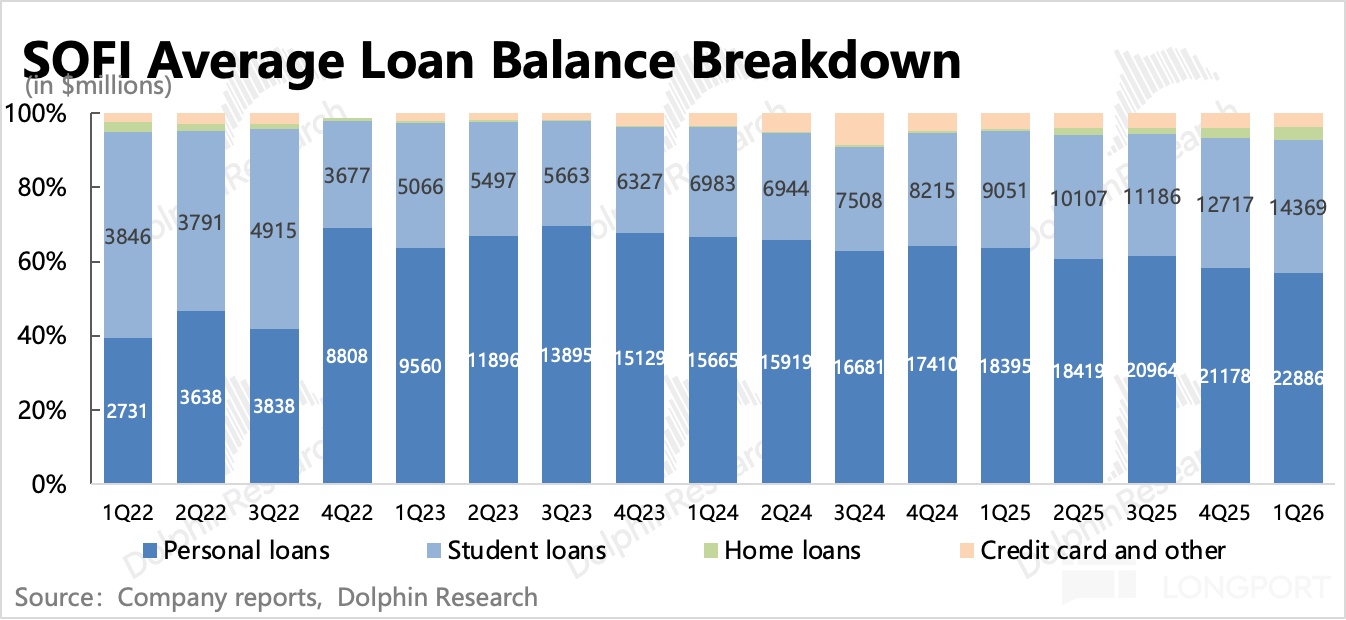
As of 1Q26, student loans remain a key pillar, at over one-third of total loans. After federal loans resumed interest accrual in 2023 (with a one-year grace period through Sep. 2024 where missed payments did not trigger default), refinancing demand rebounded fast. Quarterly originations jumped ~3x, from ~$400mn per quarter in 1H23 to over $1.5bn per quarter in 2H25.
Starting this Jul., new federal caps under the 'Biden plan' take effect for student borrowers. Historically, 38% of borrowers exceeded those caps, suggesting incremental spillover refi demand that SoFi can capture.
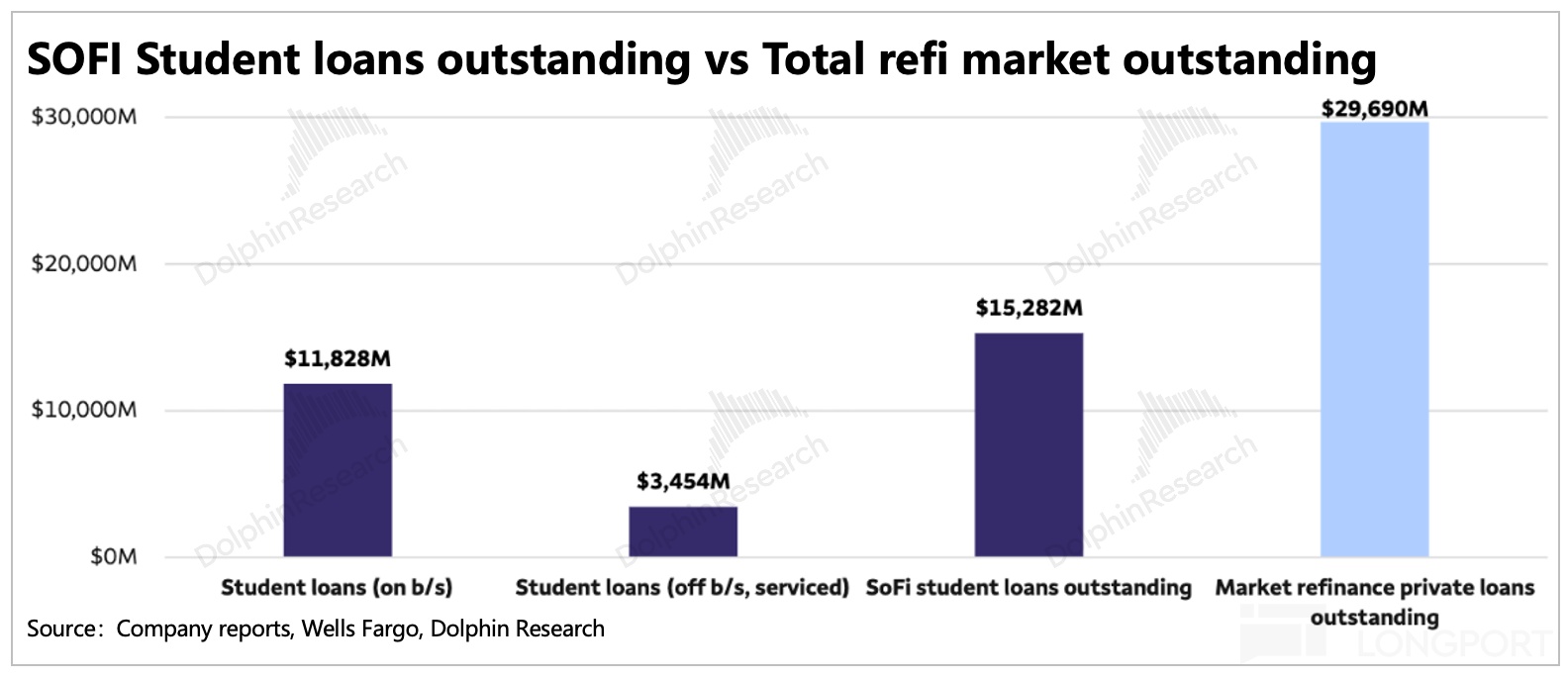
Within the category, SoFi’s student-loan refi balances (both held and serviced for sold loans) account for ~50% of the private refi market, making it the clear leader.
2) Expansion: Stacking services to drive cross-sell and stickiness
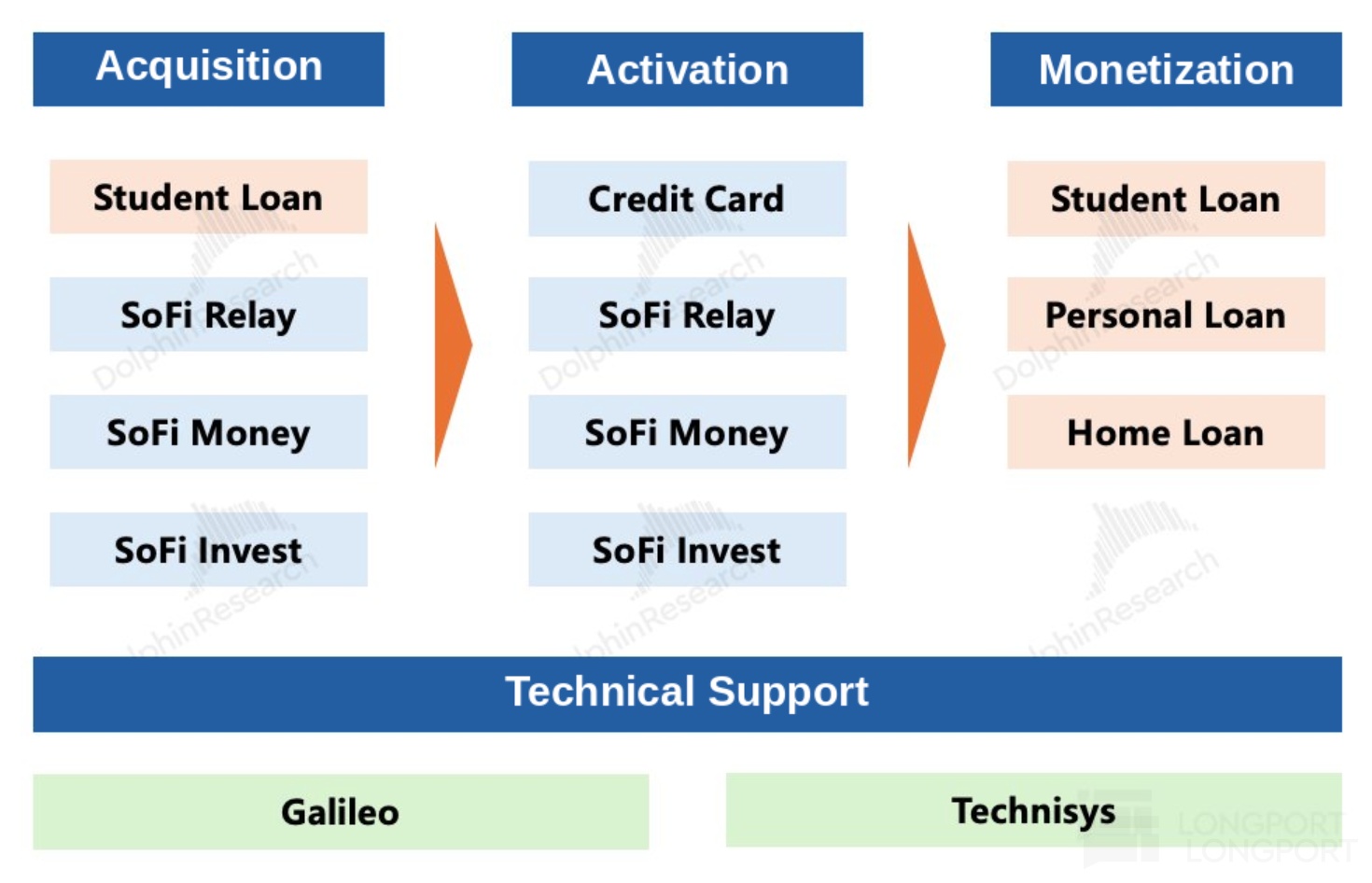
High-quality users are SoFi’s core asset, but student loans are largely one-off. To retain users, SoFi followed the life-cycle to add mortgages, personal loans, savings, credit cards, and brokerage.
Even so, its first non-lending product (SoFi Invest) arrived only in 2019, eight years after founding. By 2018, SoFi already had 500k users and a $4bn+ valuation, but operations were still centered on a single lending business.
In lending, the signature is a community membership model—founder Mike Cagney emphasized 'members' over 'customers'. After his 2018 departure amid scandal, CEO Anthony Noto, drawing on NFL and Twitter experience, doubled down on digital and the one-stop strategy atop the membership ethos.
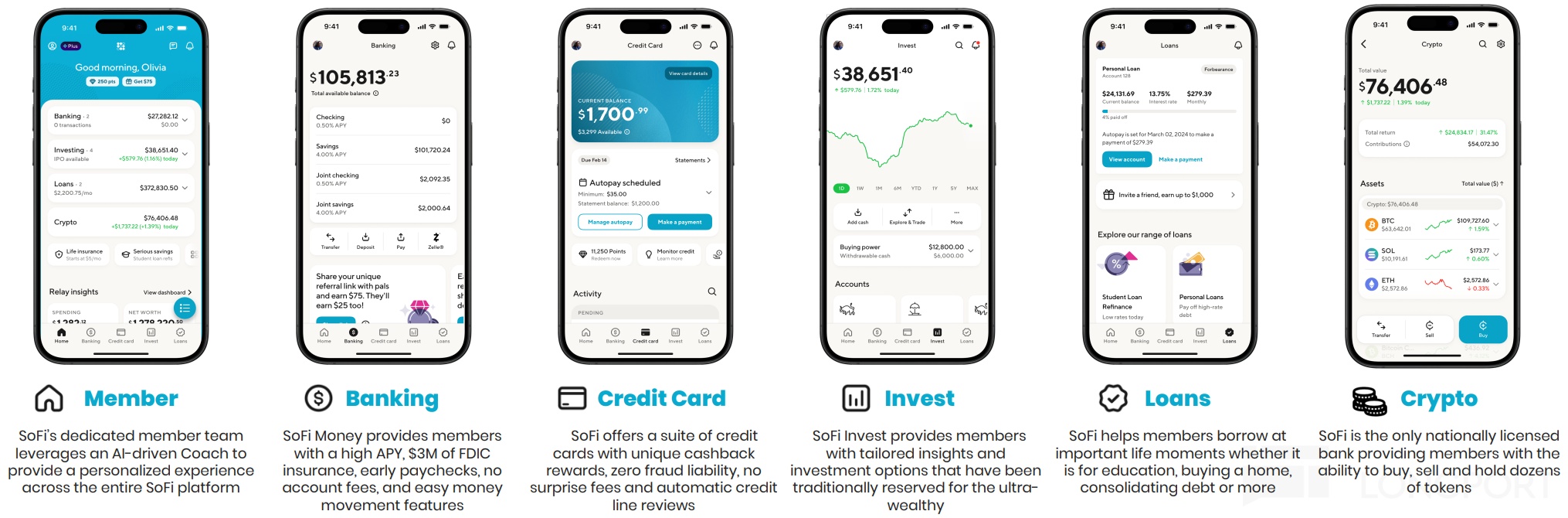
On ARPU, lending monetizes better than brokerage or payments, but its low frequency demands constant acquisition, driving higher CAC. Hence, banks and brokers use high-frequency services as acquisition tools and monetize downstream with lending—e.g., zero-commission brokers earn from margin lending, and banks attract deposits to fund higher-yield loans.
For SoFi, customized, lower-rate student refi is a strong acquisition hook, but rates alone are not a moat and are easy to copy. Early on, SoFi layered on value-added services and social referrals—career coaching, job placement, and alumni networking—to attract prime borrowers.
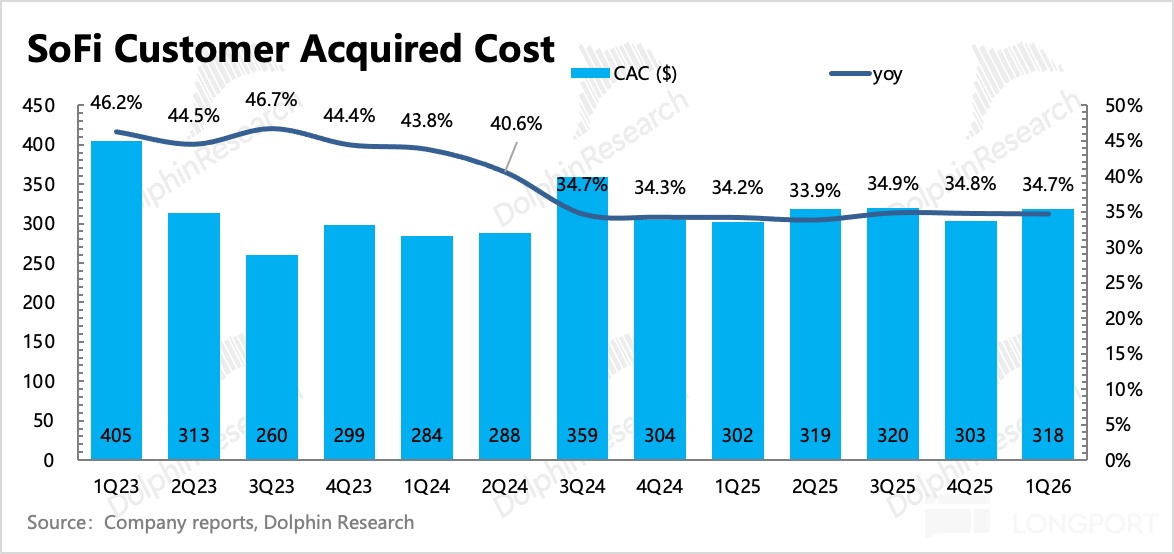
Running a premium community is costly, with CAC still $300+ per head, above stickier, trading-heavy platforms like Robinhood and Schwab. Events and meetups add expense, and reach to high-frequency prospects is limited, so building financial services was necessary to boost engagement rather than immediate profit.
Expansion was not smooth, with funding the key bottleneck. Without ample capital, SoFi could neither meet loan demand nor spend to break out via high-frequency brand marketing.
The two surges in user growth—2015 and 2020—followed pivotal funding events: E-round capital enabled personal loans and a Super Bowl ad; SPAC listing lifted awareness and unlocked funds post-IPO, fueling a step-up in acquisition.
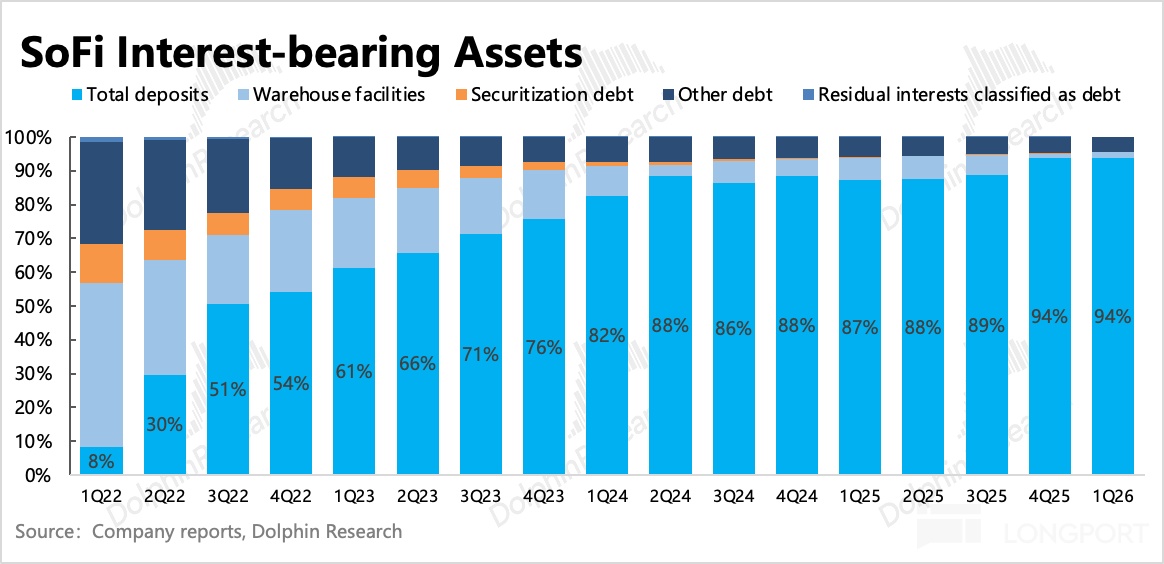
Lending growth raised the need for cheap funding. In 2022, after going public and issuing $1.1bn of zero-coupon converts the prior year, SoFi acquired Golden Pacific Bank to tap low-cost deposits. Since then, user deposits have funded over 90% of loans.
III. Lending Model: In-house + 3P in tandem, with risk control as the core edge
SoFi’s model combines engagement-led financial services, monetizing via lending, on top of a tech backbone. Accordingly, lending-related items—net interest and origination/placement fees—make up about half of revenue. Including indirectly related referral and service fees booked under Financial Services, lending-linked revenue contributes 60%+.
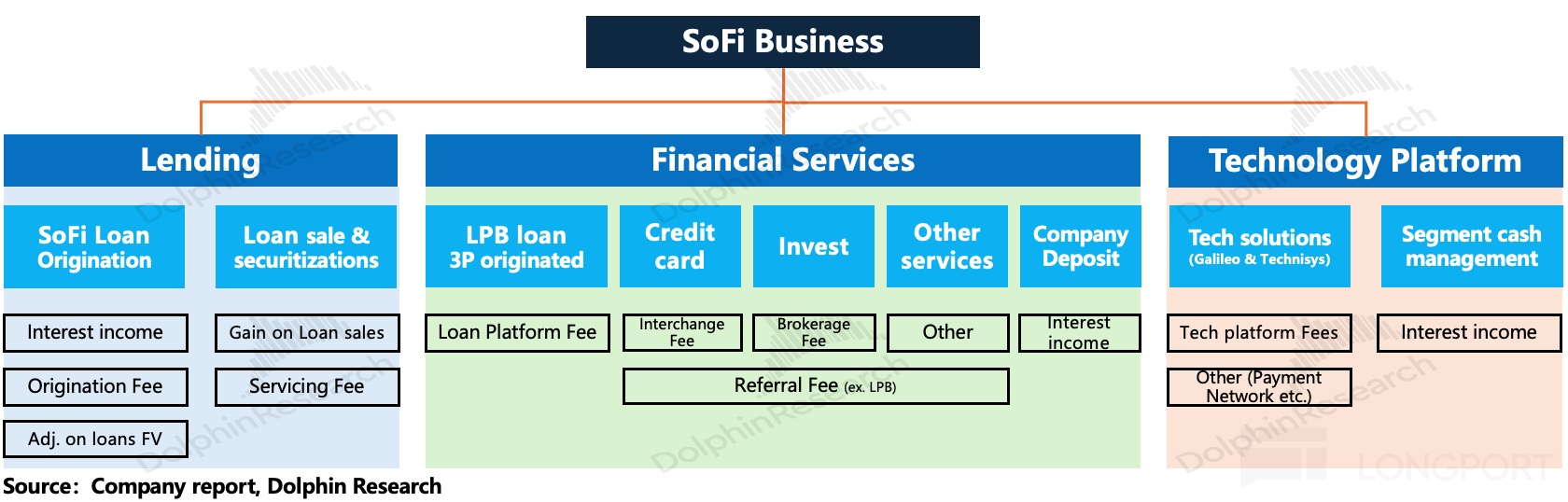
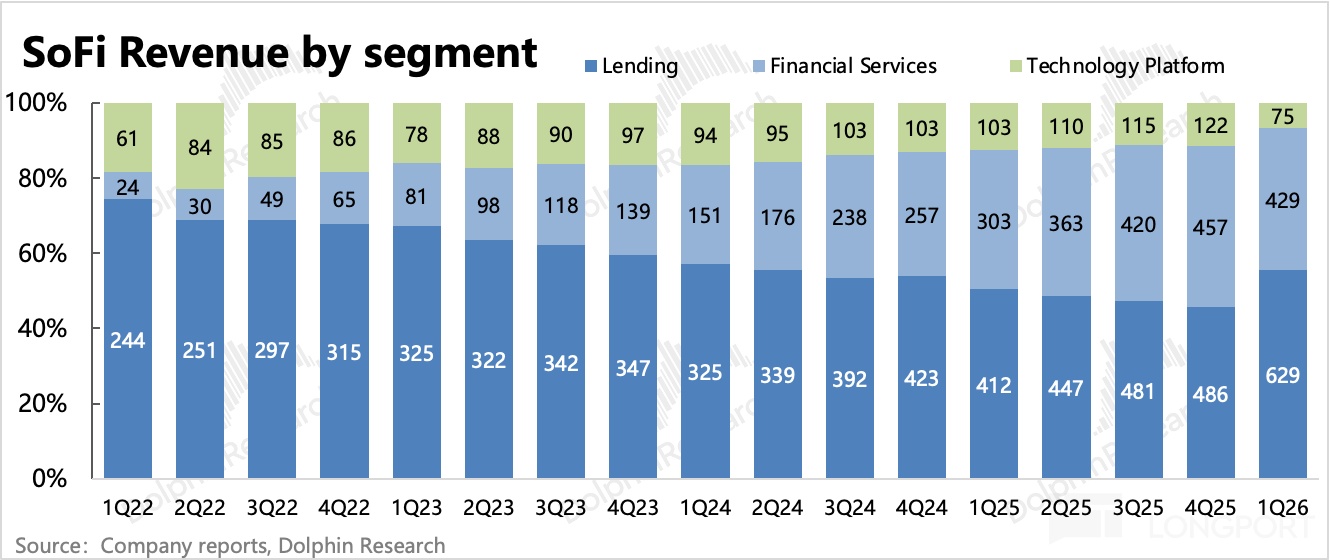
SoFi runs two lending approaches: 1) a traditional, asset-heavy model earning spreads, including deposit-loan NIM and gain-on-sale; 2) a platform, asset-light model monetizing traffic via lead-gen and outsourced servicing fees.
Both follow a 'volume x take-rate' logic. While take-rates are higher in the asset-heavy approach, the asset-light model eases balance-sheet strain, allowing faster expansion and a higher value ceiling.
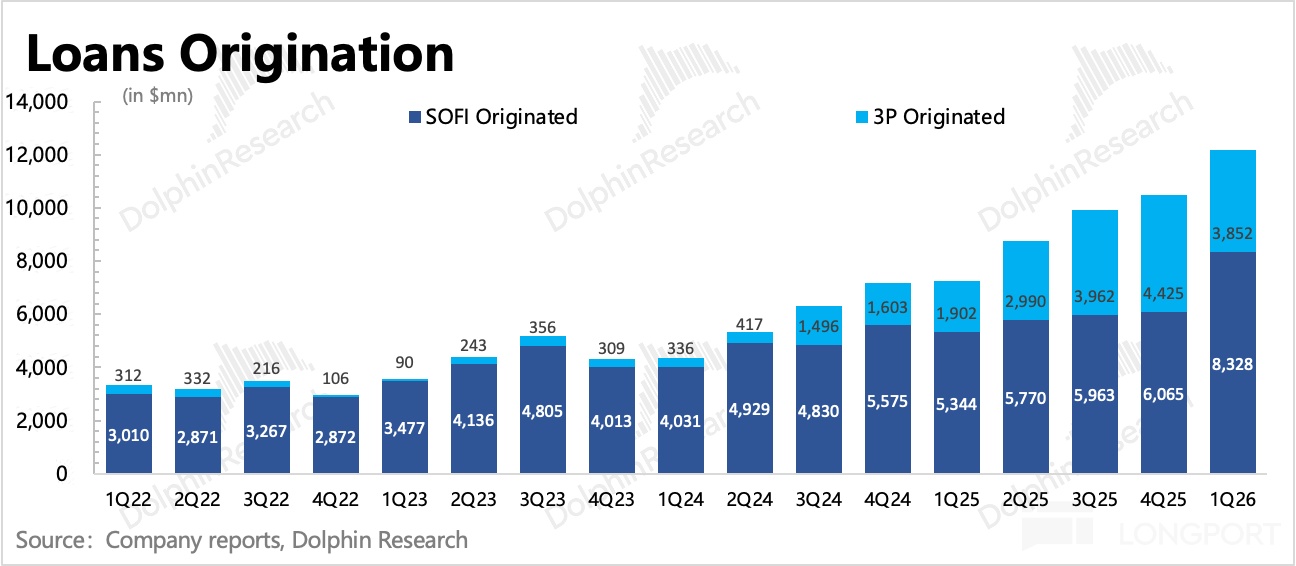
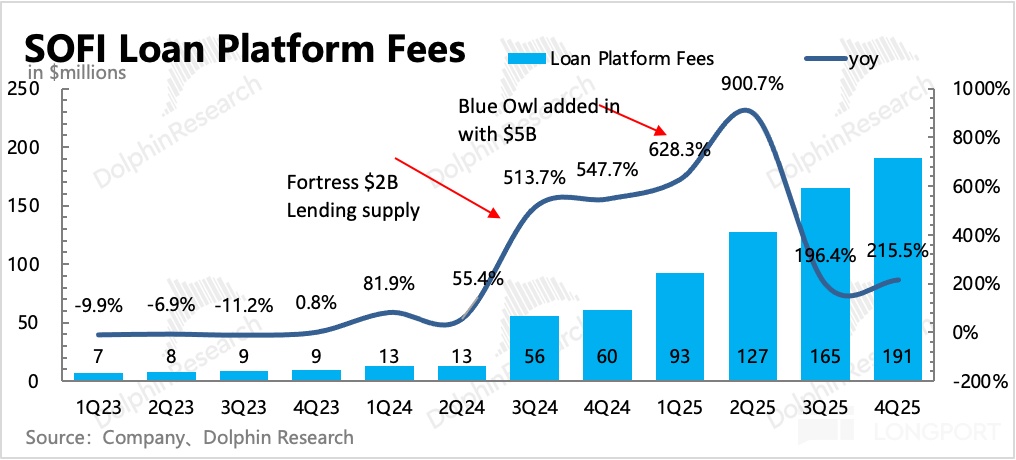
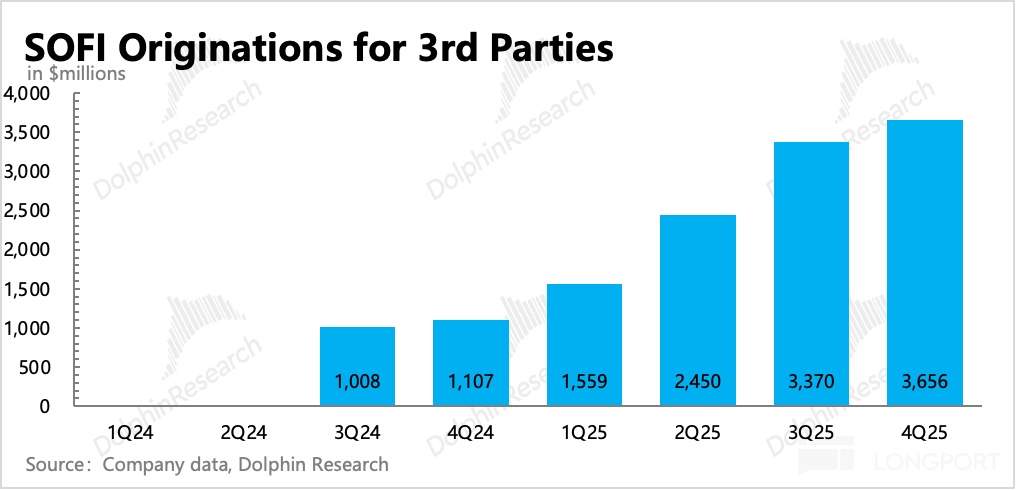
SoFi piloted the asset-light model in 2022, but platform lending (LPB) only truly ramped in 2H24. In 3Q24, third-party originations hit $1.5bn, up 250% QoQ, with LPB revenue up 340% QoQ. Alongside the federal student-loan restart, LPB became a critical investment driver, helping lift market cap by ~150% from the ~$9bn trough in Aug. 2024 within half a year.
As of 1Q26, third-party balances remain smaller than SoFi’s self-originated book, and SoFi retained more loans in Q1 amid a hawkish rate shift and abundant liquidity. Still, the asset-light path offers ample runway.
Dolphin Research now dissects the lending flywheel:
1) Asset-heavy lending: capital drives capacity
On-platform loans include personal, student (mainly refi), and mortgages, with both self-originated and third-party variants. '1P' refers to SoFi’s own originations under the asset-heavy model.
As of 4Q25, average balances were ~61% personal, ~37% student, and ~3% mortgages, with new originations tracking a similar order. Since student interest resumed, refi demand surged, and by 1Q26, student originations were growing the fastest of the three.
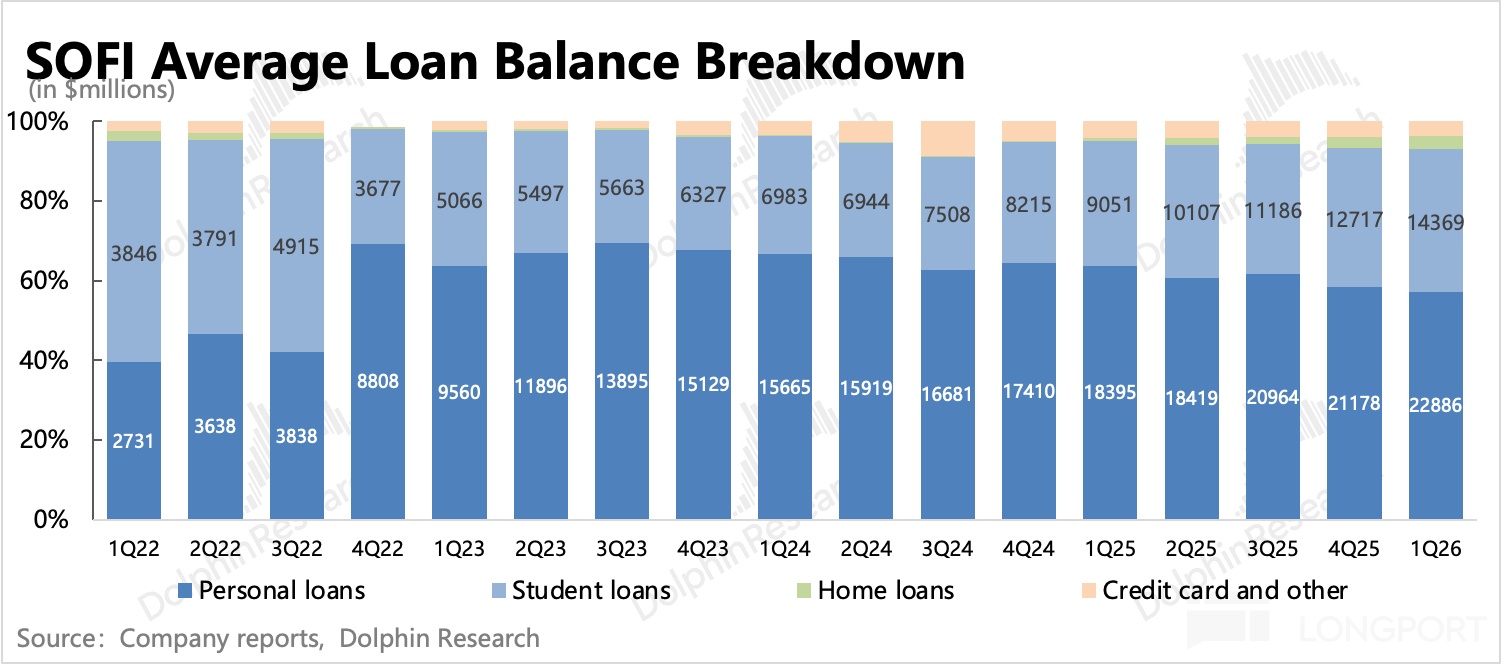
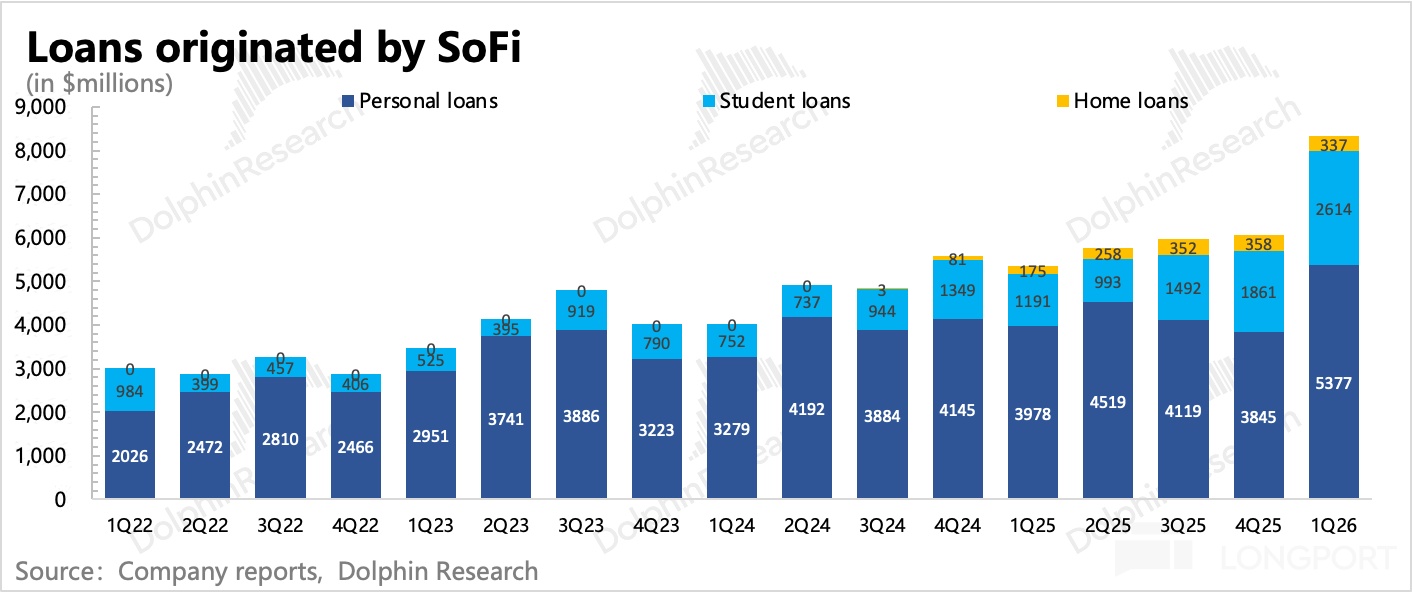
The revenue stack is standard: net interest income, origination fees and gain-on-sale, plus a small slice of servicing fees. Retention vs. sale flexes with rate cycles—higher-rate periods favor retention (richer NIM), lower-rate periods favor sales (higher fair values, faster turnover, lighter BS). In 1Q26, with a hawkish pivot and ample funding, SoFi did little loan sales.
By strategy and risk-return, sale ratios are highest for mortgages, then personal loans, and lowest for student loans. This reflects differing risk compensation and capital efficiency across products.
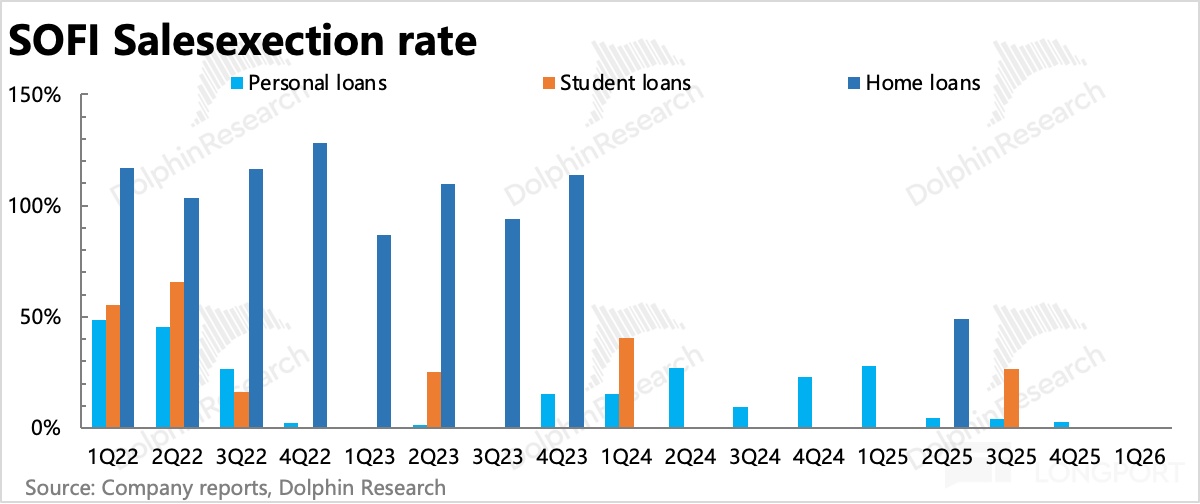
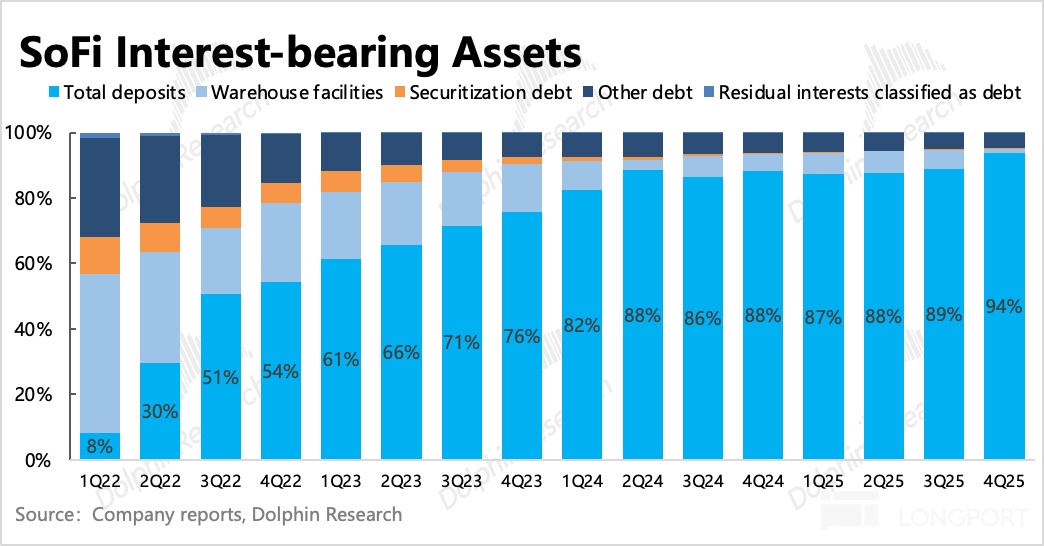
This speaks to operational flexibility—balancing funding risk and monetization. Since obtaining a bank charter in 2022 and scaling deposits (over 90% of funding since 2Q22), SoFi enjoys greater latitude to toggle between retain and sell.
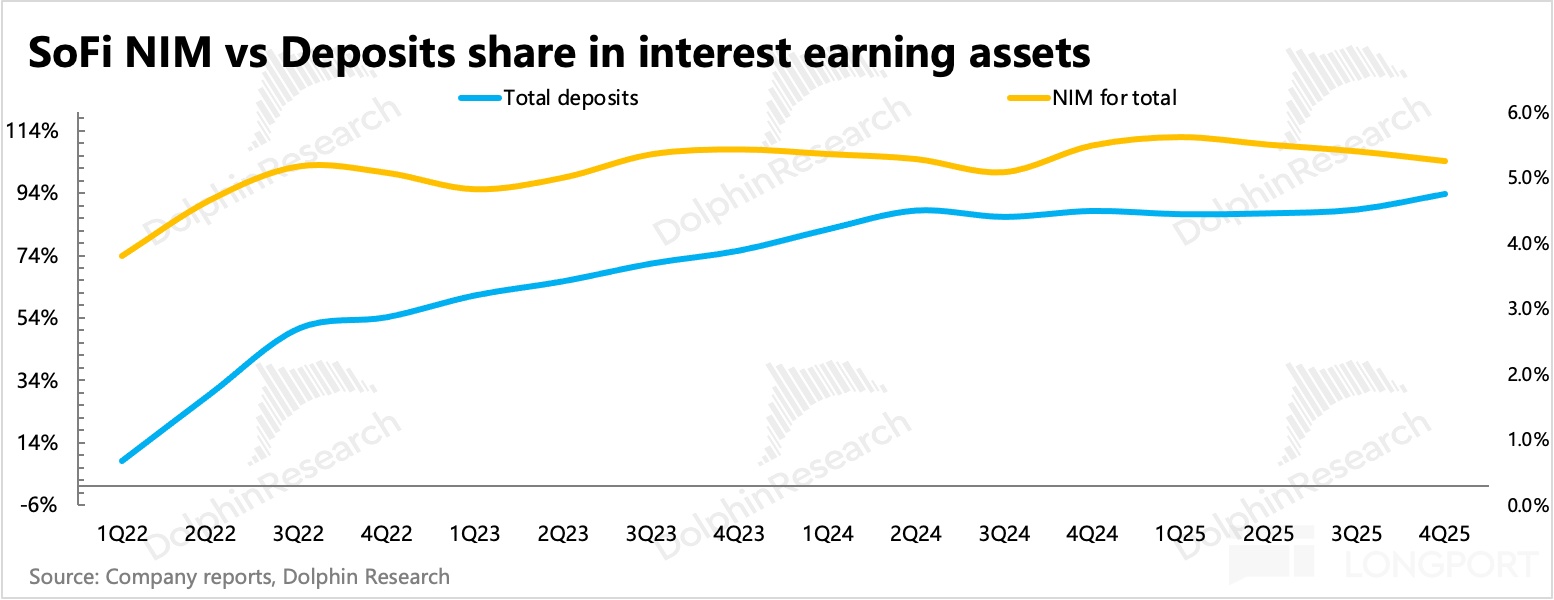
Beyond liquidity, replacing wholesale funding with retail deposits lifts NIM. As deposits rose in mix, consolidated NIM expanded accordingly.
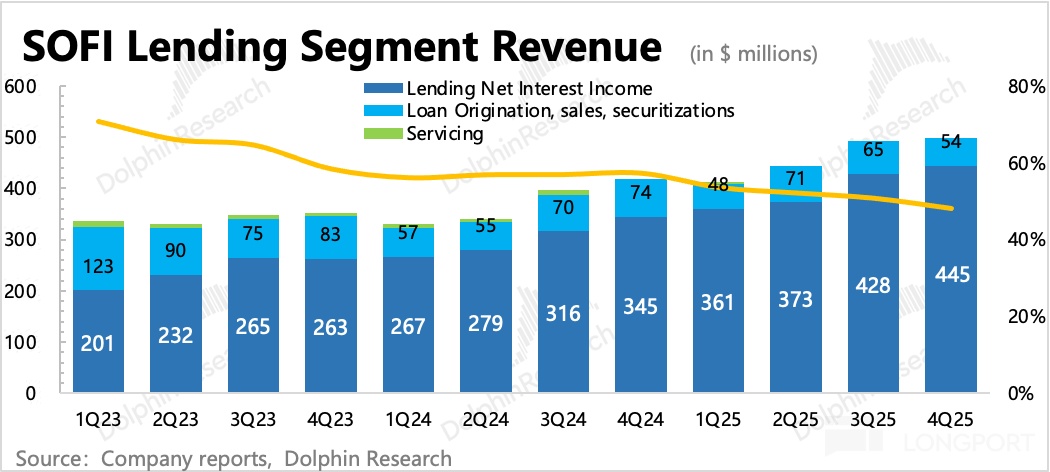
Within lending revenue, ~80% is NII, ~17% is origination/gain-on-sale/securitization, and ~3% is servicing for loans sold but still processed by SoFi. With deposit funding dampening rate sensitivity, lending revenue tracks origination volume more closely, growing steadily but naturally decelerating as the base scales.
2) Asset-light lending: monetizing premium traffic
The loan platform business (LPB) connects institutional capital with SoFi’s user base while SoFi executes processing. While both loan sales and LPB route credit to external funders, they differ materially: (1) sales lighten SoFi’s balance sheet; LPB monetizes traffic.
(2) On risk, SoFi bears funding and credit exposure until sale in the asset-heavy path; in LPB, the partner bears both from day one. SoFi holds at most three days of balances pending acceptance, and if the capital partner declines, SoFi stops processing, making LPB truly asset-light with fee-only economics.
LPB loans target users not using SoFi’s comparable products to avoid cannibalization. Currently, LPB focuses on personal loans given large demand, use for consolidating high-APR card debt or meeting short-term needs, and quicker capital turnover.
By 4Q25, LPB-originated personal loans equaled half of SoFi’s total personal originations, and 30% of overall originations. Pre-2024, SoFi mainly provided leads via comparisons, referrals for declined applicants, and proactive refi outreach to high-APR borrowers. In 2H24, SoFi deepened partnerships with Blue Owl and others, offering an end-to-end 'lead-gen + outsourced execution' solution.
Under this model, SoFi uses data and pricing to match borrowers and set terms, then handles underwriting through collections. Partners like Blue Owl simply supply capital and collect interest net of LPB fees.
SoFi’s revenue then extends beyond referrals to include risk-pricing value and fees for underwriting, settlement, and servicing. All-in LPB take-rates run ~5–6%, with ~1% from referrals and ~4–5% from execution services.
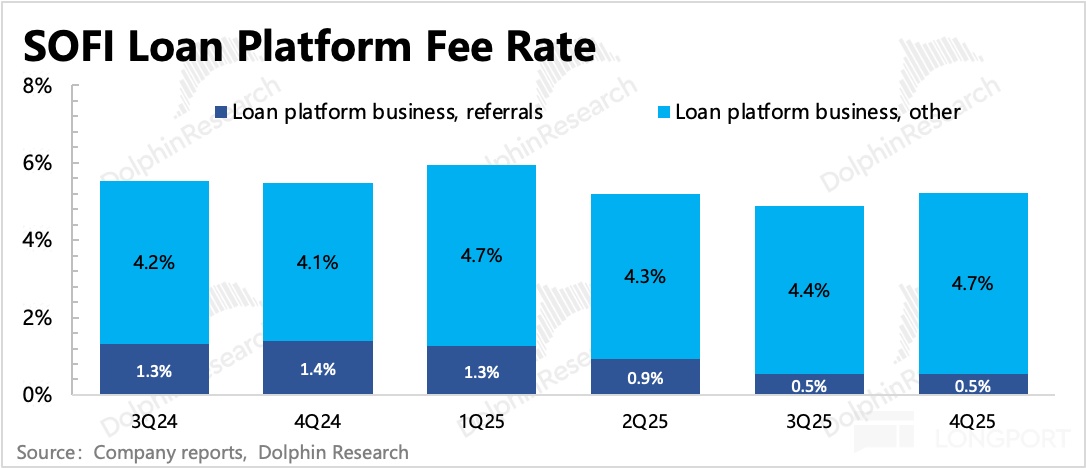
Fee tiers vary by partner, so growth is scale-led and hinges on the amount of deployable capital LPB can access. Funding partners may lack lending licenses and outsource execution to SoFi without using SoFi’s balance sheet or requiring SoFi to take default risk.
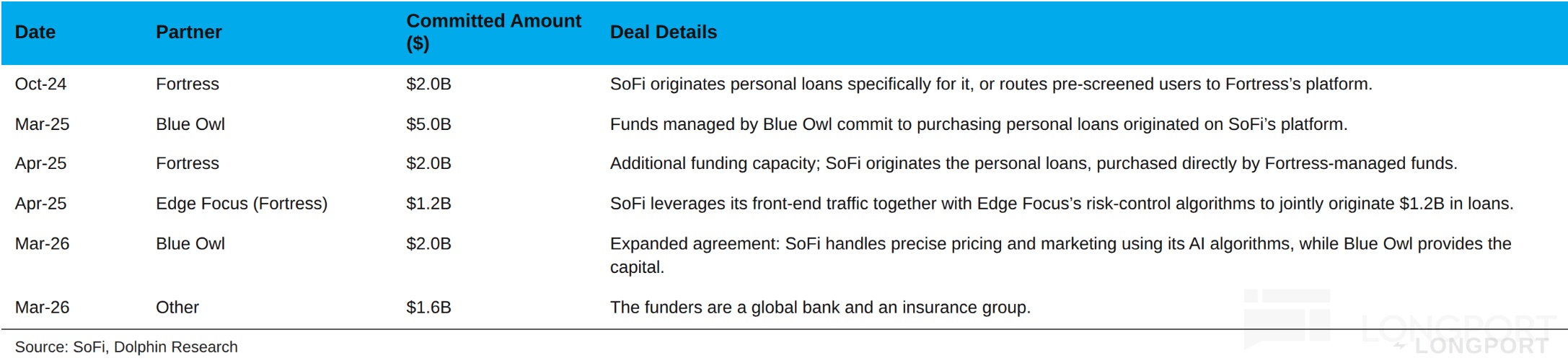
To streamline execution, partners typically pre-commit capacity. In Mar. 2025, Blue Owl and Fortress committed a combined $10bn, after which 3P originations rose 57% QoQ in 2Q, and $9.5bn was originated over the next three quarters.
By end-Mar., SoFi secured another $3.6bn across a global bank, a private asset manager, and a financial insurance group, providing fresh 'fuel' for LPB expansion. These commitments underpin the next leg of platform growth.
IV. A $2bn Bet to Unlock Tech Value
Before LPB scaled in 2024, SoFi’s growth in users and balances still looked like a spread-based bank model. Management then pivoted to a one-stop platform plus Fintech SaaS strategy.
The tech platform is the SaaS beachhead, built via the acquisitions of Galileo and Technisys, offering data processing, prepaid issuance, and account processing (funding/transfers/payments/loans). It also provides a cloud-native core (multi-account/product processing, ledgering, settlement) and API-led digital channels and AI support.
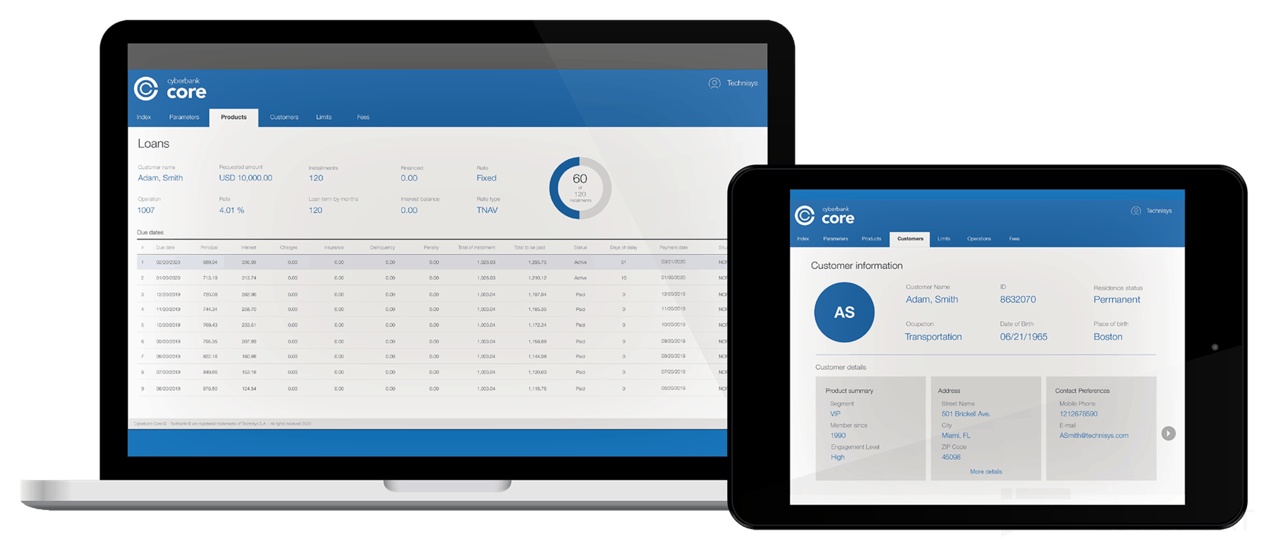
Post-integration, SoFi strengthened its own capabilities—improving credit models, accelerating product rollouts, and lowering external tech spend—while continuing to monetize Galileo and Technisys externally via platform and project fees.
Clients include competitors like Chime (Galileo for cards) and Robinhood (Galileo for cash management and debit), underscoring product strength. But Fintech SaaS is not an easy ride: after two years of high growth post-2020 acquisitions, growth slowed to 5–20% from 2022 as higher rates curbed client tech budgets.
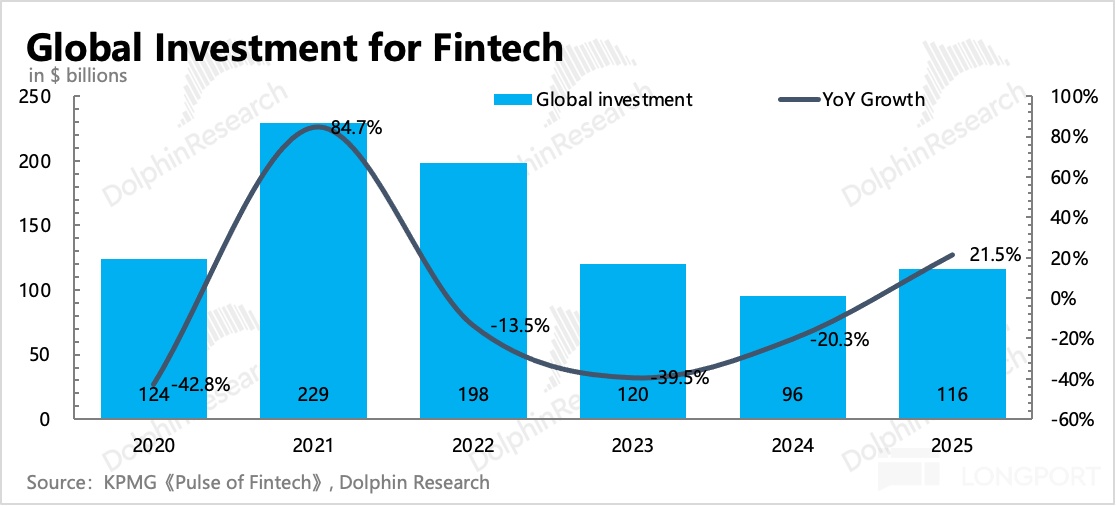
In core banking systems, incumbents like Fiserv and FIS dominate, and switching is rare unless features clearly lag. Thus, Galileo’s faster growth relies on newer Fintechs, whose purchasing cycles lengthen in volatile macro, adding quarter-to-quarter noise.
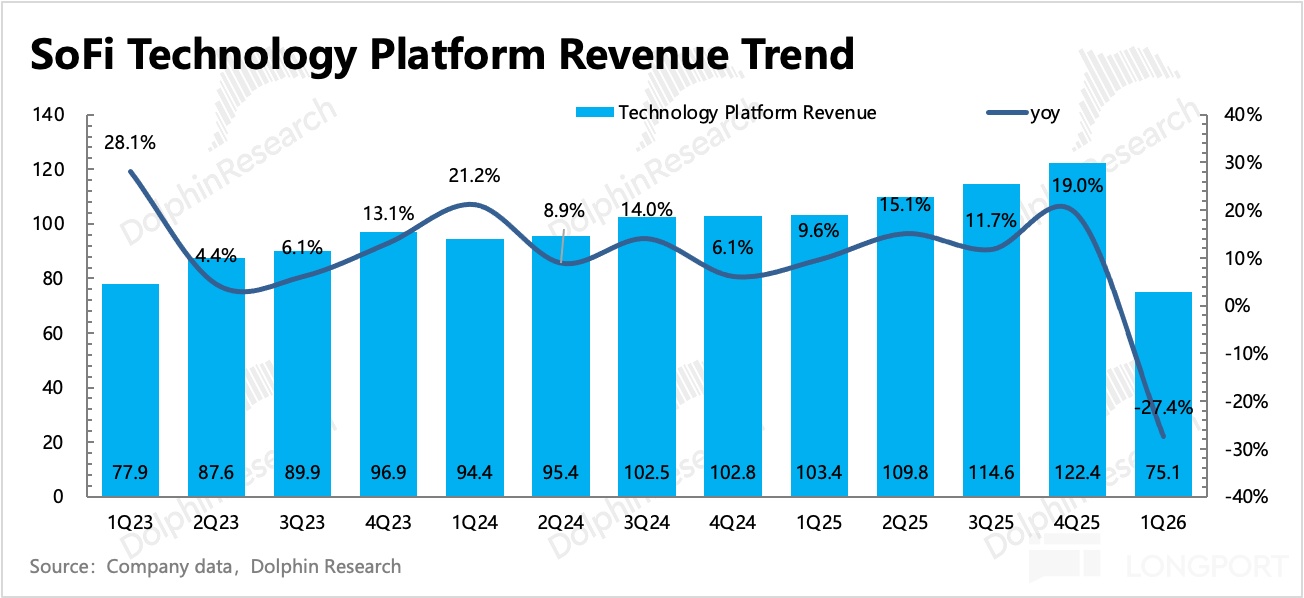
Worse, when Fintech clients struggle to raise capital, upstream, non-essential providers get cut first. In 1Q26, platform revenue fell 27% YoY due to one large client loss; excluding it, growth was still only 12%, suggesting macro headwinds persist.
SoFi is shifting focus from smaller Fintechs to more stable mid/large financial institutions, but the transition takes time and prolongs volatility. A near-term opening: Technisys’s Cyberbank is gaining traction with community banks and credit unions.
These institutions have legacy cores in need of upgrades and target lower-income households, minimizing overlap with SoFi and easing partnerships. This niche could support a steadier ramp.
V. Takeaways
Overall, even with the LPB flywheel, near-term performance is still tied to a highly unstable macro backdrop and rate expectations. SoFi is mitigating this by scaling deposits, pushing the loan-intermediation platform, and building a Fintech SaaS provider identity to dilute NIM volatility and credit risk impacts.
As discussed, the large addressable consumer credit pool and modest penetration underpin SoFi’s growth optionality. For now, strong member growth continues to attract bulls who price in further upside—consensus-implied 2026 P/E ~31x and P/TBV ~2x suggest a premium vs. peers.
Competition is intensifying, particularly as SoFi expands beyond lending into investing, payments, and crypto, bringing it head-to-head with stronger rivals. Meanwhile, differing accounting treatments within lending complicate comps and can fuel perception of overvaluation. In the next piece, Dolphin Research will assess SoFi’s value after risk haircuts, drawing on Muddy Waters’ short report.
<End>
Risk disclosure and disclaimer:Dolphin Research Disclaimer and General Disclosure

SoFi Tech
USSOFI

Chase
SZ300941

Bio-Techne
USTECH

Upstart
USUPST

Bank of America
USBAC

BANK OF AMERICA CORPORATION 6%NON CUM DEP SHS EACH REP 1/1000 SER GG
USBAC-B

BANK OF AMERICA CORPORATION DEP SHARES REP 1/1000TH PERP PFD SER 'E'
USBAC-E

BANK OF AMERICA CORPORATION 5.875%NON CUM DEP SHS REP1/1000TH SER HH
USBAC-K

BANK OF AMERICA CORPORATION 7.25% NON-CUM PERP CONV PFD SER L
USBAC-L

BANK OF AMERICA CORPORATION 5.375%DEP SHS REP 1/1000TH NON CUM SR KK
USBAC-M

BANK OF AMERICA CORPORATION 5% DEP SHS REPR 1/1000TH NON CUM PFD LL
USBAC-N

BANK OF AMERICA CORPORATION 4.375% DP SH RP 1/1000TH IN NON CU PF NN
USBAC-O

BANK OF AMERICA CORPORATION 4.125%DEP SH REP 1/1000 PFD SER PP USD25
USBAC-P

BANK OF AMERICA CORPORATION DEP SHS REP 1/1000TH INT NON CUM PFD QQ
USBAC-Q

BANK OF AMERICA CORPORATION DEP SHS REP 1/1000TH NON CUM PFD SER SS
USBAC-S

BANK OF AMERICA CORPORATION DEP SH REP 1/1200TH PRF SER 1 USD25
USBML-G

BANK OF AMERICA CORPORATION DEP SHS REP 1/1200TH PRF SERIES '2'
USBML-H

BANK OF AMERICA CORPORATION DEP SHS REP 1/1200 PFD SER 4 USD25
USBML-J

BANK OF AMERICA CORPORATION DEP SHS REP 1/1200TH PRF SERIES '5'
USBML-L

BANK OF AMERICA CORPORATION INCOME CAPITAL OBLIG NTS DUE 15/12/2066
USMER-K
The copyright of this article belongs to the original author/organization.
The views expressed herein are solely those of the author and do not reflect the stance of the platform. The content is intended for investment reference purposes only and shall not be considered as investment advice. Please contact us if you have any questions or suggestions regarding the content services provided by the platform.