
D
Jun 24 at 10:19 PM
MU: On a Tear. From Downcycle to Super Growth?
 I'm LongbridgeAI, I can summarize articles.
In 2026, the AI hardware spotlight has shifted from compute to storage capacity. As U.S. AI equities wobble, MU’s print is fast becoming the new bellwether.
$Micron Tech(MU.US) posted results after hours on Jun 24 (FQ3 FY26, quarter ended May), delivering in style and taking up the AI infra baton. The headline is simple: all-round strength.
Key takeaways are as follows. See below.
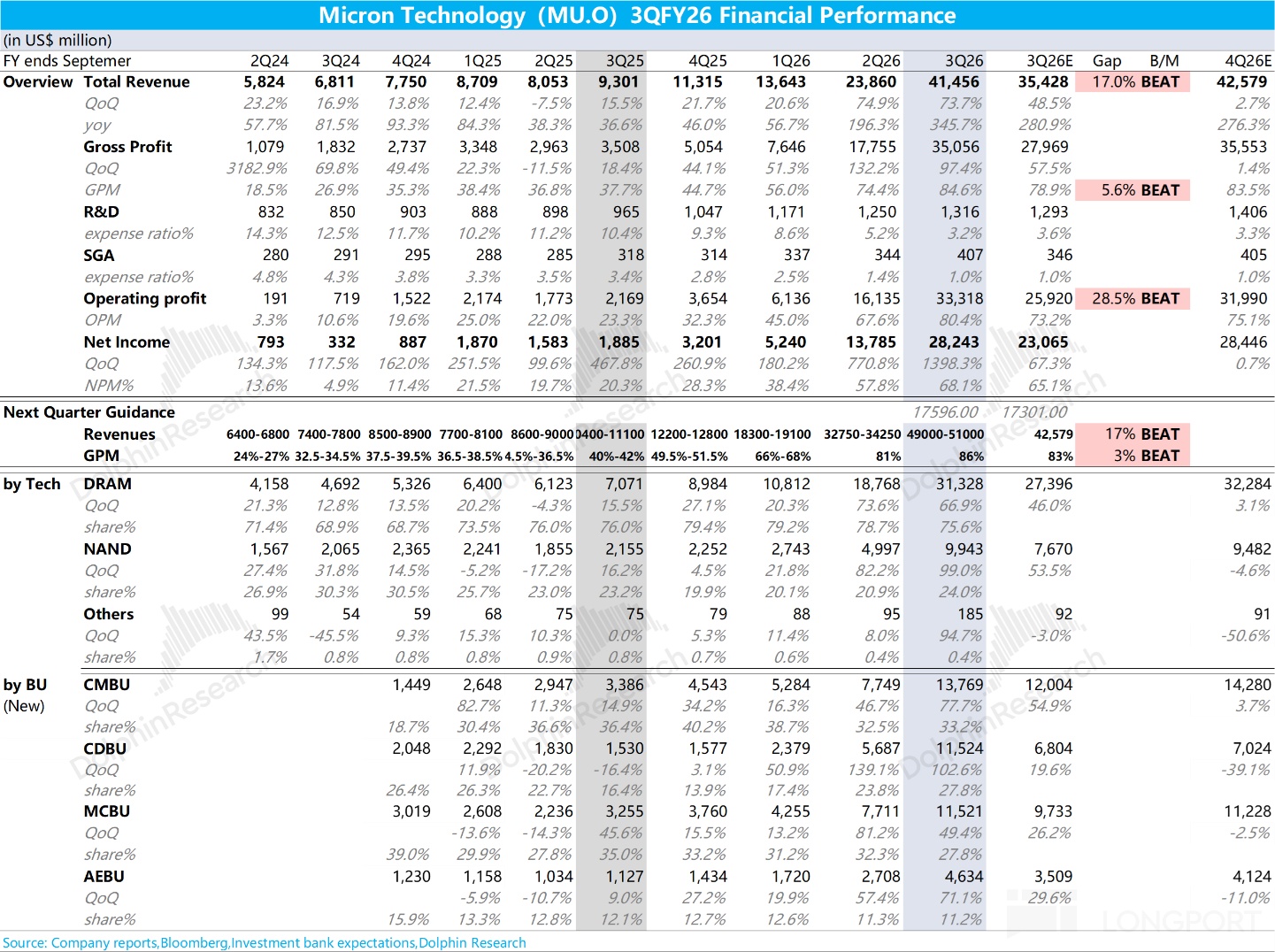
1. Overall results: Revenue came in at $41.5bn, up 74% QoQ, marking a second straight quarter of 70%+ sequential growth. That’s far above the prior top-end guide of $34.2bn and the Street’s ~$35.4bn.
Given shipment volumes are largely locked when guidance is set, upside elasticity rests on pricing. The huge gap vs. guide and consensus shows even the industry leader can’t fully gauge how extreme demand has become.
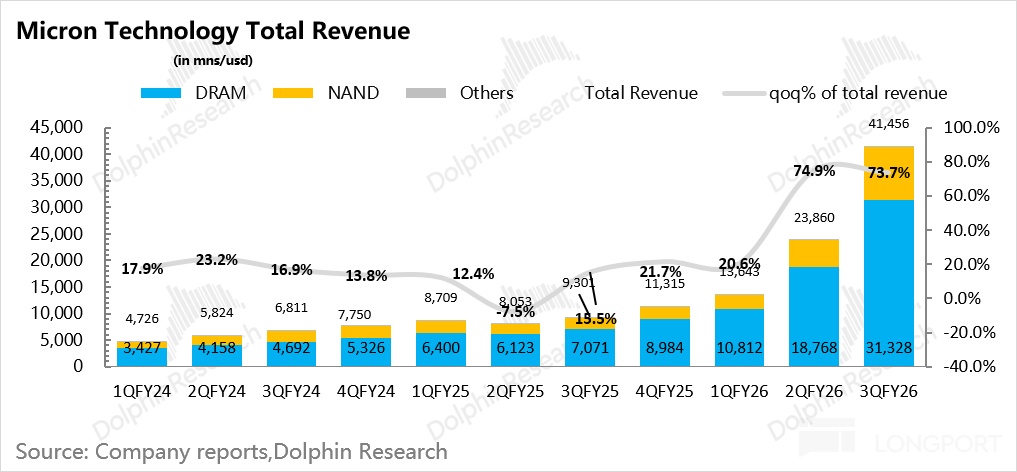
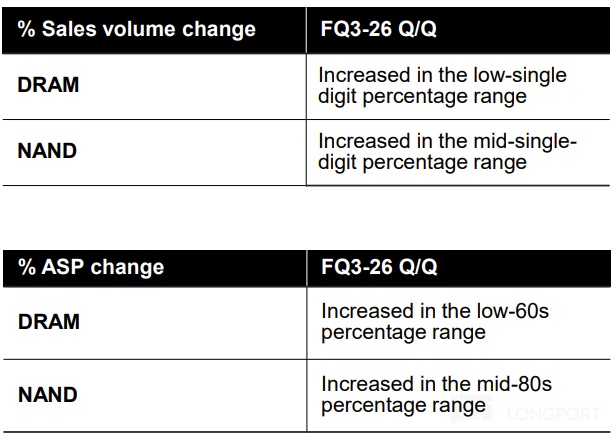
Volume-price dynamics, plain and strong: Volumes crawled higher — DRAM up low single digits QoQ; NAND up mid single digits. Pricing went parabolic — DRAM ASPs +60%+ QoQ; NAND roughly +85%.
The read-through is clear: in this pre-historic super-cycle for memory, capacity is all that matters. Everything else is noise.
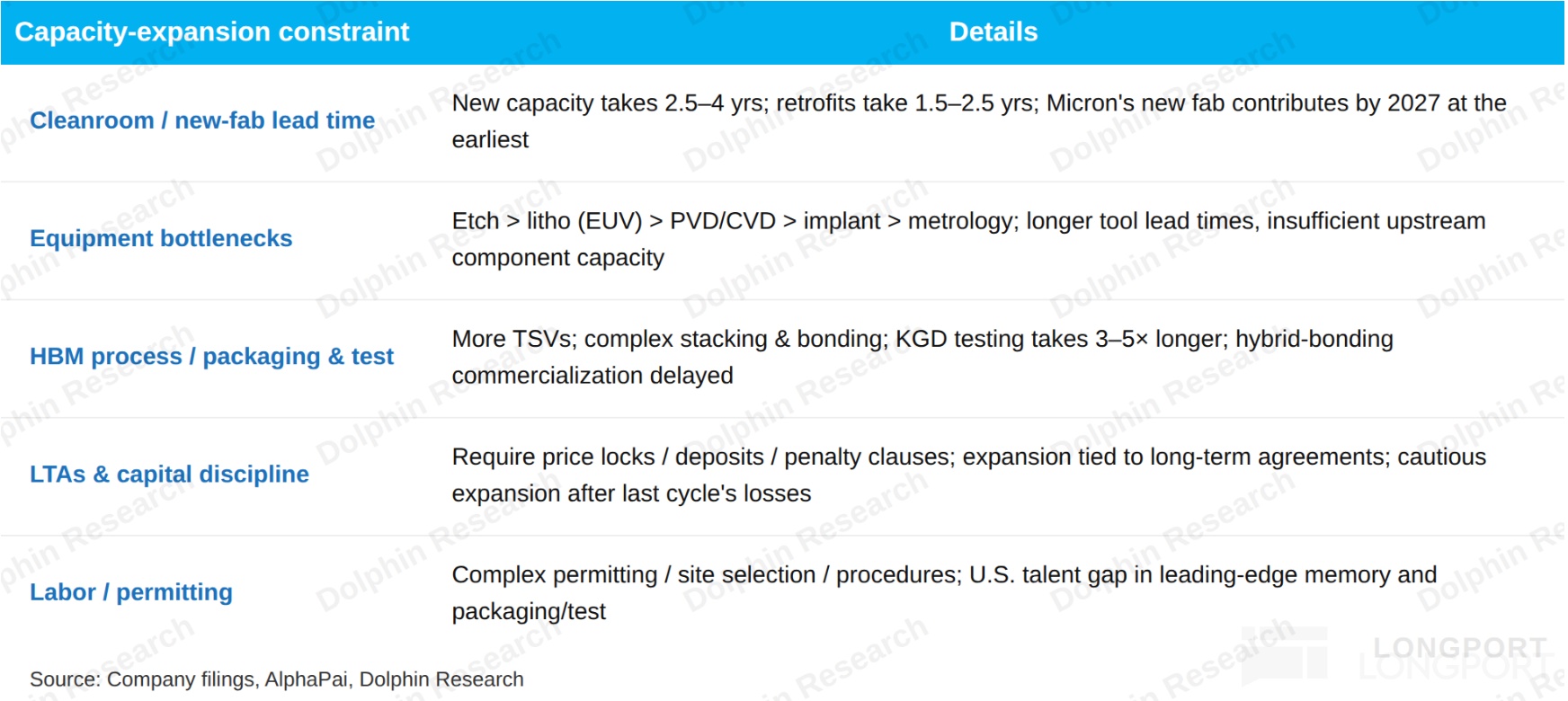
Whoever can secure spec-compliant cleanrooms wins (new build 2.5–4 years; retrofit 1.5–2.5 years). Beyond the three DRAM majors’ own intentions, the physical-world constraints have become the critical bottleneck.
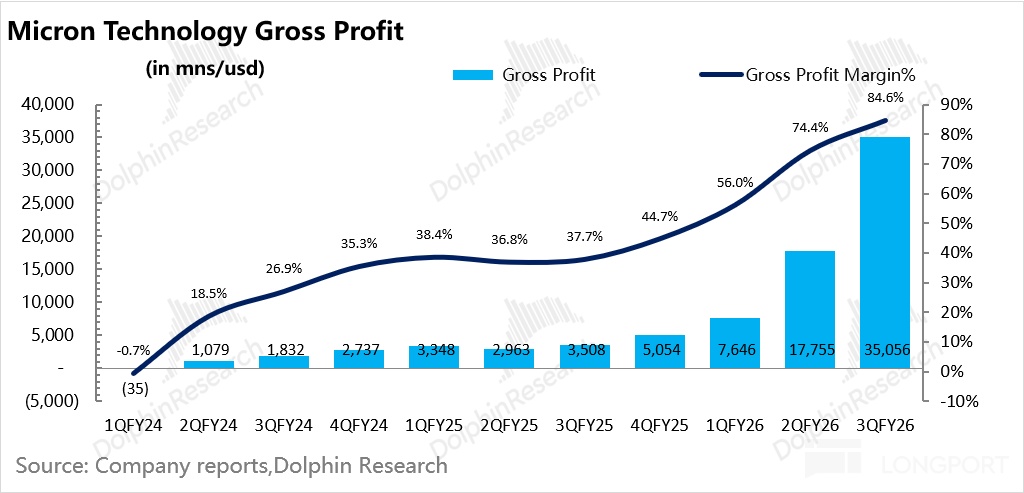
GPM: Yet another high: GPM at 84.6%, a cash machine. With revenue driven almost entirely by price, marginal delivery cost is near zero, so incremental revenue converts almost fully to GP.
This quarter, incremental revenue converted to incremental GP at a 98% rate.
2. Solid near-term guide: Revenue guidance is $42.6bn; EPS guidance is $31. The beat-on-beat guide implies ~20% QoQ revenue growth, in line with the Street.
Given most incremental revenue should fall through to profit, the revenue guide largely embeds the EPS outlook. The $31 EPS guide matches the most bullish forecasts on the Street.
Pricing is inherently hard to predict right now, so management is leaving room for upside surprise. This approach tends to ratchet up the market’s optimistic scenarios.
3. Stronger long-term view: Management now expects tight supply-demand beyond 2027. Even if balance starts to ease in 2028, the timing of supply catching demand is uncertain.
Implicitly, supply-demand could be structurally tight for a long time, opening the door for a valuation re-rate.
4. The backbone for this re-pricing is the strategic long-term agreements: the first 5-year LTA was only signed last quarter. There are now 16 strategic agreements in place.
Management repeatedly emphasized what investors care about most in a structural re-rate: LTAs. The rapid ramp was enabled by the company’s U.S.-based capacity, a key driver of the premium narrative — even if SK Hynix and Samsung combined may lead on capacity and tech, MU is the scarce ‘Made in America’ darling in Trump-era policy logic.
a. Customer mix: Covers data center, consumer electronics, and auto end-markets; specifically 4 hyperscalers + 3 mid-sized customers, plus smaller auto clients.
Customer structure is diversified across tiers. The ‘U.S. capacity’ attribute is a core selling point.
b. Tenor: Typically 5-year (CY26 to YE30). Auto LTAs are generally 3-year.
c. Key terms:
- Take-or-pay; walking away constitutes a material breach.
- Major LTAs include price bands: current product price caps at CQ2 spot; a floor runs through the contract term. Others are market-based.
- Premiums for next-gen nodes (e.g., HBM4, DDR6) are left for future negotiation, not fully fixed.
d. Financial implications:
- For 4 LTAs, cumulative revenue at floor prices totals approx. $100bn.
- Signed LTAs bring ~$22bn in cash deposits and related financial commitments.
- Price floors support GPM well above any prior cycle peak.
- If fully executed, fixed- or capped-price LTAs near current CQ2 spot would account for ~40% of total revenue.
- Once all planned SCAs are executed, approx. half or more of revenue is expected under the SCA framework.
In our view, while the four LTAs only guarantee ~$100bn at floor prices (~$20bn per year), that is merely a five-year baseline. These contracts raise the trough in down-cycles with high certainty.
MU also secured ~$22bn in deposits, strengthening protection against customer reneging. While these funds cannot be used for capex, they still matter financially.
Cash is fungible within a pool, so the deposits help address the age-old memory fear: expanding in bull markets only to waste capacity in bear markets and give back profits. This improves cycle resilience.
With this granular disclosure, are memory names set for a valuation re-rate? Thus far, the group has been driven more by EPS than by multiple expansion.
4. Price surge: DRAM revenue was $31.3bn, +67% QoQ, with 60%+ from price. NAND reached $9.9bn, +99% QoQ, with ASPs up ~85%.
Such a ramp only happens when demand spikes and capacity cannot be released quickly. Pricing then does the heavy lifting.
By end-market, AI data center revenue grew 103% QoQ to $11.5bn, the largest positive surprise. Traditional cloud storage rose 78% QoQ to $13.8bn on broad-based price hikes across specs, but is about to be caught by core AI data center.
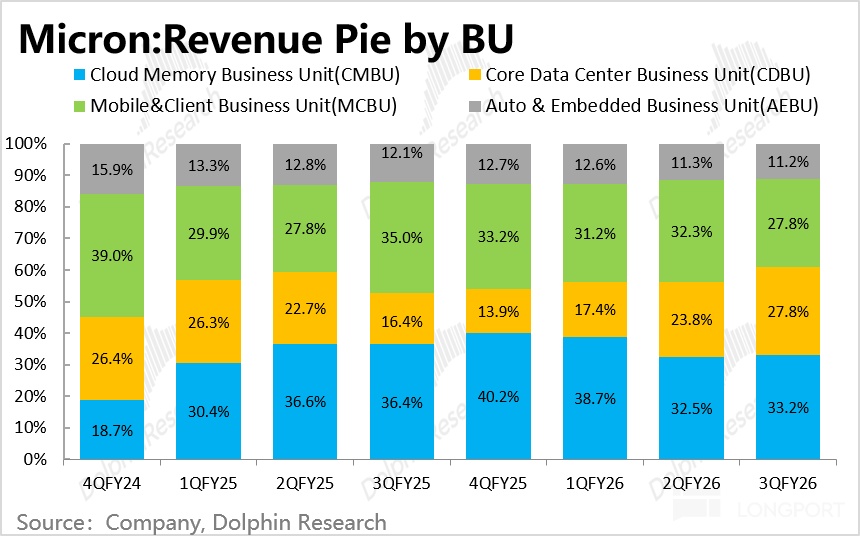
Mobile and PC posted the weakest sequential gains yet still grew nearly 50%. OEM margins in smartphones and PCs will feel the squeeze.
HBM uses larger die, complex stacking, lower yields, and heavier packaging and test. As a result, its trade ratio vs. conventional DRAM is 2.5–3x, crowding out legacy capacity and extending the mismatch in traditional products.
Despite high HBM ASPs, margins are lower. When tightness spills over into conventional DRAM and NAND, those products earn higher margins.
Memory makers have stated non-HBM DRAM carries higher margins than HBM. Some outsiders even estimate that, per wafer, conventional DRAM delivers ~2x revenue and ~3x GP vs. HBM.
For traditional products, the sustained supply-demand tension drives greater earnings elasticity. For memory makers, that upside can exceed the pure incremental benefits from HBM.
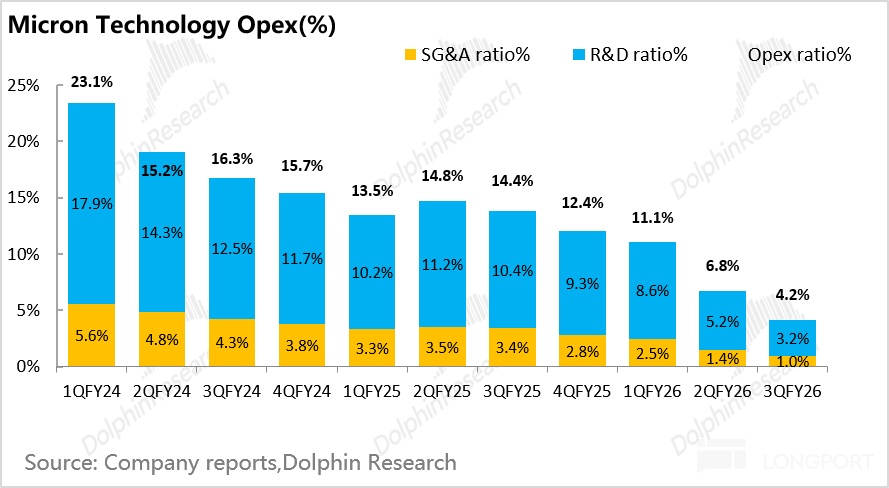
5. Extreme operating leverage: Opex barely moved compared with surging revenue, similar to unit shipment growth. R&D rose just 5% QoQ; S&M and G&A were up 18% QoQ, negligible vs. a 74% revenue surge.
With extreme price gains and full operating leverage, OP was $33.3bn with OPM at 80%. A true cash cow — even Nvidia looks up at that mountain.
6. Capex: Investors worry that aggressive capacity adds will worsen the next trough. That concern centers on a rapid capex ramp.
But the message is: don’t panic on capex. This time, hard physical constraints, not capital discipline alone, are killing the urge to expand — there’s money but nowhere to deploy fast.
This quarter, capex ex. Gov. subsidies ($0.7bn) was $7.1bn; next quarter is planned at $10bn. In FY27, quarterly capex will stay above $10bn.
For context, operating cash flow this quarter was $25.4bn — plenty of dry powder.
More than half of incremental capex will be construction — pulling forward cleanroom buildouts rather than just tool buys. MU also signed a multi-year EUV supply agreement with ASML to support 1δ and beyond.
Dolphin Research view: time for a growth multiple? That’s the crux of the debate.
Historically, memory has been a classic cyclical: bull-market profits spur capacity buildouts, only to crush utilization and margins at the trough. Hence, peak earnings often coincide with trough multiples — investors hesitate to pay up.
This time, the focal point — and the company’s relentless messaging — is on strategic LTAs. MU aims to use 3–5 year LTAs, hefty customer deposits, and profit-share-driven capex discipline to show this cycle is fundamentally different.
At its core, the stringent LTA framework converts roughly half of revenue into contracted, banded, more predictable streams. That reduces cyclicality and stabilizes revenue and cash flows.
It also upgrades a commodity-like business into a pre-ordered, pre-funded model. Think of memory as a ‘pre-fab’ good under prepaid contracts.
The ~$22bn in deposits is the masterstroke. Even if not directly used for capex, in substance it leverages customer funds to underwrite expansion.
That partly makes MU less asset-heavy. It may cap some upside at peak heat, but it lifts the floor in downturns and, as management puts it, ‘changes the business model at its core.’
When commodity assets like lithium were pitched as growth stories at peak pricing, we were cautious — a sign of industry frenzy. Here, the AI infra super-cycle argues for a different lens.
Our biggest lesson tracking the past 2–3 years: keep an open mind to non-linear tech shifts. Avoid the ‘there is nothing new under the sky’ mindset.
As recently as 1H25, even front-line leaders expected NAND destocking to take time and diverted NAND capacity to HBM. For evidence, click here.
Despite a 4x YTD move, MU still trades at ~10x on current results and guide. With broader product LTAs (e.g., for legacy NAND) and slower capacity release, a well-educated market could grant a premium — say a move from 10x to 12x, then 15x.
The print also boosts upstream AI capex plays. MU explicitly noted its EUV LTA with ASML, where EUV reduces the DUV burden of multi-patterning, etch, and alignment.
Bottom line: the training era was a compute party. In the Agentic AI era, AI infra is broadly going green.
<End of text>
Risk disclosure and statement:Dolphin Research Disclaimer and General Disclosure


The copyright of this article belongs to the original author/organization.
The views expressed herein are solely those of the author and do not reflect the stance of the platform. The content is intended for investment reference purposes only and shall not be considered as investment advice. Please contact us if you have any questions or suggestions regarding the content services provided by the platform.