D
Jun 25 at 12:43 AM
TCOM (Trans): Aims to serve 10x inbound travelers within 5 yrs
The following is Dolphin Research’s$Trip.com(TCOM.US) FY26Q1 earnings call Trans; for the earnings take, cf. 'TCOM: One More Leg Down Before the Reg. Hammer Falls?'.
I. Key takeaways from the print
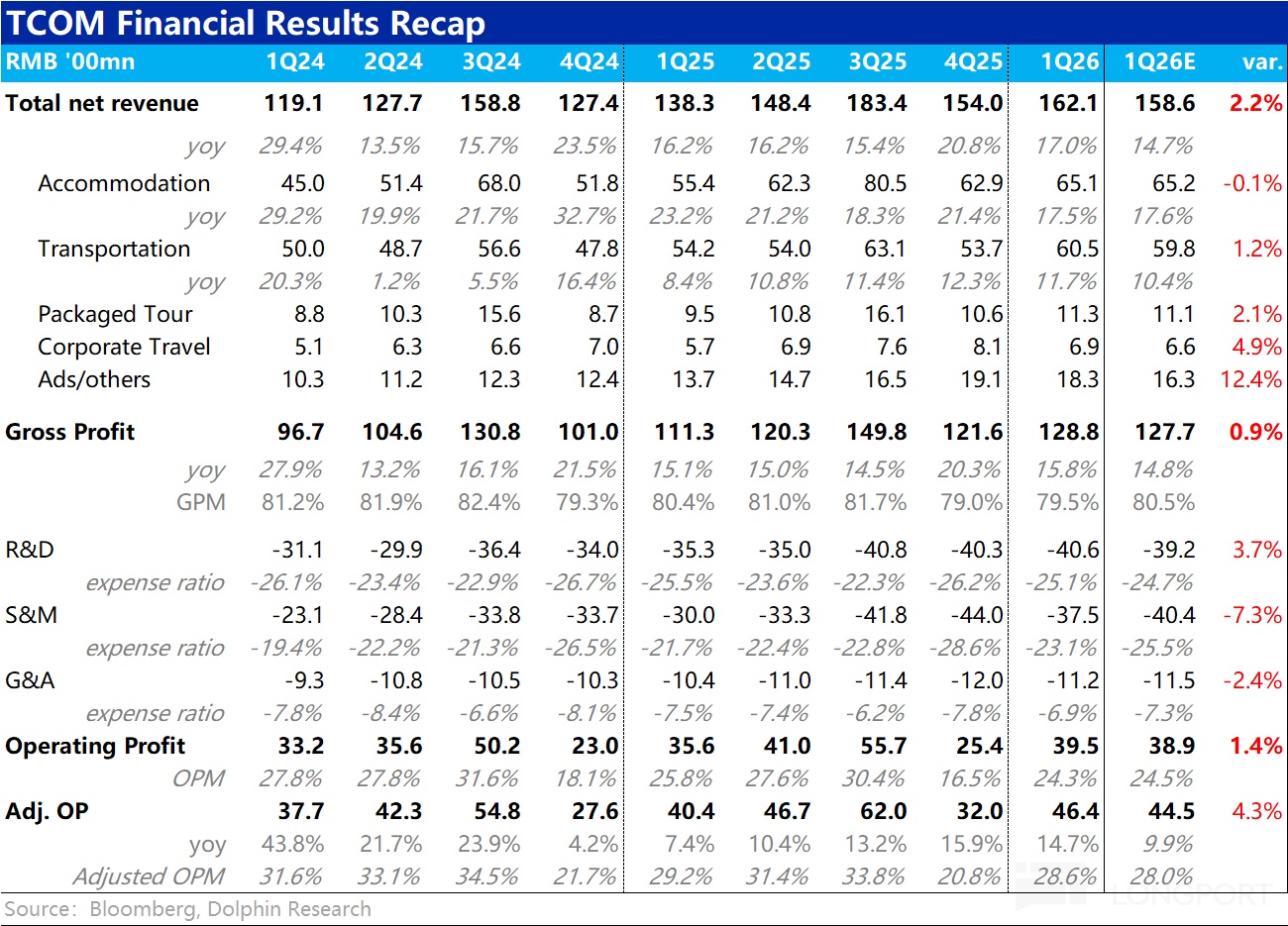
1. Headline financials: Q1 total net revenue was RMB 16.2bn (+17% YoY), modestly beating consensus (RMB 15.8bn; ~+2%). Non-GAAP diluted EPS per ADS was RMB 5.73 (~$0.83). As of Mar 31, 2026, cash, cash equivalents and ST investments totaled RMB 104.0bn (~$15.1bn).
2. By segment: Accommodation revenue RMB 6.5bn (+17% YoY), driven by solid Intl hotel bookings. Transportation ticketing RMB 6.1bn (+12% YoY), supported by Intl air and land transport demand. Packaged tours RMB 1.1bn (+19% YoY), on expansion in Intl offerings and small-group customized tours; corporate travel RMB 690mn (+20% YoY). Adj. S&M rose 24% YoY, outpacing revenue growth on proactive marketing; Adj. R&D +12% YoY; Adj. G&A +5% YoY.
3. Q2 guide: Net revenue growth of 3%–8% YoY, a notable decel. vs. Q1. Management cited two main drags: (1) higher oil and geopolitics lifting airfares, tightening capacity and disrupting some long-haul routes, weighing on air travel demand; (2) proactive compliance optimization, especially adjustments in train-ticket practices, creating a one-off hit to near-term metrics. Both factors are fully embedded in the Q2 guide.
4. Capital returns & balance sheet: No dividends or buybacks were discussed on the call. There was no update on capital return plans.
II. Earnings call details
2.1 Management highlights
1) Inbound: 200mn served in five years, top strategic priority
a. ~20mn inbound visitors served in 2025; ~7mn in Q1 alone, up ~90% YoY, setting a strong base. The team set a core goal to 'serve 200mn inbound visitors over the next five years,' underscoring confidence in China’s long-term inbound potential. b. Policy tailwinds continue: visa-free entry now for 80+ countries, plus transit visa-free stays up to 10 days; Alipay and WeChat Pay now support credit cards. From top-down policy to payments infrastructure, systemic improvements are lowering inbound frictions.
c. In Q1, the platform coordinated 110k+ local suppliers for inbound services, including 14k serving foreign visitors for the first time. It deepened focus across 29 high-potential destinations, helping local partners build integrated products bundling attractions, lodging and local services into complete itineraries. Average inbound stay reached 5.1 days (+11% YoY), indicating deeper experiences; travelers from Europe/US now contribute ~25% of inbound traffic, signaling broader diversification.
d. Marketing: invited 1,000+ global influencers to visit and share authentic content on social media. The call center offers 30+ languages, 24/7, and the team partnered with the KOL China exploration program to attract creators from Argentina, Korea, Japan, Thailand, Singapore and more, showcasing China through localized lenses.
2) Intl OTA (Trip.com): rapid growth, structurally improving margin
a. Gross bookings on the Intl OTA platform grew ~65% YoY, with app bookings at an all-time high. Direct traffic and user stickiness kept strengthening. b. APAC is the core base and long-term growth engine, with Europe/US also growing fast. Management highlighted meaningfully improved Trip.com margin YTD, as larger direct traffic, stronger brand awareness and ongoing product innovation jointly drive structural profitability gains.
c. Focus areas: extend APAC coverage; elevate user experience via AI and product innovation; fortify service infrastructure. Maintain ROI discipline in non-core Intl markets.
3) AI strategy: two pillars — in-house capabilities + ecosystem integration
a. In-house AI: core search is integrated with the AI assistant, supporting natural language and voice. Users can submit complex, multi-variable requests across dates, budgets, locations and lodging preferences and receive bookable filtered results, lowering decision friction materially. AI is deployed across CS automation, content generation (incl. video), multilingual support, itinerary curation and real-time translation.
b. Ecosystem integration: via APIs, MCP and an Agent Framework, interfaces are opened to third-party AI platforms. The supplier network, real-time pricing, inventory and transaction rails are packaged as AI-ready modular services and embedded into leading AI workflows. The goal: wherever a travel request starts in AI, the platform’s supply and fulfillment are already in place.
c. Management view: AI changes the planning entry point, but long-term winners are those that reliably translate complexity into end-to-end fulfillment. That is the company’s core edge.
4) Other growth drivers
a. Event-led travel (sports, concerts, cultural festivals) saw Q1 gross bookings up 74% YoY, with events like F1 Shanghai drawing substantial inbound traffic. b. Silver generation: Club All Friends hotel bookings more than doubled YoY in Q1. Offline flagship stores paired with AI chat tools lower planning barriers for seniors, and off-peak travel is encouraged to lift industry capacity utilization.
c. Small-group customized tours: orders rose 27% YoY, with per-capita spend 55% above large-group tours and trip duration 11% longer, evidencing product mix upgrade. d. Domestic travel: strong demand in Chinese New Year for nearby trips and family/multi-generational travel. Short-haul, high-quality trips kept growing, and Gov. culture-tourism vouchers supported spending.
2.2 Q&A
Q: What is the long-term AI strategy and investment plan? With AI agents rising, how will the company defend its edge?
A: (James Liang) We believe AI will reshape how travelers discover, plan and book, but it will not replace professional travel platforms. Travel is a high-stakes, high-complexity decision where value lies in reliable execution, requiring real-time inventory, deep supply-chain connectivity and robust global service infrastructure — capabilities we have built over decades. As travel AI shifts from information to fulfillment, our competitive edge should amplify.
Our strategy has two pillars: first, keep strengthening in-house AI — core search is connected to our AI assistant for natural-language and voice inputs, enabling multi-variable requests and directly bookable results, sharply reducing decision friction. AI is also deployed internally to raise efficiency, expand CS automation and lower operating costs. Second, plug into the broader AI ecosystem — through APIs, MCP and an Agent Framework, we are integrating with leading AI platforms, embedding our premium supply into next-gen AI travel experiences. By wiring real inventory and reliable fulfillment into top AI platforms, we can capture AI-driven demand and cover overseas markets more efficiently. Our goal is simple: wherever planning starts, we participate first and provide trusted execution. AI changes the entry point; long-term winners will be platforms that turn complexity into certainty, and we believe we are best positioned.
Q: How will you achieve the five-year goal to serve 200mn inbound visitors? What are the key actions?
A: (Jane Sun) China’s inbound policy is very favorable: 80+ countries now have visa-free access, with 10-day transit visa-free options, and Alipay/WeChat Pay now support credit cards, greatly improving payment experience. Against this backdrop, our team has acted on several fronts. We invited 1,000+ global KOLs to experience China and share authentic stories on social media; our call center provides 30+ languages, 24/7, to guide prospective visitors. We connect with 110k+ suppliers, 14k serving foreign guests for the first time, upgrading capabilities across hotels, attractions and services; and we offer one-stop services from air and hotels to attractions and transport so first-time visitors can plan with ease.
We served ~20mn inbound visitors last year. The five-year goal is 200mn, and we will keep pushing toward it.
Q: How do you view China’s OTA competitive landscape, including regulation and the impact from AI-native interfaces?
A: (Jane Sun) Competition remains broadly rational, with service quality, supplier coverage and user experience as the core battlegrounds rather than aggressive price wars. On compliance, regulators continue to emphasize platform governance, transparent pricing and fair competition with clear, consistent direction. We fully support this and have proactively strengthened compliance and operations, which may bring short-term pressure but represent normalization and long-term health.
On AI, conversational interfaces are changing discovery and planning, shifting away from traditional click-based search. We embrace this shift, but travel remains complex and service-intensive, where supply integration, reliable fulfillment and after-sales service are key moats — and the core value of OTA platforms. Overall, the combined push on compliance, AI embedding and efficiency should reinforce large OTAs’ advantage in broad supply, reliable fulfillment and quality end-to-end service.
Q: What is the latest on regulatory reviews? How should we think about near-term and longer-term impact?
A: (Cindy Wang) We are fully cooperating with authorities and maintaining constructive dialogue. It is too early to speculate on timing or outcomes while matters are ongoing. In recent months we have proactively reviewed and optimized certain practices to strengthen compliance and governance, and we remain committed to elevating operations in line with evolving standards. These adjustments may affect near-term business and financials, but we view them as beneficial to the company and the industry’s long-term health.
More broadly, regulatory frameworks for large platforms are evolving globally. We believe a transparent, fair and orderly regime ultimately benefits consumers, fosters healthy competition and enhances long-term sustainability. Operationally, we will stay focused on serving travelers and partners, executing on priorities and creating sustainable long-term value for stakeholders.
Q: How do the new train-ticket rules affect the business directly? Any quantification on the financial impact?
A: (Cindy Wang) We fully support the latest guidance on train-ticket operations and are working closely with relevant authorities. Consumer trust and user experience are core, and we will keep products and operations aligned with evolving requirements. Strategically, train tickets remain an important acquisition and retention channel. Our focus is not just ticketing but completing the travel loop across transport, lodging and destination services.
Financially, as the business has diversified — with growth in accommodation, Intl travel and other segments — domestic train tickets now contribute far less to total revenue and profit than historically. As the industry adapts to the new rules, optimization of certain train-related products and value-added services will create some near-term, transitional pressure, which is reflected in current expectations and partly in the Q2 guide. Longer term, a diversified mix, strong cross-sell, ongoing efficiency gains and tight cost control should support sustainable growth and resilient profitability.
Q: What are the latest booking trends and specifics behind the Q2 guide? How do you see summer and 2H demand?
A: (Jane Sun) We expect Q2 net revenue growth of ~3%–8% YoY, a slowdown from Q1’s strength due to a mix of macro and operational factors. Domestically, higher airfares have cooled air travel demand vs. Q1, with consumers optimizing destinations, itineraries and transport choices. Domestic hotel ADR has turned modestly positive YoY, reflecting resilient lodging demand and a more balanced supply-demand setup. The guide also incorporates the near-term impact from proactive compliance adjustments in certain business lines, which normalize financials in the short run but strengthen platform quality and sustainable growth.
Intl: higher airfares have tempered some long-haul demand, though pricing offsets volume to a degree. On hotels, Intl lodging demand remains healthy, supported by local demand and short-haul trips. Inbound remains the strongest growth pillar, aided by APAC source markets, better visa policies, improved connectivity and rising awareness of China as a destination.
Looking to 2H, visibility is limited and we remain cautious, assuming current dynamics broadly persist with cyclical swings across markets and products. We will focus on disciplined execution and cost control, while continuing to invest in Trip.com’s Intl expansion, inbound travel and AI capabilities to balance near-term discipline with multi-year growth investments.
Q: What are the key operating highlights for Trip.com’s Intl business and the 2026 outlook overseas?
A: (Cindy Wang) Intl growth remained strong in Q1 — platform gross bookings rose ~65% YoY, with inbound up ~90% as a core driver. Demand was broad-based across APAC, Europe and the US. Execution kept improving: app bookings hit a record high, direct traffic and retention strengthened, and product depth, localization and service quality rose across priority markets.
APAC is the foundation and a major long-term opportunity. Even with macro swings in some markets, we stay focused on timely assistance and contingency support, building local ops and investing in durable advantages. As scale expands, these efforts are translating into strong efficiency gains. YTD, Trip.com margin has improved meaningfully as larger direct traffic, stronger global brand and ongoing product innovation drive structural profitability.
For the rest of 2026, we will extend APAC coverage, enhance UX via AI and product innovation and keep fortifying service infrastructure, while preserving ROI discipline in other Intl markets. Despite macro and geopolitical volatility that may create cyclical demand swings, our priority is unchanged: deliver reliable travel experiences, strengthen positioning and build a sustainable, profitable Intl business.
<End>
Risk disclosure & statements:Dolphin Research Disclaimer & General Disclosure
Login to unlock14,077characters for free
This content is only available to signed-in users. Sign in to your Longbridge account to read the full post.