
D
Jul 10 at 06:23 AM
SK hynix Heads to the U.S. Seeking a Fair Valuation?
 I'm LongbridgeAI, I can summarize articles.
Memory is the hottest — and most crowded — track in global tech assets right now. AI has lit HBM, DRAM and NAND all at once, sending SK Hynix, Samsung and Micron shares up several-fold over six months. Yet just as the frenzy peaked, the market abruptly reversed, with leading memory names tumbling sharply from their highs.
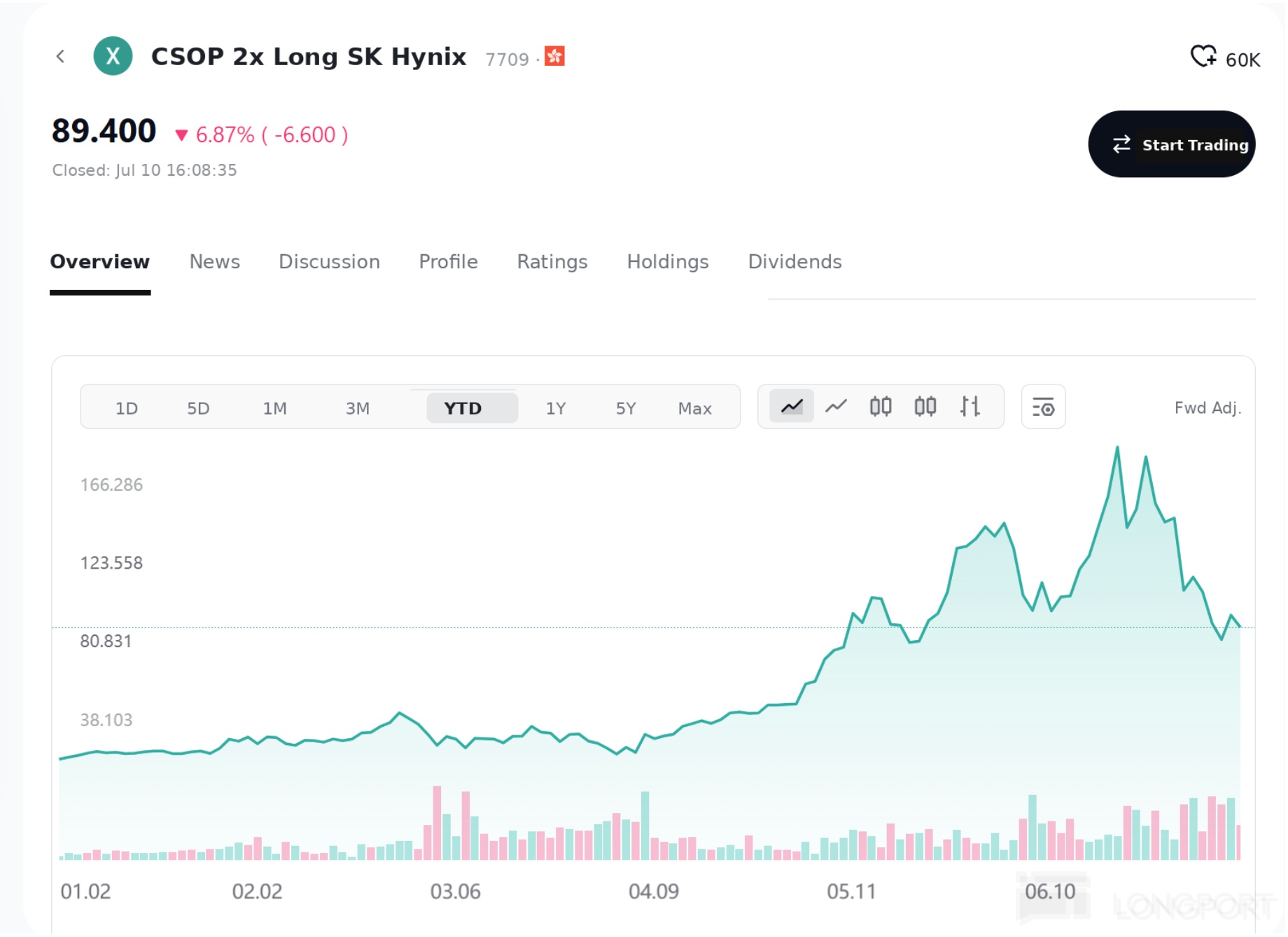
Right at this boom-then-chill moment, one of memory’s true heavyweights, SK Hynix, put its stock on Nasdaq.
On Jul 10, SK Hynix ADRs began trading in the U.S. The interesting bit: on HBM leadership and DRAM share,$SK Hynix(SKHY.US) clearly outruns Micron, yet trades at a persistent valuation discount (FY2027, 4.2x PE vs. Micron at 6.6x). This discount is less about fundamentals and more about a 'Korea discount' — U.S. investors historically had limited access to, and lower trust in, Korean firms.
So is Hynix going Stateside simply to raise cash for capex? We don’t think so. With ample cash on hand and earnings inflecting, it could have tapped low-cost debt but chose equity and a U.S. listing instead. The real play is a capital-market move aimed at valuation reset.
In this piece, we walk through the why and how of SK Hynix’s ADR, then set it side-by-side with Micron to assess whether this 'memory leader' merits a rerate.
I. The backstory of SK Hynix’s U.S. ADR
1.1 Deal specifics
SK Hynix plans to issue 17.79 mn new common shares, to be offered as 177.9 mn ADSs, implying each ADR represents one-tenth of a common share. Typical common-to-ADS ratios are 1:2 or 1:4, so this 1:10 split is unusually granular, designed to set a more approachable per-ADR price and attract retail and smaller institutions.
On size, the new issuance is roughly 2.5% of outstanding shares (current major shareholder SK Square holds 20.5%). This also reflects Korea’s Fair Trade Act requirement that controlling shareholders maintain at least 20% ownership.
In the latest prospectus, pricing was anchored to the Korea close on Jul 3, 2026 at KRW 2,425,000 per share. Translating at the day’s FX, this equates to about US$158 per ADS. With final ADR pricing at US$149 on Jul 9 (≈ US$1,490 per common share), that is a 6% discount vs. the anchor. Based on the 177.9 mn ADS size, gross proceeds are roughly US$26.5 bn.
Key dates:
Jul 6–9, 2026: Bookbuilding; Jul 9, 2026: Pricing; Jul 10, 2026: Nasdaq trading begins; Jul 14, 2026: Settlement; Jul 29, 2026: Underlying new common shares list on Korea Exchange.
1.2 Why list in the U.S.?
Hynix says all proceeds will fund domestic capacity in Korea: ~KRW 26.6 tn (≈ US$17 bn) for the Yongin cluster Phase 1 fab, ~KRW 18.9 tn (≈ US$12 bn) for the Cheongju P&T7 advanced packaging plant, and ~KRW 12 tn (≈ US$7.8 bn) for EUV lithography tools. These sum to roughly US$37 bn, above the US$26.5 bn raise, so proceeds will cover part of the plan rather than map 1:1.
Is the ADR purely about financing expansion? Unlikely. As of Mar 2026, cash and equivalents were KRW 21.1 tn (≈ US$13.5 bn), enough to fund 2026–2027 capex with earnings ramping. If it only needed capital, Hynix could issue low-cost debt; choosing equity likely reflects three aims:
1) Narrow the 'Korea discount' and reset valuation
Hynix has long traded below Micron, driven by two factors: U.S. investors’ difficulty accessing Korea-only listings, and lingering distrust of Korean corporates. Family-controlled conglomerate structures and past governance controversies have weighed on perception, reflecting different governance and regulatory standards vs. the U.S.
As an FPI (foreign private issuer), Hynix can be exempt from many U.S. exchange governance rules aside from SEC audit committee requirements, provided not mandated by home-country law. So governance standards will largely remain Korean. Even so, listing in the U.S. brings changes on trading access, disclosure transparency and a global investment narrative that can compress the 'opacity premium' embedded in the discount.
i) Trading: Immediate expansion of marginal buyers with more capital able to own Hynix, potentially including sizable passive flows. It also enables like-for-like comparison with Micron in the same market and currency.
ii) Disclosure: While the governance framework is unchanged, Hynix filed a U.S.-style F-1 for the first time (risk factors, MD&A, segment data; English; subject to U.S. securities liability) and will follow with 20-F annuals. This is a real disclosure upgrade even without governance overhaul, reducing information asymmetry.
iii) Global narrative: Previously a Korea-listed memory pure-play, Hynix will now sit alongside Nvidia and Micron as a global AI core asset in investor discourse.
2) Pair buybacks at home with issuance abroad
Alongside the ADR plan, management has flagged a large onshore buyback-and-cancellation program in Korea. i) In Korea (lower valuation): deploy cash to buy back and cancel shares, lifting EPS and shareholder returns while supporting the stock. ii) In the U.S. (higher valuation): issue ADS to source USD capital for strategic investment.
Street chatter expects a 5–10% ADR premium. Inclusion in major U.S. indices or ETFs could push it higher. With only 2.5% initial ADR capacity, once filled, new ADRs can only be created by canceling existing ADRs and delivering Korea-listed common shares, making U.S.-only investors reluctant to part with ADRs.
3) Broaden the base and upgrade holder quality
Historically, Hynix’s holders skewed to onshore institutions and trading-oriented foreign capital. ADR listing opens the door to index inclusion and more long-only demand. It could enter the Nasdaq Composite, U.S. index funds and MSCI U.S.-related indices, bringing steady passive inflows. Many U.S. pensions, mutual funds and policy-constrained accounts cannot directly buy foreign ordinaries; ADRs let them hold SK Hynix in their native accounts.
II. How capable is Hynix?
Unlike Samsung Electronics, which also has mobile, foundry and display, Hynix looks more like Micron on P&L purity. Earnings come entirely from memory, with DRAM near 80% of revenue. As ADRs trade in the U.S., investors will increasingly benchmark it directly against Micron.
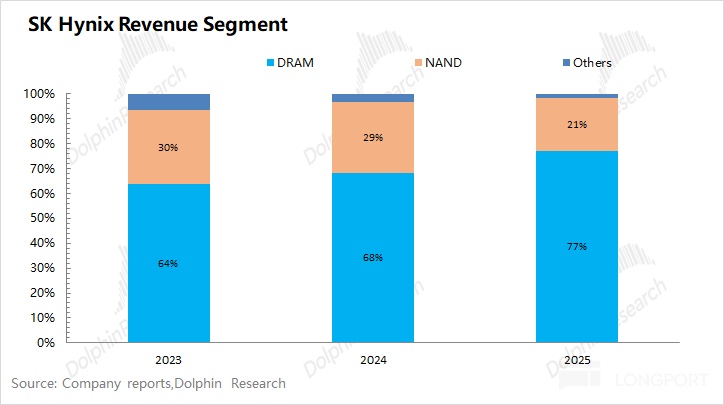
On both market share and technology, Hynix still holds an edge over Micron. 2.1 Market share
i) DRAM
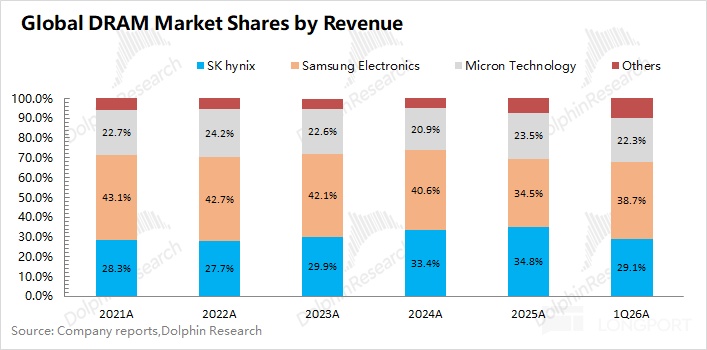
Hynix’s DRAM share dipped to ~30% in Q1 2026. This does not signal weakening competitiveness; management prioritized HBM, reallocating DRAM capacity and intentionally sacrificing legacy DRAM shipments. With more capacity routed to HBM, Hynix has the smallest exposure to traditional DRAM. Amid AI-driven shortages, legacy DRAM pricing surged 90%+ QoQ in Q1, making peers’ DRAM prints shine and compressing Hynix’s share.
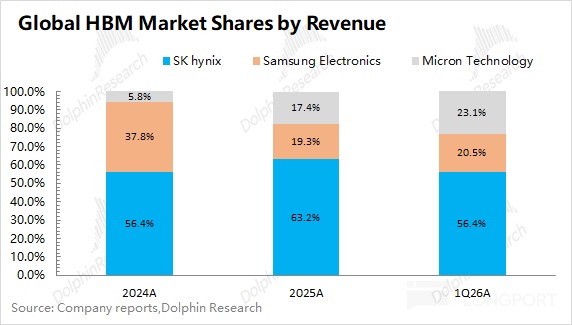
Within HBM, Hynix’s share has also eased. It still leads the segment, but Micron is gaining. Hynix’s early technical lead won Nvidia’s trust, yielding an early-mover oligopoly. As Samsung and Micron caught up, customers sought supply diversification.
Micron, the late entrant, skipped a node to accelerate. It did not commercialize HBM3, jumping from HBM2E to HBM3E and HBM4. Skipping a generation initially depressed share, but as HBM3E ramps and U.S.-sourcing preferences rise, Micron’s share is climbing.
ii) NAND
Hynix has long put less emphasis on NAND, which is now ~20% of revenue. Even as NAND prices rose, management reiterated the priority is not more wafer starts but faster migration to 321-layer NAND to lift bits per wafer.
With a technology-led growth playbook, Hynix’s NAND share has hovered near 20%, broadly tracking industry growth. On Jul 2, 2026, Hynix announced ~KRW 100 tn of investment in Cheongju: KRW 80 tn for a new NAND fab (M17) and KRW 20 tn for the P&T7 advanced packaging plant (part of this ADR-funded plan).
M17 will be Hynix’s fourth NAND fab (after M11, M12, M15) and the first new NAND facility in nine years — the last was M15, ramped in 2018. The investment is 4x M15; while capacity specs are undisclosed, the scale will be substantial.

2.2 Technology
i) DRAM
In DRAM nodes, Samsung and Hynix have moved into 1c, while Micron, using a different naming scheme, is now at 1γ (gamma). Samsung and Hynix adopted EUV from 1a; Micron used multi-patterning DUV at 1α and 1β and introduced EUV at 1γ. 1c and 1γ are same-generation, roughly 6th-gen 10nm-class, so the trio is broadly neck-and-neck on DRAM process today.
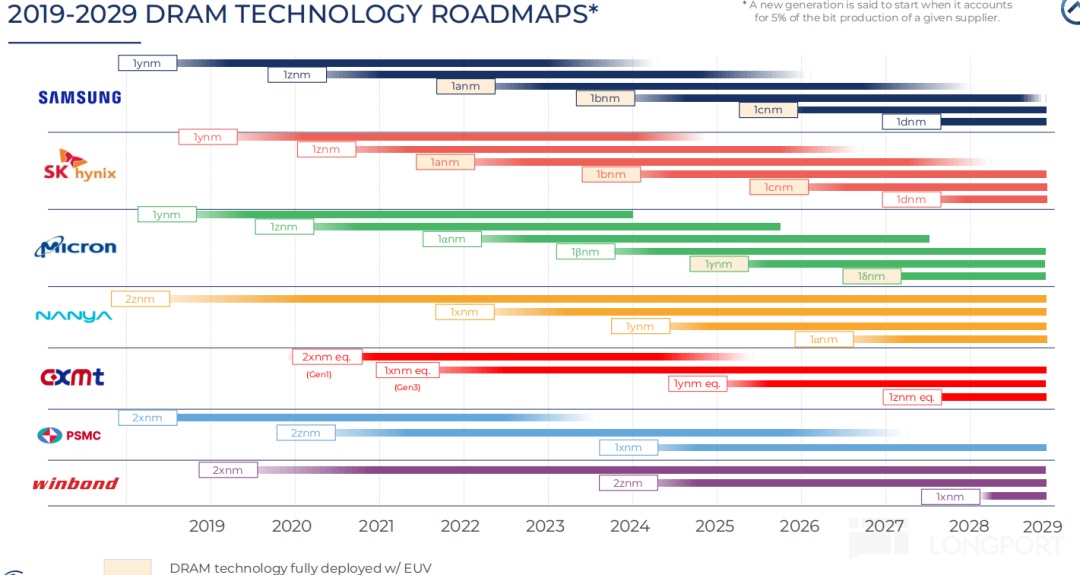
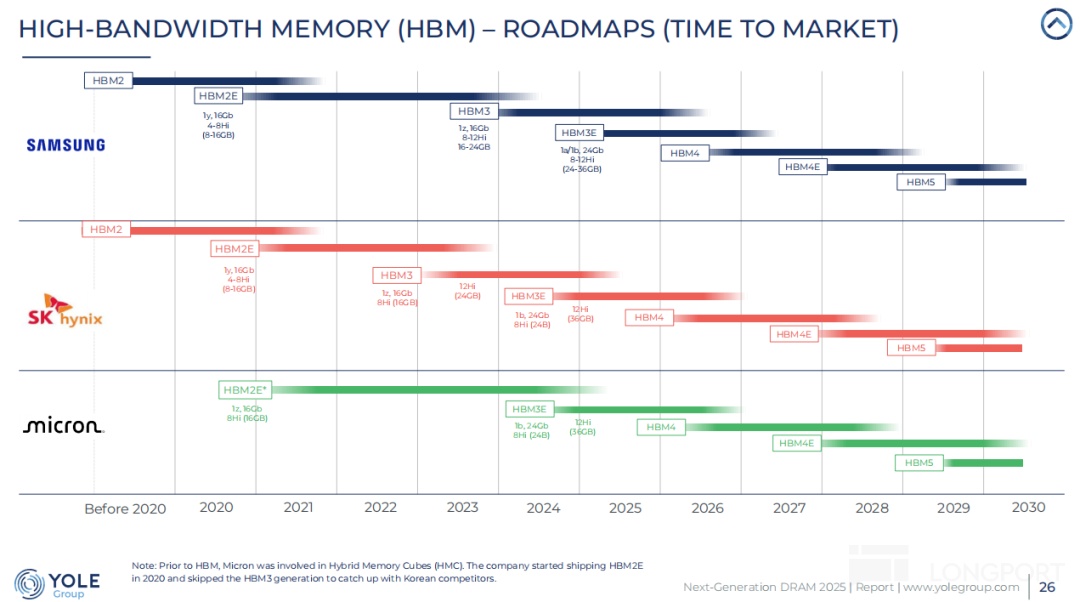
The differentiation is sharper in HBM, the AI-era focal product. Since HBM3, Hynix has led on technology and volume. A self-reinforcing loop — high yield → reliable supply → Nvidia trust → more orders → higher scale → even better yields — delivered 60%+ HBM share.
Samsung and Micron did not stand still; all three now have HBM4 in production. Downstream giants like Nvidia want multi-sourcing to preserve bargaining power. Consensus still sees Hynix as the largest HBM supplier on yields and relationships, but Samsung and Micron will claw back share.
ii) NAND
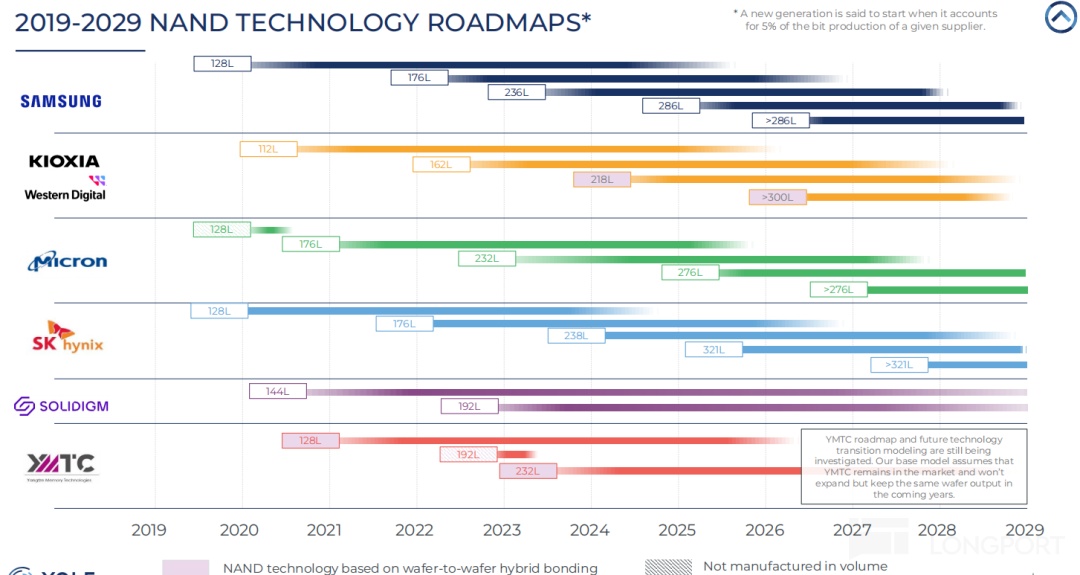
NAND is more fragmented, with six major players vs. DRAM’s concentrated triopoly (~90% combined). Capacity can be expanded via layer-count scaling rather than new lines, so the Big 3 prioritize NAND less. By layer count, Hynix has topped 300 layers, while Micron trails by ~0.5–1 node. Micron boosts bit density by tighter cell pitch and peripheral circuit optimization, making its 276-layer density comparable to Hynix’s 321-layer.
This does not mean the two are equivalent. We see Hynix as still having the edge. With higher single-die capacity at 321 layers, Hynix can build ultra-high-capacity enterprise SSDs with lower power per GB, higher storage density and lower TCO.
3. What the ADR means for Hynix
Across DRAM, HBM and NAND, Hynix leads Micron on both share and technology. With ADRs, investors can compare both names on the same exchange and currency. Despite its strength, Hynix’s market cap (~US$1.03 tn) often sits below Micron (~US$1.12 tn), a clear discount.
On PE, the discount is starker. Samsung Electronics has diversified ops, while Hynix and Micron are purer memory plays. On 2026–2027 PE, Hynix trades well below Micron. With 2026 capacity largely pre-sold and LTAs progressing, 2027 earnings visibility is improving, so we view multiples on a 2027 basis.
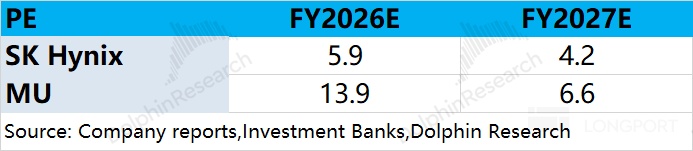
Hynix’s fiscal year is essentially calendar, while Micron’s runs 3–4 months ahead, a minor mismatch. On an aligned FY2027 view, Hynix at ~4.2x PE vs. Micron at ~6.6x remains a wide gap. Even after alignment, Micron screens at ~6–6.5x for 2027.
With superior share and tech, the ADR should push Hynix’s multiple closer to Micron’s. But as an FPI with Korea-based governance norms, some 'Korea discount' will persist. The biggest change from ADRs is broader access to capital and better disclosure, which should enhance recognition, but full parity is unlikely.
U.S. hyperscalers prefer LTAs with Micron given onshore capacity. In HBM for 2027, Hynix’s LTA (long-term agreements) coverage is ~70%, while Micron’s is ~80–90%. Even if investors apply a 'Micron framework' to Hynix, matching Micron’s multiple is tough. Still, Hynix’s ~4x PE in Korea looks too low; a move to ~5x would imply ~20% upside.
Supplementary
1. ADR conversion mechanics
i) Local-to-ADR (constrained): once the initial capacity is filled, new ADRs can only be created when existing holders cancel ADRs. Given Korea’s Monopoly Regulation and Fair Trade Act, increasing capacity via new issuance is unlikely near term (SK Square must keep ≥20%).
ii) ADR-to-local (open): after the underlying new shares list on Jul 29, investors can cancel ADRs and receive Korea-listed commons at any time, with no material restrictions.
2. Index and passive flow timeline
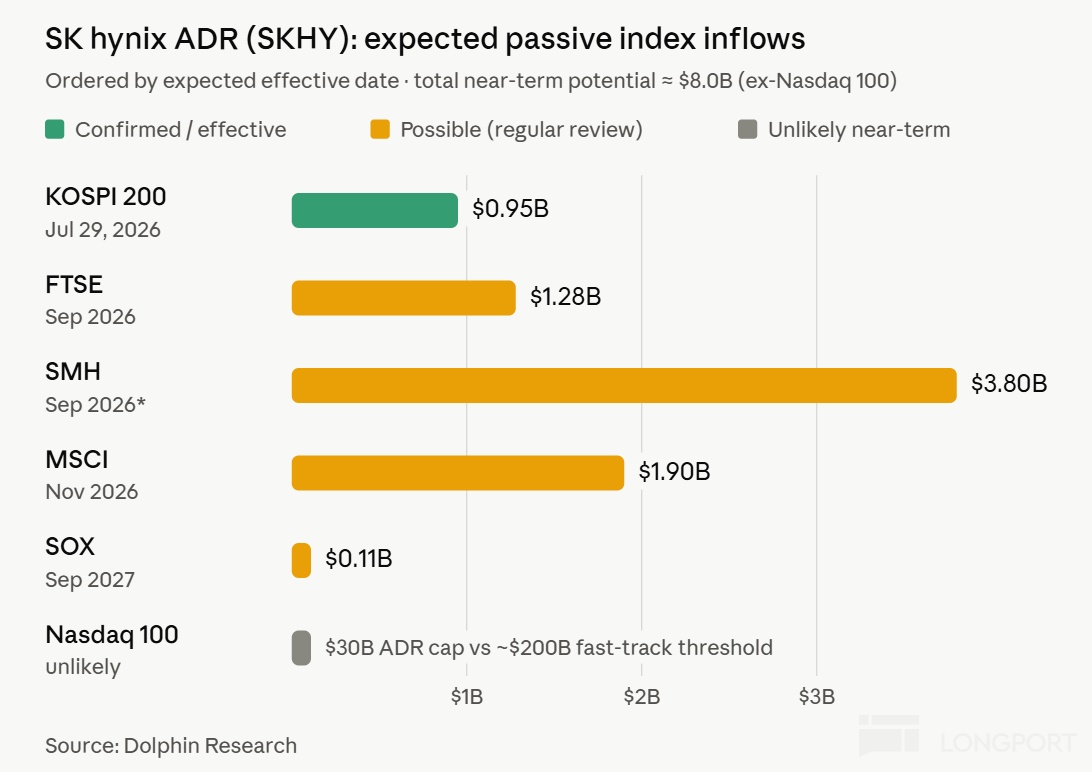
*Event: Earliest inclusion could be Sep 2026 if treated as an IPO; if not, it may slip to Sep 2027 — making the timing of the US$3.8 bn (largest single passive inflow) uncertain by about a year.
$XL2CSOPHYNIX(07709.HK) $SK Hynix - WI(SKHYV.US)
<End>
Risk disclosure and statements:Dolphin Research Disclaimer and General Disclosure



The copyright of this article belongs to the original author/organization.
The views expressed herein are solely those of the author and do not reflect the stance of the platform. The content is intended for investment reference purposes only and shall not be considered as investment advice. Please contact us if you have any questions or suggestions regarding the content services provided by the platform.