
T
TheInvestingIguana
Featured

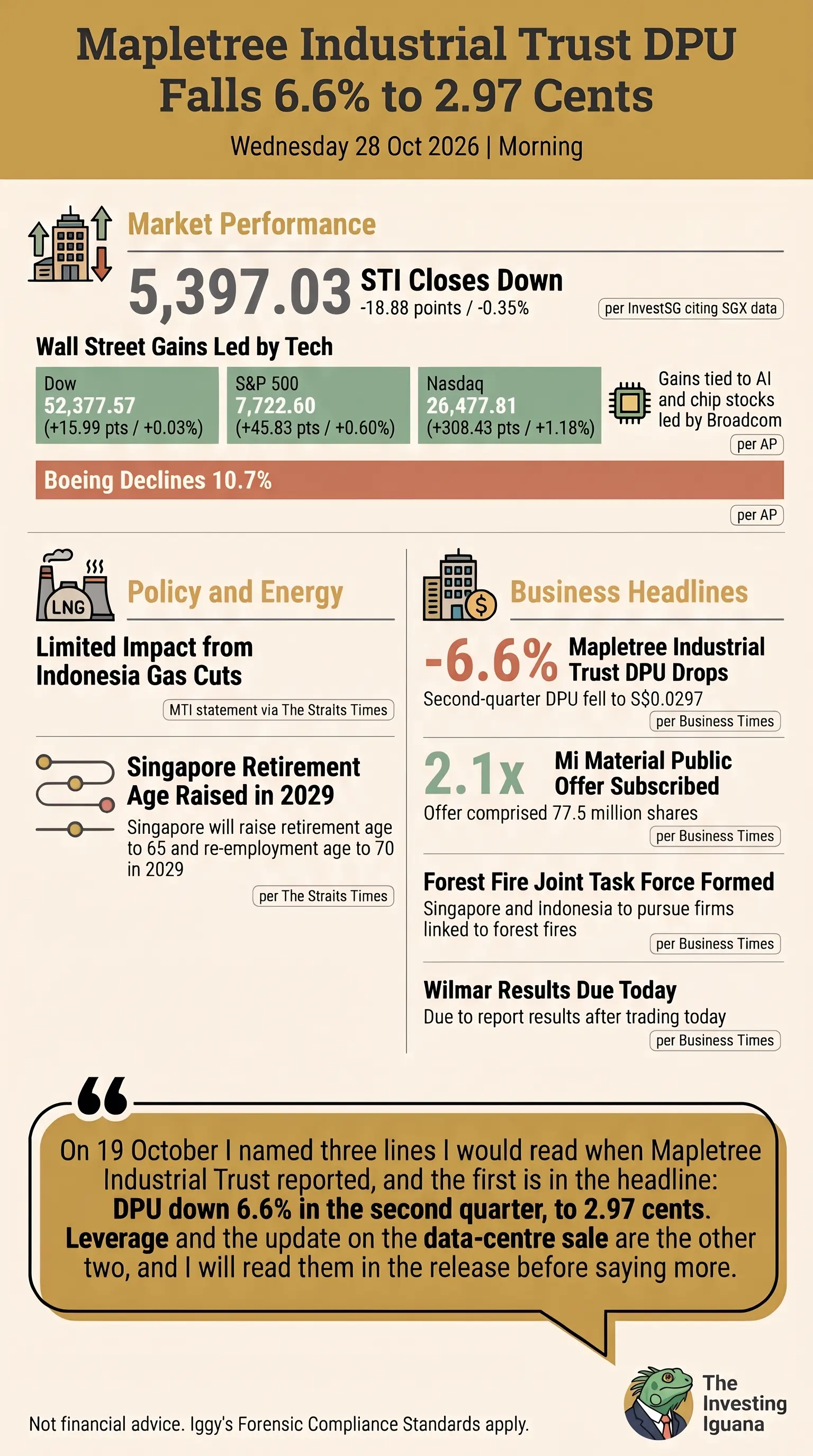
Iggy’s Journal: Mapletree Industrial Trust’s Second-Quarter DPU Fell 6.6% to 2.97 Cents

Wednesday 28 Oct 2026 | Morning

The Numbers

STI: Tuesday’s close was 5,397.03, down 18.88 points or 0.35%, per InvestSG citing SGX data.

Wall Street on Tuesday, in a session that ran after SGX had closed: the Dow finished at 52,377.57, up 15.99 points or 0.03%. The S&P 500 finished at 7,722.60, up 45.83 points or 0.60%. The Nasdaq finished at 26,477.81, up 308.43 points or 1.18%. The Associated Press tied the gains to AI and chip stocks led by Broadcom, and noted that Boeing fell 10.7%.

Second Minister for Trade and Industry Tan See Leng said on 27 October that Indonesia’s gas cuts will have a limited impact on Singapore’s power sector, citing LNG terminal capacity and backup fuel reserves (MTI statement via The Straits Times). The Straits Times also reports that Singapore will raise the retirement age to 65 and the re-employment age to 70 in 2029.

Business Times headlines: “Mapletree Industrial Trust posts 6.6% drop in Q2 DPU to S$0.0297”. Mi Material’s public offer of 77.5 million shares was 2.1 times subscribed. Singapore and Indonesia will form a task force to pursue firms linked to forest fires. $Mapletree Ind Trust(ME8U.SG) 

Wilmar is due to report results after trading today.

My Personal Take

On 19 October I named three lines I would read when Mapletree Industrial Trust reported, and the first is in the headline: DPU down 6.6% in the second quarter, to 2.97 cents. Leverage and the update on the data-centre sale are the other two, and I will read them in the release before saying more. MIT results review will be out in days to come. 

Cheers, Iggy 🦖

Not financial advice. Iggy’s Forensic Compliance Standards apply.
图片 1,共 1 张Long image
F
FaithAnchor
Featured

$NTT DC REIT USD(NTDU.SG)

NTT DC REIT: Better Fee Alignment, but Is It the Best Data Centre REIT?

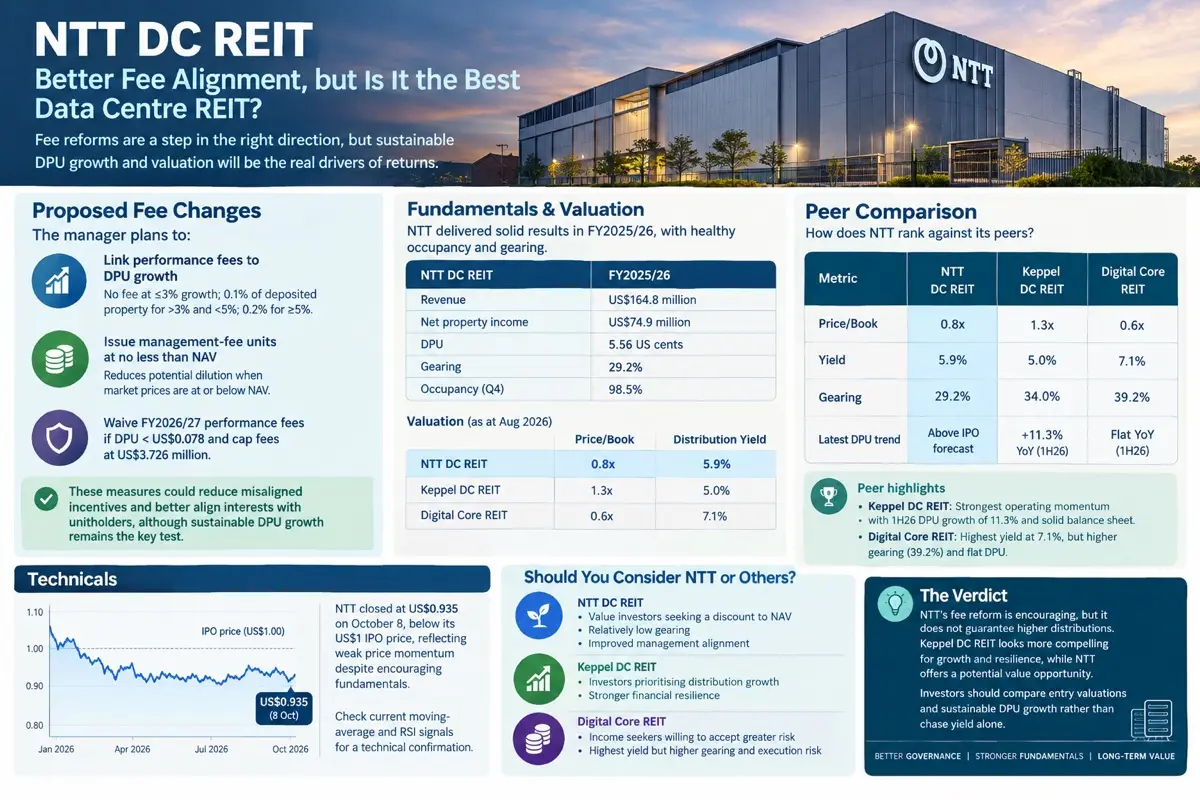
The manager plans to link performance fees to DPU growth and issue management-fee units at no less than NAV. It also proposes waiving FY2026/27 performance fees if DPU falls below US$0.078 and capping fees at US$3.726 million. These measures could reduce misaligned incentives and unnecessary dilution, although sustainable DPU growth remains the real test.

Fundamentals and valuations

NTT reported FY2025/26 revenue of US$164.8 million, net property income of US$74.9 million and DPU of 5.56 US cents, exceeding IPO forecasts. Gearing stood at 29.2%, with occupancy reaching 98.5% in Q4.

As of August 2026, NTT traded at approximately 0.8 times book value with a 5.9% distribution yield. Keppel DC REIT traded at 1.3 times book with a 5.0% yield, while Digital Core REIT offered a 7.1% yield at 0.6 times book.

Technicals and peer comparison

NTT closed at US$0.935 on October 8, below its US$1 IPO price, reflecting weak price momentum despite encouraging fundamentals. Current moving-average and RSI signals should be checked before confirming a technical reversal.

Keppel DC REIT stands out for operating momentum, with 1H26 DPU growth of 11.3%. Digital Core REIT offers the highest yield but carries greater balance-sheet risk, with gearing of 39.2% and flat 1H26 DPU.

Investment verdict

NTT could appeal to value investors seeking a discount to NAV, relatively low gearing and improved management alignment. However, Keppel DC REIT looks more compelling for investors prioritising distribution growth and financial resilience. Digital Core REIT suits income seekers willing to accept greater risk.

Ultimately, NTT’s fee reform is encouraging, but investors should demand evidence of sustainable DPU growth before treating its valuation discount as a bargain.

NTT DC REIT 0 Better Fee Alignment, but Is It the Best NTT Data Centre REIT? Fee
F
FaithAnchor

$Frasers Cpt Tr(J69U.SG)

Frasers Centrepoint Trust (J69U) delivered a strong FY26. DPU reached a record 12.35 cents, NPI grew 15.7% to S$321.7 million and leverage fell to 38.7%.

At around S$2.06, that works out to roughly a 6% yield. Occupancy is also an impressive 99.7%, while 6.6% rental reversions suggest there is still room for income growth.

But would I rush in before the ex-dividend date?

No.

The 6.214-cent 2H distribution looks attractive, but investors should remember that the dividend isn’t free money. Once FCT goes ex-dividend, the unit price should theoretically adjust lower by roughly the distribution amount.

The bigger question is what investors are paying for the underlying REIT.

This is where FCT becomes interesting against CapitaLand Integrated Commercial Trust (C38U).

CICT offers greater diversification across retail, offices and integrated developments. That gives it a broader earnings base, but its office exposure also makes it more sensitive to the commercial property cycle.

FCT is much more focused on suburban retail. That means less diversification, but its malls benefit from recurring daily spending such as groceries, food and essential services. Its 99.7% occupancy and positive rental reversions reinforce that defensive quality.

FCT also has potential growth from AEIs at NEX, Hougang Mall and Causeway Point, while lower financing costs are helping support DPU.

At S$2.06, I don’t think investors need to chase the dividend. I would rather wait for the post-ex-dividend adjustment.

Around S$2.00 becomes more interesting, while S$1.95 or below would provide a better margin of safety, assuming fundamentals remain intact.

Bottom line: CICT offers diversification and scale; FCT offers focused suburban retail exposure, strong occupancy and improving income. I prefer accumulating FCT on weakness rather than buying simply for the dividend.

图片 1,共 1 张
T
TheInvestingIguana
Featured

Iggy’s Journal: Frasers Centrepoint Trust’s Income Rose 8.2%, Its Payout Per Unit Rose 2.0%

Friday 23 Oct 2026 | Morning

The Numbers

STI: Thursday’s close was 5,415.14, down 22.85 points or 0.42%, according to Singapore Business Review citing SGX data. That is about 5.0% below the 6 October close of 5,701.54.

Wall Street on Thursday, in sessions that ran after SGX had closed: the Dow finished at 52,867.98, up 11.89 points or 0.02%. The S&P 500 finished at 7,663.43, down 93.74 points or 1.21%. The Nasdaq finished at 26,008.86, down 694.00 points or 2.60%. The Associated Press called it the S&P 500’s worst day since July and tied the fall to AI stocks, on worry that elevated interest rates threaten the AI boom. The Nasdaq is now about 5.8% below its 6 October close of 27,599.89.

Oil: December Brent settled at US$113.17 a barrel, up US$4.35 or 4.00% (ICE Futures via Xinhua; Dow Jones Market Data shows the same figure). Xinhua attributes the rise to worry over the transport of Middle East energy supplies.

Rates: the MAS 6-month T-bill cut-off yield was 1.95% at Thursday’s auction, up from 1.90% on 8 October. Applications were S$16.07 billion for S$8.60 billion offered.

Frasers Centrepoint Trust results, announced on 22 October: full-year distribution per unit (DPU) of 12.35 Singapore cents, up 2.0%. Second-half DPU of 6.214 cents, up 2.6%. Full-year distributable income of S$252.2 million, up 8.2%.

My Personal Take

The first thing I noticed in the FCT results was the distance between two growth rates. Distributable income rose 8.2% for the year, but the payout per unit rose only 2.0%. Dividing one by the other implies about 6% more units sharing the income, and DPU is the number a unitholder is actually paid. Wall Street’s fall came after SGX closed on Thursday, so Singapore meets it at 9am today. Next I want to see the gearing line in the FCT release. I will do a deep dive soon on FCT.   $Frasers Cpt Tr(J69U.SG) 

Cheers, Iggy 🦖

图片 1,共 1 张Long image
T
TheInvestingIguana
Featured

Iggy’s Journal: SGX Opens Today After Friday’s US Drop

Mon 19 Oct 2026 | Morning

The Numbers

The STI closed Friday 16 Oct at 5,415.53, up 12.03 points or 0.22%, before the US session opened. The US then fell. The Dow closed at 52,002.41 (down 0.34%), the S&P 500 at 7,659.44 (down 1.09%) and the Nasdaq at 26,140.03 (down about 2.1%). The Associated Press attributed the fall to selling in technology and semiconductor shares, on concern about how long AI infrastructure spending can continue without squeezing earnings. Today is the first SGX session since that drop, and it opens at 9am.

Business Times headlines this morning include S-REITs starting their Q3 earnings season with interest rates in focus, DBS remaining analysts’ pick ahead of Q3 earnings after the banks’ share slump, and AI funding fears puncturing a rally in Asia’s picks-and-shovels stocks. I have read the headlines only.

My Personal Take

The first session after a big overseas fall is a noisy one, so I will watch the three banks rather than the index. DBS, UOB and OCBC dividends are what many heartland households live on, and a slump in the shares lifts the yield only if the dividend holds. That question belongs to the Q3 results, not to a Monday morning. On Friday I said this was the session I would check first, and the bank prices at the open are where I start.

Cheers, Iggy 🦖

Not financial advice. Iggy’s Forensic Compliance Standards apply.
图片 1,共 1 张Long image
F
Fattycat
Featured

🚀 Why Data Centre S-REITs Are Under Pressure - Even With Booming AI Demand

Keppel DC REIT (AJBU) and NTT DC REIT USD (NTDU) are trading near 52-week lows despite strong structural demand.

Here is what is happening 👇

📉 Macro & Interest Rate Headwinds

• Yield competition: Higher US Treasury yields mean risk-free bonds look more attractive, pulling capital away from dividend stocks.

• Refinancing costs: Older, cheaper debt is maturing and being replaced at today’s higher rates. This directly reduces distributable income.

🏢 What Affects Each One

• NTT DC REIT (NTDU): Still finding its footing post-IPO, plus US dollar currency swings on SGX.

• Keppel DC REIT (AJBU): Higher overall borrowing costs and market caution around specific asset allowances in Guangdong.

💡 The Key Insight

• Business remains strong: Occupancy stays above 98%, and AI plus cloud growth keeps pushing rental income higher.

• It’s pricing, not performance: The drop reflects higher capital costs across the sector, not weakening demand from tenants.

🤔 With prices at these levels, are you adding to your positions or waiting for more clarity?

Not financial and investment advice. Do your own due diligence ☺️.

$NTT DC REIT USD(NTDU.SG)$Keppel DC Reit(AJBU.SG)

图片 1,共 1 张
F
Fattycat
Featured

🚀Stronger Singdollar: What It Means for Your S-REITs

MAS is widely tipped to tighten policy on 14 October by steepening the S$NEER policy band slope. What does a stronger Singapore dollar mean for our REIT portfolio?🤔

📉 REITs With Overseas Assets (Facing Headwinds)

• Lower Distributions: Rental income earned overseas converts into fewer Singapore dollars, pulling DPU down.

• Valuation Impact: Foreign assets revalue lower in SGD terms. This pushes net asset value down and gearing ratios higher on paper.

🛡️ Pure Singapore REITs (Naturally Protected)

• Cost Savings: A stronger SGD helps fight imported inflation. It keeps utility, cooling and maintenance expenses in check.

• No Currency Risk: With all assets based in Singapore there is zero translation loss. Plus SORA rates stay lower than US rates, a helpful bonus.

📌 In Short

Where a REIT owns its assets matters most during an MAS tightening cycle. Pure-play domestic REITs offer much stronger resilience against currency swings and operational cost pressure.

See the full details in the infographic! 🖼️

Not investment or financial advice. Do your you due diligence ☺️.

Source: Economists expect MAS to tighten monetary policy again in October, though some see room for a pause- Business times 12 Oct 2026.

图片 1,共 1 张
T
TheInvestingIguana
Featured

Iggy’s Journal: Your Share Fell Ex-Dividend. Did You Actually Lose Money?

Mon 12 Oct 2026 | Morning

The Numbers

An illustration from the episode: a S$4 share with an 8-cent dividend. The 8 cents is 2% of the S$4 price. On the ex-dividend date the share may adjust to about S$3.92, a fall of 8 cents. The share no longer carries the dividend entitlement from that date, but the 8 cents is not paid that day. It is due on a separate payment date. The adjustment may be close to the dividend, but it is rarely exact, because other price moves can happen on the same day.

My Personal Take

A price chart shows one number for the day. It cannot separate the dividend from everything else that moved the price. If the same S$4 share closed at S$3.95 on its ex-dividend date, the price would be 3 cents above the S$3.92 adjustment, and the chart alone could not show why. In the episode I go through which dates and which payment type on the notice matter, and how I compare the price fall with the declared rate.

📺 YouTube: https://youtu.be/TMH6fhhQidk

📩 Substack: https://investingiguana.com/p/the-share-fell-when-it-went-ex-dividend

Not financial advice. Iggy’s Forensic Compliance Standards apply.

- YouTube

- YouTube

YouTube 上盡享你喜愛的影片和音樂、上載原創內容,並與親友和世界各地的人分享。

youtu.be
图片 1,共 1 张Long image
谋
谋定后动

Featured[Mou Weekly] Interest expenses exceed 1 trillion, can the US government no longer sustain it? (Week 41 of 2026 | Total Issue 291) In the absence of a recession, the deficit remains

Last Tuesday, the S&P 500 closed at 7,818.93, marking its first closing record high since August 13, with a weekly gain of 1.2%. On Wednesday, the 10-year U.S. Treasury auction cleared at 5.30%, a 24-year high. On Thursday, the Congressional Budget Office released its fiscal year 2026 ledger: revenue of $5.40 trillion, spending of $7.40 trillion, and a deficit of $1.99 trillion; net interest of $1.14 trillion, which is $227 billion more than defense spending. The deficit stands at 6.2% of GDP, unemployment is at 4.2%, with no wars on home soil and no recession...

图1:美国联邦财政收支对比(FY2025决算,FY2026初步决算,单位:万亿美元) 项目 FY2025 FY2026 同比 增减额 占比 总收入 5.24 5
图2:多收的和少收的,源头都是AI 联邦收入各项目的同比变动,2026财年 200 +1,880亿美元 个人:工资、奖金、股票收益都在交税 企业:2025年税改
图4:微软2026财年的联邦税单:法定21%,实缴2.4% 资本开支1,159亿,同比增八成,三分之二买的是服务器和GPU 140 120 1,159亿 1,0
国库的两扇门 国库 先建数据中心 税以后再交 个人所得税 企业所得税 工资、奖金、股票收益 +1,880亿 -700亿 三目 S $ T 一次性费用化 一 个人+3
T
TheInvestingIguana
Featured

Maybank Reiterates BUY on CSE Global at S$2.25 After S$190.5 Million of US Contracts

Wed 30 Sep 2026 | Analyst Update

$CSE Global(544.SG) 

The Numbers

Maybank Research reiterated its BUY on CSE Global with a S$2.25 target price after two new US contracts worth a combined S$190.5 million. The first covers power-distribution centres and integrated electrical and control systems for the Calcasieu Pass 2 LNG expansion in Louisiana, executed from 2026 to 2028. The second is a follow-on for the Cheyenne Power Hub in Wyoming, supplying power-distribution infrastructure for an adjacent data centre in 2026 to 2027.

Maybank expects a stronger 2H26 as CSE's new facility reaches a monthly run rate of US$20 million to US$23 million, and says resolving the copper-supply bottleneck could potentially double that run rate. It also forecasts capacity more than tripling by 2027 to 2028, another data-centre customer by 1Q27, and an AWS order of roughly US$250 million to US$350 million for FY27, which it expects could arrive by December. The contracts are secured. The AWS order and the new client are Maybank forecasts, not company-announced orders.

My Personal Take

My first reaction to S$190.5 million was that it was the news. What I almost missed is that the forecast in the same note is larger: the low end of Maybank's AWS range, US$250 million, is about S$320 million at Tuesday's 1.2780 USD/SGD, and no company has announced it. It took me a while to keep the signed and the forecast apart in my head, because both sit under one BUY. A company announcement of the AWS order would change how I weigh this, and so would December passing without one. 🦖

Not financial advice. Iggy's Forensic Compliance Standards apply.

图片 1,共 1 张Long image
F
FaithAnchor

$United Hampshire Reit USD(ODBU.SG)

United Hampshire US REIT: Flight or Fight?

Another 25bps hike to 3.75–4.00% is hardly good news for REITs. Higher-for-longer rates mean refinancing stays expensive and investors can demand more yield.

UHREIT, however, isn’t starting from a weak position. 1H FY2026 revenue rose 5.8% to US$37.8m, NPI grew 6.4% to US$25.5m and distributable income rose 5.8% to US$13.7m. DPU reached 2.16 US cents, while occupancy remained strong at 97.6%. Net leverage was 39.7%.

At around S$0.48, the REIT trades at roughly 0.66x NAV and offers close to a 9% annualised yield. The problem is the chart: the price has slipped from around S$0.54 to its 52-week low, showing that sentiment remains fragile.

So, flight or fight? Neither blindly. UHREIT’s defensive grocery exposure and cash yield provide a cushion, but rates can stay painful for longer.

For income investors, staying invested while averaging in makes more sense than chasing the yield. But keeping some powder dry—and looking beyond REITs—is equally important.

Not financial advice.

United Hampshire eU US REIT: BETTER LIVING Flight or Fight? FOOD FRESH Another 2
F
Fattycat
Featured

💰 Capland Ascott Trust - Below NAV, 7% Yield, But Is It a Safe Buy?

Is Asia Pacific’s largest lodging trust trading at a big discount? 🏢✨

Looking at the monthly chart, CLAS appears to be approaching key resistance. Its price is still trading below levels seen during pre-COVID period. During pre-COVID levels CLAS was ~S$1.20.

Here let’s take a full look at CLAS and what makes it promising and what to watch out for:

✅ Why It Looks Promising

1️⃣ Deep Valuation Discount

P/B ratio just 0.67, below its 5-year median of 0.7435 and NAV of S$1.15 per unit

2️⃣ Strong Yield

Trailing distribution yield 7.31%, above its 5-year average of 6.43%

3️⃣ Analyst Upside

Consensus rating is Buy with 12-month target S$1.00 (current ~S$0.835)

4️⃣ Global Footprint

Properties across 16 countries in APAC, Europe, and the US ( Serviced residences, hotels, and student housing )

⚠️ What to Watch

The balance sheet is healthy with coverage above 1x. However, lower expected earnings ahead and foreign exchange risks mean the low price is not without reason.

Is CLAS on your watchlist for high-yield recovery? Is the company’s fundamental and financial health getting worse?

For more information, please refer to the infographic and let’s discuss🤔👇

Not financial and investment advice. Please do your own due diligence ☺️.

$CapLand Ascott T(HMN.SG)

图片 1,共 3 张
< HMN CapLand Ascott T Closed(weekends)09/27 873 Quotes RelatedProducts Overview
CapitaLand Ascott Trust D SGD 1~ 0.835+0.010(+1.21%) 1.50 BB 20 SMA close 2 1.38
T
TheInvestingIguana
Featured

Iggy's Journal: US Treasury Yields Just Hit Their Highest Level Since 2007. Your CPF Statement Won't Show It.

27 September 2026, Evening

Video Release

The question I kept coming back to this week wasn't why US Treasury yields reached 5.22 percent. It was why my own CPF statement barely reacted to something that size. That gap is the whole story.

The Numbers

This is a genuine global bond shock, the kind of move that reprices risk everywhere it touches. But Singapore's transmission mechanism runs differently, CPF Ordinary Account still sits at its guaranteed 2.50 percent regardless of what Washington's bond market does, and this week's 6-month T-bills yielded between 1.70 and 1.92 percent, both untouched by the headline number. The risk hasn't vanished just because your statement looks calm, it's moved somewhere else, into the balance sheets of specific REITs that actually have to refinance debt in this environment. Sector medians currently sit at 39.6 percent gearing and 3.3 times interest coverage, numbers that describe an entire sector's cushion, not any one name's.

My Personal Take

I don't want anyone reading a US Treasury headline and assuming their own portfolio absorbed the same shock, because it didn't, not directly, and not evenly. CPF's guarantee doesn't move with a foreign bond market, and neither does a T-bill you've already locked in. What actually moves is a REIT's refinancing cost the next time its debt comes due, and that's a company-by-company question, not a headline-level one. A sector median tells you the general cushion, it doesn't tell you whether the specific REIT sitting in your own portfolio is closer to the healthy end of that range or closer to the edge. I wouldn't let a dramatic number out of Washington replace an actual forensic check of the names you're holding. Full breakdown of which structural factors actually matter for refinancing risk is in today's video.

Not financial advice. Iggy's Forensic Compliance Standards apply

图片 1,共 1 张Long image
F
FaithAnchor
Featured

$DBS(D05.SG)

Fed Hike: A Mixed Bag for Singapore Banks

The Fed’s surprise 25bp hike to 3.75–4% changes the rate narrative. For Singapore banks, it’s less about an immediate earnings boost and more about how long rates stay elevated.

FY2026 numbers already show margin pressure. DBS’ NII has softened, while OCBC and UOB have also seen NIMs edge lower as funding costs rise and the rate cycle turns.

A higher-for-longer environment could slow further NIM compression, but it’s not a free lunch. Higher funding costs, weaker loan demand and rising credit risks could offset some of the benefits. Tariffs, energy inflation and heavy AI capex add another layer of uncertainty for corporate borrowers.

Valuations also leave less room for disappointment. DBS trades at a premium to book, while UOB remains comparatively cheaper on both price-to-book and earnings multiples.

Technically, all three local banks remain at elevated levels after their strong runs.

The key question now: can higher rates protect margins without triggering higher credit costs?

Not financial advice. Investors should conduct their own research and consider their risk tolerance.

Fed Hike: A Mixed Bag for Singapore Banks X DBS 9 OCBC The Fed's surprise 25bp h
T
TheInvestingIguana
Featured

Iggy's Journal: Inflation Ticks Up for a Third Straight Month. The STI Barely Noticed.

23 September 2026, Evening

(No infographic for this post; I'm on a plane right now) 


The STI closed at 5,709.9, down 13.85 points, a quiet 0.24 percent day. Underneath that quiet, Singapore just posted its highest core inflation reading in two years, and the room is genuinely split on what MAS does about it in October.


The Numbers

Core inflation rose to 2.2 percent in August from 2 percent in July, the third straight monthly increase, while headline inflation, which includes accommodation and private transport, ticked up to 2.3 percent. Airline ticket costs jumped 12.9 percent, the sharpest rise in nearly four years, and services inflation climbed to 2 percent from 1.7 percent the month before. MAS already tightened the SGD NEER slope twice this year, in April and again in July, and economists are now split on whether October brings another small tightening or a hold. DBS's Chua Han Teng summed up the tension in four words, inflation "firmed but not accelerating."  

My Personal Take

Barclays called this data "more benign" than what MAS was pricing in back in July, and I think that's the real story hiding under a boring index day. The central bank tightened twice this year on the expectation that growth would eventually show up as inflation. Now the inflation is showing up, just slower and milder than the move that was meant to get ahead of it. That's not a policy mistake, it's a central bank managing a moving target in real time, but it does mean the case for October restraint gets a little stronger with every print like this one. If your T-bill or fixed deposit is coming up for renewal around then, this is exactly the kind of data that decides whether your next rate looks better or worse than the last one.


Cheers, Iggy

F
Fattycat
Featured

$CapLand Ascendas REIT(A17U.SG)$Mapletree Ind Trust(ME8U.SG)

$Mapletree PanAsia Com Tr(N2IU.SG)$Keppel DC Reit(AJBU.SG)

📉 S-REITs Grinding Lower After Jackson Hole - Here’s the Full Story

Since the 2026 Jackson Hole symposium, S-REITs have been in a steady downtrend.

Following Fed Chair Kevin Warsh’s hawkish message, the sector fell an average of 1.6% over seven trading days while the broader STI actually gained 0.5%.

This is not about poor earnings, it is a discount-rate shock. As US 10-year yields climbed toward 4.81%, the yield spread investors demand from REITs got squeezed.

Even though most blue-chip S-REITs have 70–87% of debt hedged to protect dividends, share prices dropped as money rotated into banks to chase higher interest margins.

📊 Who’s Down, Who’s Holding Up

🔴 Under Pressure:

CapitaLand Ascendas (CLAR) and MPACT both fell over 3%, weighed by higher leverage and operational headwinds.

🟢 Resilient:

Data center-focused REITs stayed in the green. For example :Keppel DC REIT +0.28% and Mapletree Industrial Trust +0.52%, backed by strong balance sheets and the AI growth story.

🔑 What’s Next?

All eyes on tomorrow, 11 Sept CPI. The coming inflation data will move yields and decide whether S-REITs derate further or stage a recovery.

👉 See the “Real Estate Trust Performance Trends” infographic for the complete winner/loser breakdown😀

Not financial advice. Please do your own DD☺️.

图片 1,共 1 张Long image
F
FaithAnchor
Featured

$DBS(D05.SG)

DBS, OCBC or UOB: Which Bank Wins on S$10,000?

For a S$10,000 investment, DBS wins the dividend race, but it is not necessarily the cheapest.

Using FY2026 annualised payouts, S$10,000 generates roughly S$421 from DBS, S$386 from UOB and S$332 from OCBC. DBS therefore ranks first for income, although part of its payout includes a capital-return component that may not be permanent.

Force Ranking

1. DBS — BUY/HOLD

The clear quality leader. 1H26 net profit reached S$6.01bn, ROE was 17.5% and asset quality remained strong. The downside is valuation: around 19x earnings and 3x book, making DBS the most expensive.

2. UOB — BUY

The valuation winner at roughly 16x earnings and 1.4x book, with ~4% yield. However, weaker ROE and greater exposure to regional economies temper the upside.

3. OCBC — HOLD

Strongest 1H26 earnings growth, but its ~17x P/E and ~2x book valuation leave less margin of safety. Its lower ~3.3–3.5% yield also trails DBS and UOB.

Technically, all three remain strong after their 2026 rally, but valuations are stretched. Falling rates could further compress NIMs, while credit losses and slower regional growth remain key headwinds.

Verdict: DBS for quality and income; UOB for value; OCBC for growth. Overall: DBS > UOB > OCBC.

Not financial advice.

图片 1,共 1 张
D
Dacai
Featured

$Suntec Reit(T82U.SG)

The Context: 

The prices of reits have come under pressure lately due to the increased probability of a rate hike. Some of my friends saw it as an opportunity to buy at a more attractive price and dividend yield while others are adopting a wait-and-see approach. Then the yield of the 10-year Treasury fell in reponse to Governor Waller’s speech which was interpreted by the market as support for maintaining the interest rate in September but this is contingent on the inflation data showing signs of deflation.

Subsequently, the August job data report showed a stronger than expected figure for non-farm payroll jobs which made the yield go up.

My Trade: Maintain while watching for an opportunity to add more.

Takeaway: News can have a pronounced short-term impact on stock prices but expectations can change quickly. For long term value investors, if the convictions and fundamentals haven’t changed drastically, there is no need to panic and do reactive trades.

图片 1,共 1 张