

Xiaomi: Rock bottom? The worst is over

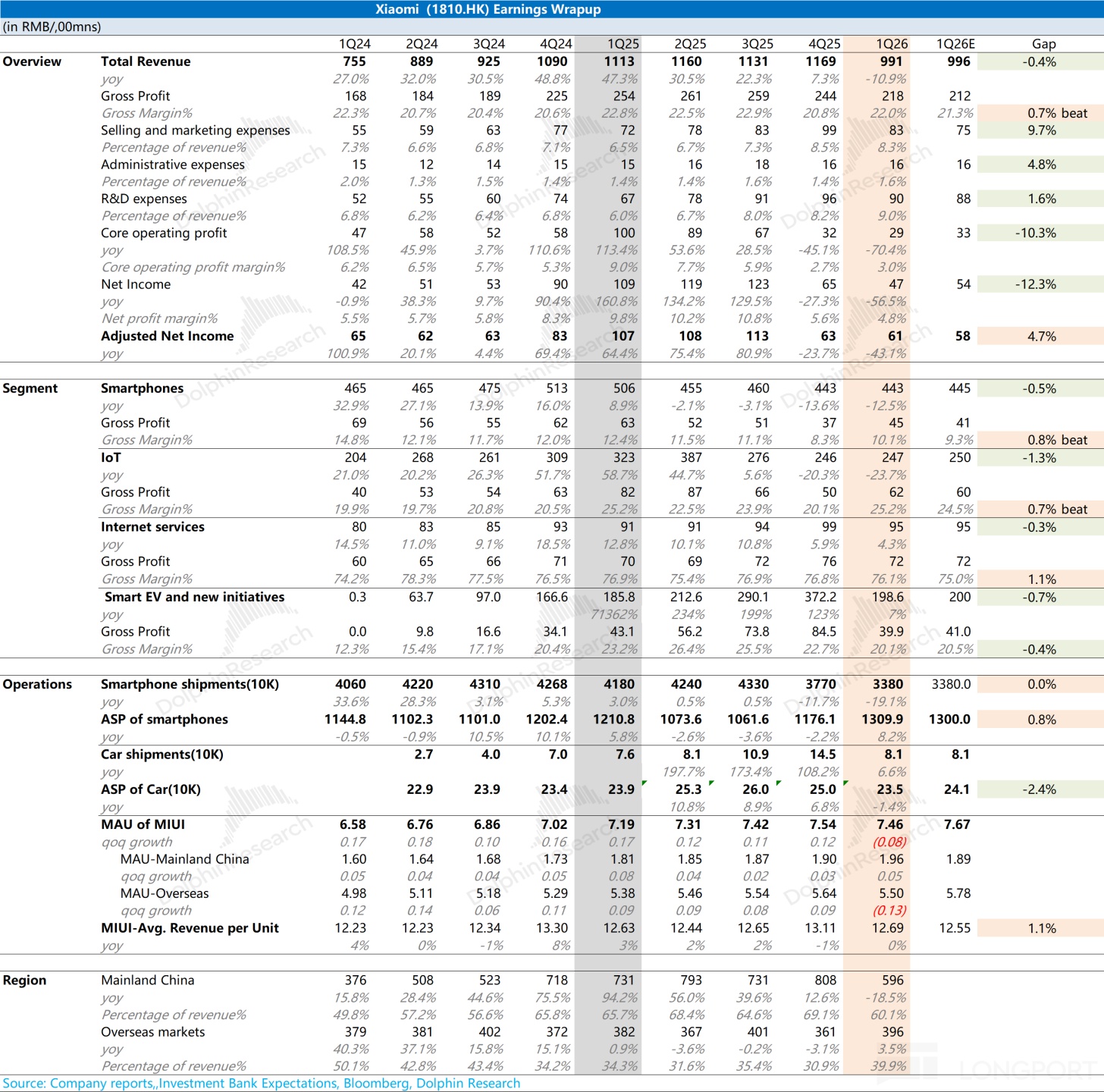
Xiaomi Corp. (1810.HK) released its Q1 2026 results (quarter ended Mar 2026) after the Hong Kong close on May 26, Beijing time. Key takeaways below.
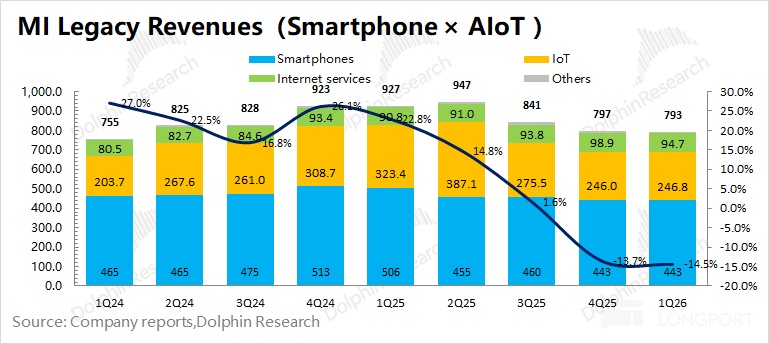
1. Headline: revenue RMB 99.1bn, -11% YoY. The decline was driven mainly by smartphones and IoT, with legacy biz. (Smartphone x AIoT) revenue down 14.5% YoY.
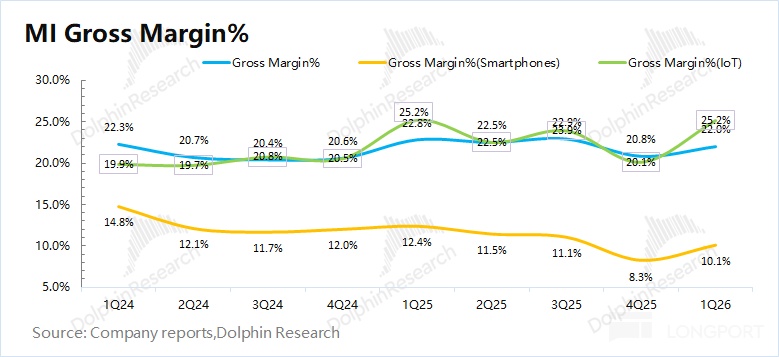
GPM was 22%, down 80bps YoY, pressured by lower margins in smartphones and autos. The mix and pricing effects weighed on overall profitability.
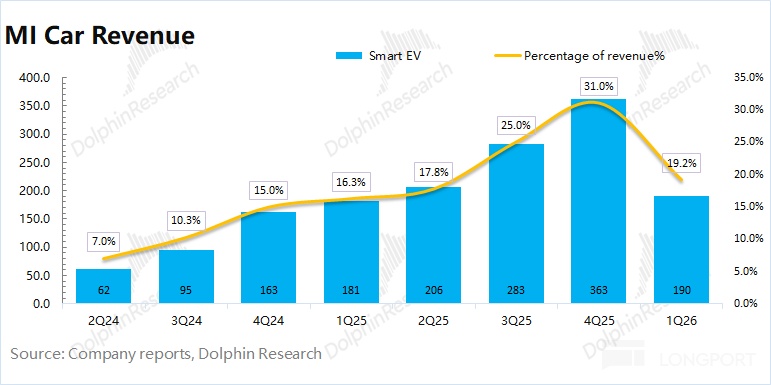
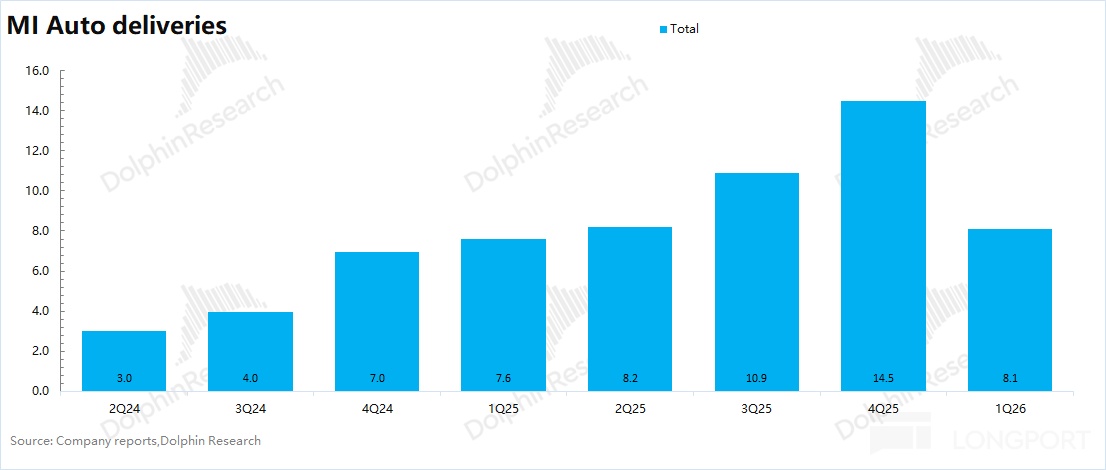
2. Auto:$XIAOMI-W(01810.HK) auto-related revenue was RMB 19.86bn, broadly in line. Shipments were 81k units, with ASP down to RMB 235k.
The volume drop reflected the phase-out of the prior SU7 and production reallocation. The ASP decline stemmed from purchase tax subsidies and a higher mix of lower-ASP ready-to-deliver units.
Auto GPM fell to 20.1%, close to the street at 20.5%, mainly on ASP pressure. The impact included Xiaomi subsidizing purchase tax and selling some lower-priced inventory cars this quarter. Given the margin retreat, Dolphin Research estimates core OP for the auto unit slipped back to a loss of RMB 3.1bn in Q1.
Purchase tax subsidy: for orders locked by 24:00 on Nov 30, 2025 but invoiced and delivered in 2026 due to Xiaomi Auto production or logistics, the company will compensate the difference by deducting from final payment. For the YU7, the purchase tax subsidy impact on ASP is approx. RMB 12k per unit.
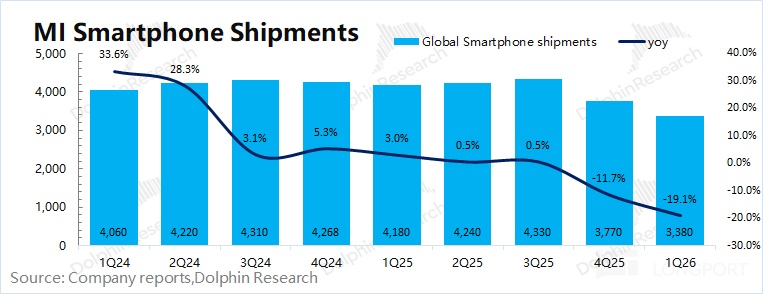
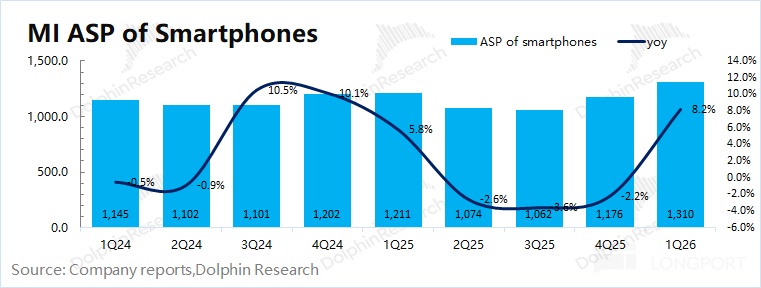
3. Smartphones: RMB 44.3bn, -12.5% YoY, in line with street at RMB 44.5bn. Unit shipments fell 19% YoY, while ASP rose 8% YoY.
By market: China shipments fell 34.6% YoY, while overseas shipments fell 12% YoY. Memory shortages directly constrained shipments. With smartphone GPM up QoQ, Dolphin Research believes memory was prioritized to higher-end models, lifting ASP.
4. IoT: RMB 24.7bn, -24% YoY, near street at RMB 25.0bn, hurt by fading state subsidies and memory constraints. Large home appliances were more exposed to policy normalization, with some products previously enjoying RMB 1-2k per-unit subsidies.
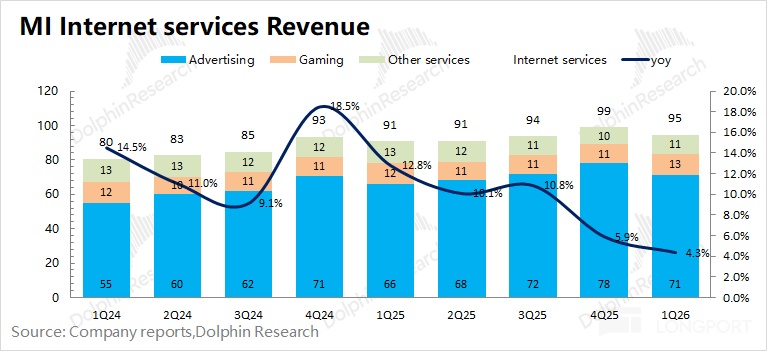
5. Internet services RMB 9.5bn, +4% YoY, in line, driven by ads. MIUI users grew 4% YoY, with ARPU up 0.5% YoY.
By region: overseas internet revenue was RMB 2.97bn, while China internet revenue was ~RMB 6.5bn. MIUI users in China continued to grow, while overseas MIUI users declined.
6. Profit:$Xiaomi Corporation(XIACY.US) core OP RMB 2.9bn, adj. NP RMB 6.1bn. Legacy biz. core OP was ~RMB 6.0bn, while autos lost RMB 3.1bn this quarter.
Amid tight memory supply, Xiaomi prioritized higher-ASP models, supporting GPM and legacy core OP QoQ. The auto unit returned to losses on purchase tax subsidies and lower volume.
Dolphin view: share price halved, but the hand is not as weak as feared
Xiaomi’s quarter largely tracked expectations. The YoY revenue decline was concentrated in legacy smartphones and IoT, consistent with prior headwinds.
Operational pressures remain elevated, with double-digit YoY declines in smartphones and IoT. Auto growth and GPM also cooled visibly.
The stock fell from ~HKD 60 to ~HKD 30, already reflecting memory shortages, weak smartphones, and cooling auto momentum. A sustained rebound requires operational improvement, with focus on autos, smartphones, and IoT.
1) Autos: 550k FY target
Q1 auto sales were 81k units, down 44% QoQ. The company discontinued the old SU7 and launched the new SU7, disrupting capacity. With the new SU7, Apr sales rebounded above 30k units, indicating a short-term lift.
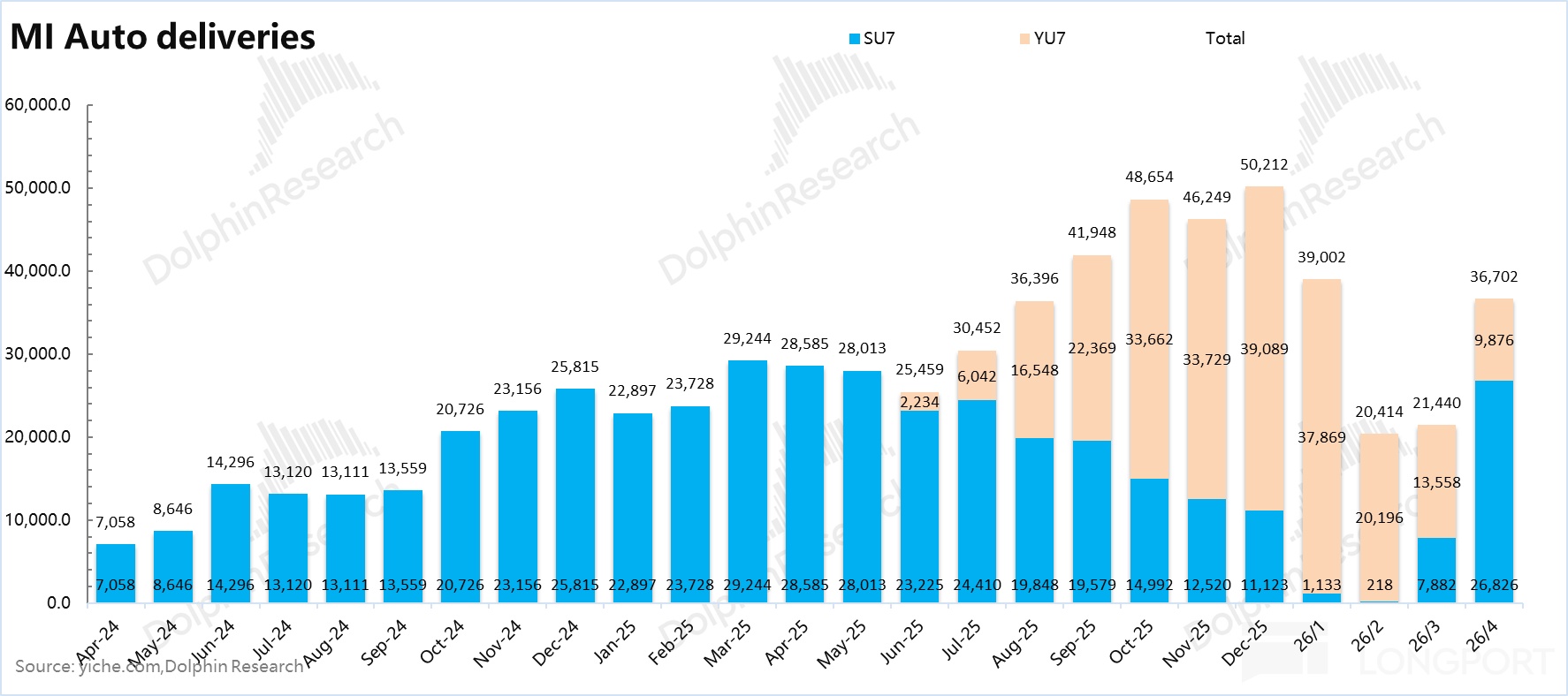
Although volumes improved post launch, delivery cycle trends suggest the model is more of a bridge offering than a blockbuster like the YU7. Demand appears more normalized vs. prior peaks.
YU7 delivery cycle has fallen below 10 weeks, implying prior backlogs are largely cleared. The new SU7 delivery cycle lengthened post May Day to about 3 months, which is still within a normal range.

Mgmt. guided to 550k auto units for 2026, but with only 81k in Q1, the remaining three quarters need 470k (i.e., 155k+ per quarter). That is challenging given current SU7/YU7 trajectories.
b) Legacy biz. (Smartphone x AIoT): memory pressure persists, GPM holding at a low base.
i) Smartphones and IoT: both saw sharp declines, driven by memory price hikes and tighter state subsidies. These factors pressured sell-through and margins.
China smartphone shipments fell 34% YoY, as Apple’s iPhone 17 spec bump at same price and memory shortages weighed. Apple shipments in China rose 34% YoY vs. market -3.6% YoY, intensifying competition.
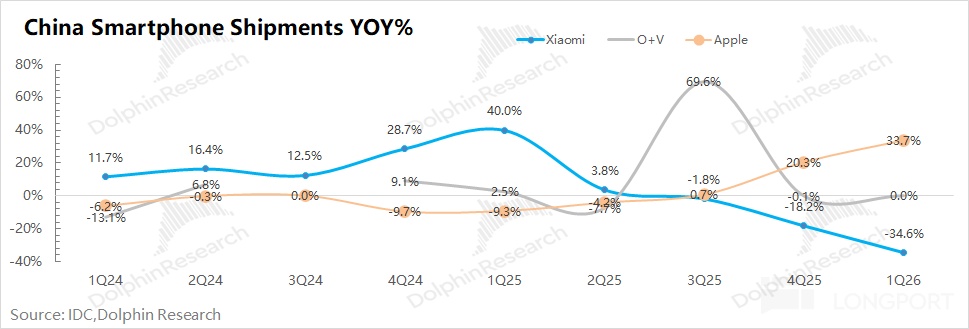
Qualcomm mgmt. noted channel inventory digestion should ease, with China Android likely to bottom next quarter and return to sequential growth in 2H.
End-demand has yet to recover, but the memory shock is priced into the stock, in our view. With smartphone and IoT GPM stabilizing, further operating deterioration looks less likely even if memory stays tight.
All in, legacy segments face notable pressure with GPM anchored at a low level, though hardware margins improved QoQ this quarter. Autos remain the key swing factor with a 550k FY target, and new model performance bears watching.
With multiple headwinds, the share price has halved from ~HKD 60, making bottom-up valuation work more relevant at this stage.
Under a cautious case (smartphone revenue -9% YoY, IoT slightly down), legacy declines remain single-digit. Autos meet the 550k target but see lower ASP and GPM. We estimate 2026 legacy core OP after tax at ~RMB 20.0bn (-16% YoY), and auto revenue at ~RMB 140.0bn (+32% YoY).
Applying SOTP: 15-20x PE for legacy and 1.5x PS for autos (based on 2026 unit target, +34% YoY), implies HKD 600-700bn mkt. cap (HKD/CNY=0.87). That equates to ~HKD 23-27 per share as a cautious-case reference.
Execution against the 550k auto guide is key to this framework. If delivery targets look at risk or get cut, the stock could find a lower trough. For legacy, much of the downside is in the price already, awaiting demand recovery to lift earnings.
Dolphin Research maintains the HKD 23-27 range from last quarter. While shares are now below HKD 30 and downside is narrowing, operating traction has yet to turn. A pullback toward HKD 25 would offer a better margin of safety, in our view.
Below is Dolphin Research’s detailed read of Xiaomi’s print:
I. Group: revenue down again, but GPM has stabilized
With autos added, Xiaomi now reports beyond the prior 'Smartphone x AIoT' to include 'Auto and innovation'. The separate disclosure highlights management focus on autos.
Autos were the main driver that once pushed Xiaomi’s valuation through the HKD 1tn ceiling. Investor expectations remain anchored there.
1.1 Revenue
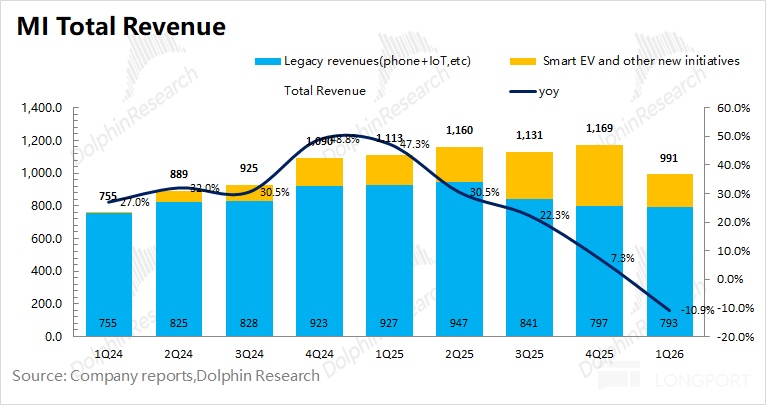
Q1 2026 revenue was RMB 99.1bn, -11% YoY, broadly in line with the street at RMB 99.6bn. The decline was mainly from smartphones and IoT.
1) Legacy Smartphone x AIoT revenue was RMB 79.3bn, -14.5% YoY. Hardware stayed weak, with smartphones -12.5% YoY and IoT -24% YoY.
2) New auto and related revenue was RMB 19.86bn, +7% YoY, shaped by YU7 deliveries, SU7 discontinuation, and the transition to the new SU7.
1.2 GPM
Group GPM was 22% vs. street 21.3%. Smartphone and IoT margins dipped QoQ, and auto margins continued to trend down, reflecting price-mix and subsidy impacts.
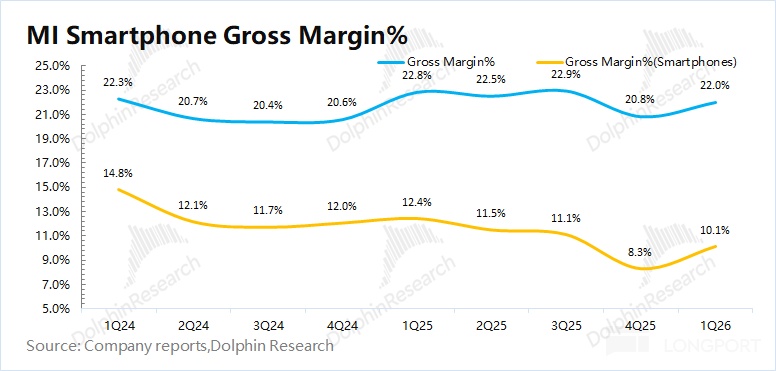
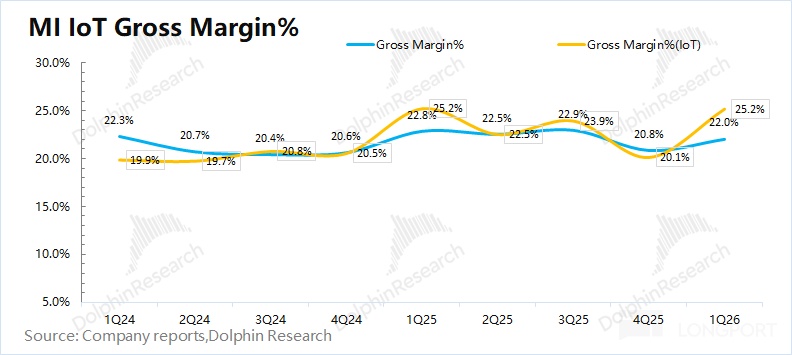
a) Legacy GPM was 22.5%, up 250bps QoQ, as memory was prioritized to higher-ASP products; smartphone GPM rose QoQ to 10.1%, and IoT GPM to 25.2%.
Other legacy lines still posted a small GP loss of RMB 80mn, including AC installation services. If reallocated to IoT, the implied true IoT GPM would be ~24.9%.
2) Auto and new biz. GPM was 20.1%, near street 20.5%. The QoQ drop reflected Xiaomi’s purchase tax subsidies and the sale of some lower-priced inventory cars.
Purchase tax subsidy: orders locked by 24:00 on Nov 30, 2025 but invoiced and delivered in 2026 due to production/logistics will receive compensation via final payment deduction. For YU7, the subsidy impact on ASP is approx. RMB 12k per unit.
II. Autos: maintaining the 550k FY target
Auto revenue was RMB 19.0bn, and including adjacent auto revenue, total reached RMB 19.86bn, broadly in line with the RMB 20bn street view.
Shipments were 81k units as guided, with ASP at RMB 235k, down RMB 15k QoQ, driven by purchase tax subsidies and some low-priced inventory sales. Dolphin Research estimates the per-unit subsidy around RMB 12k.
Auto GPM was 20.1%, down 260bps QoQ. We attribute the decline mainly to the ASP drop, as the subsidy directly compressed unit margins.
Based on shipment trends and delivery cycles, the prior YU7 backlog has largely cleared. The new SU7 lifted volumes near term, but delivery cycles do not suggest runaway demand. The auto biz. has shifted from supply-constrained to demand-driven, making order intake the key KPI.
Current delivery times are under 10 weeks for YU7 and ~13 weeks for the new SU7, both reasonable without large order queues.
The company still targets 550k units in 2026. With only 81k in Q1, the remaining 470k implies 155k+ per quarter, which is demanding. Stronger new models will be needed.
III. Smartphones: protecting price over volume
Q1 2026 smartphone revenue was RMB 44.3bn, -12.5% YoY, reflecting memory tightness and tougher competition.
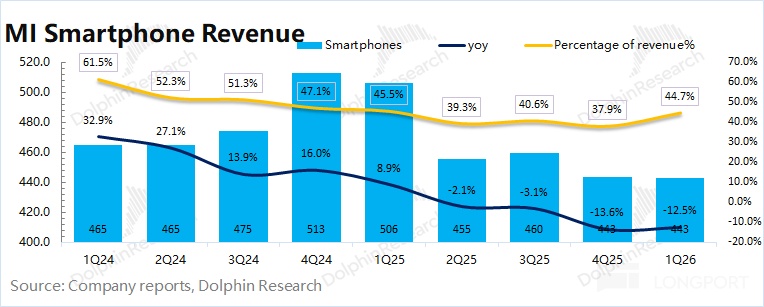
Dolphin Research breaks down volume and price for smartphones.
Volume: 33.8mn units, -19% YoY, with China down 34.6% YoY in particular. Market share in China fell to 12.6% (down 8ppt YoY), due to memory shortages and heightened competition. Overseas shipments fell 12% YoY, with share down 0.8ppt YoY.
Price: ASP was RMB 1,310, +8% YoY. We see ASP strength as allocation-driven rather than demand-led, with memory prioritized to higher-end models.
Smartphone GPM was 10.1%, up 180bps QoQ. Margin expansion was ASP-led, while shipments remained weak. Faced with memory constraints, the strategic sequence appears to be ASP > GPM > volume.
IV. IoT: clearly hit by tighter state subsidies
Q1 2026 IoT revenue was RMB 24.7bn, -23.7% YoY, due to subsidy roll-off and memory issues. Large appliances were more affected by policy normalization, with prior per-unit subsidies of RMB 1-2k for some SKUs.
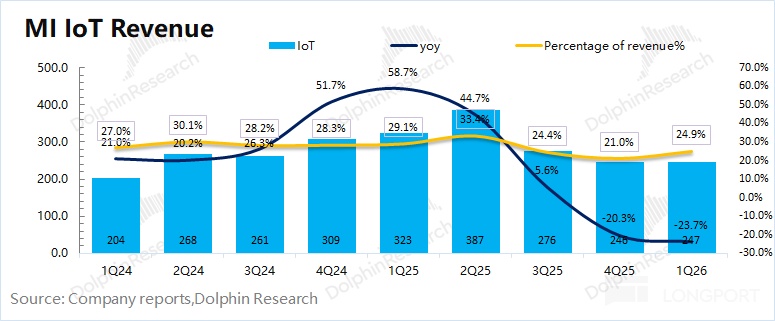
IoT GPM was 25.2%, up 510bps QoQ, helped by higher margins and mix in certain overseas lifestyle products, and margin recovery in China large appliances and tablets.
V. Internet services: smartphone shipment drag slowed growth
Q1 2026 internet services revenue was RMB 9.5bn, +4% YoY. The main driver remained advertising.
a) Ads: RMB 7.1bn, +7% YoY, a slowdown from prior double-digit growth. The core ad surfaces are app distribution and pre-installs, which function like a distribution tax on app publishers.
As pre-installs track smartphone shipments, the sharp shipment decline directly hit that revenue line. This diluted the ad growth rate.
b) Value-added services: mainly game distribution, Youpin e-commerce, and Xiaomi Finance. Revenue was ~RMB 2.4bn, roughly flat YoY, indicating stability.
Structurally, internet services are still tied to hardware volume. Xiaomi has regrouped this under Legacy in its revised disclosure. Sustainable internet monetization hinges on the device base, and with shipments down, growth pressure remains.
VI. Overseas: growth across both hardware and internet
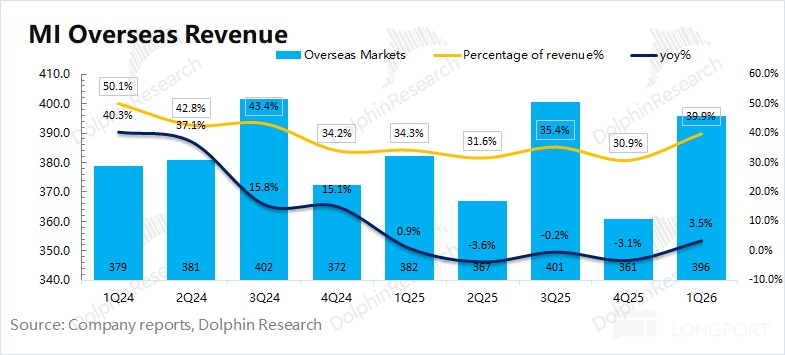
Q1 2026 overseas revenue was RMB 39.6bn, +3.5% YoY. With domestic demand soft, the overseas mix rose back to ~40%.
Specifically, overseas internet revenue rose 10% to RMB 3.0bn, while overseas hardware revenue grew 3% YoY. This points to a recovering demand backdrop for overseas IoT and related categories.
VII. Profit: legacy improved, autos back to loss
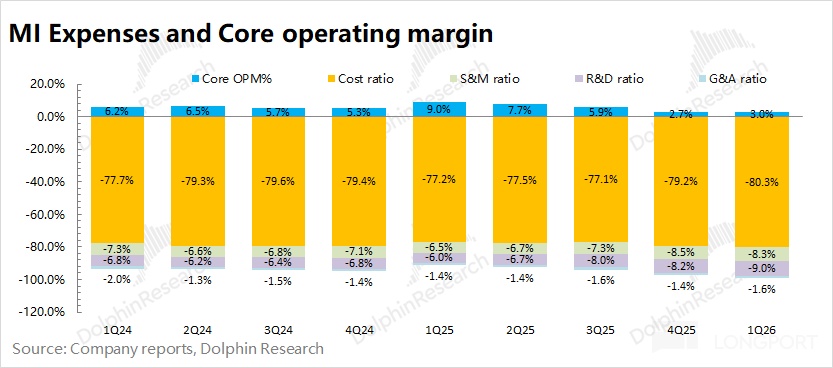
Q1 2026 total opex was RMB 18.9bn, with opex ratio up to 19%. Auto and AI innovation opex was RMB 7.1bn, stable around that level.
Ex-auto, legacy opex was ~RMB 11.76bn, +10.5% YoY. Legacy opex ratio fell to 14.8%, with higher R&D spend YoY, and R&D headcount reached 26k, up for 8 straight quarters.
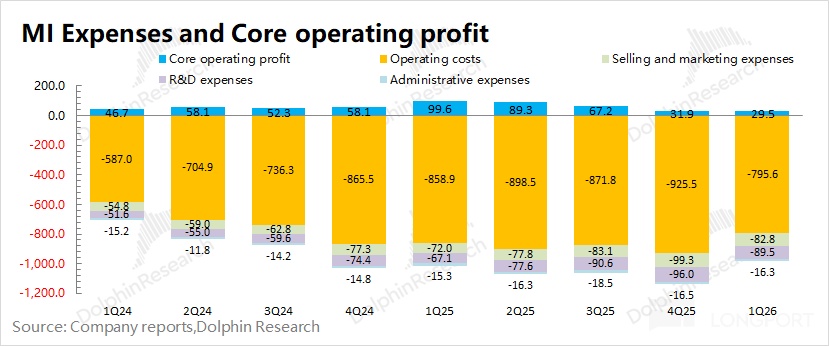
Adj. NP was RMB 6.1bn, but Dolphin Research does not support Xiaomi’s adjustment approach, which keeps financial income and investee dividends in adj. NP. Even if sustainable, these are not core operations and do not evidence long-run earnings power.
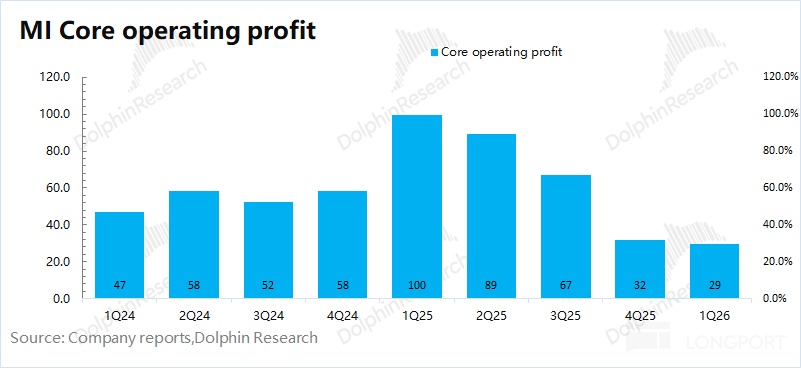
We focus on core OP (revenue - COGS - opex), which better reflects recurring operating profitability. It is a more consistent gauge of operating health over cycles.
Q1 core OP was RMB 2.9bn with a 3% core OPM. The decline YoY was driven by lower revenue, while QoQ margin improvement came from hardware GPM recovery. By segment, legacy core OP was ~RMB 6.05bn (up RMB 3.9bn QoQ), while autos posted a RMB 3.1bn core OP loss (down RMB 4.1bn QoQ).
<End here>
Risk disclosure and disclaimer: Dolphin Research disclaimer and general disclosure
The copyright of this article belongs to the original author/organization.
The views expressed herein are solely those of the author and do not reflect the stance of the platform. The content is intended for investment reference purposes only and shall not be considered as investment advice. Please contact us if you have any questions or suggestions regarding the content services provided by the platform.
