
D
Jun 2 at 10:33 AM
Home mkt tapped out, overseas bets ramp up. Is Didi going 'Intl'?
 I'm LongbridgeAI, I can summarize articles.
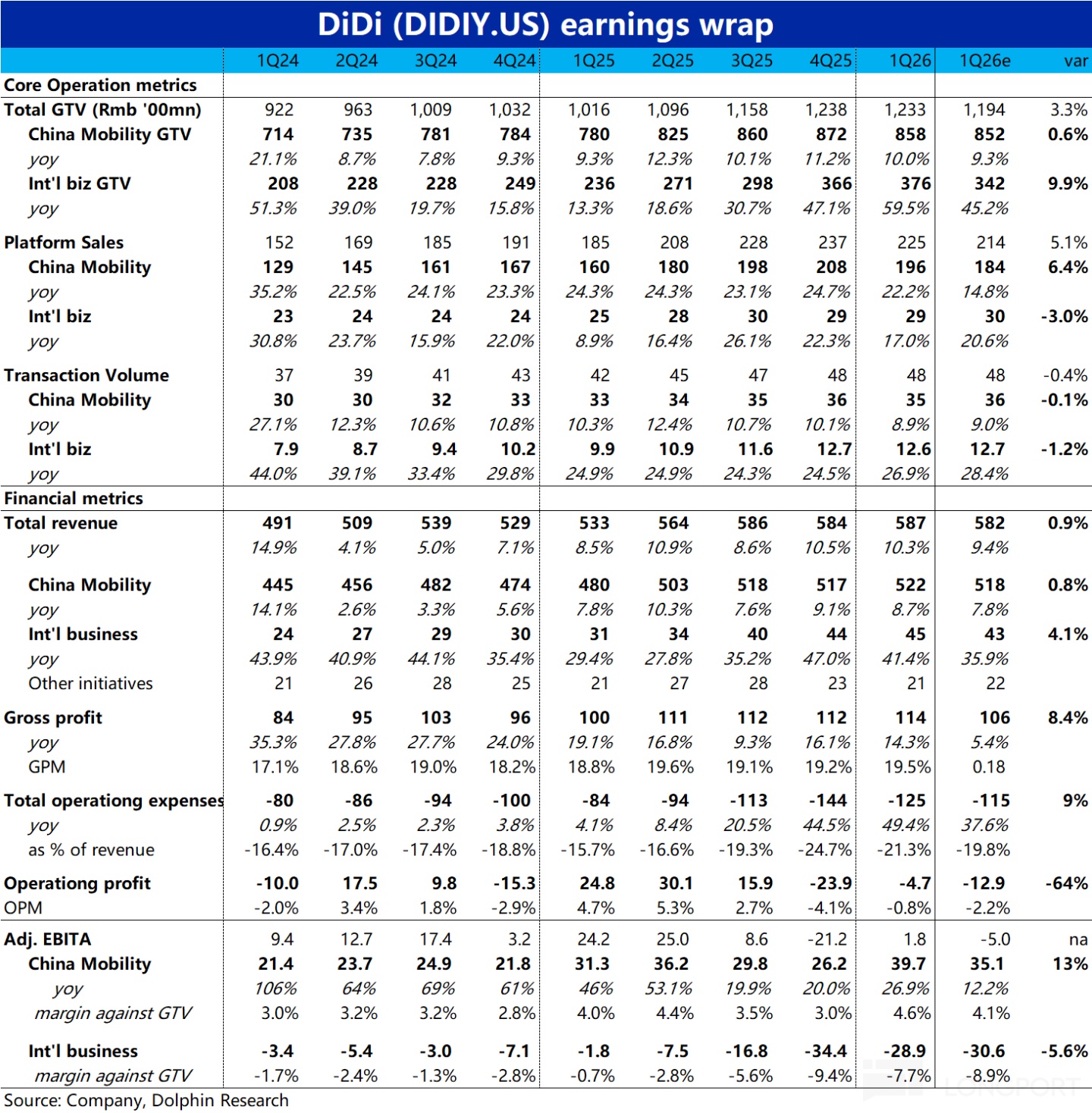
Ride-hailing leader $DiDi(DIDIY.US) released Q1 2026 results pre-market on 6/2. In absolute terms, performance was soft — high investment with adj.EBITA still under RMB 200 mn. But vs. expectations there were notable positives: domestic core profits beat materially, and Intl growth was strong while losses came in slightly better than expected.
1) Domestic mobility growth remained steady: This quarter Didi domestic GTV was RMB 85.8 bn, up 10% YoY and slightly slower QoQ (approx. 1pct), modestly above Bloomberg consensus. By price-volume, domestic orders rose 8.9% YoY, also easing by approx. 1pct QoQ. In other words, Avg. ticket size edged up by approx. 1% YoY.
2) Domestic net take rate kept improving: This quarter Didi domestic mobility revenue (GTV net of taxes and passenger subsidies) was approx. RMB 52.2 bn, up about 9% YoY and broadly flat QoQ, but still slightly lagging GTV growth. Conversely, Didi domestic platform sales (GTV net of driver payouts, taxes, etc.) grew 22% YoY, with QoQ growth slowing by about 3pct yet still far outpacing GTV.
With growth rates at Platform Sales >> GTV > Revenue, we infer Didi's domestic platform take rate is still trending higher, while consumer subsidies remain broadly stable. Calculated domestic platform take rate reached 22.8%, up 2.3pct YoY and sustaining a YoY uplift of 2pct+ for roughly two years.
3) Food delivery drove re-acceleration in Intl GTV: Boosted by Brazil food delivery, Intl GTV rose 59.5% YoY, accelerating ~12pct QoQ and well above Bloomberg consensus. Ex-FX, growth was still 49%, with similar QoQ acceleration.
Meanwhile, Intl orders increased 27% YoY, notably below GTV growth. The mix shift toward higher-ticket food delivery orders drove GTV growth to outpace order growth, with Brazil food delivery ticket size estimated at up to 3x ride-hailing.
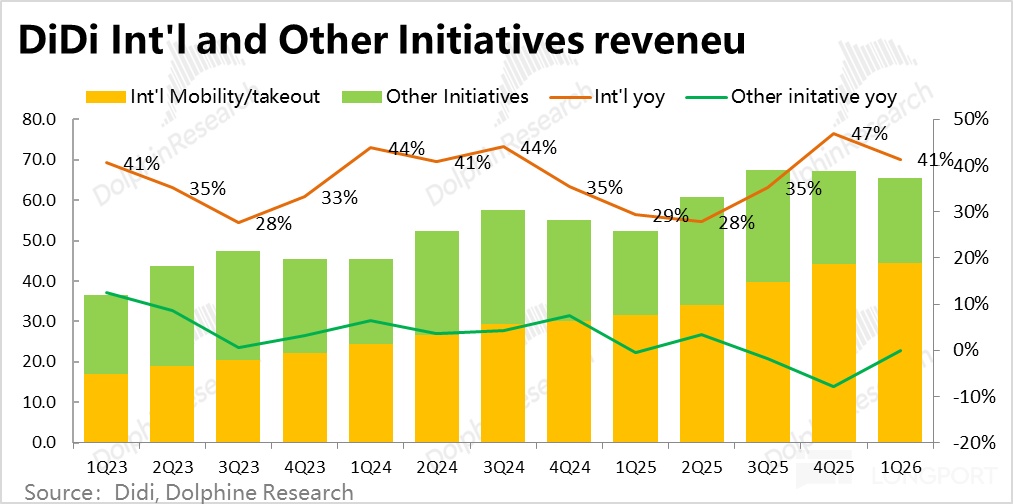
4) Food delivery is scaling awareness, not profits: Despite the sharp pickup in Intl GTV, Intl revenue grew 41% YoY but decelerated ~6pct QoQ. Platform sales grew only 17% YoY, also slowing ~5pct QoQ.
The large and widening gap between platform sales and GTV growth clearly shows that most of Brazil food delivery GMV is being passed through to merchants and riders, and to consumer subsidies, leaving limited platform take.
On platform sales/GTV, Intl blended take rate was approx. 7.8%, which continued to edge down after a notable drop last quarter.
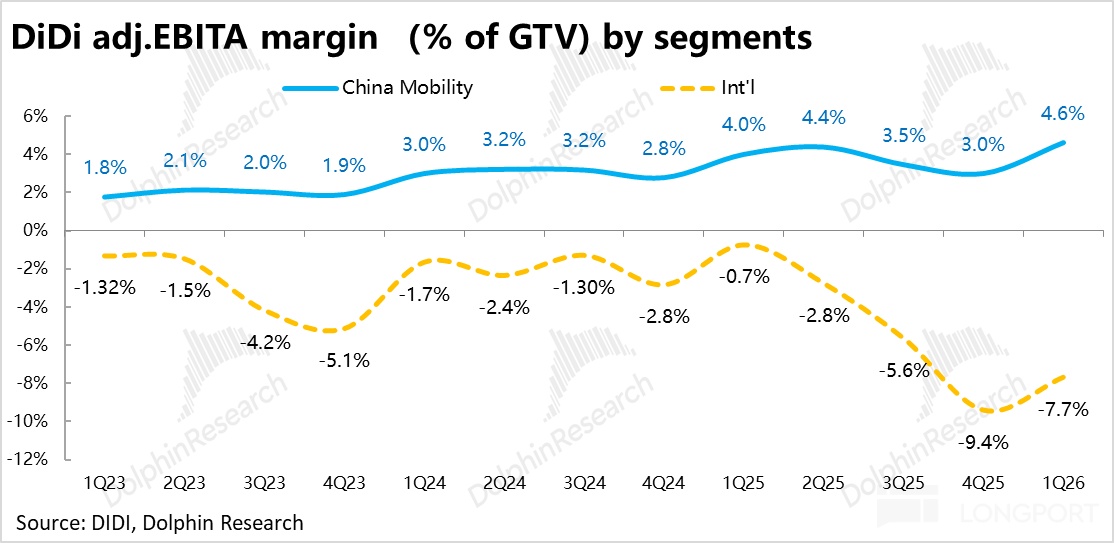
5) Domestic profit release beat expectations: Domestic adj.EBITA was RMB 3.97 bn, well above the market’s ~RMB 3.5 bn, with profit up nearly 27% YoY. Profit margin on GTV was 4.6% this quarter, up 0.6pct YoY. In short, domestic profit conversion is improving and exceeded expectations, consistent with the ongoing rise in domestic platform take rate.
6) Intl still deeply loss-making, but better than expected: With sustained heavy investment and limited incremental revenue beyond scale, Intl losses remained close to RMB 2.9 bn. But this improved vs. market’s ~RMB 3.1 bn loss and Q4’s RMB 3.4 bn. Loss margin narrowed slightly QoQ (from -9.4% to -7.7%).
Overall, due to combined losses of Intl and other innovation totaling close to RMB 3.8 bn, company-wide adj.EBITA was still under RMB 200 mn, yet it beat market expectations for a ~RMB 500 mn loss.
7) GP broadly stable; opex surged: GPM was 19.5% this quarter, up 0.3pct QoQ with limited change. Domestic margin tailwinds and Intl margin headwinds largely offset at the group level, with domestic positives slightly outweighing.
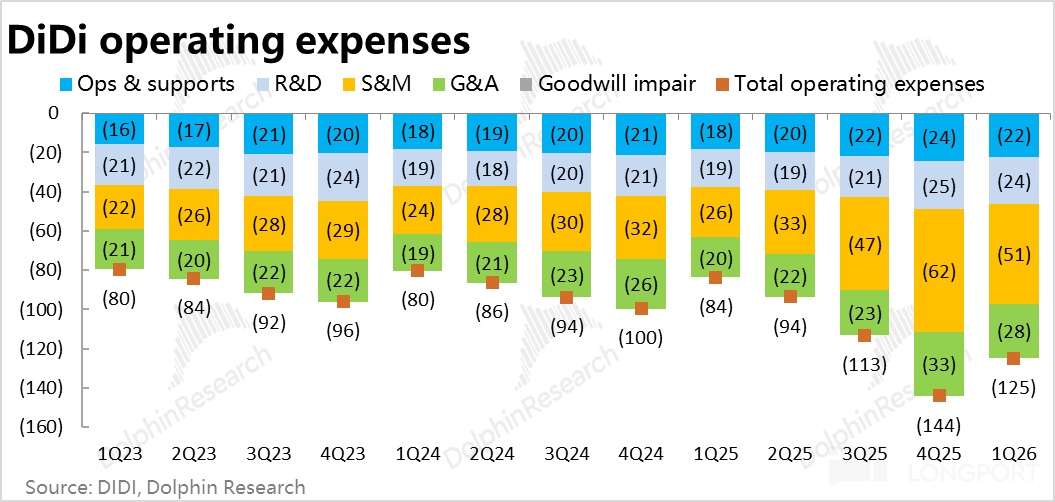
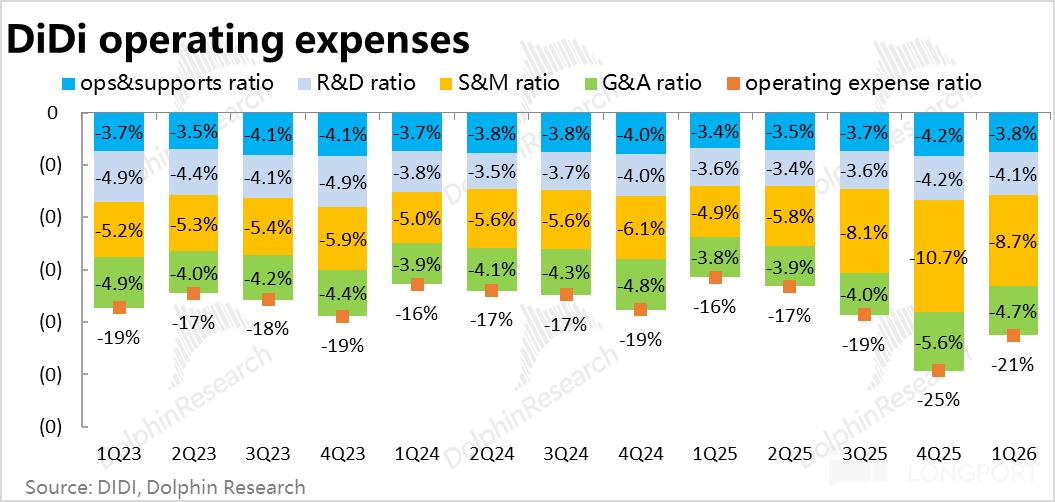
Opex continued to grow rapidly, with the four operating expense lines totaling RMB 12.5 bn, up 49% YoY and accelerating vs. last quarter. This clearly indicates an aggressive investment phase.
Most notably, sales and marketing expenses jumped 96% YoY with no slowdown. Given domestic consumer subsidies likely did not rise materially, the approx. RMB 2.5 bn YoY increase in marketing spend was largely allocated to Intl.
At the same time, Ops support, R&D, and G&A each grew roughly 20%–40% YoY, indicating a broad-based ramp in spend.
8) Shareholder returns: Per company disclosure, from early Mar to end-May, the company repurchased nearly $200 mn of shares, plus ~$340 mn last quarter, which annualized equals ~6.3% of current market cap. Supportive, but not overly generous.
Dolphin Research view:
1) As analyzed above, the group’s absolute performance was still weak, but there were several expectation beats. By segment, domestic maintained steady growth while margins continued to rise, significantly above expectations.
Meanwhile, Intl remains in heavy losses, but growth kept accelerating and beat expectations, and loss margin narrowed vs. expectations, which is a relatively positive signal. From an expectations perspective, both domestic and Intl performed well with no obvious deficiencies.
2) On the outlook and logic, changes are limited vs. last quarter, and recent public actions are few. This quarter’s print shows domestic remains stable and cash-generative, while Intl — especially Brazil food delivery — continues to see high investment, seeking near-term losses in exchange for future market and valuation upside.
On one hand, domestic is mature and, before autonomous driving drives step-change, a second growth curve is necessary. On the other, unlike China where Didi is largely confined to ride-hailing with most other ecosystems occupied by giants, Intl still offers a chance to evolve into a cross-vertical super-app like Uber or Meituan, which is difficult domestically.
Thus, while group profitability is near zero due to Intl investment and the stock has pulled back, which is not ideal for investors, the strategy is understandable from the company’s standpoint. It is also similar to Meituan or Alibaba seeing group profit pressure from food delivery investment. Didi looks similar at first glance, but its core domestic business remains stable in performance and competitive landscape.
Therefore, regardless of Intl success, Didi does not face a zeroing-out risk. If Intl underperforms, prior investment may be written off and valuation reverts to domestic business only, implying a valuation floor.
3) Valuation: As noted last quarter, with Intl losses expanding and nearly offsetting domestic profits, the market shifted from SOTP to valuing on consolidated 2026 profits. We also noted that if Intl shows clear loss reduction or domestic profit growth significantly beats, the market would tilt back toward SOTP. This print should nudge that tilt and aid multiple repair, though the market will not fully revert to SOTP while group profits are near zero.
Post this quarter, we raise 2026 domestic adj.EBITA growth to 25%, or approx. RMB 15.2 bn. The more elastic driver is how much Intl plus new biz will lose in 2026. We remain conservative, expecting full-year Intl losses around RMB 8.0 bn and other innovation losses at RMB 2.0–3.0 bn.
Total group 2026 adj.EBITA may be only around RMB 5.0 bn, implying a consolidated multiple still above 20x. On this basis, upside would be limited.
But as noted, the market should marginally favor SOTP post this print. Under a neutral case, once there is clear narrowing of losses in Intl plus other, the market would lean to valuing domestic profits. On 2026 domestic adj.EBITA of RMB 15.5 bn less ~RMB 2.5 bn of SBC (non-operating income exceeds taxes, so no extra tax deduction), at 12x, implied market cap is RMB 156 bn, about 39% upside vs. current.
Overall, Dolphin Research views Didi’s core domestic biz as stable without major downside, with potential for phase losses if new biz investment overshoots. When valuation is sufficiently cheap, we would play for multiple repair with relatively high certainty.
Key charts and commentary follow:
I. Biz growth: domestic steady; Intl investing heavily in food delivery
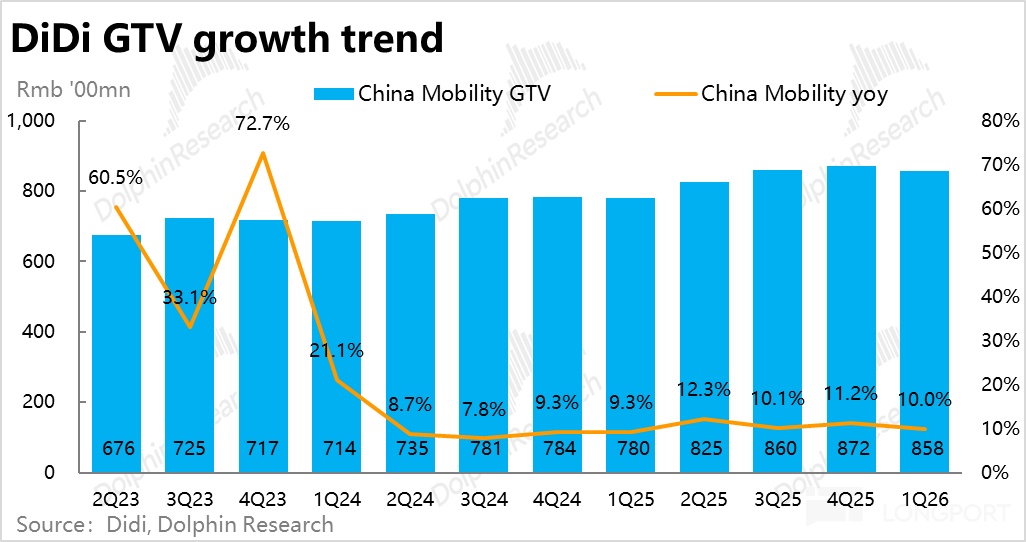
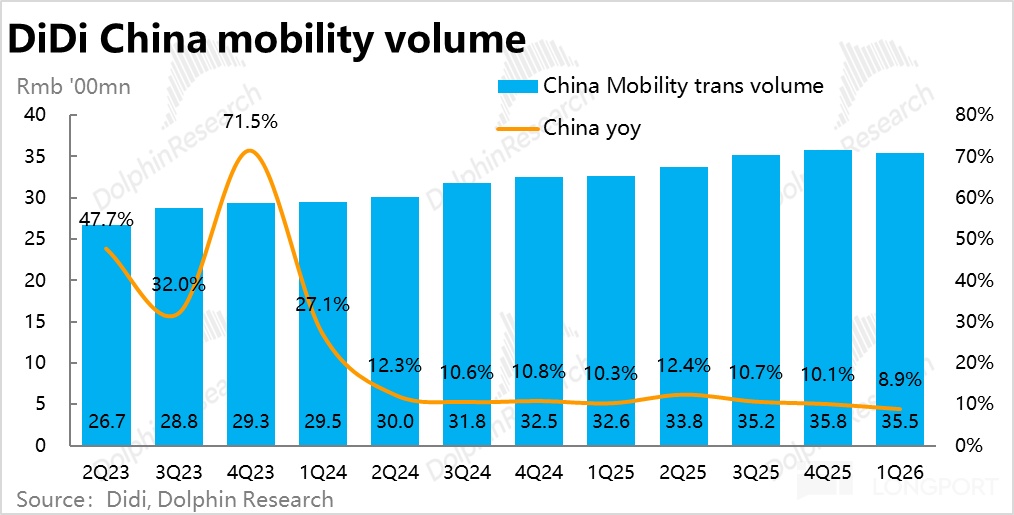
1) Domestic growth steady: Core operating metric — Didi domestic GTV was RMB 85.8 bn this quarter, up 10% YoY and slightly slower QoQ (approx. 1pct), modestly above Bloomberg consensus. By price-volume, domestic mobility orders (ride-hailing, hitch, designated driving, etc.) rose 8.9% YoY, also easing ~1pct QoQ.
Thus, domestic growth remained steady with no notable volatility, and Avg. ticket size edged up approx. 1% YoY.
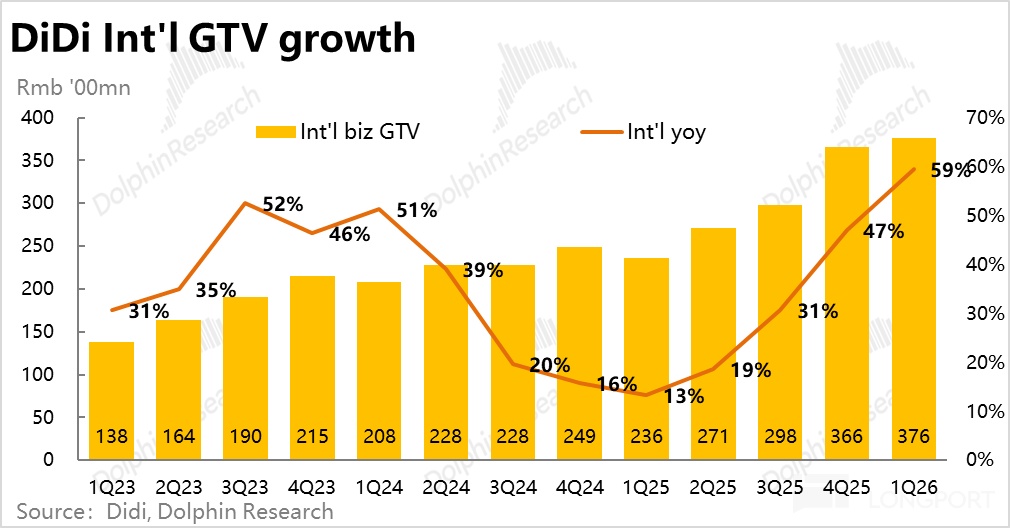
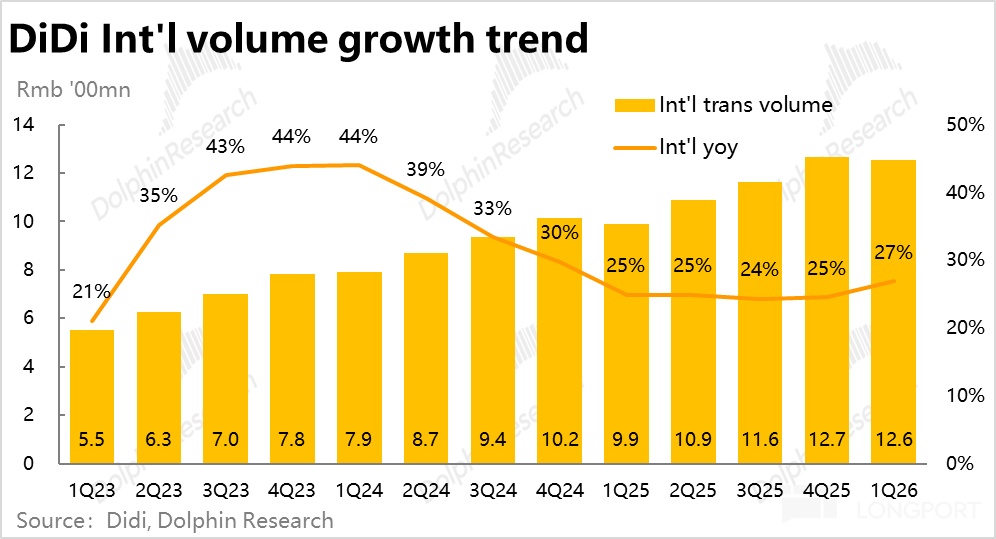
2) Food delivery growing well; Intl accelerating: As Brazil food delivery expands, Intl GTV rose 59.5% YoY this quarter, QoQ acceleration over 12pct and well above Bloomberg consensus. Even ex-FX, growth was 49%, with similar QoQ acceleration.
Intl orders grew 27% YoY, materially below GTV growth. Per company, a higher mix of high-ticket food delivery drove GTV growth to far exceed order growth. Previously in Brazil, Didi’s ticket size was only $4 vs. iFood at $11, and Didi’s food delivery ticket may now be higher, making its impact on GTV several times that on orders.
II. Domestic take rate rising; Intl scaling without profits
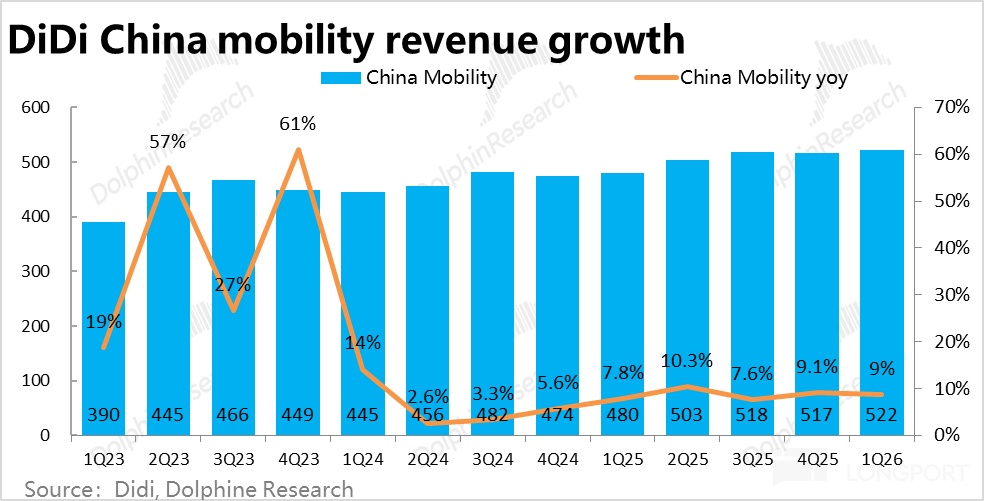
1) Domestic take rate continued to rise: On revenue, Didi domestic mobility revenue (GTV net of taxes and passenger subsidies) was approx. RMB 52.2 bn, up about 9% YoY and broadly flat QoQ, but still slightly below GTV growth. Conversely, Didi domestic platform sales (GTV net of driver share and taxes, reflecting platform retained earnings) grew 22% YoY, with a larger QoQ slowdown of 3pct yet still well ahead of GTV.
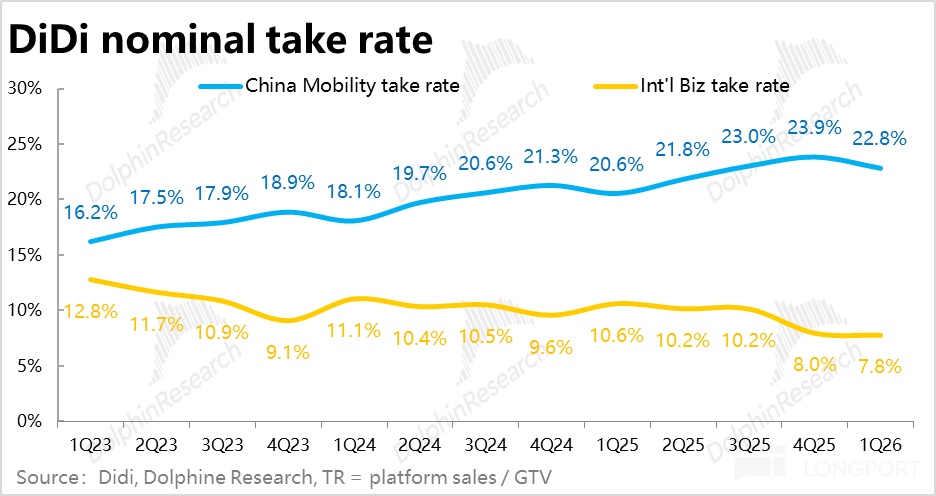
With growth at Platform Sales >> GTV > Revenue, Didi’s domestic platform take rate remains on an upward trajectory, while consumer subsidies are broadly stable. Based on platform sales/GTV disclosed, domestic platform take rate reached 22.8%, up 2.3pct YoY, sustaining a 2pct+ YoY uplift for about two years, underpinning margin expansion in recent years.
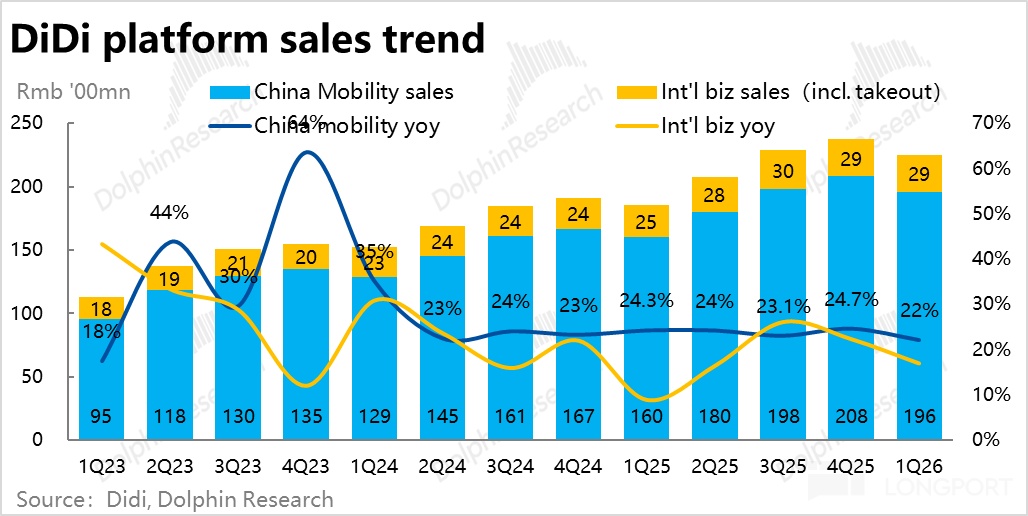
2) Intl scaling without profits: Although Intl GTV growth accelerated sharply, Intl revenue rose 41% YoY but decelerated ~6pct QoQ. Intl platform sales grew only 17% YoY, also slowing ~5pct QoQ.
The large and widening gap between platform sales and GTV growth shows that the rapid growth of Intl, especially Brazil food delivery GMV, is still being ceded to merchants, riders, and consumer subsidies, with limited platform retention. This is the core reason for continued heavy losses.
On platform sales/GTV, Intl blended take rate was approx. 7.8%, which continued to edge down after last quarter’s clear drop.
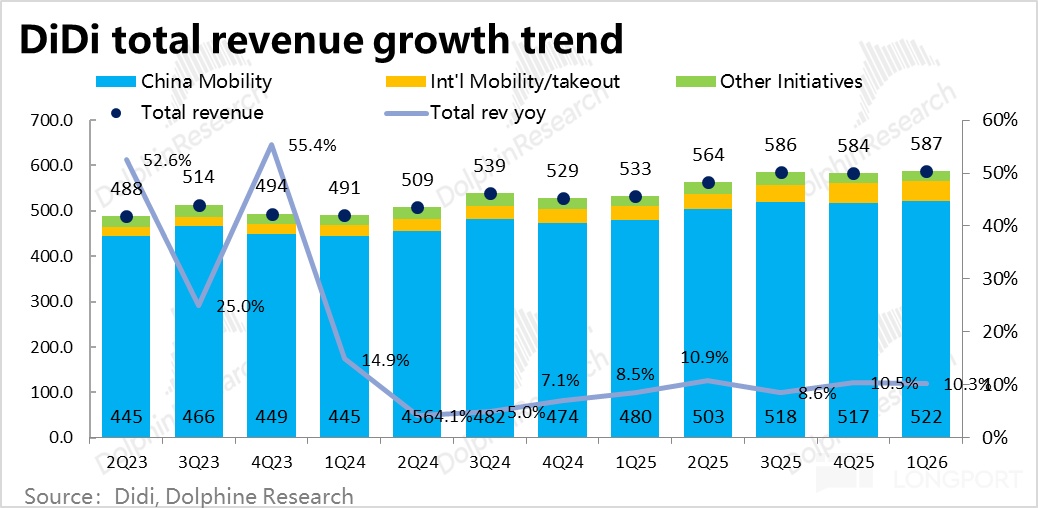
Combining domestic, Intl, and other innovation, Didi’s total revenue was approx. RMB 58.7 bn this quarter, up 10.3% YoY, with growth marginally lower and broadly stable QoQ. Overall, domestic is stable while Intl, despite high business growth, still contributes limited revenue.
III. Early profit turn, but Intl and new biz losses remain a hole
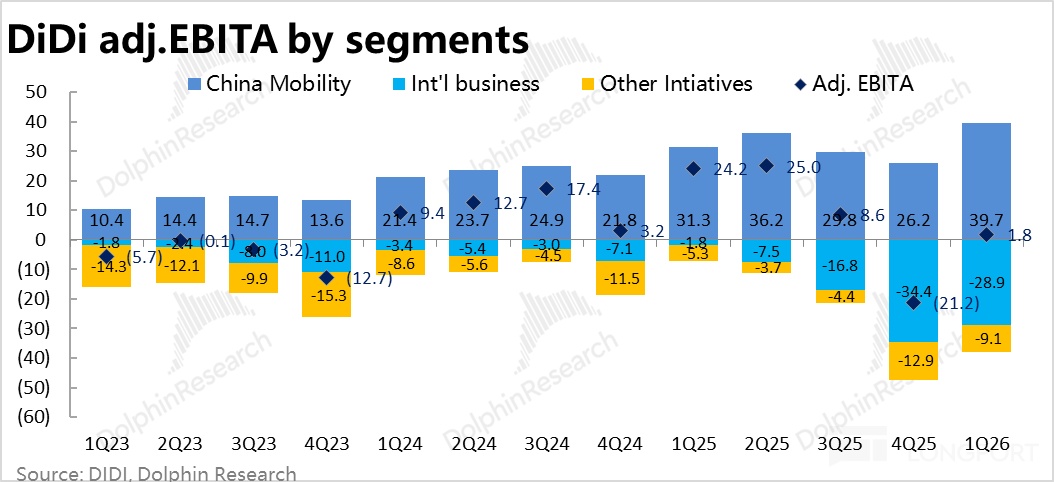
From platform sales trends, domestic profit release was expected to be solid, while Intl remained loss-making. Specifically, domestic adj.EBITA was RMB 3.97 bn, well above market’s ~RMB 3.5 bn, with profit up nearly 27% YoY. Margin on GTV was 4.6%, up 0.6pct YoY.
However, for Intl, with elevated investment and limited incremental revenue, losses were still near RMB 2.9 bn, improved vs. market’s ~RMB 3.1 bn and last quarter’s RMB 3.4 bn. At least, as scale grows, loss margin narrowed slightly QoQ (from -9.4% to -7.7%).
With combined losses of Intl and other innovation still close to RMB 3.8 bn, group adj.EBITA was under RMB 200 mn, still very low in absolute terms. Yet vs. expectations, it was a sizable beat relative to the expected ~RMB 500 mn loss.
IV. GP stable; opex surged; profits plowed back into investment
On costs and expenses, Didi’s GPM was 19.5% this quarter, up 0.3pct QoQ with limited change. This reflects domestic margin tailwinds (platform sales growth far above GTV) offset by Intl margin headwinds (platform sales growth far below GTV).
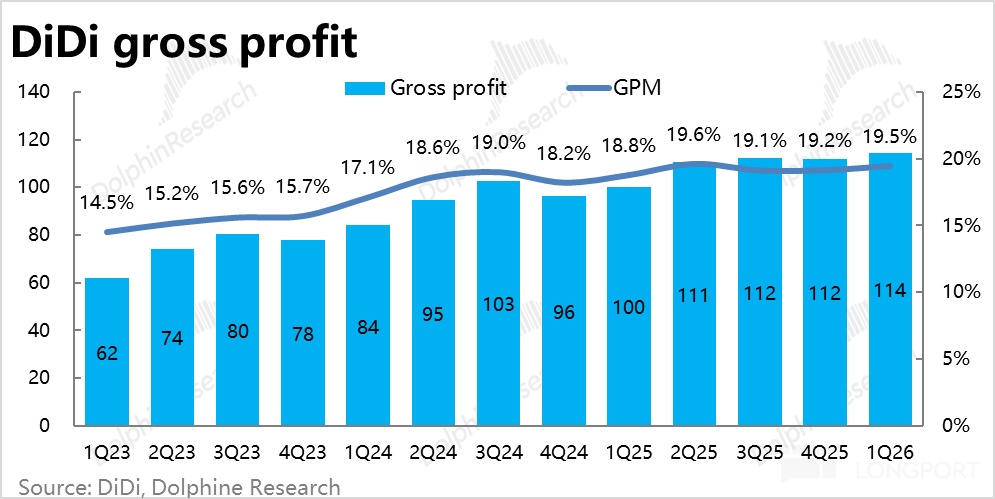
On expenses, the four operating expense lines totaled RMB 12.5 bn, up 49% YoY, accelerating vs. nearly 45% last quarter. This clearly shows Didi is in an aggressive investment phase.
Most notably, sales and marketing rose 96% YoY with no slowdown. Given domestic consumer subsidies did not rise materially, the approx. RMB 2.5 bn YoY increase was largely deployed to Intl.
Ops support, R&D, and G&A each grew roughly 20%–40% YoY, also elevated, indicating broad-based investment ramp.
<End here>
Dolphin Research past analyses on [Didi Global]:
Earnings reviews
Nov 28, 2025 earnings review 'Food Delivery War Didn’t Hit, Why Did Didi Kneel?'
Aug 28, 2025 earnings review 'Without Food Delivery, Didi Still Did Fine?'
Jun 5, 2025 earnings review 'Food Delivery War Didn’t Hit, Didi Quietly Minted Money'
Mar 19, 2025 earnings review 'Didi: Domestic Is Mature But Needs Guarding, Overseas Story Unfolds Slowly?'
Risk disclosure and statement: Dolphin Research disclaimer and general disclosure

The copyright of this article belongs to the original author/organization.
The views expressed herein are solely those of the author and do not reflect the stance of the platform. The content is intended for investment reference purposes only and shall not be considered as investment advice. Please contact us if you have any questions or suggestions regarding the content services provided by the platform.