
D
Jun 4 at 10:41 PM
LULU Trans: Q2 discounting peaked; sequential improvement ahead
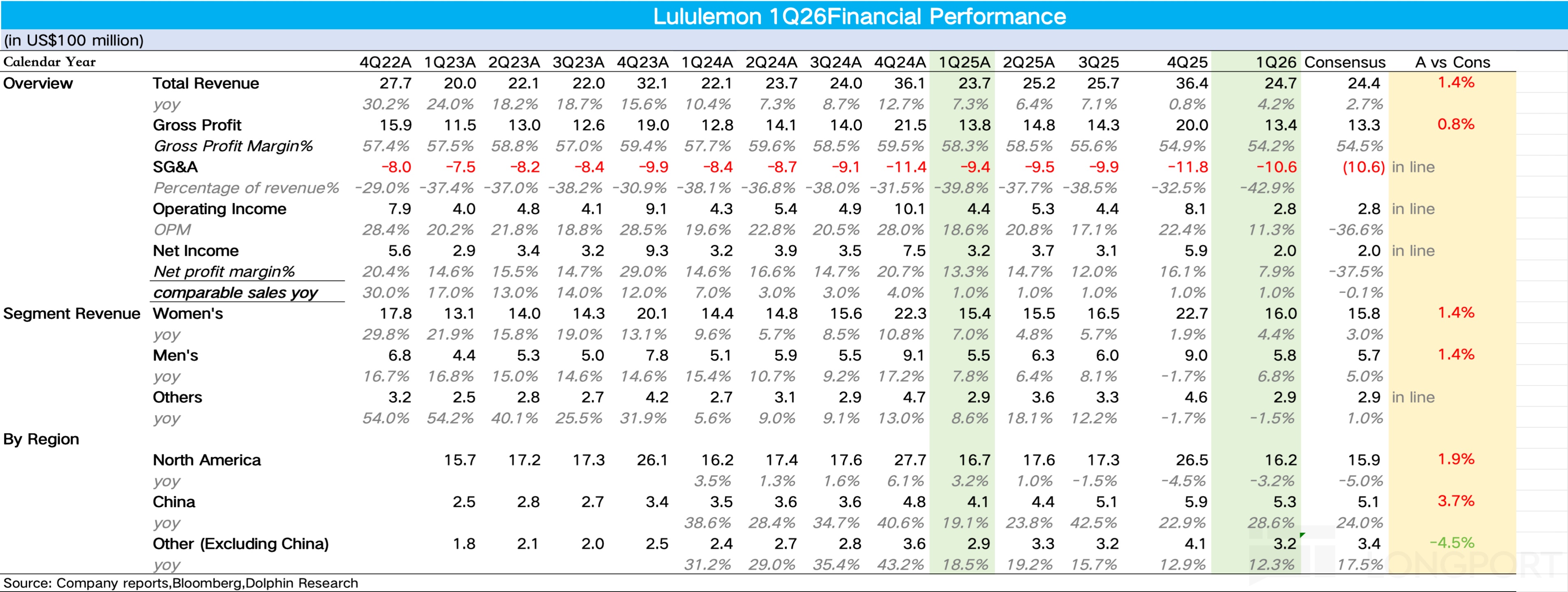
The following is Dolphin Research's transcript of LULU FY26 Q1 earnings call. For the earnings take, see 'Lululemon: Founder backlash, soft results, can a CEO change save the leggings?'.
I. Key takeaways
1. Shareholder returns: Repurchased approx. 2.2 mn shares in Q1 at an Avg. price of $165. Remaining authorization is about $1 bn, and FY26 buyback is expected to be in line with FY25. Management reiterated discipline on capital allocation.
2. Q2 guide: Revenue of $2.45–2.475 bn (-2% to -3% YoY) and EPS of $1.76–1.81 (vs. $3.10 a year ago). Operating margin (OPM) around 11.6% (vs. 20.7% last year). Guidance embeds continued softness in North America.
3. FY26 guide cut: Revenue of $11.0–11.15 bn (flat to -1% YoY; previously guided to growth) and EPS of $10.95–11.15 (vs. $13.26 in FY25). Full-year OPM down about 380 bps and GPM down about 90 bps. Management cites brand noise and product cycle issues.
4. Capex and inventory: FY26 capex guided to $700–720 mn. End-Q1 inventory value +2% YoY with units -4% YoY, with the gap largely due to tariffs and FX. Inventory quality is being managed to enable faster chase.
II. Call details
2.1 Management commentary
1. North America
a. Q1 sales down 4% on a constant-currency basis, with comps -6% (US -4%, Canada -6% cc). Feb and Mar were the strongest months of the quarter. Trends deteriorated from late Apr into early May, mainly over the past 6–7 weeks.
b. Two main drivers of deterioration: (i) broad traffic declines across all age cohorts from negative brand publicity (proxy fight plus mid-Apr ingredient questions), and (ii) some new launches missed, especially the 'new yoga style' away-from-body campaign (Align/Groove) which did not deliver the expected halo. Conversion followed traffic lower.
c. Q2 North America is guided down low double digits, and the US is in that range as well. Management said the negative publicity is abating, but traffic has yet to return to pre-noise levels. Visibility remains limited near term.
d. FY North America is guided to a high single-digit decline, with the US a bit weaker than Canada. Assumptions are cautious given recent trends.
2. Mainland China
a. Q1 revenue +30% reported (+23% cc), with the Lunar New Year calendar adding about 8 pts; comps +13%. Growth was above the full-year run-rate before the late Apr–early May brand noise spilled into China, which has since faded. Momentum has started to recover.
b. Q2 is guided to mid-to-high teens growth, and the full-year guide remains around +20%. Management views 20% as the market’s underlying growth engine and expects a return to that run-rate in 2H. Execution will lean on community and product activations.
c. Recent events: late May yoga experience at the Great Wall in Beijing drew 2,000+ guests and 70 brand ambassadors. The 6th Summer Sweat Games will run from late Jun to Aug, culminating in a national final in Hangzhou. These aim to reinforce run and train brand equity.
3. Rest of World
a. Q1 revenue +13% (+9% cc) with comps +1%. Q2 and FY are expected to grow high single digits to low double digits, with low teens embedded in the FY guide. Regional momentum remains resilient overall.
b. The Iran situation disrupted Middle East franchise operations. Europe and Japan saw softer tourist traffic, which management views as transitory. No structural issues are flagged.
c. Opened the first store in Greece recently. The first store in India is planned for this year. International white space expansion continues.
4. Product innovation and speed
a. Q1 winners included run franchises (Fast & Free, Swiftly, Metal Vent) as well as Daydrift and Define (new silhouettes and colors). The away-from-body yoga push was well received on its own but lacked a halo to adjacent categories. Color choices were one factor.
b. Q2 and 2H pipeline: hot-weather run, tennis, golf and lifestyle. New outerwear and casual fabrics are slated for 2H, with newness penetration at about 30% now (35% target for the year). Mix should broaden into peak seasons.
c. Chase capability: FY26 chase volume is up about 20% vs. FY25, and inventory units are down about 4% to create space for fast replenishment; chased items include Groove pant and Define. Speed-to-shelf is a focus.
d. Product lead times have been cut from 18–24 months to 15–16 months. The goal is 12–14 months, with the main bottleneck being tech systems deployment. Further reductions will be incremental.
5. Brand marketing and community
a. FY26 marketing spend will rise to about 6%–6.5% of revenue (vs. 5.6% last year), up roughly 10%–15% YoY. Investments focus on brand tentpoles (Great Wall yoga, SeaWheeze half marathon, NYC summer yoga series, US Open sponsorship), collabs, elite athlete social content, and media/partner experiences (incl. a NYC pop-up). Spend is aimed at restoring top-of-funnel momentum.
b. The Aug SeaWheeze half marathon in Vancouver nearly sold out instantly. This reinforces the brand pull of community events. Engagement remains a differentiator.
6. Store experience and channels
a. In-store execution includes a 15% SKU reduction to spotlight newness and innovation, merchandising by function and lifestyle, and sharply fewer markdown displays. Early feedback is positive.
b. Tests at select stores include deeper SKU reductions, localized assortments, and refreshed fixturing and mannequins. Rollouts will depend on learnings.
c. LULU ended Q1 with 816 stores globally, net +5 with 6 optimizations. FY net adds are planned at about 40 (low end of 40–45), with 10–15 in North America (incl. 8 in Mexico) and 25–30 Intl (most in China), plus ~35 optimizations. New-store payback is about 1 year, and remodels 2–3 years.
d. E-comm represented 40% of Q1 revenue (about $1 bn), up 4% YoY. The team continues to enhance on-site visual merchandising and the shopping experience. Digital remains a key growth engine.
7. Enterprise efficiency
a. Ongoing optimization of the global supply chain network, indirect cost savings via procurement (price/terms and vendor consolidation), and deployment of AI-driven systems and automation to boost efficiency. These are intended to support margins.
b. In Q1, enterprise efficiency actions offset roughly 100 bps of tariff headwinds at the GPM line. Further benefits are expected through the year.
2.2 Q&A
Q: What is the mix of newness vs. core, and did recent softness skew to core or newness?
A: Our goal is to lift newness penetration from 23% last year to 35% for the full year, and we are around 30% now, with variability through the year. Some new products met expectations while others fell short. Recent pressure has been broad-based across categories rather than concentrated in one type.
Q: Does underperformance of recent newness pose similar risk in Intl markets?
A: Intl assortments are more diversified than North America, and refreshed colors/iterations of core hero items contribute more to growth in Intl. As a result, Intl leans on both core heroes and a broader newness mix, making it less dependent on newness than the legacy North America market. This provides some cushion.
Q: Is the assumed improvement in 2H markdowns driven by easier comps or better demand?
A: We expect a sequential improvement in Q3 vs. Q2, and Q4 markdowns below last year (Q4 was the peak markdown quarter last year). For the full year, markdowns are seen flat to slightly better, with Q2 as the high watermark in 2026. The trajectory reflects normal seasonality and inventory discipline.
Q: What happened in China recently, and what gives you confidence in full-year improvement?
A: Looking back over the last 6–7 weeks, China was hit during the late Apr to early May peak of negative publicity, and has since improved. We maintain the +20% full-year guide, which reflects our view of the market’s underlying growth engine and aligns with 2H seasonality. As brand noise fades, we will continue unique guest engagement, as seen with the Great Wall Yoga Festival, and the upcoming Summer Sweat Games will further reinforce run and train. We remain confident in our premium positioning and guest connection in China and expect growth to revert to ~20% for the year.
Q: How did North America progress through Q1, and how does May trend relate to the low-teens Q2 decline and scope for 2H improvement?
A: North America was -4% in Q1, better than our prior mid-to-low single-digit decline expectation. Feb and Mar were the strongest months, with trends softening from late Apr into May over the last 6–7 weeks. Q2 North America is guided down low double digits, and we currently assume 2H broadly consistent with current trends and slightly better than Q2. We outlined initiatives in-flight—brand investments and chase up ~20%—but we have not embedded material benefits in guidance, leaving room for upside if they deliver.
Q: Is the NA decline primarily product design, category demand, or macro?
A: Macro noise exists, but athleisure/active category trends look relatively stable and our relative position within the category slipped. The bigger issue was a broad traffic decline, with conversion secondary. Drivers point to the late Apr brand publicity shock (proxy fight plus ingredient questions) and, despite strong tracking in Feb/Mar, some recent newness—especially the new yoga series—failing to generate a halo.
Q: What changed in the Q2 guide vs. 90 days ago, and any early signals from SKU reduction on conversion or store productivity?
A: We see 2H trends roughly in line with underlying run-rates and slightly better than Q2, reflecting some dissipation of late Q1/early Q2 noise. We have not embedded material benefits from initiatives yet, allowing upside if they land. On SKU reduction, stores are down 15% in SKUs, now merchandised by function/lifestyle with far fewer markdowns. Early feedback is positive, and we expect benefits to build; notably, Q1 global full-price sales grew high single digits and US full-price sales improved sequentially vs. Q4, supporting this strategy.
Q: With limited halo from some newness, what are the learnings on design and activation, and was traffic decline concentrated in any demographic?
A: We have learnings on both product design and activation. Away-from-body yoga pieces were well received individually but did not lift adjacent categories, with color being one factor; some items may need more sustained exposure to build awareness. We will keep leaning into store and online front-of-house presentation. Traffic declines were broad across age groups rather than concentrated in a specific cohort.
Q: What exactly drove the negative social media cycle, how long did it last, why did it fade, and were there lingering effects? Which regions were most affected?
A: It was a combination of factors: PR pressures during the proxy fight and mid-Apr questions around certain product ingredients. Coverage has since subsided. Even so, traffic has not fully returned to pre-noise levels, so it is prudent to update guidance. The US and Mainland China were most impacted.
Q: What adjustments can you make to underperforming products, and do these experiences change the launch slate for the rest of the year?
A: We will apply these learnings going forward. Q1 strength included run (Fast & Free, Swiftly, Metal Vent), Daydrift, and Define (including new silhouettes), and the pipeline remains exciting for 2H with new casual fabrics and hot-weather assortments in run, tennis and golf. Chase is up ~20% YoY, enabling faster replenishment, and hero items like Groove pant and Define are already in chase. We did not embed material benefits from these actions in 2H guidance, creating upside if they perform as usual.
Q: With new CEO Heidi O'Neill named but not yet onboard, does this change your current management focus?
A: Our action plan is unchanged, with the core goal to restore full-price sales health. We will stay flexible based on current trends and prepare for Heidi’s Sep start so she inherits a business with tangible progress. Continuity remains the priority.
Q: How much more are you spending on marketing, where is it going, and why tighten new-store adds to the low end of 40–45? How do you assess new-store returns?
A: We are lifting FY26 marketing to 6%–6.5% of revenue, up roughly 10%–15% YoY (vs. ~5.6% last year). Investments include major brand events (Great Wall Yoga Festival, SeaWheeze half, NYC summer yoga series, US Open), new collabs, local run/yoga community events, media/partner experiences (incl. a NYC pop-up), and elite athlete social content. Store count guidance narrowed as a handful of openings shift into 2027; NA plans 10–15 (8 in Mexico) and Intl 25–30 (most in China). New-store payback is about 1 year and remodels 2–3 years; we remain satisfied with returns and will vet each real estate deal carefully.
Q: Excluding the Lunar New Year calendar effect and brand noise, what is the underlying China comps trend now? Within the 20% full-year growth, how much is comps vs. new stores, and does China contribute positively to margins?
A: Q1 grew 30% reported (+23% cc), with about 8 pts from the Lunar New Year calendar. Before the disruption, growth was tracking above the full-year guide; Q2 is guided to mid-to-high teens, and we align 2H with the ~20% full-year pace as the underlying engine. Q1 comps were 13% (vs. 30% total revenue), and we have not disclosed full-year comps. China continues to deliver healthy OPM expansion, and we will keep investing to drive the long-term growth trajectory.
Q: What constrains compressing the product development cycle to 12–14 months, when will faster speed show up in comps, and does a shorter calendar raise GPM risk (e.g., air freight)?
A: The main constraint is rolling out and adopting the necessary tech systems, which takes time. Benefits from speed will accrue with each quarter and delivery, rather than all at once. There is a trade-off between speed and air freight, but we do not see a faster overall calendar as inherently driving structurally higher product costs.
Q: When can full-price sales turn positive, and what did the 'high single-digit growth' metric in Q1 refer to?
A: By 'reg price' we mean full price. Global full-price sales grew high single digits in Q1; US full-price was slightly negative but improved markedly vs. Q4. We expect Q2 full-price sales to decline mid-single digits given softer overall trends and seasonal clearance. For the full year, we see full price flat to slightly better, improving as the year progresses.
<End of text>
Risk disclosure and statements:Dolphin Research disclaimer and general disclosure
Login to unlock14,511characters for free
This content is only available to signed-in users. Sign in to your Longbridge account to read the full post.


