

From Daydream to Billions: Is SpaceX Really That 'Sci‑Fi'?

'Iron Man' Elon Musk has once again gifted capital markets with his Mars dream — $SpaceX(SPCX.US), a 'crazy idea' funded with $27 mn twenty years ago that has become a $2 tn space biz empire.
Earlier this year, in Dolphin Research’s initial piece on space economics, 'Musk Drops Another Bomb: SpaceX Is Rewriting Space Economics,' we outlined how SpaceX turned a cost-down concept into an executable business model.
With more granular numbers now available from the prospectus, we revisit SpaceX through the lens of valuation and operations to decode the story behind the data.
This report addresses three questions:
1) Valuation step-ups: How did SpaceX rise? What powered each $100 bn-level valuation breakout?
2) Biz mix: How are the core businesses and capital allocation mapped today?
3) Launch core: How long can an ~80% market share moat hold? Why did capacity soar but launch revenue lag? How would Starship’s full orbital ops break the market ceiling?
I. From market disrupter to trillion-dollar infra builder
Products like Starship and Starlink feel straight out of 'Star Trek.' Stripped of the mystique, the playbook is simple: build ships, sail out, cast the net, and harvest fees.
The difference is the 'ship' is a launch vehicle, the 'net' is a space communications mesh, and the 'catch' is connectivity fees — with space compute fees potentially next.
The base layer of the space economy is a transport ship that can haul the 'net' into orbit. Rockets have flown for decades, but scalable unit economics depend on ship design and transport cost. That became SpaceX’s opening.
(1) Holding the line for a 'daydream': Before SpaceX, launch was a niche with few players (Boeing and Lockheed), priced on cost-plus. After the 2003 Columbia disaster, NASA outsourced LEO transport and shifted to fixed-price, milestone-based payments, giving SpaceX, founded in 2002, a survival lane.
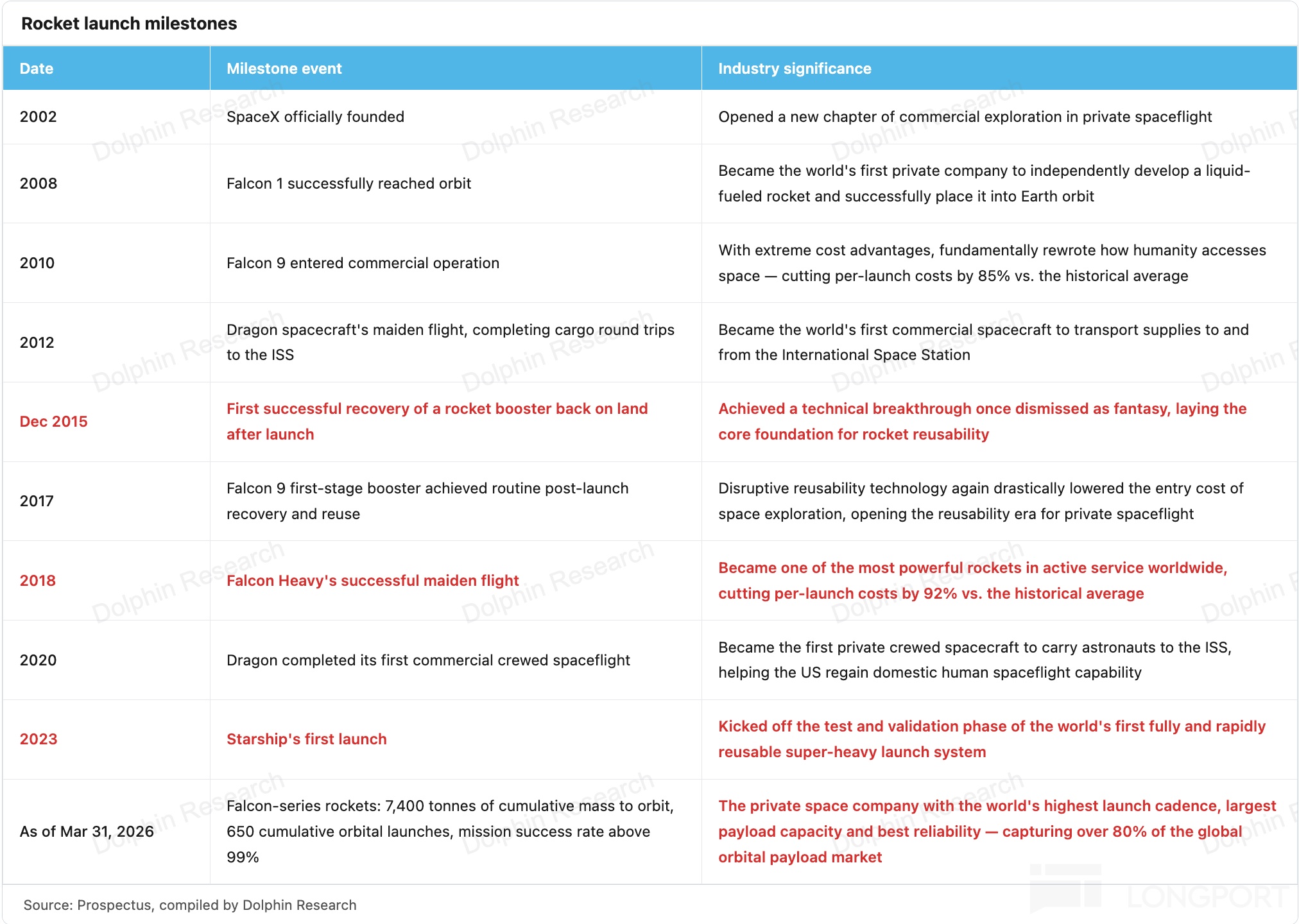
After three failed launches, Falcon 1’s fourth flight succeeded in 2008, securing a $1.6 bn NASA contract and a lifeline. Valuation rose from $27 mn at founding to $200 mn, moving pricing from 'funding a madman' to having a tangible start.
(2) Rocket reuse: The core breakthrough was cutting launch costs with a method rivals could not copy. Musk’s answer was booster recovery and reuse.
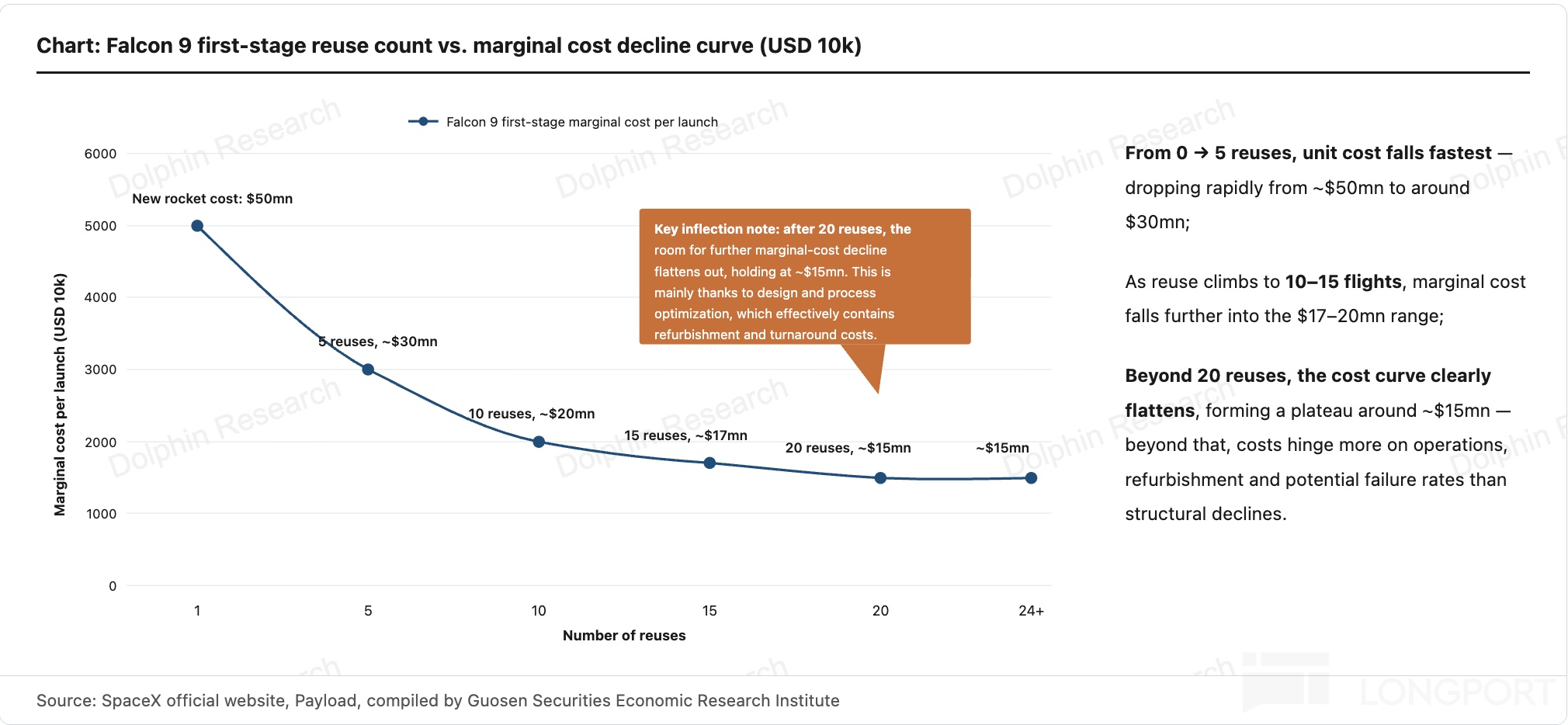
By end-2015, the first-stage booster return became reality, cutting Falcon 9’s per-launch internal cost from roughly $50 mn to about $15 mn with >20 reuses. In Mar-2017, SpaceX became the first to use a recovered booster for a commercial mission.
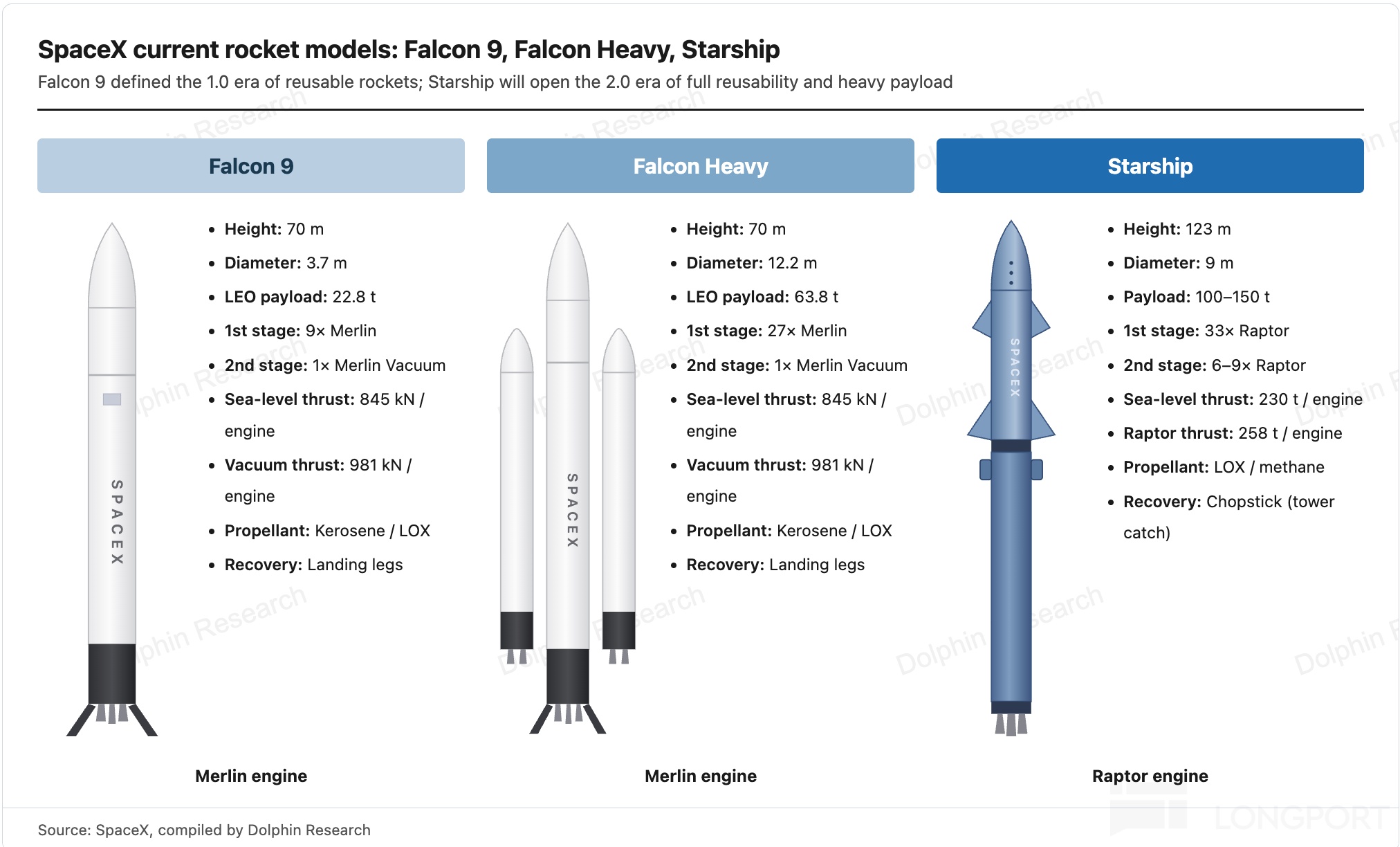
In 2018, Falcon Heavy, the 'big freighter' (63.8t to LEO), debuted on the Falcon 9 platform, halving cost per kg again. At that point, incumbents were left in the dust.
Valuation climbed to ~$12 bn during the tech breakthrough phase (2010–2015), then jumped to ~$30.5 bn in the maturity-to-commercialization phase (2015–2019), with a premium for leadership embedded.
(2) Cast the net, harvest fees: satcom constellation and connectivity ARPU
Transport cost-down alone capped the external demand; valuation stalled below $50 bn. The true unlock was using the transport edge to build a downstream empire — Starlink, the LEO broadband constellation.
Basics: LEO sats are defined by orbital altitude, typically within 2,000 km for Starlink. Shorter distance means low latency, but fast orbits (~90–120 min per lap) limit dwell time over any spot, so continuous coverage requires a large constellation, i.e., Starlink’s mesh.
Musk thus extended from 'building ships' to 'weaving the net,' creating captive launch demand. From 2020–2023 was the 'net-laying' phase, with monetization showing up after 2023.
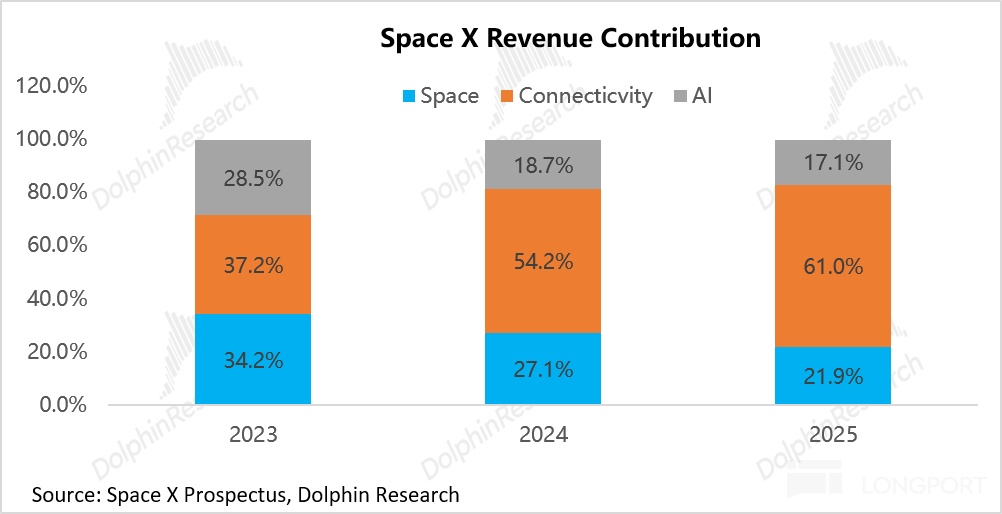
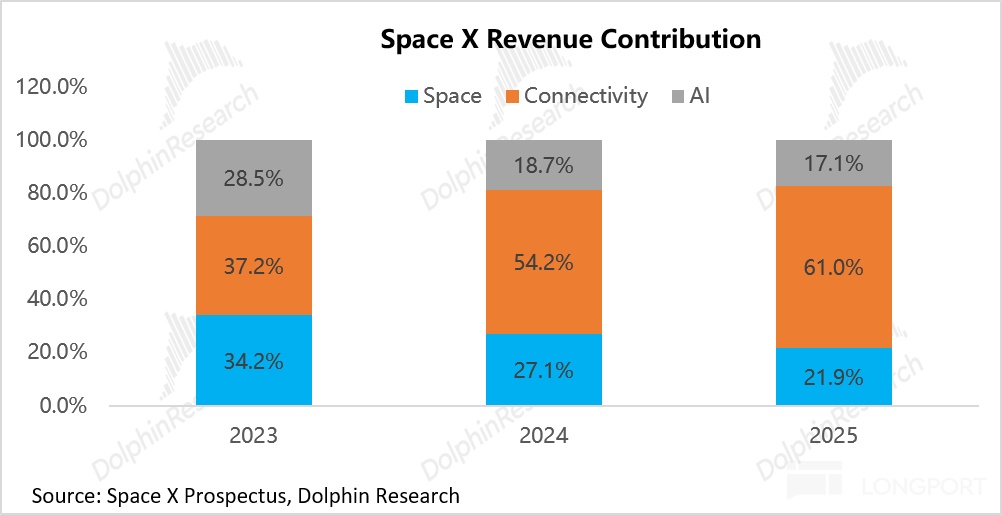
In 2023, Starlink revenue surpassed launch to become SpaceX’s largest line. By 2025, Starlink accounts for 61% of revenue with nearly 9 mn subs.
A tight flywheel has formed: high-cadence launches drive satellite cost down → better mesh boosts network value → B2C subs/B2B use cases generate steady cash → cash funds next-gen rockets (Starship).
With tech leadership and a commercial loop in place, the market reframed SpaceX as 'moat-heavy communications infra' plus a 'SaaS-like subscription model.' That repriced valuation from sub-$100 bn to an ~$800 bn leap.
(4) The next big swing: space compute supremacy?
Satcom is bearing fruit; the next 'net' is a space compute grid. This will cost far more than the comms mesh, and requires in-house AI model work, making it a capital sink — hence the logic to list.
To assemble the pieces, Musk executed a key move: full acquisition of xAI (Feb-2026), swapped at a ~$1 tn SpaceX vs. ~$250 bn xAI value. xAI brings the Grok LLM, Colossus compute cluster, and the X platform.
The core narrative: with Starship V3 driving ultra-low launch cost (target <$200/kg to orbit), deploy orbit-scale AI data centers in the 100 GW class. Leverage abundant solar in space to push compute cost down, theoretically to a tenth of ground levels. Musk is betting the AI endgame will be decided by energy control.
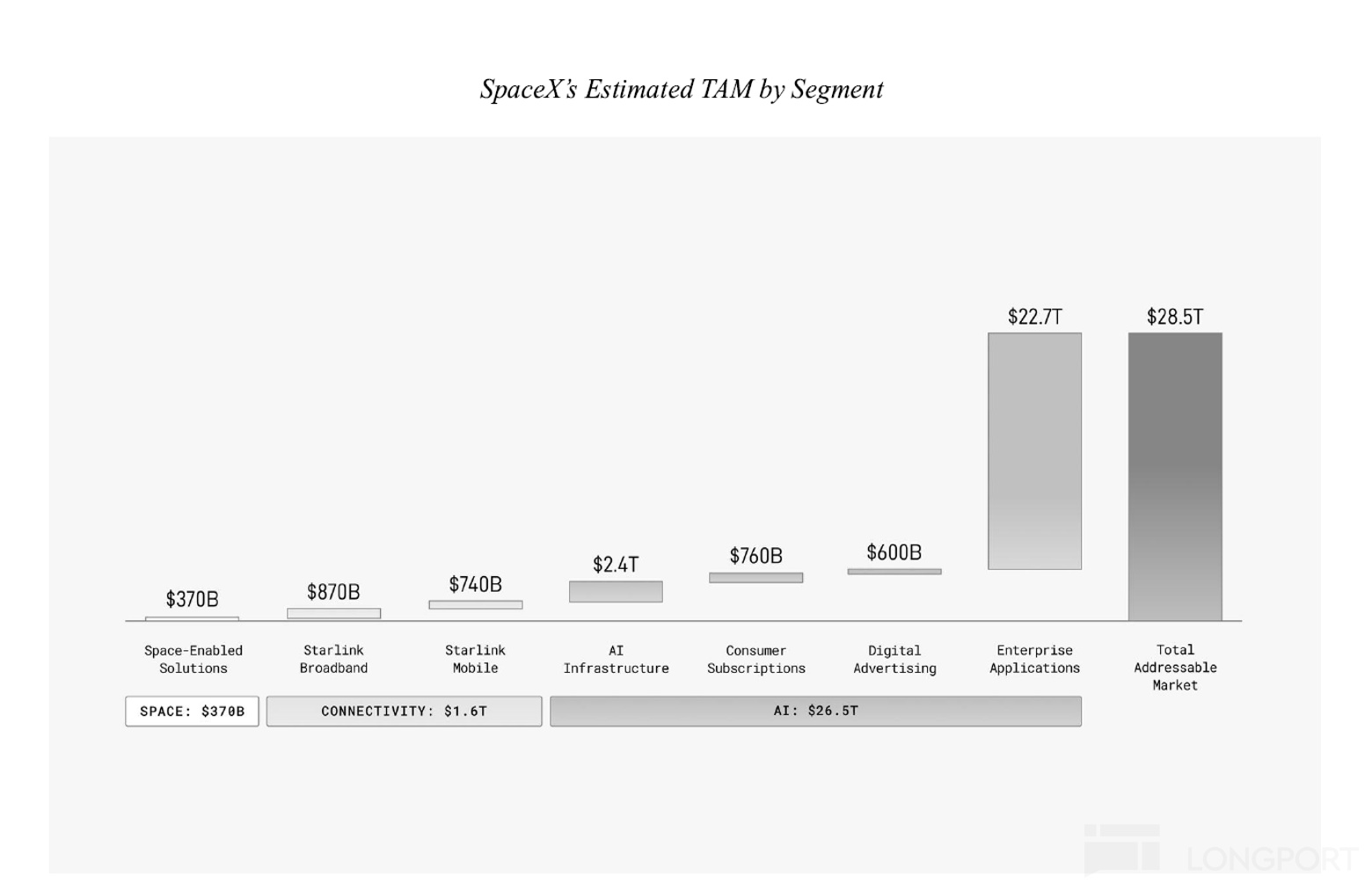
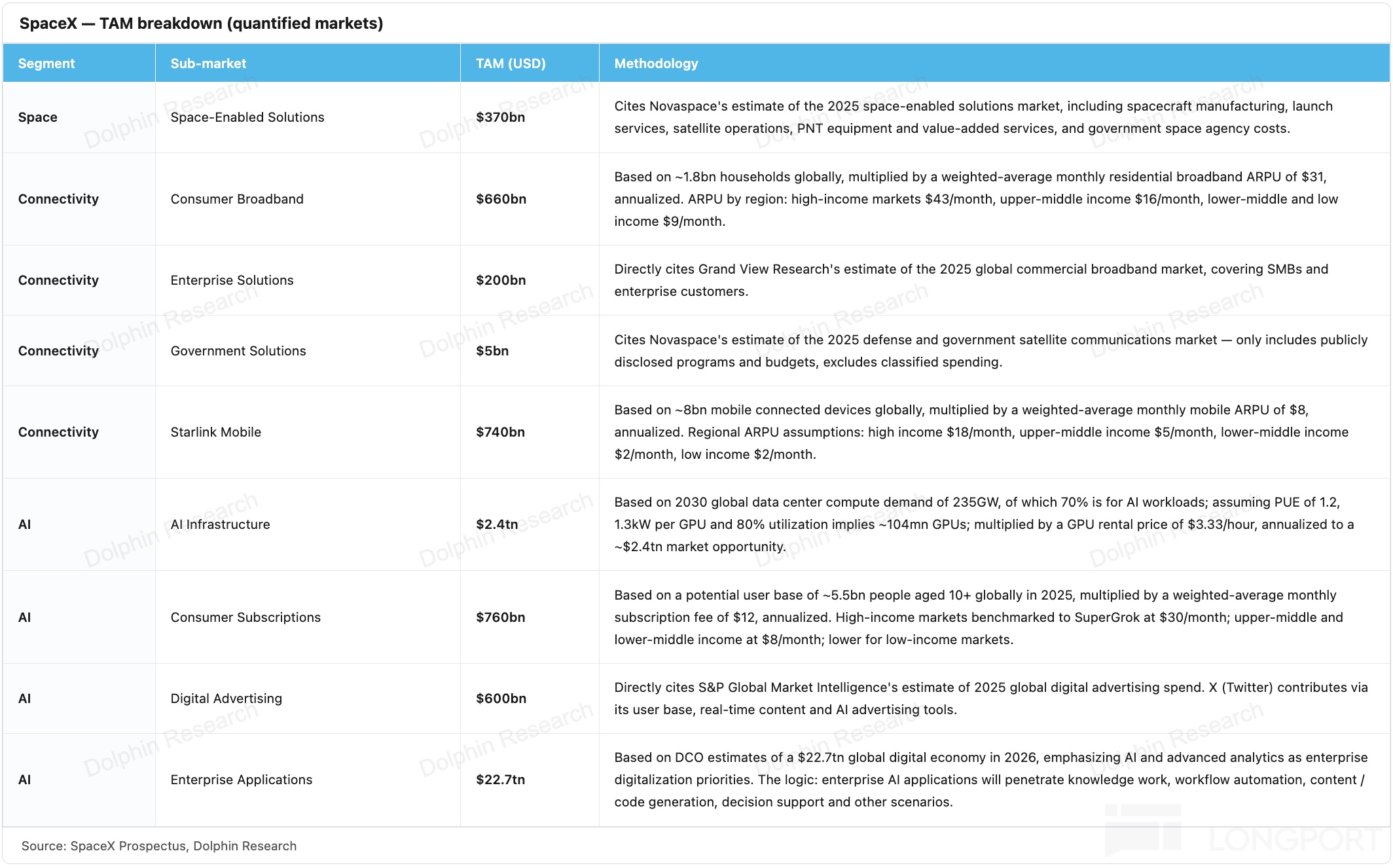
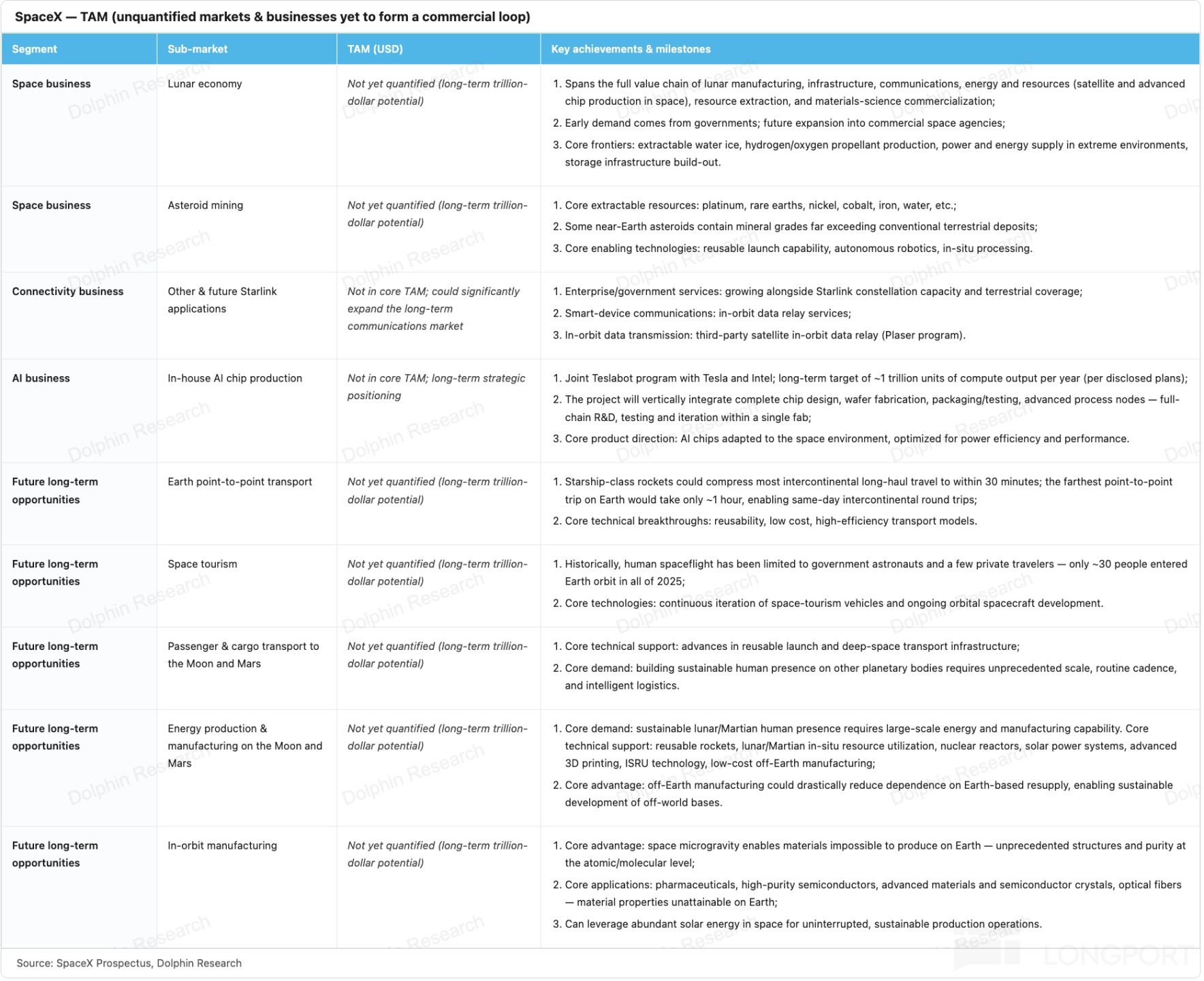
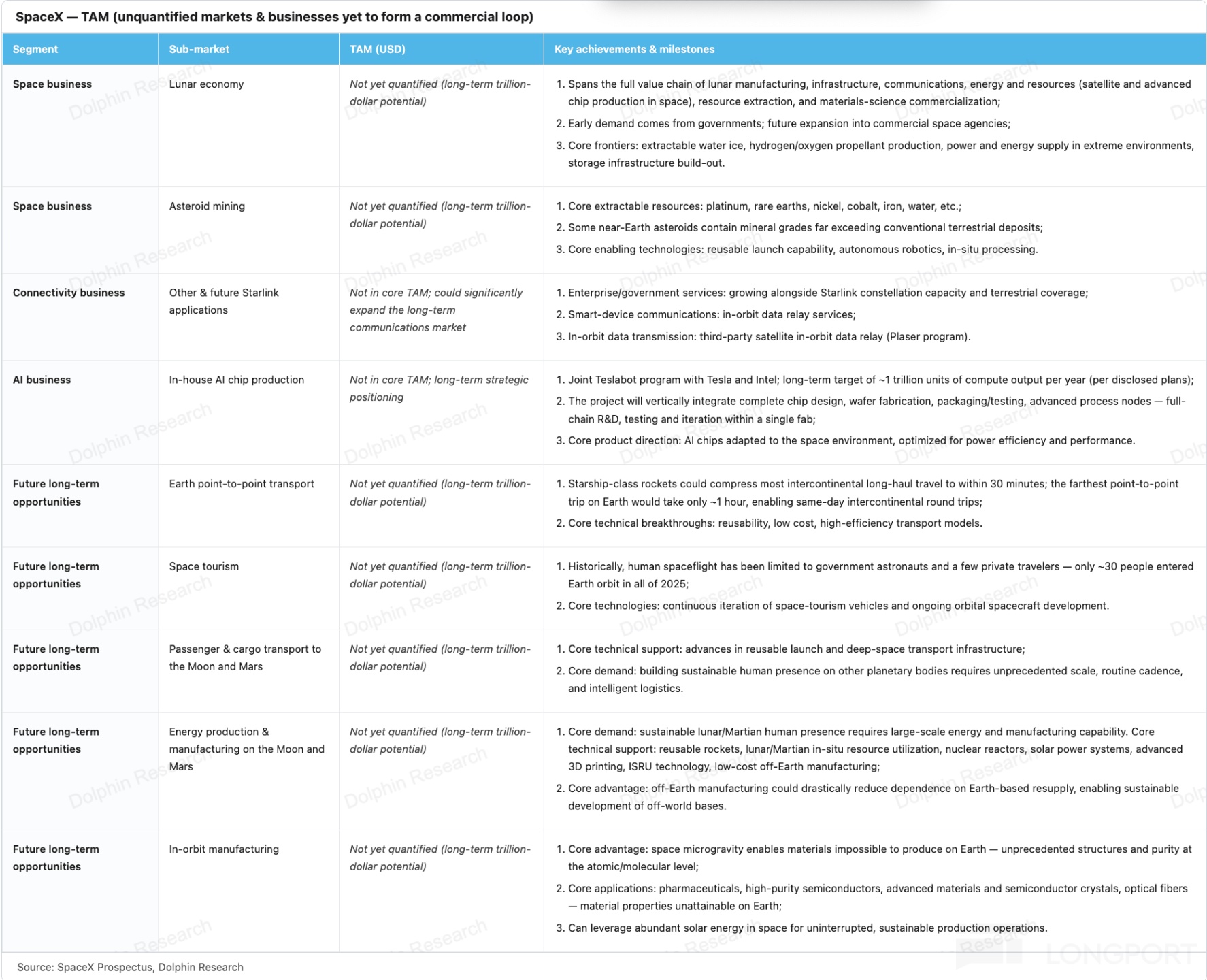
This move expands SpaceX’s serviceable market from a $0.37 tn space solutions + $1.6 tn global connectivity market to a $26.5 tn AI market, totaling $28.5 tn (ex-China and Russia). Enterprise use cases could account for ~80% of TAM.
Space-based AI data centers are still conceptual and face major engineering hurdles — thermal, hardware refresh, power beaming, radiation — but they create a multi-trillion-dollar long-dated growth option for SpaceX.
II. Where does the money come from?
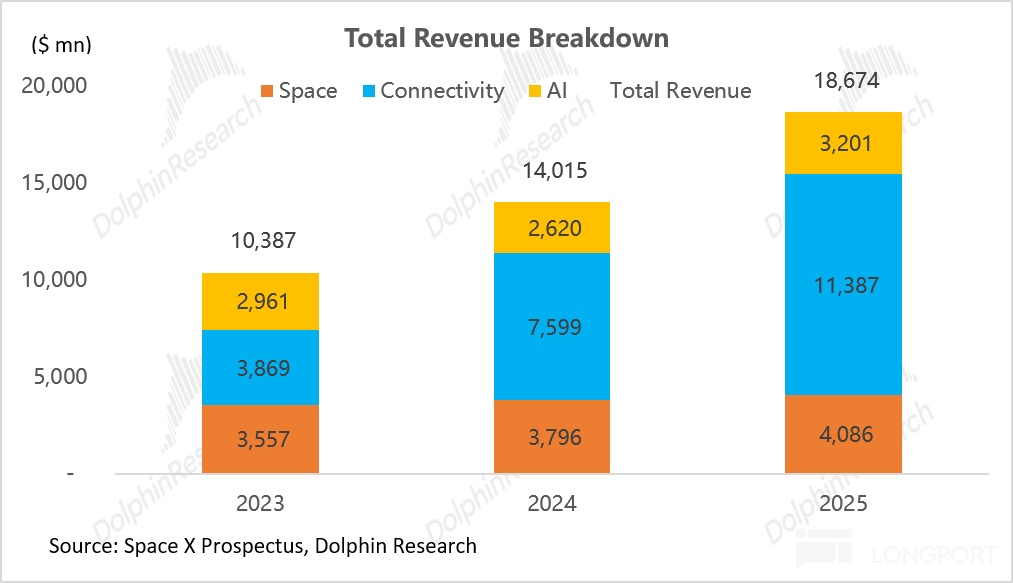
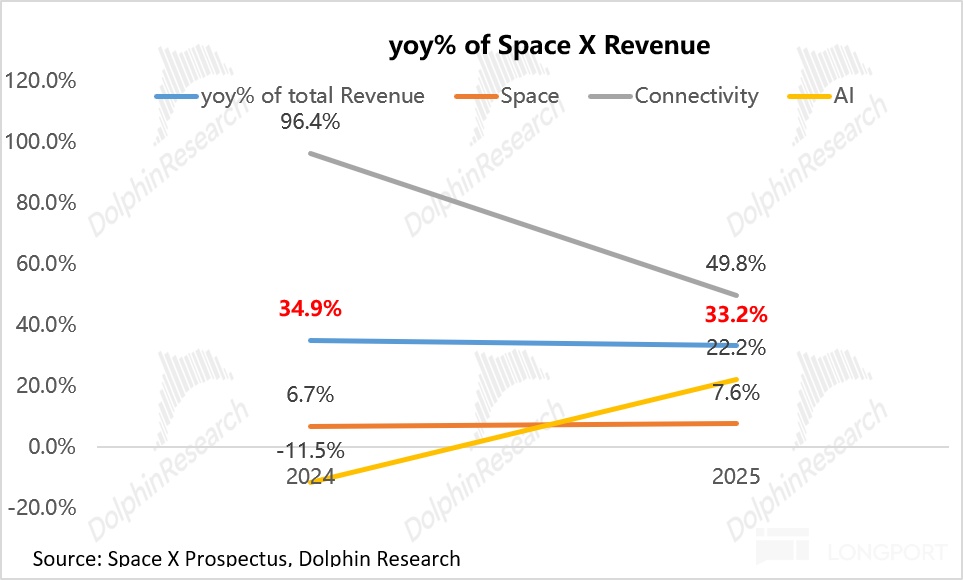
From 2023 to 2025, SpaceX ran on three engines: Space (transport/launch), Connectivity (Starlink), and AI. Total revenue climbed from $10.4 bn to $18.7 bn, +34%.
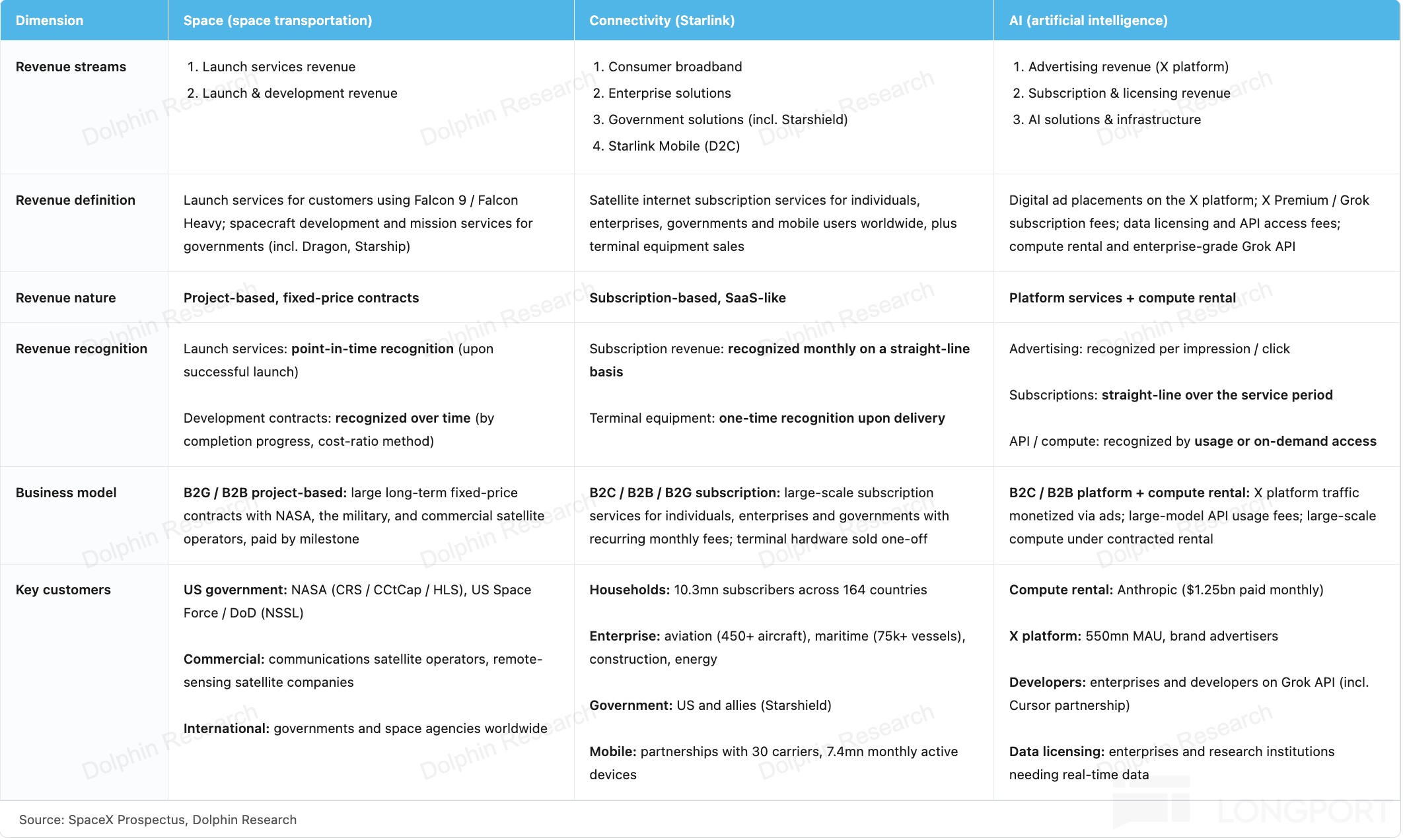
Rev. mix: capacity under-monetized, network cashes in, AI burns cash
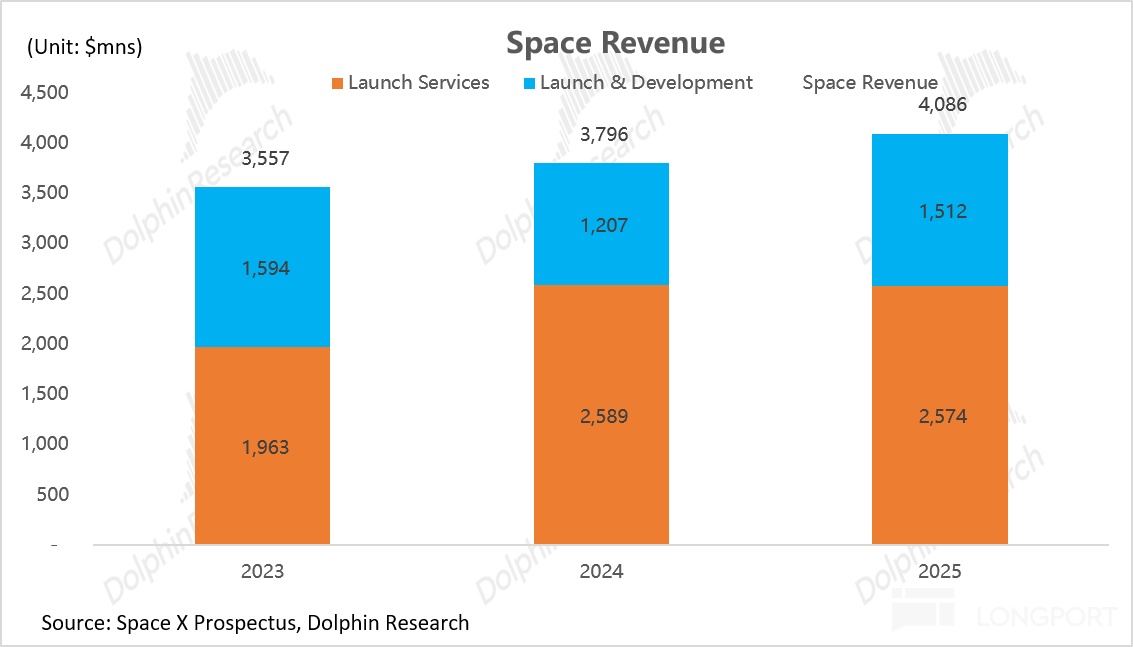
In SpaceX’s P&L, rockets are the hidden master — the moat — but contribute little revenue because most capacity serves internal demand and is eliminated on consolidation. Space launch revenue CAGR over two years was only 7.2%, a deliberate choice to prioritize in-house missions.
The revenue workhorse is Starlink, which monetizes that capacity. Mix rose from 37% in 2023 to 61% in 2025, with a stunning 72% two-year revenue CAGR. AI remains early, with ~4% two-year CAGR.
② Profitability: Starlink is the cash cow
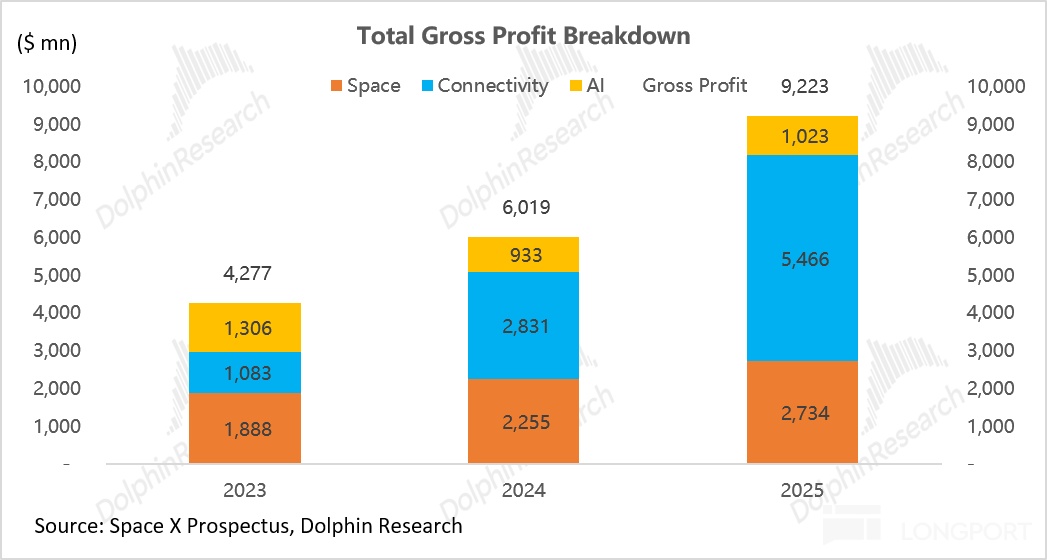
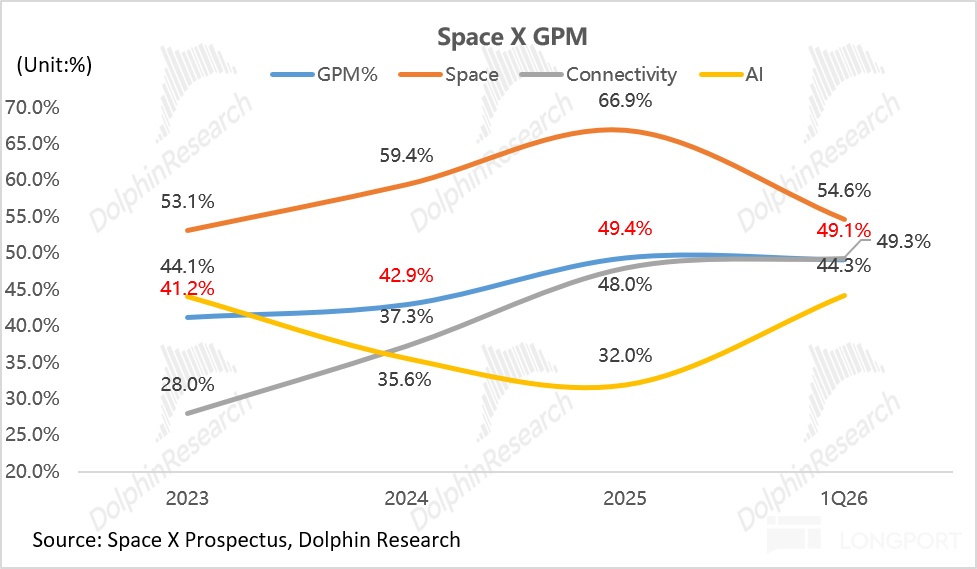
With scale effects, consolidated GPM rose from ~41% in 2023 to 49% in 2025, with GP doubling from $4.28 bn to $9.22 bn.
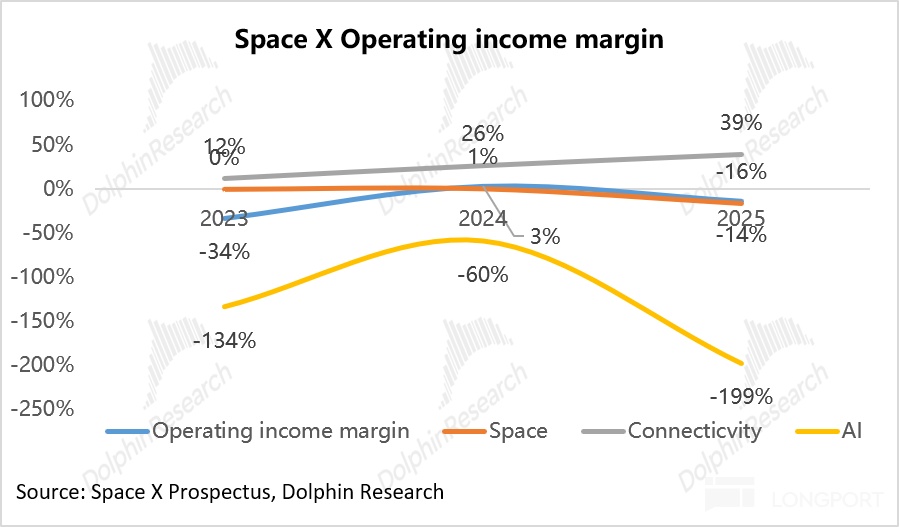
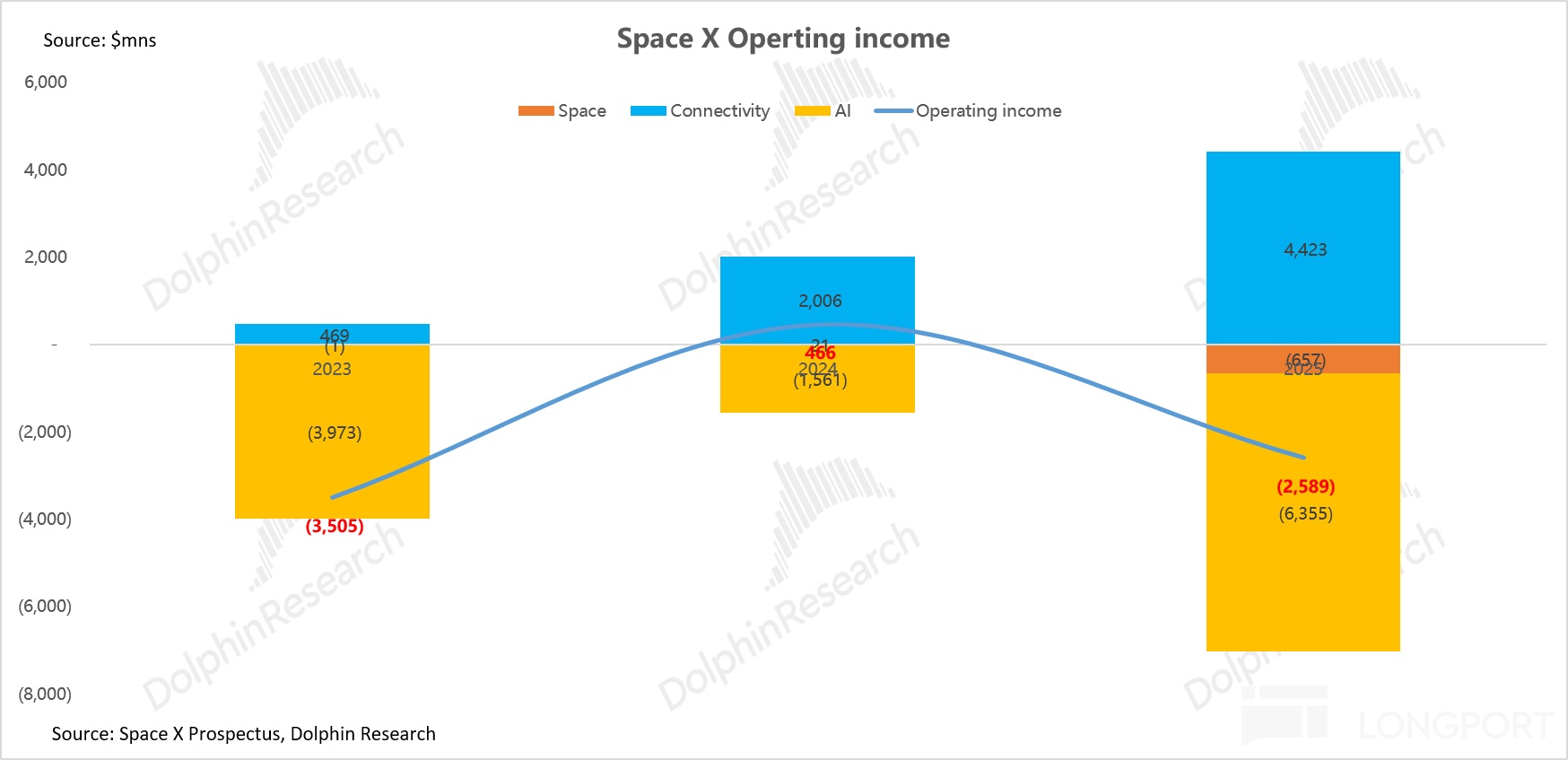
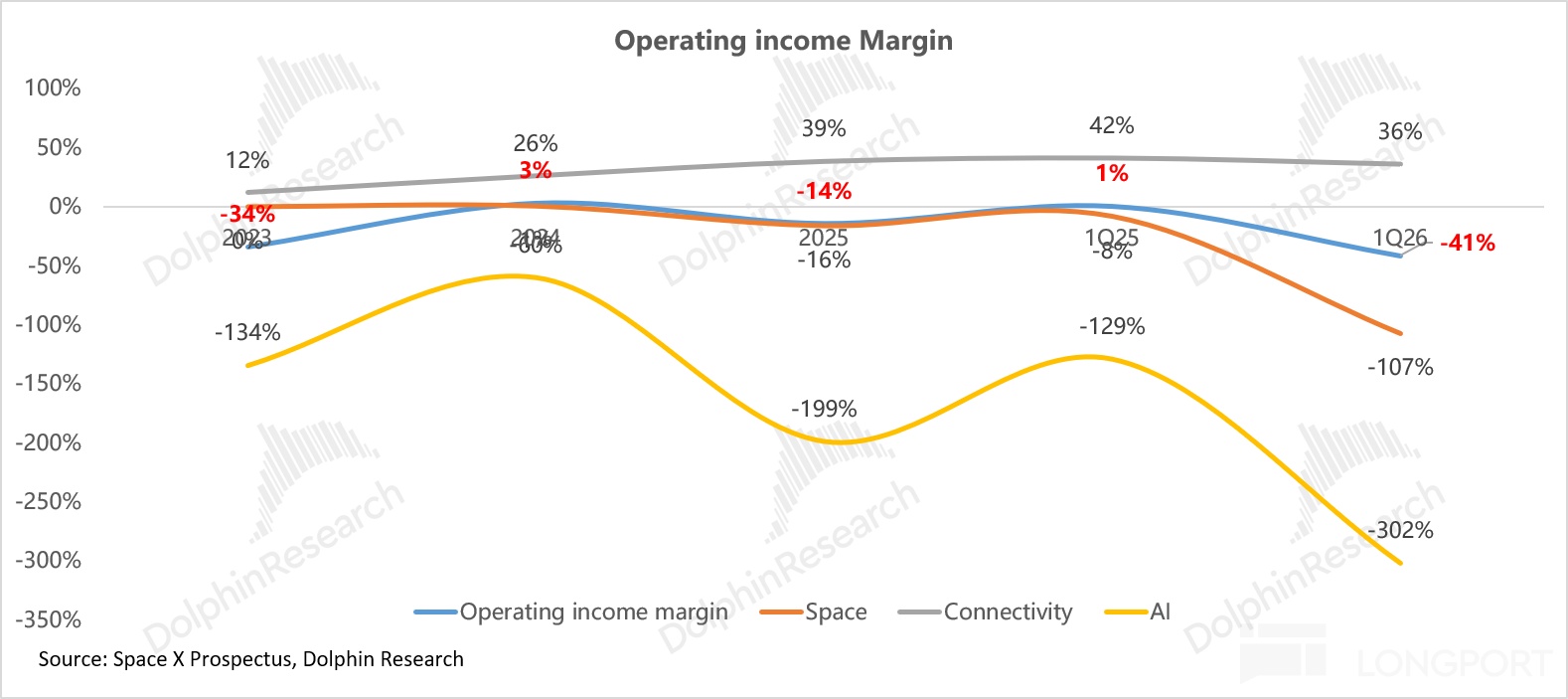
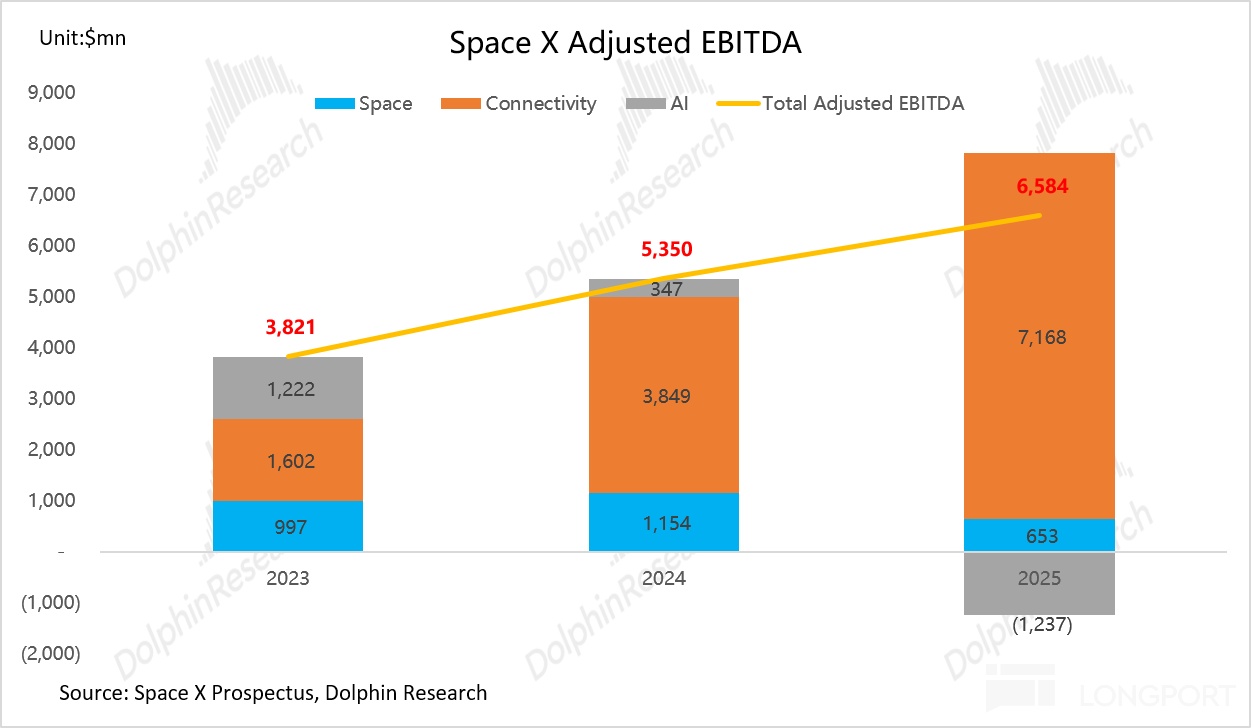
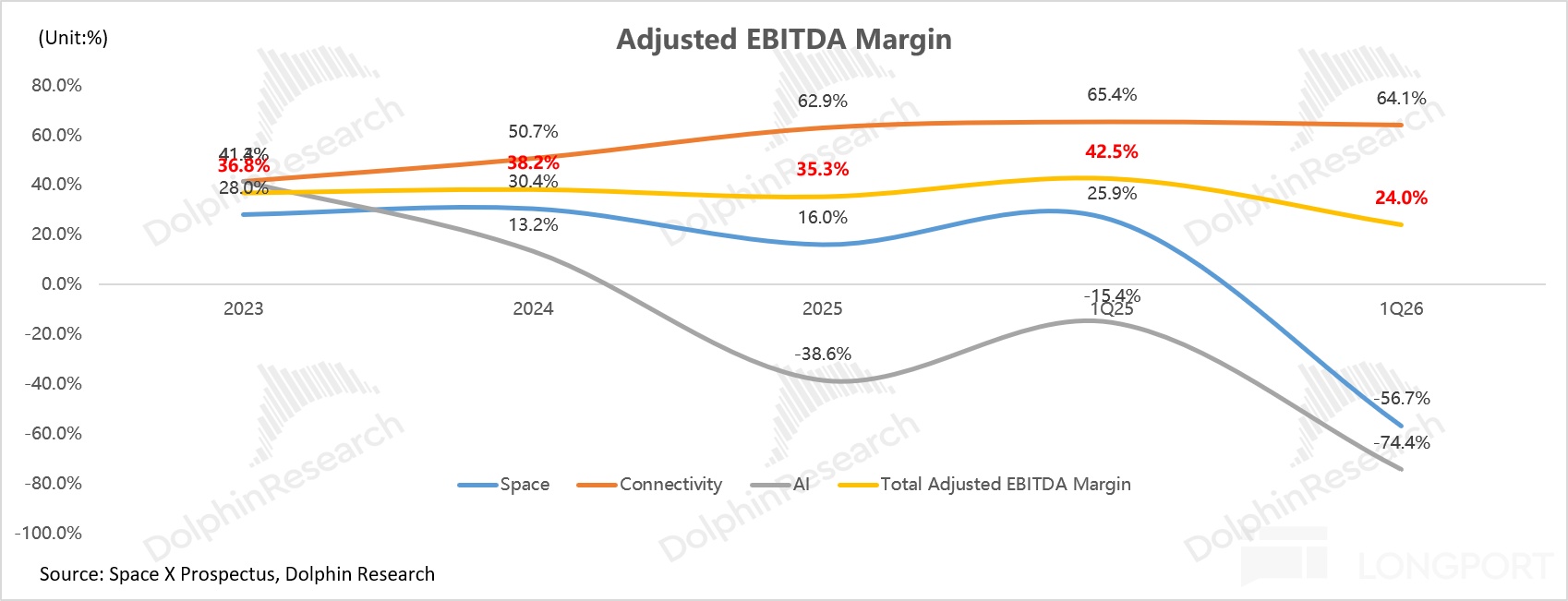
Once the mesh is built, Starlink’s profits shine: GPM jumped from 28% in 2023 to 48% in 2025, with a 125% two-year GP CAGR. OP surged from $470 mn to $4.4 bn (~10x), and segment EBITDA margin hit 63% — a textbook cash cow.
③ Starlink profits feed two 'cash burners'
With an expansive space vision, Starlink profits won’t be paid out. The two main sinks are Starship and space AI.
AI: OP loss of $6.4 bn erased Starlink’s profits and then some. Spend was concentrated in AI R&D — >$5 bn in 2025 (~59% of company R&D) — and capex of $12.7 bn, over 60% of total cash outflow.
Space segment loss on paper: Falcon 9 is a cash machine, but Starship hit a critical R&D phase. ~$3 bn in iterations drove the Space transport business to a $660 mn OP loss in 2025.
III. Space hegemony’s soul: where does transport’s confidence come from?
The foundation of the tower is transport. The key question is whether real moats exist in space logistics. We break down this core business next.
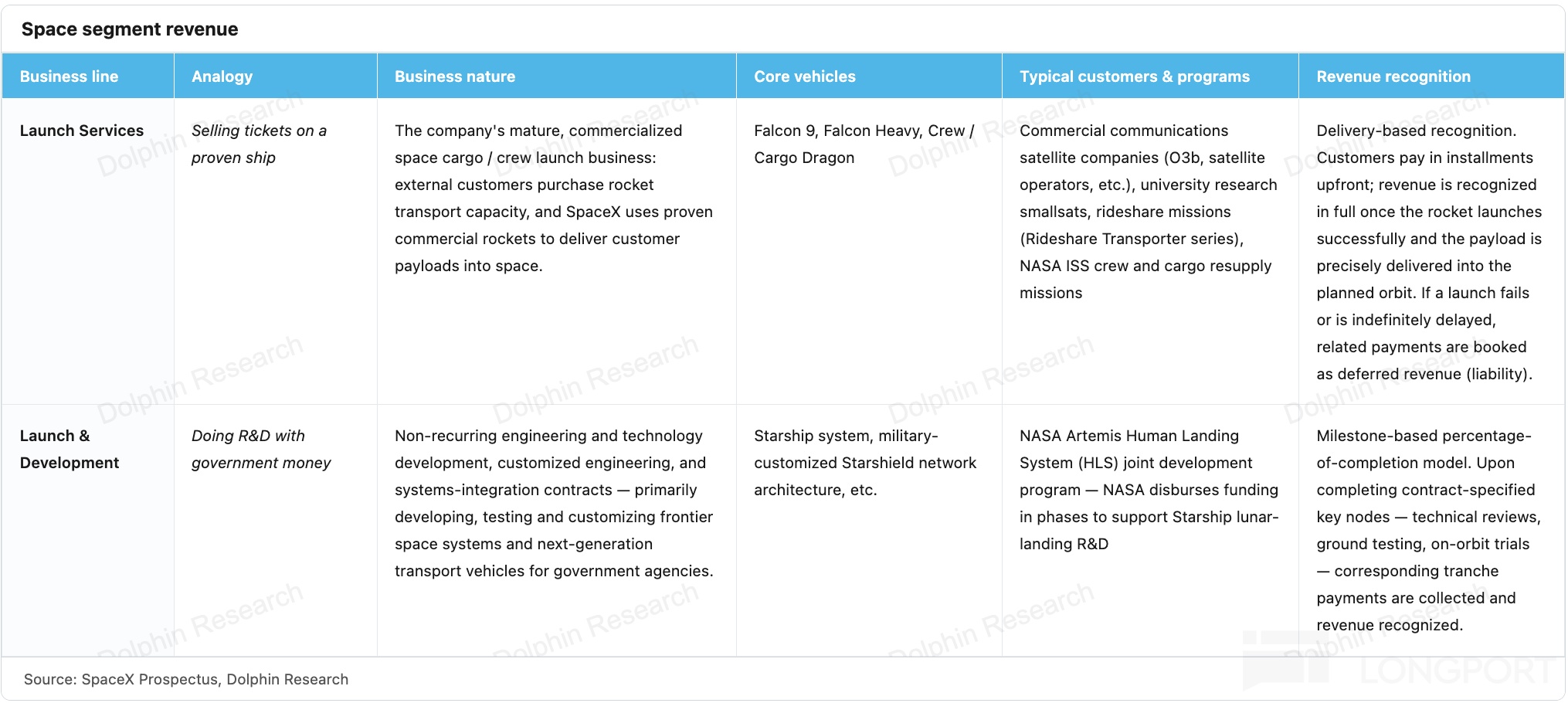
The segment consists of launch services and launch/R&D. Combined revenue is only ~$4.1 bn in 2025, modest in size.
1. Launch: express delivery to orbit
Main workhorses are Falcon 9 and Falcon Heavy. Customers include commercial satellite operators (e.g., O3b, Viasat), agencies, and the U.S. Gov. (NASA, Space Force), and the product is a ticket and a seat to orbit.
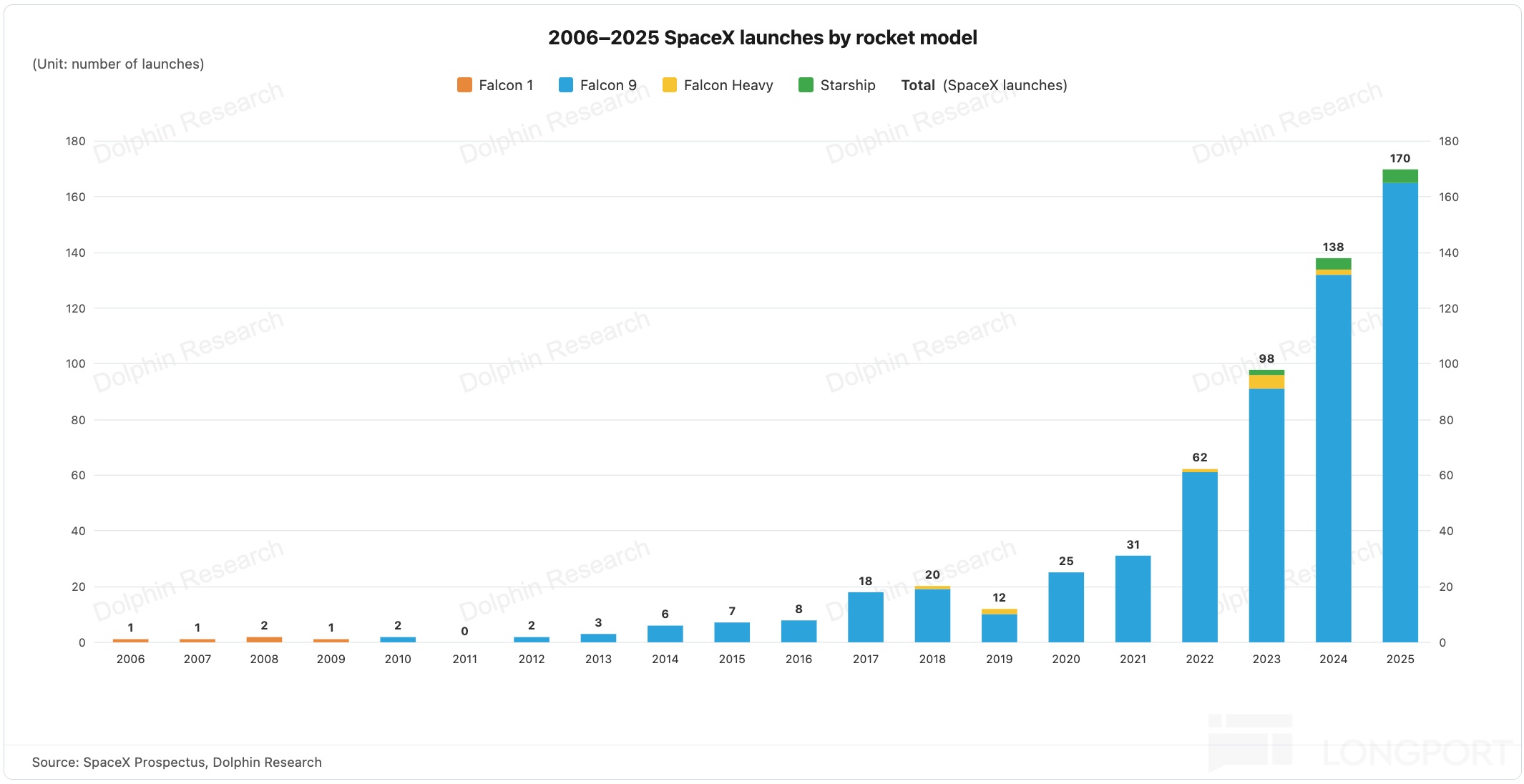
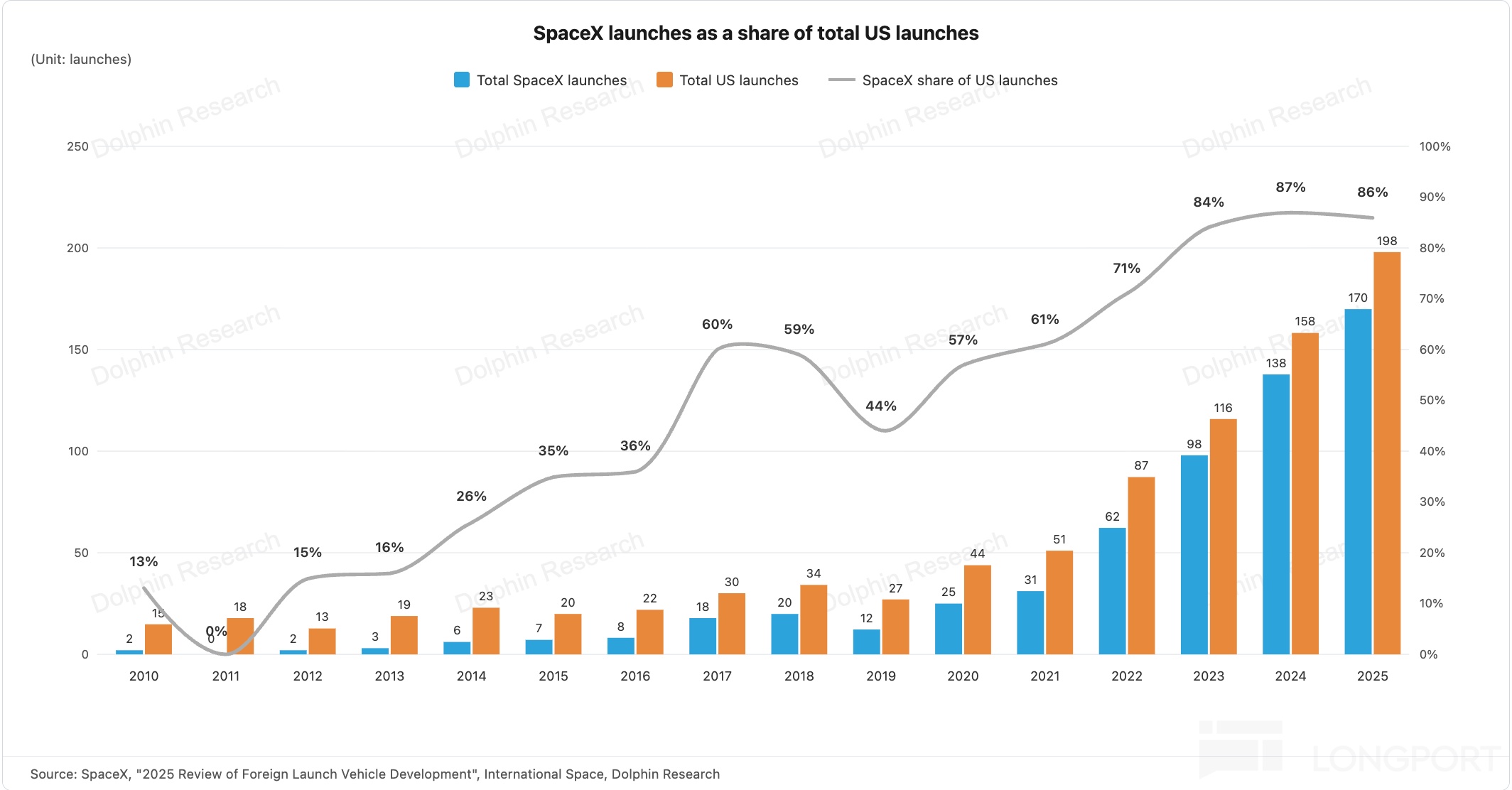
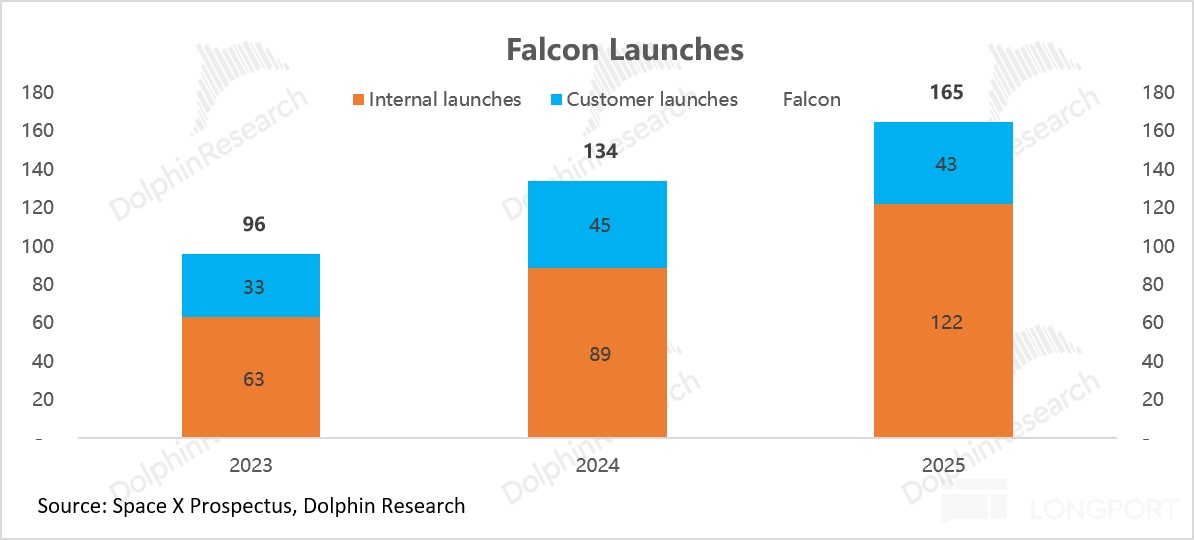
In 2025, SpaceX flew 165 Falcon missions (Falcon 9 ~97% of total), controlled ~80% of global mass to orbit, and accounted for 86% of U.S. launch count. However, because ~74% of launches carried internal payloads, much of the revenue is eliminated on consolidation, understating physical throughput and economic value.
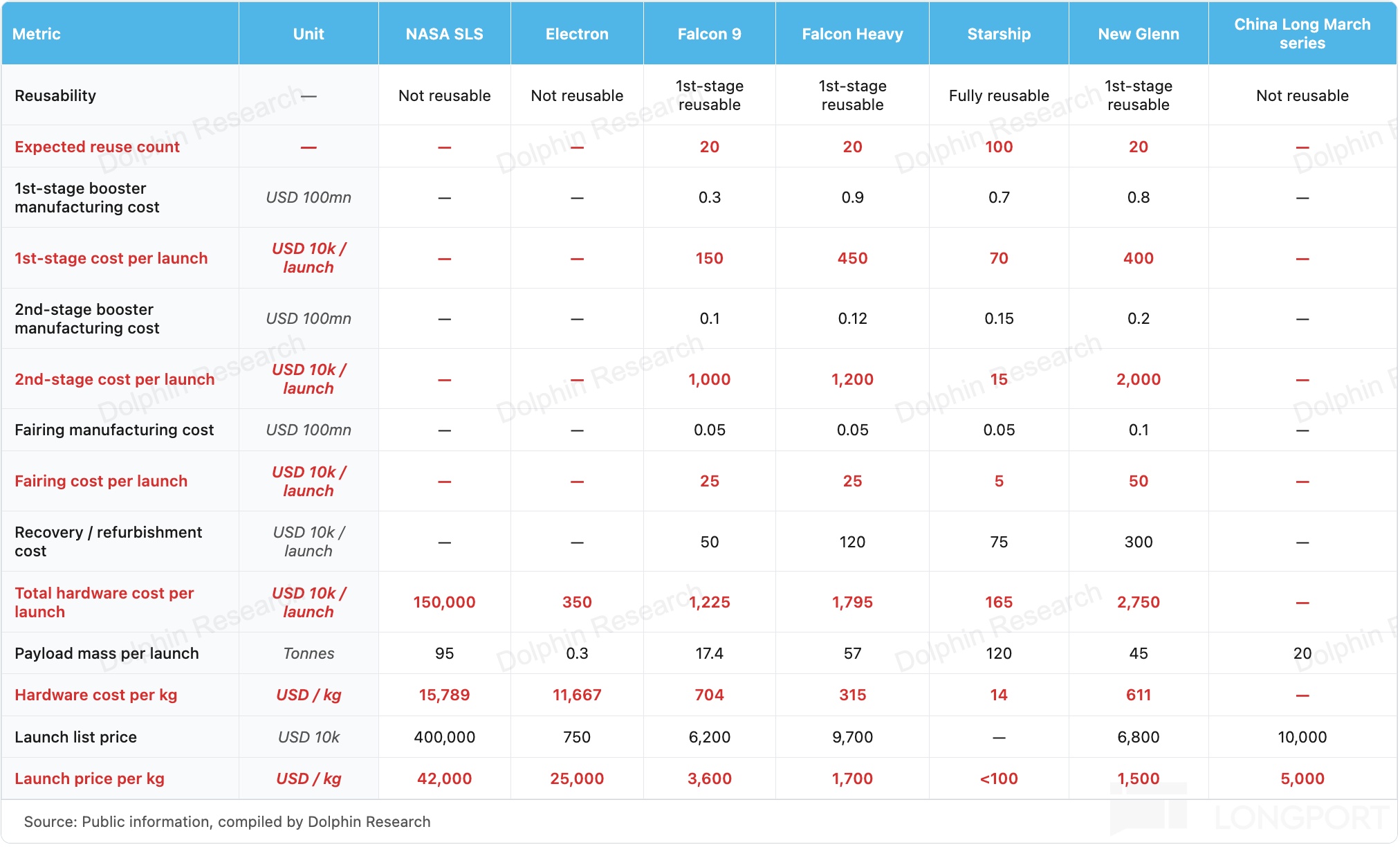
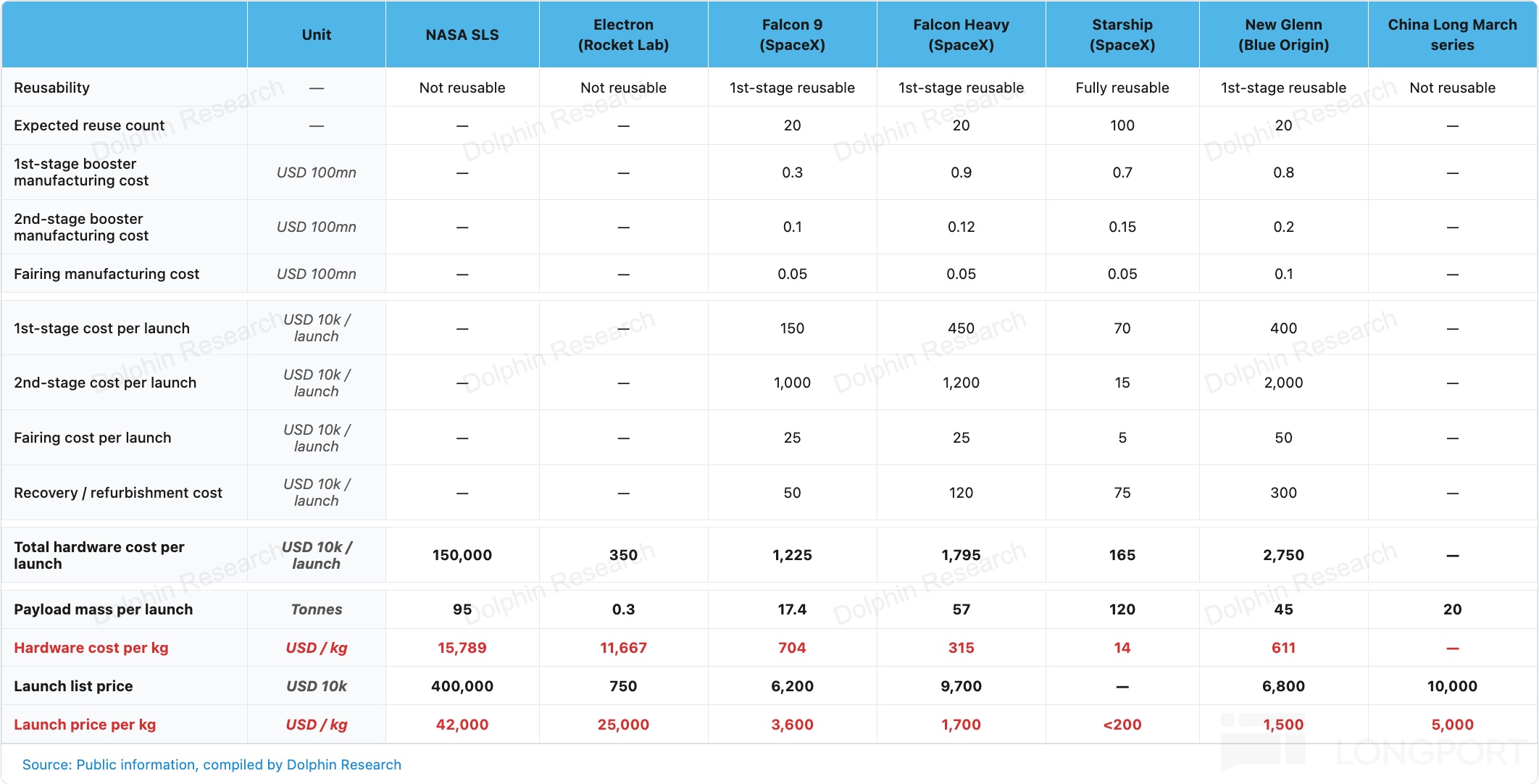
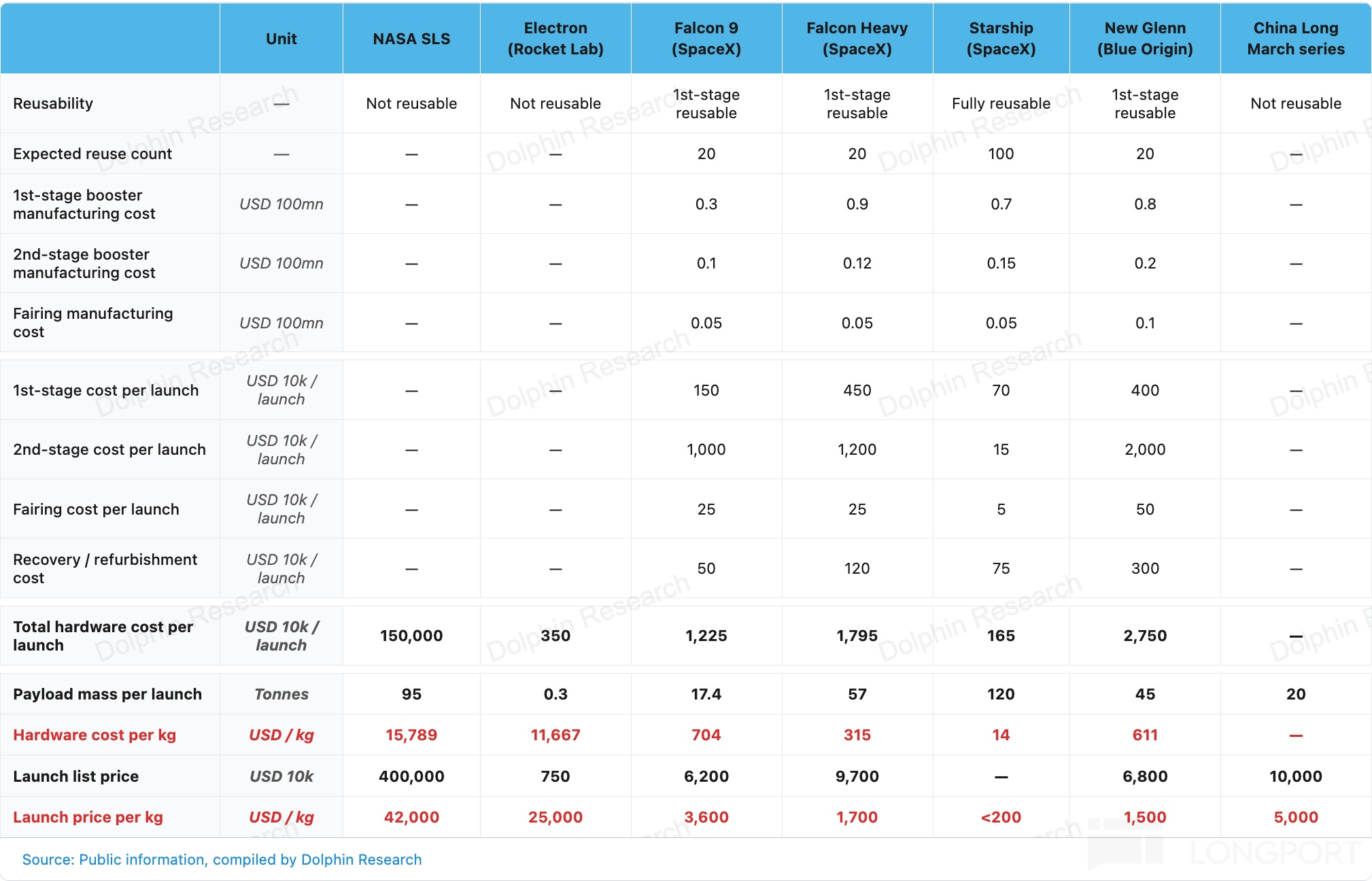
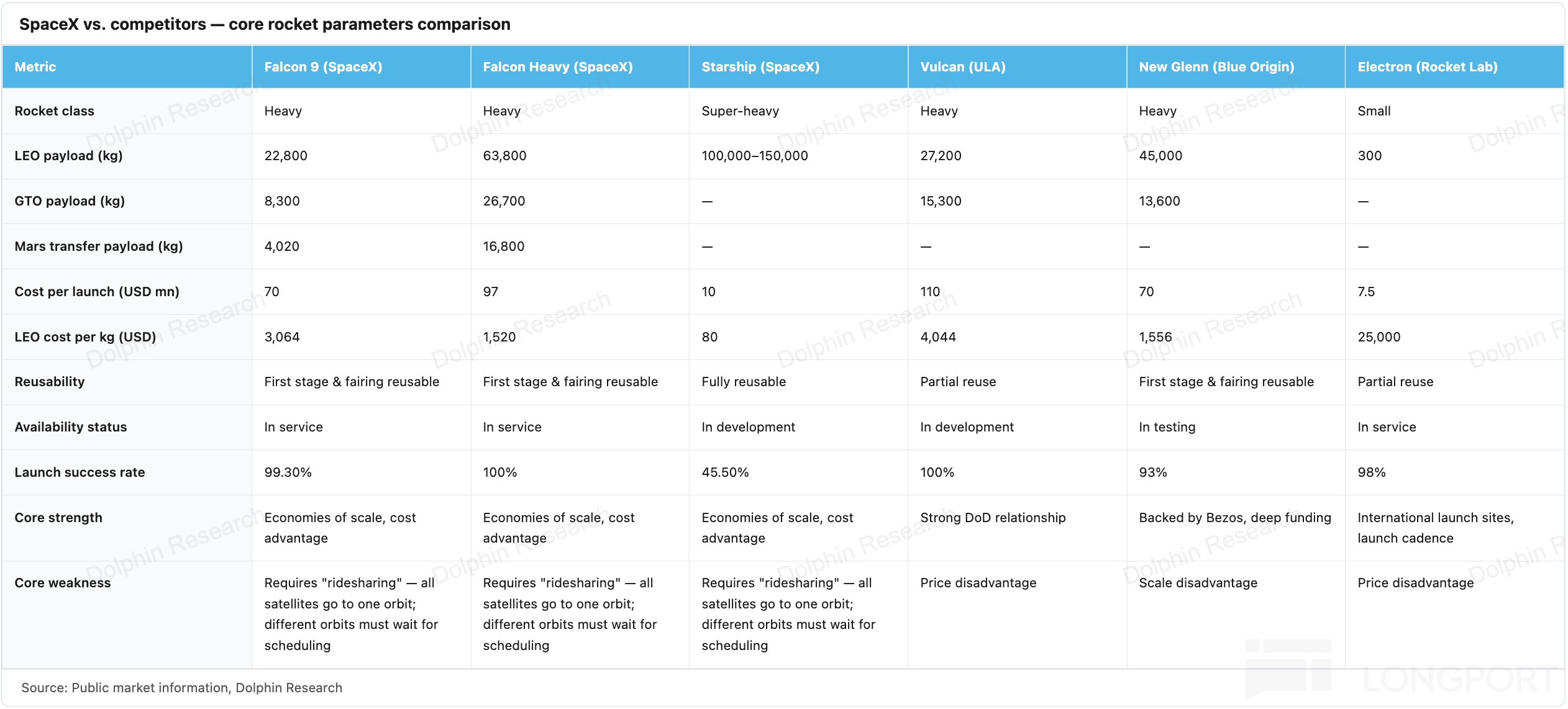
The decisive edge is first-stage reusability, with superior payload per launch and lower price per kg.
2. Custom R&D: pushing the deep-space frontier
Alongside per-kg/pricing launches, SpaceX undertakes bespoke Gov. programs (e.g., NASA HLS lunar lander) and defense projects. Revenue is recognized by milestones/POC, tied to agency budget pacing and SpaceX’s speed through gates (e.g., PDR/CDR, engine hot-fire, orbital demos).
That makes revenue lumpy and non-linear across project cycles. Moreover, Gov./defense missions (e.g., GPS for Space Force, classified payloads) carry stricter safety requirements and longer prep, with different pricing mechanics and typically lower margins vs. pure commercial launches.
Current focus is Starship R&D: targeting the first fully and rapidly reusable architecture (both stages recoverable with quick turnarounds), driving cost to $200/kg vs. Falcon 9’s ~+$3,000/kg and ~+$18,500/kg for expendables.
If achieved, Starlink V3 constellation build-out and space compute become straightforward from a logistics standpoint. Starship’s success or failure will determine whether SpaceX can unlock a new $10 tn+ market — it is not only the Space segment’s bet, but also decisive for the company’s valuation ceiling.
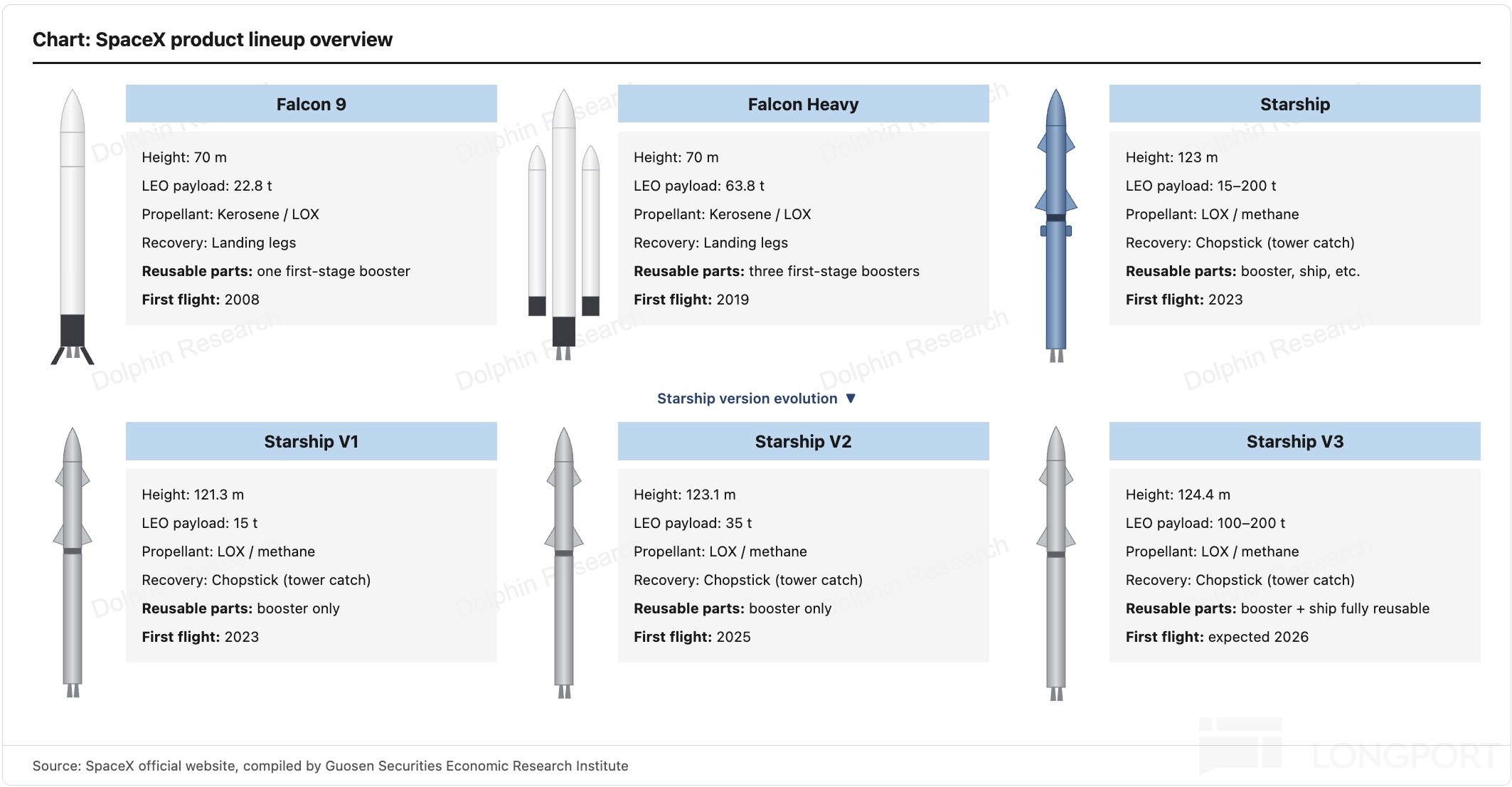
Three core questions for the Space business:
① How deep is the first-stage reuse moat?
In our view, the moat is built on engineering difficulty, vertical integration, and learning-by-doing. Catch-up will take years for peers.
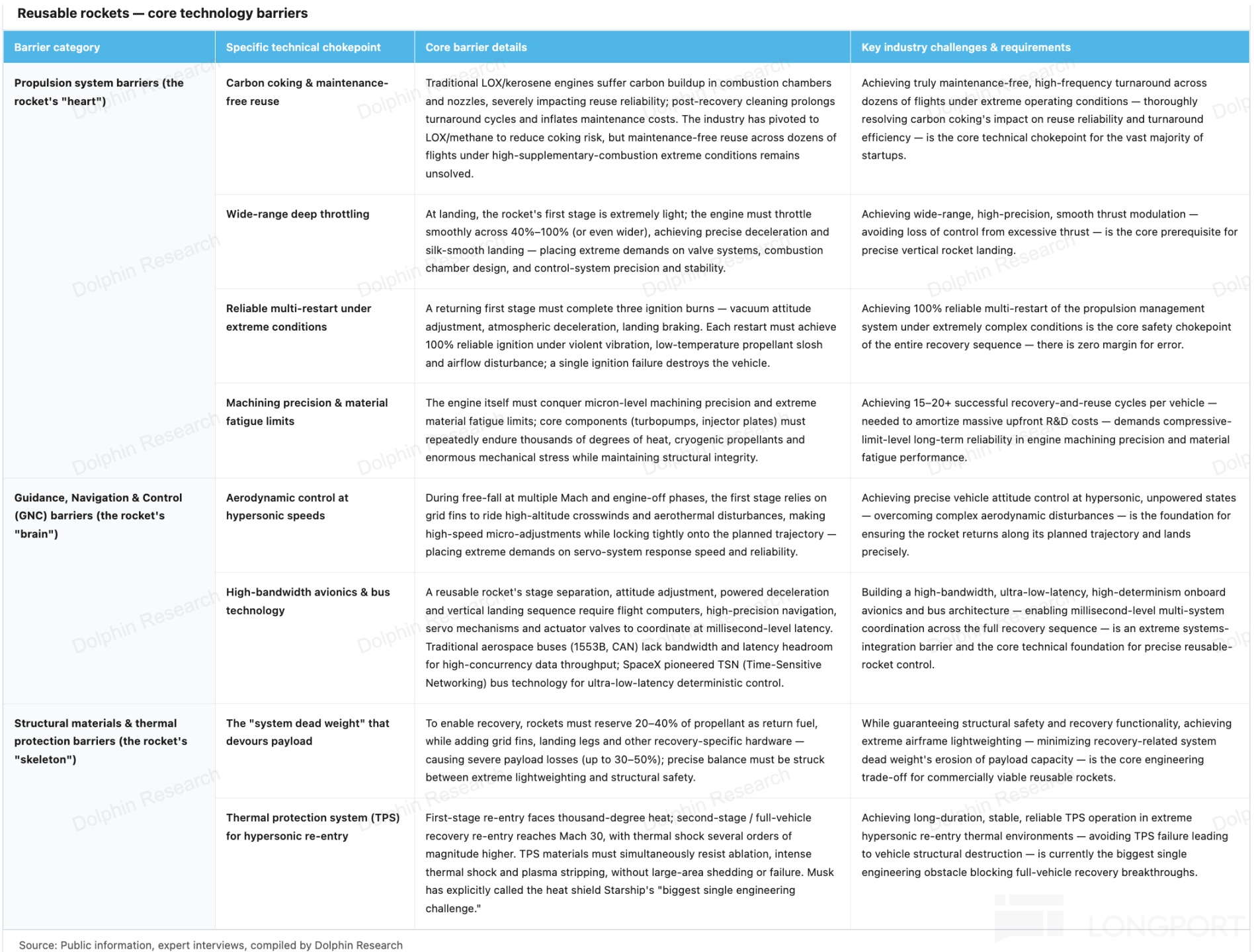
a. Technical moat: hell-level engineering gates
Propulsive recovery is a system-level battle against physics. Landing a multi-dozen-ton booster traveling at several times the speed of sound requires breakthroughs in propulsion, controls, and materials.
Propulsion: traditional fuels coke and limit reuse; methane/LOX engines are preferred for longevity. Engines must support deep throttling (≤40% to avoid lofting) and execute three high-altitude relights under violent conditions.
Controls: akin to throwing a chopstick from tens of km up and having it land upright. Grid fins must damp gusts with millisecond-level attitude corrections to lock onto a moving droneship.
Materials: structures endure thousand-degree re-entry heating while storing -200°C cryogens. Ultra-lightweighting is essential to offset payload penalty from recovery propellant reserves.
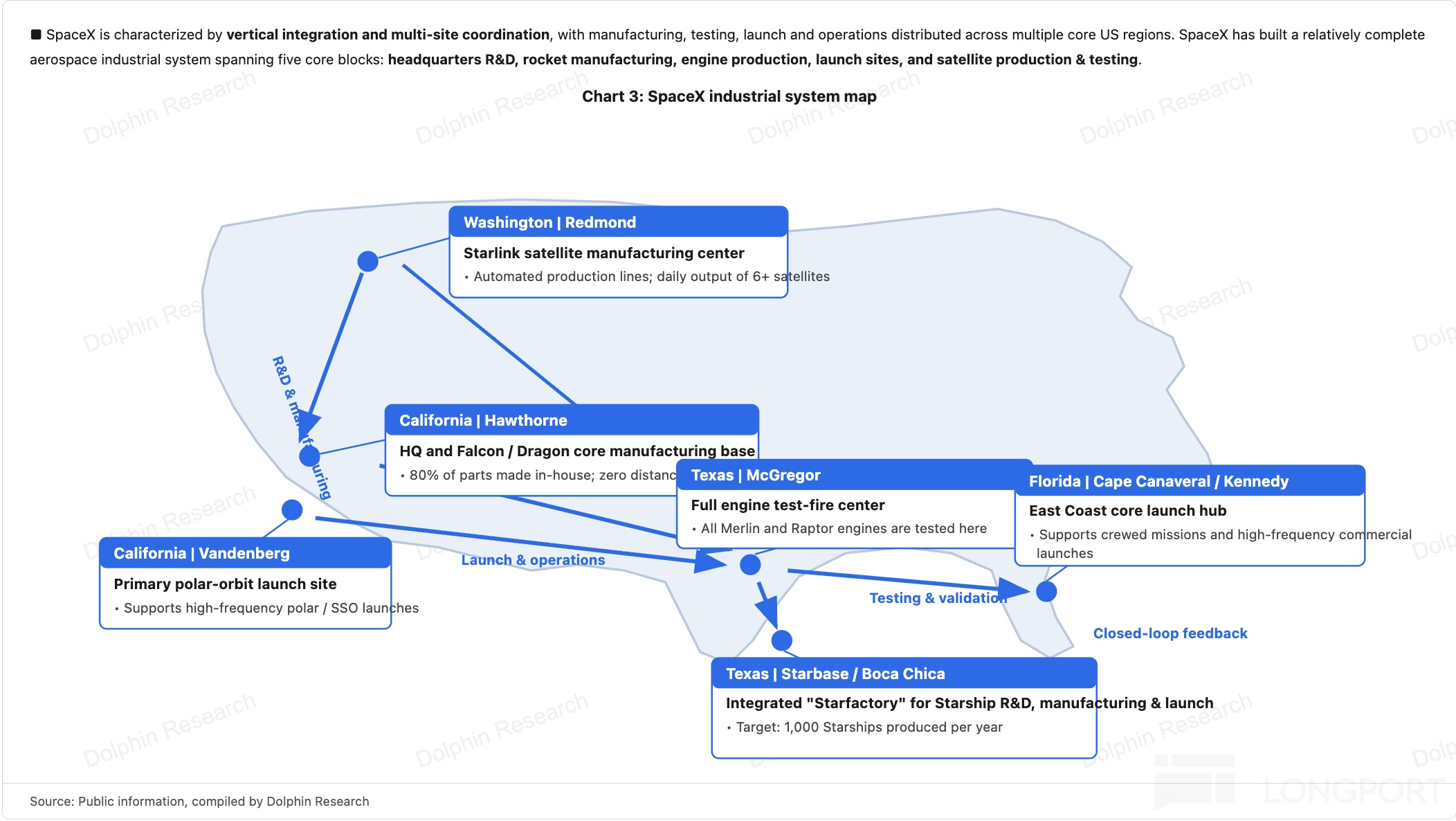
See the schematic below for details:
c. Vertical integration: keep the crown jewels in-house
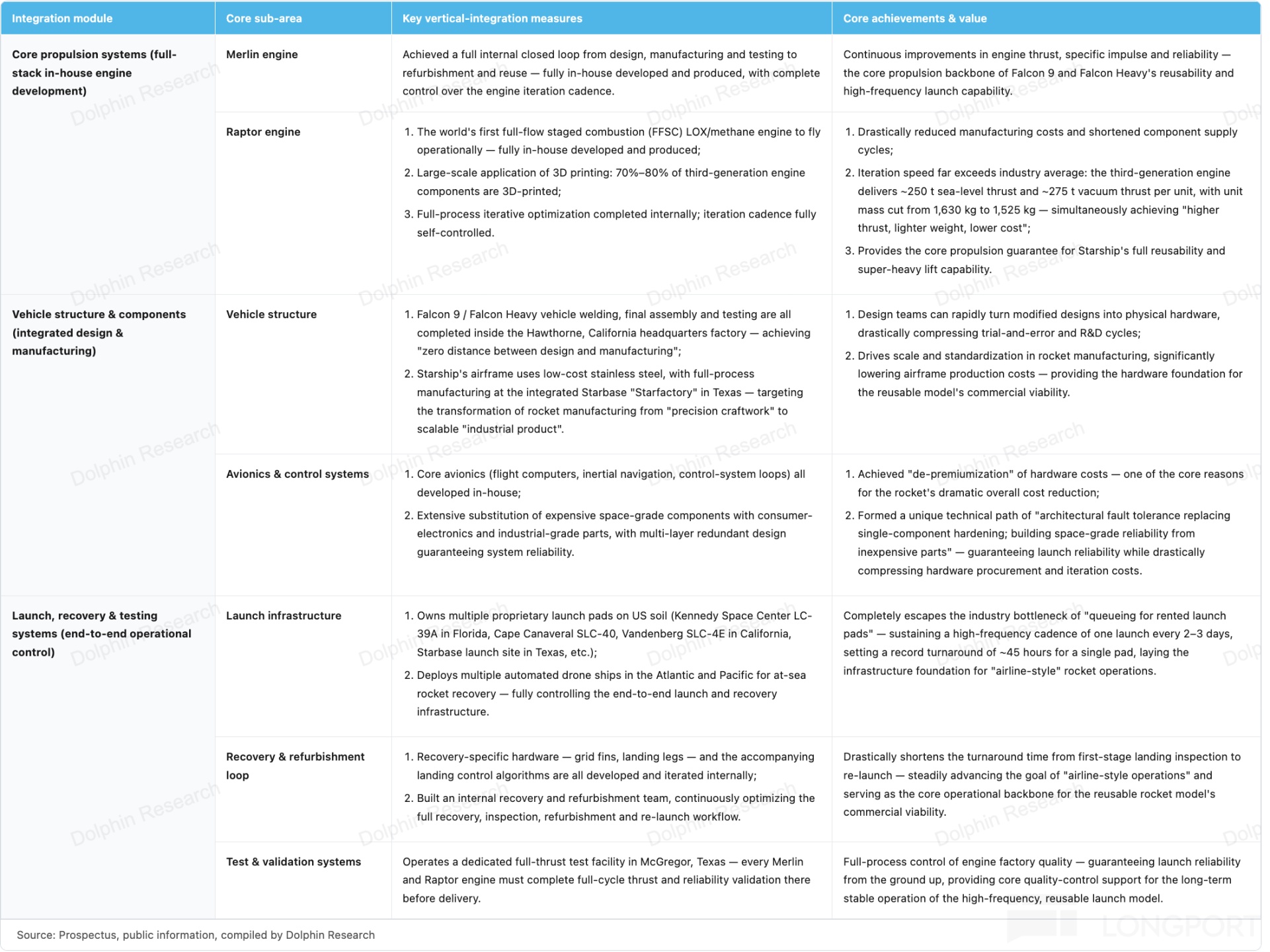
Unlike legacy primes that lean on tiered suppliers, SpaceX internalizes wherever possible. Roughly 80% of core hardware is self-designed and self-manufactured, with only ~20% sourced externally (e.g., specific sensors, specialty composites, some COTS electronics).
Integration spans the highest-cost, most technical pieces — engines, structures, launch/recovery, and test systems. Rivals face long lead times to replicate.
c. Launch cadence and flight-history moat (Starlink’s self-feeding loop)
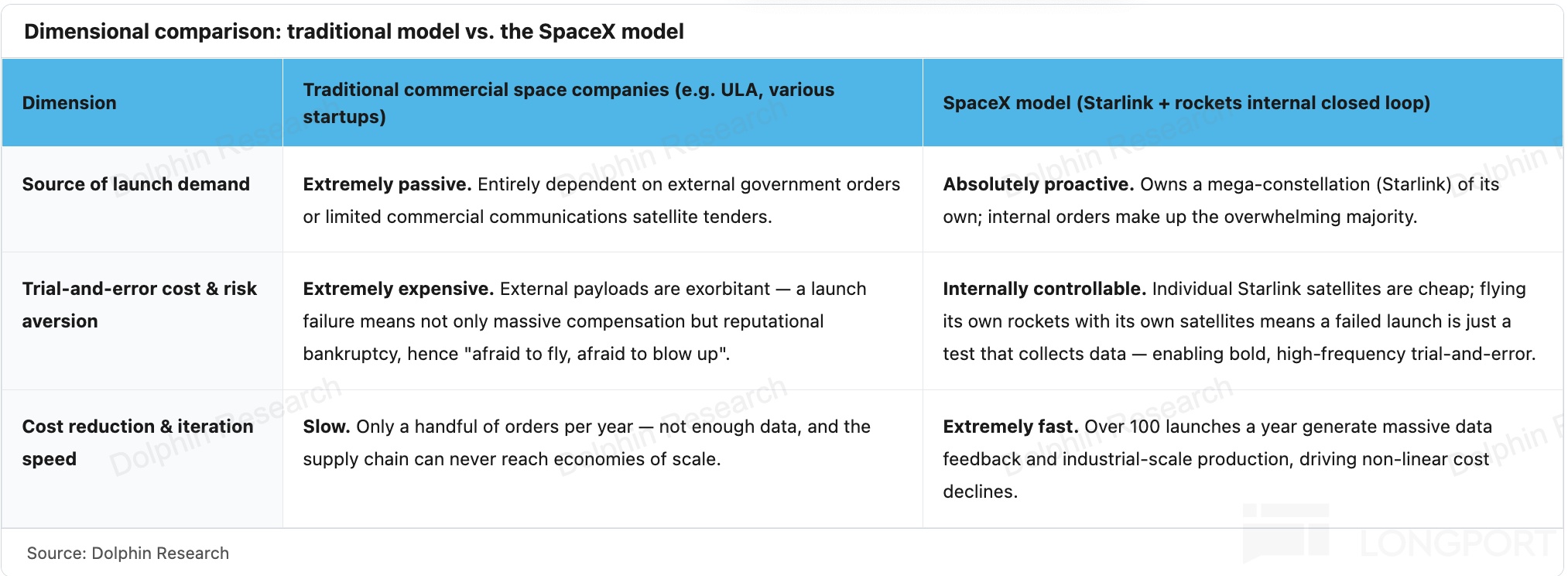
Reliability is the first principle in space. A GEO comsat can cost hundreds of millions; a failed launch wipes out years of work. Agency and commercial buyers prioritize flight heritage above all else.
SpaceX’s captive demand provides frequent real-world trial-and-error. Each mission returns massive extremes-data (thermal, vibration, aero loads) to refine flight software and structural models.
This data flywheel and engineering know-how, fed by hundreds of flights, create a 'time moat' money alone cannot compress.
d. Cost and pricing power moat
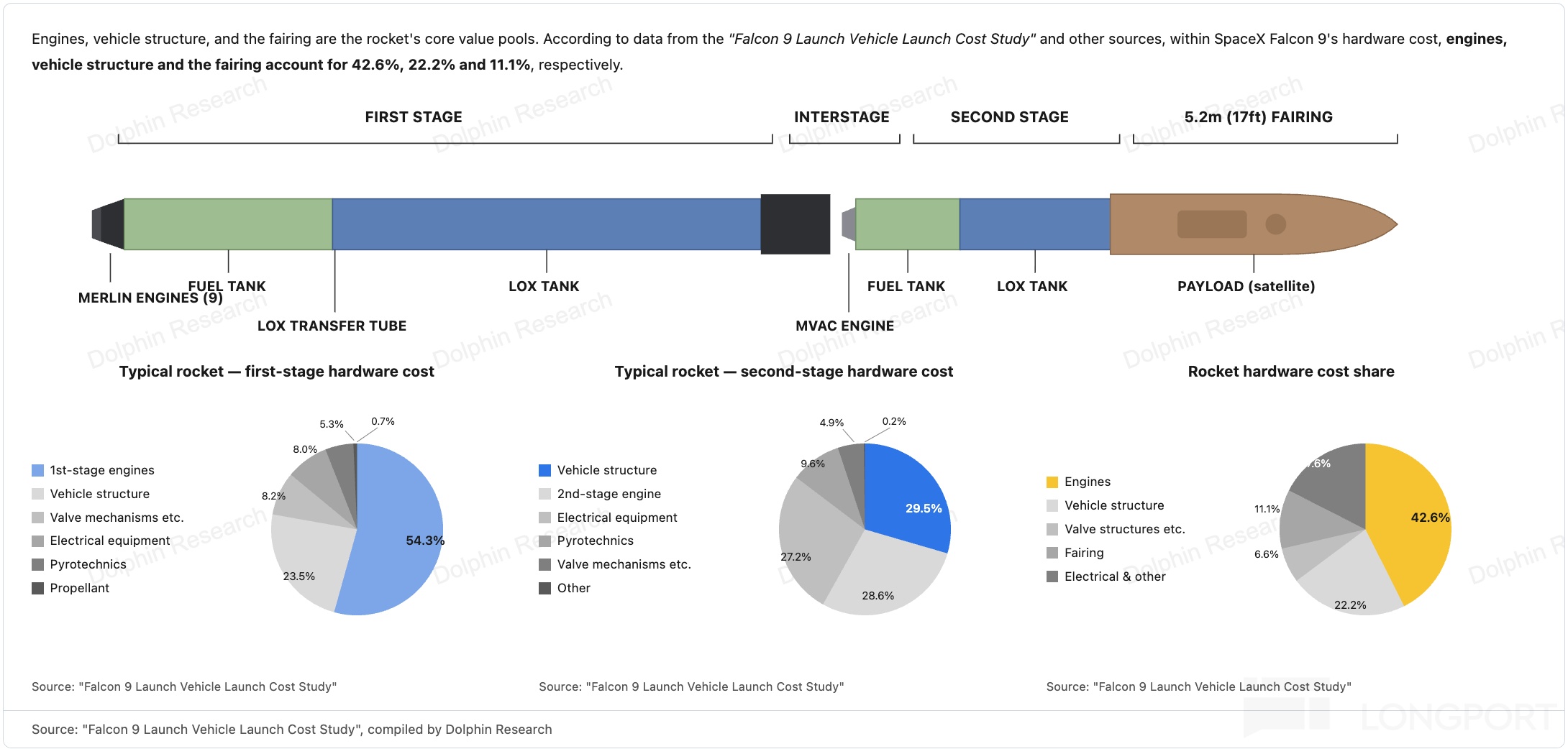
Extreme engineering discipline, vertical integration, and cadence-enabled reuse deliver hard economics. On Falcon 9, the first-stage booster plus fairings comprise ~70% of hardware cost; expendable launches implied ~$50 mn per flight in manufacturing.
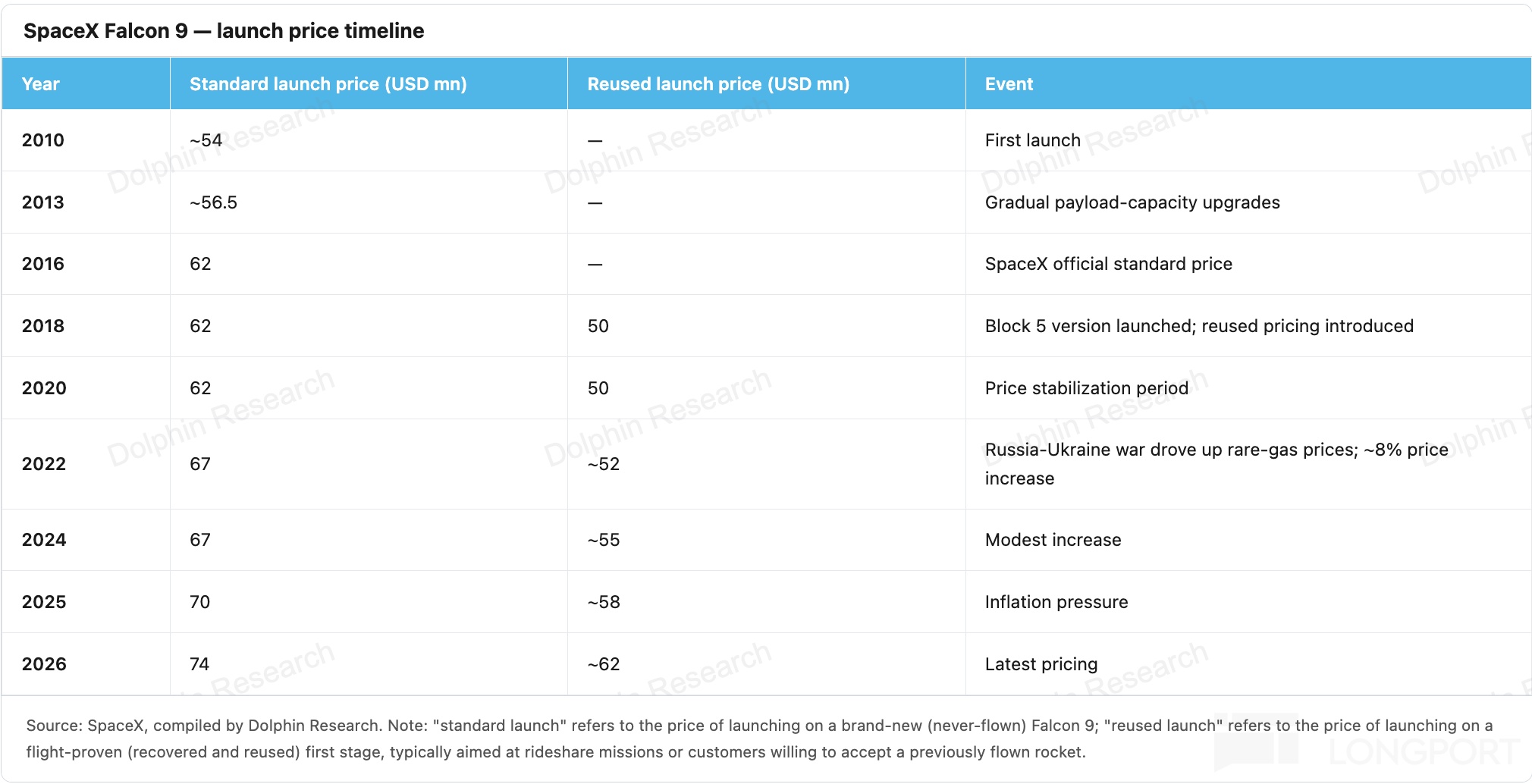
With up to 34 reuses per booster by end-2025, internal marginal cost per launch (incl. refurbishment, propellant, range ops) falls to ~$15 mn — ~70% lower. Even at ~$74 mn/$62 mn (standard/reuse) list prices, GPs are rich.
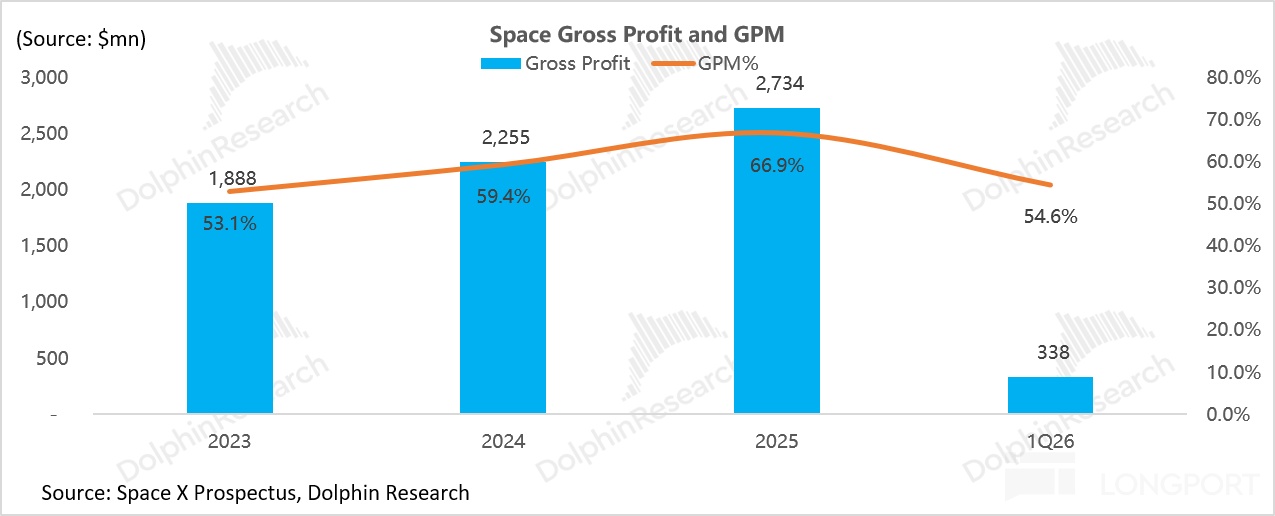
If competition emerges, SpaceX can cut to sub-$30 mn, pushing expendable-only peers into loss-making spirals per launch. Launch GPM rose from ~53% in 2023 to ~67% in 2025, driven by more reuses lowering unit cost while ASPs held firm or rose, widening the GP spread. Pricing has trended up, reflecting genuine supply-demand tightness.
This dynamic shows SpaceX monetizing its monopoly position while the market lacks low-cost, mature alternatives. Cost-down gains accrue to profits rather than customers, funding Starship R&D.
But in Q1-2026, launch GPM eased from ~66% YoY to ~55%, mainly due to:
a. Mix shift toward Gov./defense: With full execution of DoD’s NSSL Phase 2 and more NASA Artemis missions, lower-margin Gov./defense revenue rose from ~35% to ~47%, dragging blended margins.
b. Starship V3 drag: As a new vehicle, V3 carries higher manufacturing costs vs. the mature, 300+ recovery-validated Falcon 9. Lower yields and supply-chain frictions lifted fixed costs per launch.
On the 12th V3 test (May-2026), most objectives were met, but the booster splashed after multiple engine relight failures. Hardware losses were expensed, hitting margins, while depreciation from heavy Starship capex also weighed on costs.
② How long does SpaceX stay ahead in reusability?
SpaceX still leads decisively, but peers are at different stages:
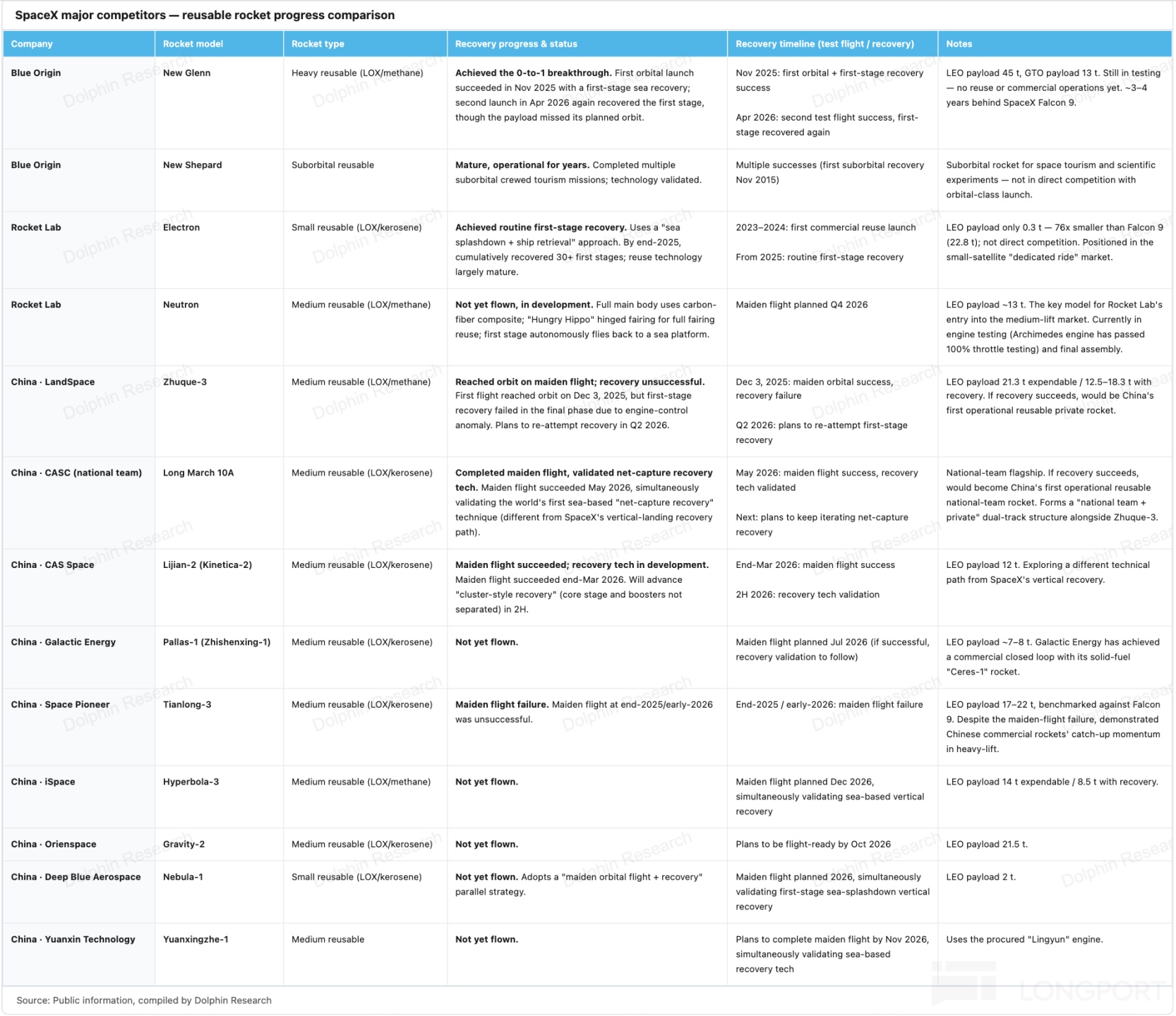
Tier 1: Blue Origin. New Glenn achieved its first ocean booster recovery in Nov-2025, becoming the world’s second orbital-class reusable. It then executed its first reuse in Apr-2026, a 0-to-1 milestone.
However, with limited reuse cycles, New Glenn has yet to enter stable reuse and commercial ops. Falcon 9 has a decade of experience and 300+ recoveries; catching up will likely take years to reach today’s reliability.
Tier 2: Rocket Lab. Electron has validated partial first-stage recovery via parachute and reused one engine, but full-vehicle routine reuse remains unproven. Its Falcon 9 analog, Neutron, targets a first flight in H2-2026 without attempting vertical recovery.
Substantive competition vs. Falcon 9 likely sits 2–3 years out; Neutron’s recovery success will define the real gap.
Tier 3: China’s commercial space. As of Jun-2026, China has not yet recovered an orbital-class rocket and remains pre-reusability. But a sprint is underway: Long March 10B aims to demo the world’s first at-sea net recovery, while Zhuque-3 and Lijian-2 push frequent tests.
Industry consensus expects a first Chinese orbital recovery between late-2026 and H1-2027, making China the second nation with this capability after the U.S.
Overall, challengers are still crossing the '0-to-1' threshold. SpaceX is compounding from '1 to 100' with a 10–12 year time lead that capital alone cannot compress.
③ If prices are lower, why is the launch market still 'tiny'?
In 2024, the global launch market was only ~$18.7 bn. Precedence Research sees ~$64.3 bn by 2034, a ~13% CAGR — modest vs. satellite internet or AI compute.
Two locks, in our view:
1. Demand-side structure: mostly a stock game
a. GEO comsat demand is saturated to declining: Core buyers of GEO comsats face long lifecycles (15+ yrs) and scarce GEO slots, making it a replacement market. Annual unit launches hover in the low tens, steady with little growth elasticity.
b. Gov./defense is high value but low frequency: Deep space probes and high-end reconnaissance command big contracts but have long R&D cycles and low cadence, limiting steady volume.
c. Non-Starlink LEO constellations are slow and lack scale: Competitors’ transport costs are high, blocking the business loop. Only Starlink has proven B2C broadband subscriptions and a self-reinforcing cycle of launch → mesh → operate → profit → re-launch.
To a degree, SpaceX prioritized internal capacity, helping it consolidate downstream scale advantages.
d. EO and smallsat markets are long-tail and low ticket: Universities and startups drive volume, but tiny payloads mean small contracts and heavy rideshare reliance. Counts are up, but the TAM share is small and cannot carry growth alone.
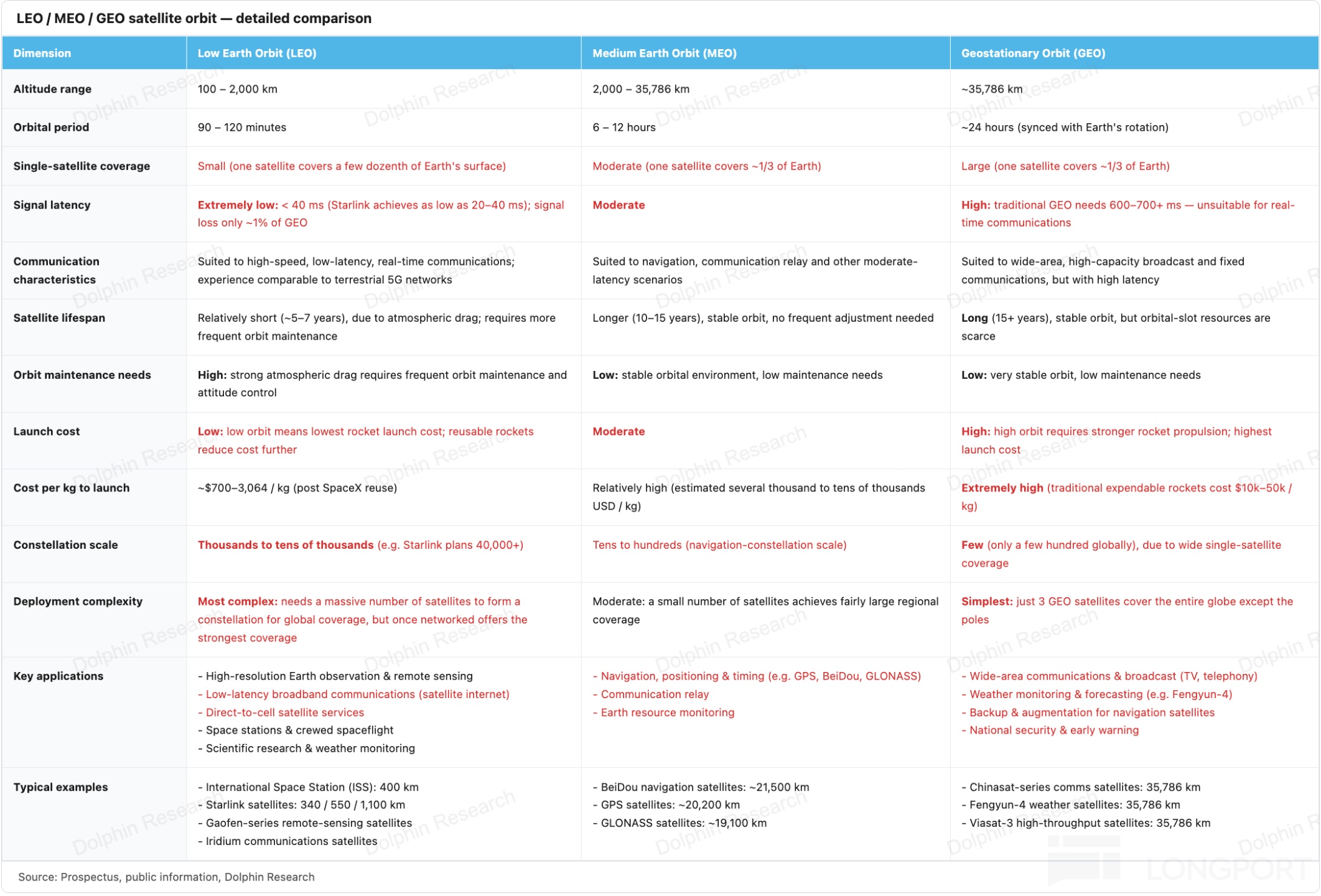
2. Supply/industry coordination: cost barriers persist; payload capacity and business loops are misaligned
a. Absolute launch cost still blocks new demand: Even with Falcon 9’s reusability cutting prices from $10k–$20k/kg to ~+$3,000/kg, it is still expensive for most missions.
Without a step-change to hundreds of dollars/kg or less, space tourism, bio-pharma, and in-orbit manufacturing remain uneconomic. Insurance premiums further raise total cost of use.
Only when fully reusable vehicles like Starship push cost into the hundreds or even tens of dollars/kg — with airline-like turnaround — will rockets become true 'space trucks' and unlock a wave of downstream apps, driving exponential growth.
b. 'Rockets wait for satellites': The bottleneck is payload manufacturing. Despite ample lift capacity, high-value satellites are still largely bespoke or small-batch builds, taking 2–3 years each.
SpaceX has de facto scale advantages in sat manufacturing capacity.
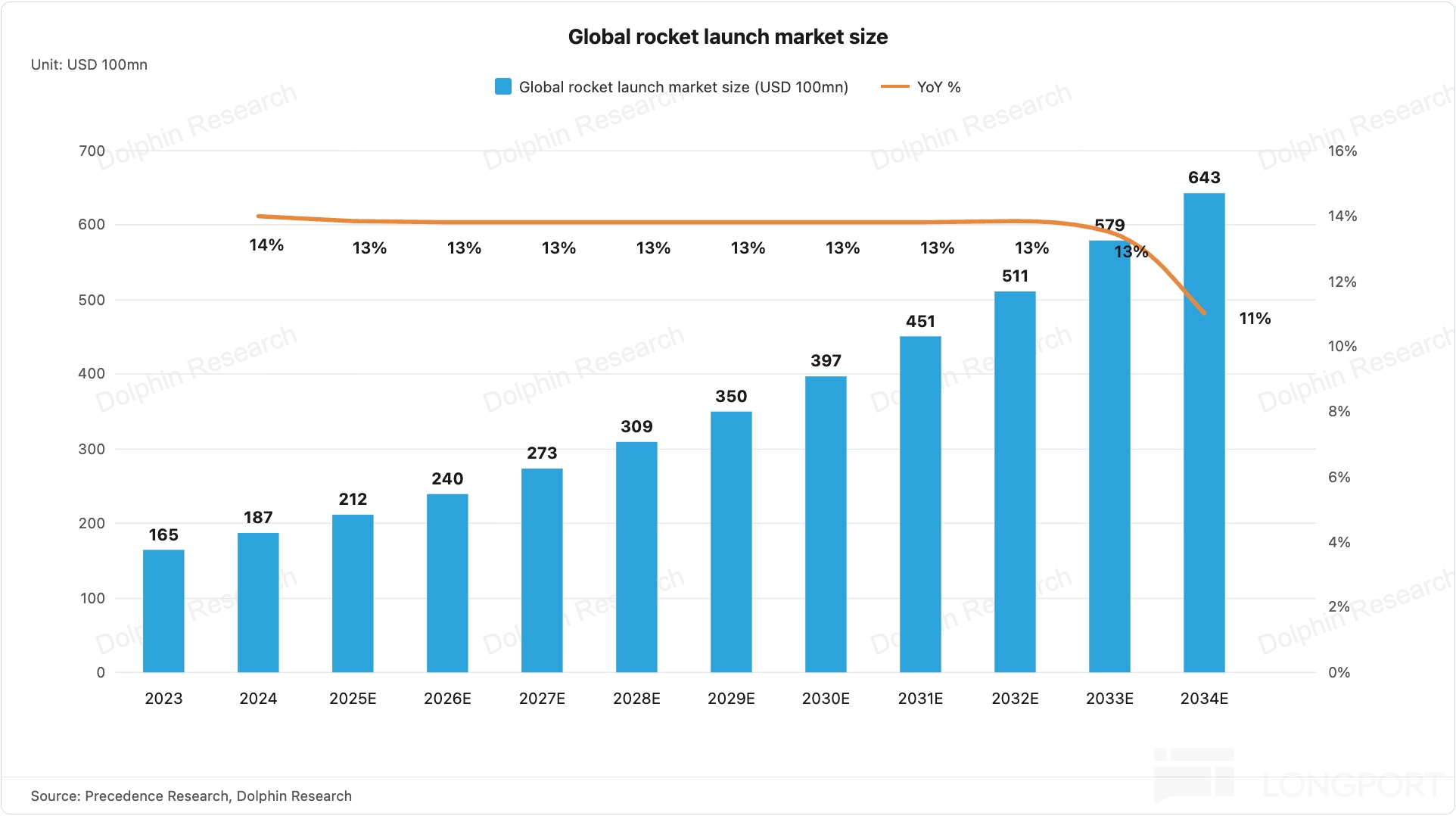
④ Starship — progress and timeline for full reuse on both stages?
Falcon 9 reuse may be near its cost floor at ~$15 mn marginal cost per mission due to the expendable second stage and hard costs for propellants/refurb. To drop orbital cost from ~$700–1,000/kg to sub-$200/kg and enable higher-value layers (Starlink V3, space AI), Starship must achieve full reuse — booster and ship.
Iteration is accelerating. On May 23, 2026, Starship completed its 12th test flight and the first of V3. The flight validated Raptor 3 engines, TPS updates (removing some tiles to gather peak heat data), and the ability to release 20 mock Starlink V3 sats and 2 modified sats in orbit.
The ship achieved a controlled splashdown in the Indian Ocean. The booster failed a multi-engine relight and broke up over the sea, but the mission achieved over 95% of primary objectives, marking a shift from tech validation to capability validation.
Timelines, stage by stage:
Booster recovery: Super Heavy’s launch, recovery, and reflight profile has been proven in prior tests. Expect attempts to resume as soon as flight 13 or 14, with a high probability of success.
Ship recovery: The remaining gate for full reuse. To date, the ship has only executed ocean soft landings; tower capture and refurbishment cycles are outstanding. TPS robustness, re-entry control, and landing precision need several more iterations.
Musk has guided that full reusability is targeted in 2026, with orbital payload services starting in H2-2026. Plan-wise, once validated, Starship will first deploy Starlink V3 (up to ~60 sats per mission; >60 Tbps capacity added per launch; cadence every 2–3 months),
then move to external commercial missions around mid-2027 after 5–6 validation flights. This lines up with expectations for orbital AI compute satellite deployment starting in 2028 — Starship commercialization is a prerequisite for space compute infra.
On costs, fully reused Starship targets $200/kg. That underpins mass Starlink V3 buildout (single-sat capacity ~20x Gen-2; ~60 per flight), space AI data centers (from 2028), and long-horizon Mars work — enabling $10 tn+ categories.
In short, full reuse on Starship is the bridge from today’s capacity leadership to an interplanetary infra platform. It connects the current cash cow to trillion-dollar options and is the key to scaling launch from a ~$10 bn market to a higher order of magnitude.
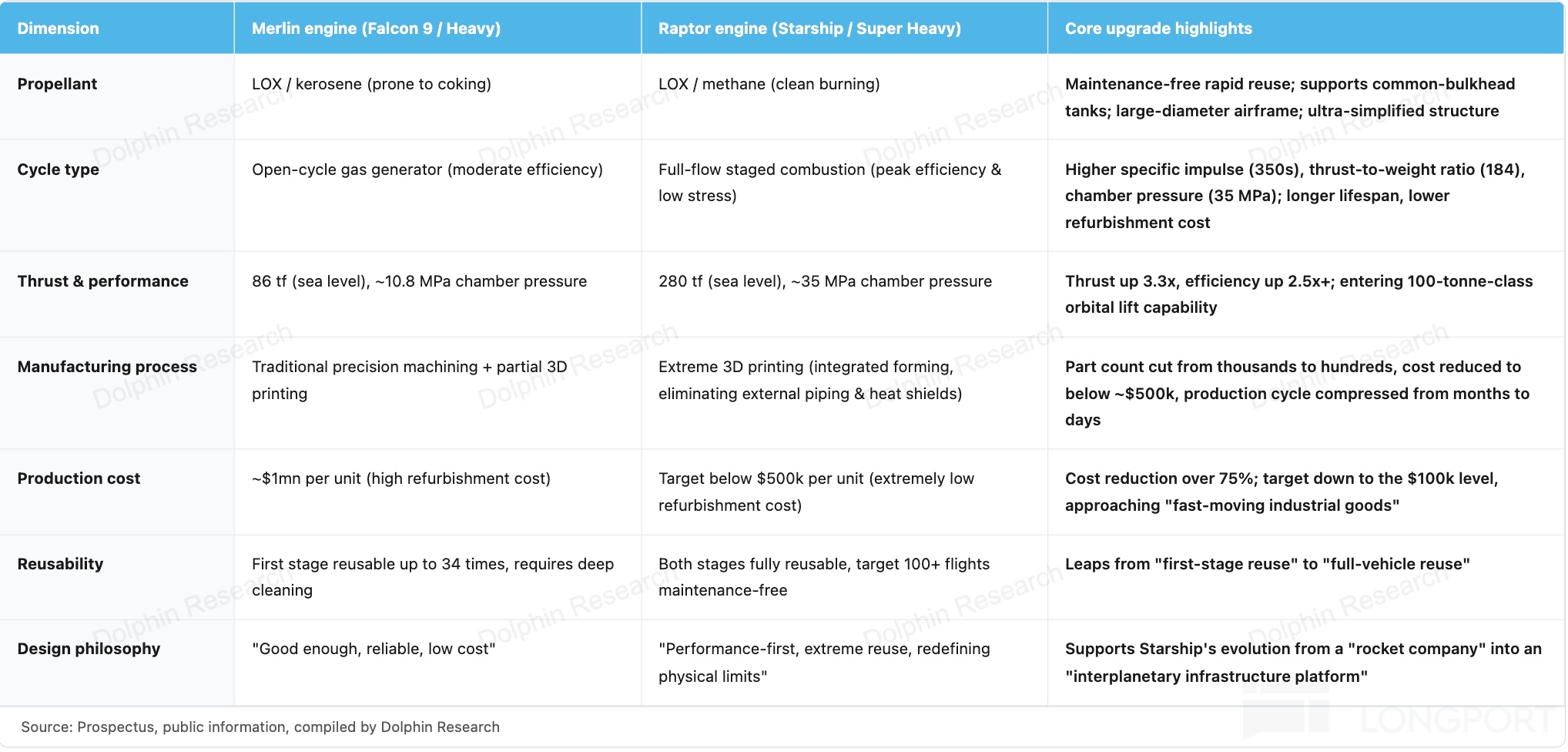
Overall, in space transport, Musk appears to have delivered another asset with no clear peer in sight. We will next deep-dive satellite manufacturing and the communications network. Stay tuned.
<End>
Related reads:
<Rocket Lab: SpaceX’s most dangerous rival?>
<Challengers to SpaceX: Can Bezos and China’s teams catch up?>
<Musk’s 'nuke' again: Can SpaceX truly reshape 'space economics'?>
The copyright of this article belongs to the original author/organization.
The views expressed herein are solely those of the author and do not reflect the stance of the platform. The content is intended for investment reference purposes only and shall not be considered as investment advice. Please contact us if you have any questions or suggestions regarding the content services provided by the platform.
