

SpaceX: AI cash burn persists—Is 'space compute supremacy' the ultimate play?

In 'From Daydreams to Fortunes: Is SpaceX Really That Sci‑Fi?', Dolphin Research noted that among $SpaceX(SPCX.US)'s three pillars (launch, Starlink, AI), AI is the most cash‑intensive yet offers the biggest valuation upside.
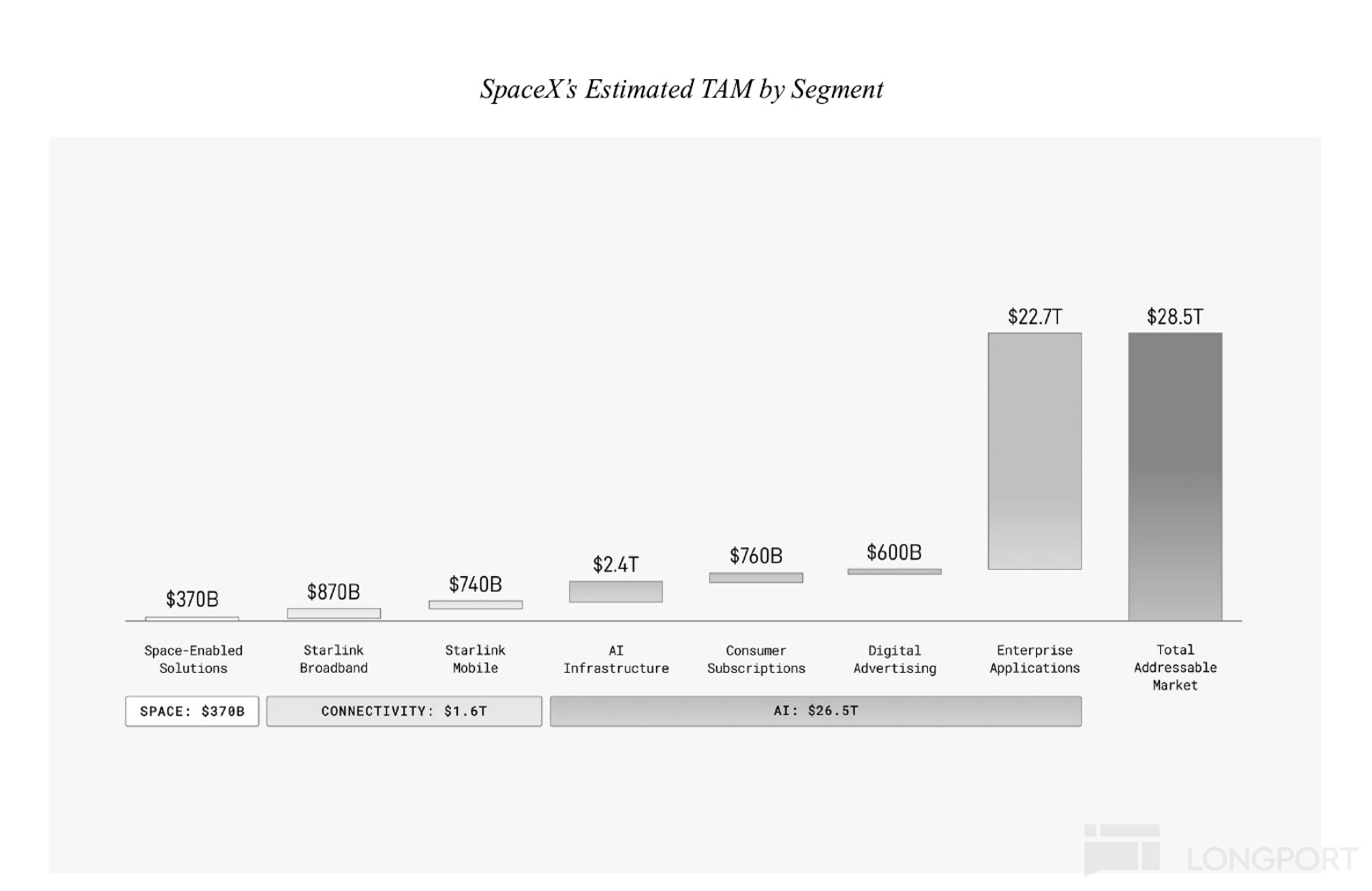
It underpins the shift from a hard‑tech space infrastructure giant to a platform‑level intelligent services provider. It also anchors a total TAM of $28.5TN, of which AI accounts for 93%, with enterprise use cases contributing nearly 80% of that opportunity.
This report drills into the AI stack and addresses five core questions:
1) What are the core modules of SpaceX's AI asset map? 2) Why is X's ad revenue still under pressure despite being the foundational data source?
3) How intelligent is the Grok LLM today and where is monetization? 4) Compute leasing: how long can this unexpected cash‑flow windfall last?
5) Space data centers: sci‑fi leap or a real path to orbital compute dominance?
1) What are SpaceX AI's core modules?
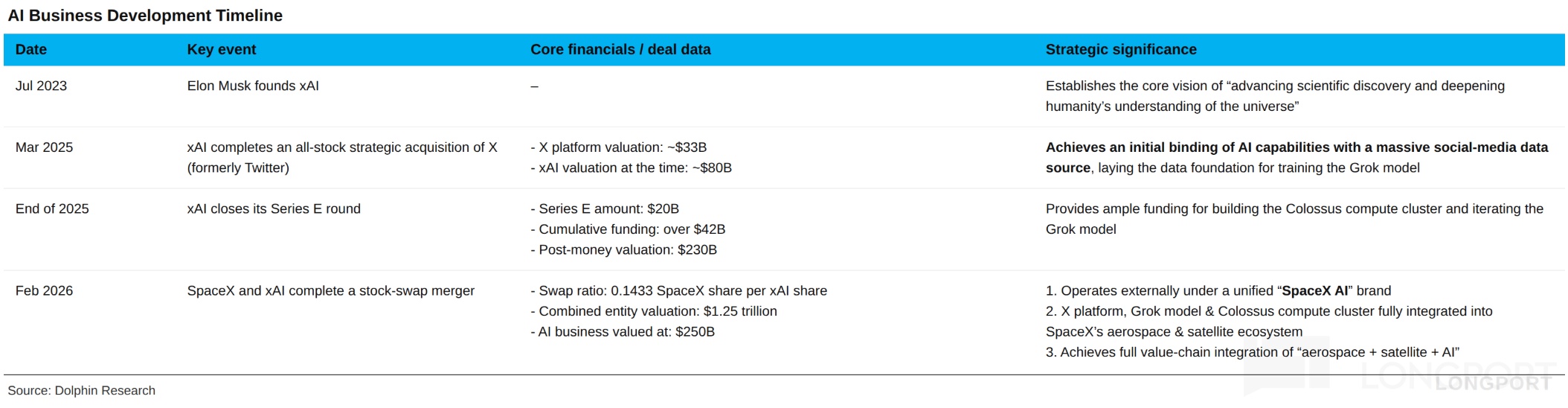
SpaceX's AI biz took shape in Feb 2026 after fully acquiring xAI. The development timeline:
Elon Musk founded xAI in Jul 2023 to advance scientific discovery and understanding of the universe. In Mar 2025, xAI acquired X (ex‑Twitter) in an all‑stock deal, binding data and AI at inception with X valued at ~$33bn and xAI at ~$80bn. By end‑2025, xAI raised a $20bn Series E at a $230bn post‑money valuation.
In Feb 2026, SpaceX and xAI merged via share swap, valuing the combined entity at ~$1.25TN, with AI marked at ~$250bn, and rebranded externally as 'SpaceX AI'. From then, the X platform, the Grok family, and the Colossus compute clusters were integrated into SpaceX's launch and satellite ecosystem.
Following integration, xAI's senior team saw major changes. Michael Nicolls, a veteran Starlink engineering leader, became President of AI, signaling a strategic push to deeply fuse space edge computing with spatial AI.
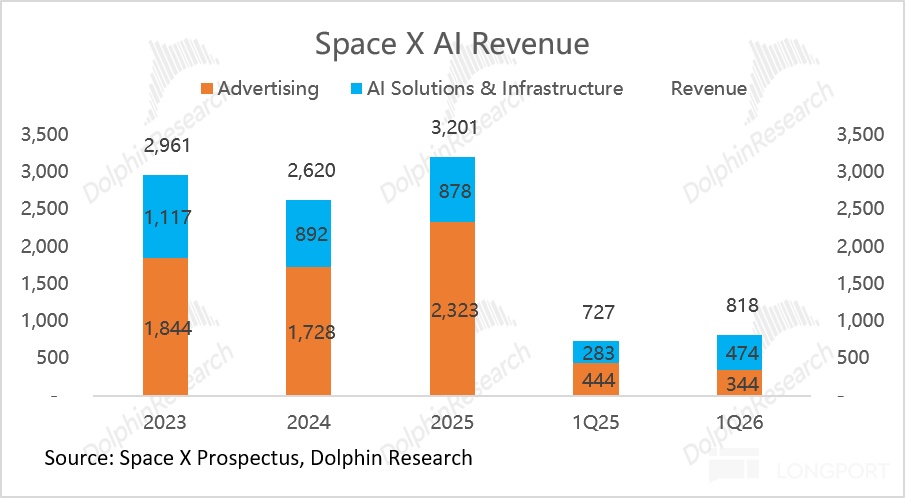
Revenue is split into ads and AI solutions & infrastructure. Ads are from X; AI solutions & infrastructure include: 1) X subscriptions and data licensing; 2) Grok subscriptions and API access; 3) compute infrastructure (Colossus) leasing, which ramped from 2026.
From 2023 to 2025, AI segment revenue grew modestly from $2.96bn to $3.20bn, a 2‑yr CAGR of ~4%. Growth came from AI solutions & infrastructure, up from $0.64bn to $1.36bn (2‑yr CAGR ~46%), while X ad revenue fell from $2.32bn to $1.84bn (~11% avg. annual decline).

We examine four core blocks: (i) X platform; (ii) Grok LLM; (iii) compute leasing (Colossus); (iv) space compute.
2) Why is X's ad revenue under sustained pressure?
Since Musk bought Twitter for $44bn in late 2022, it has been reshaped from a social platform into xAI's data warehouse and distribution channel. On data, ~350mn real‑time posts per day power Grok with a unique, high‑velocity corpus; on distribution, X's 550mn MAUs provide a near zero‑cost funnel, with ~117mn users touching Grok features and ~4.4mn paid X subscribers (~0.8% penetration).
Ad revenue has declined from its 2022 peak due to industry structure and internal retrenchment:
i) Brand‑heavy DNA met a performance onslaught
X, since Twitter days, leaned toward brand ads and awareness. With macro/geopolitical uncertainty, brand budgets are constrained and dollars shift to conversion‑oriented platforms with measurable ROI.
Rivals possess superior conversion stacks:
a) TikTok: dominates on time‑spent, driving sticky ad outcomes. b) Google Search: captures explicit purchase intent in queries.
c) Amazon: owns end‑of‑funnel purchase data, enabling cost‑efficient performance ads. d) Meta: AI‑driven ad tech (e.g., Advantage+, GEM) leads on attribution and conversion.
By contrast, X underperforms on full‑funnel conversion from view to purchase. Compute and R&D shifted to Grok and foundation models, slowing ad‑algo iteration and hurting targeting precision.
ii) Strategy pullback triggered brand flight
In 2023, Musk reallocated resources to AI and cut headcount, notably content moderation, while loosening speech controls, hitting brand safety thresholds. This sparked an exodus as mainstream advertisers paused or exited.
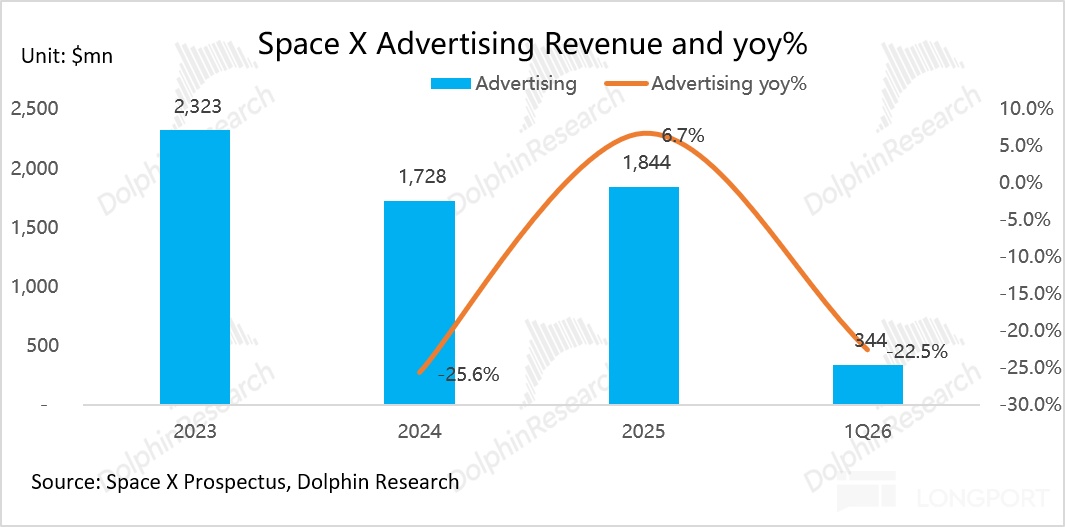
Ad revenue fell 26% YoY in 2024 to $1.7bn. Rebranding to 'X' diluted brand equity and user cognition, and the company booked ~$3.8bn in goodwill and intangibles impairment in 2023; rebuilding trust will take time.
iii) Platform rebuild caused near‑term pain
In Q1 2026, X overhauled its AI ad infra: full auto‑buying, probabilistic attribution, Grok‑driven real‑time brand safety, and a unified ads‑recommendation stack. The aggressive rebuild disrupted sales, with ad revenue down ~$100mn YoY (‑22.6%) to $340mn in the quarter.
Musk ultimately aims to make X an 'everything app' that fuses AI, payments, comms, content, and commerce, shifting from ads‑only to AI‑led multi‑monetization (subs, ads, pay, commerce). Grok would run through the stack to form a data→model→monetize→user flywheel.
In reality, X risks becoming the US version of Weibo: central during breaking news, but daily commercial traffic and engagement are being eroded by rivals, pressuring share.
3) Grok LLM: where are IQ and monetization now?
Grok is xAI's LLM family with a differentiated edge: exclusive access to ~350mn daily X posts. Unlike ChatGPT relying on non‑exclusive partners (e.g., Reddit) or web search, X is the 'first mile' for breaking news.
That second‑level freshness plus exclusive corpus boosts Grok's real‑time data advantage. Commercialization runs on multiple tracks:
To C: bundled to X Premium/Premium+ and offered via a standalone SuperGrok ladder (Lite/Standard/Heavy), while a free tier helps ad value on X. To D: Grok API with usage‑based billing for developers and startups.
To B: For SMBs: a self‑serve, seat‑based SaaS (Grok Business). For mid/large and regulated customers: Grok Enterprise with private cloud/on‑prem, private data connectors, compliance, and custom fine‑tuning.
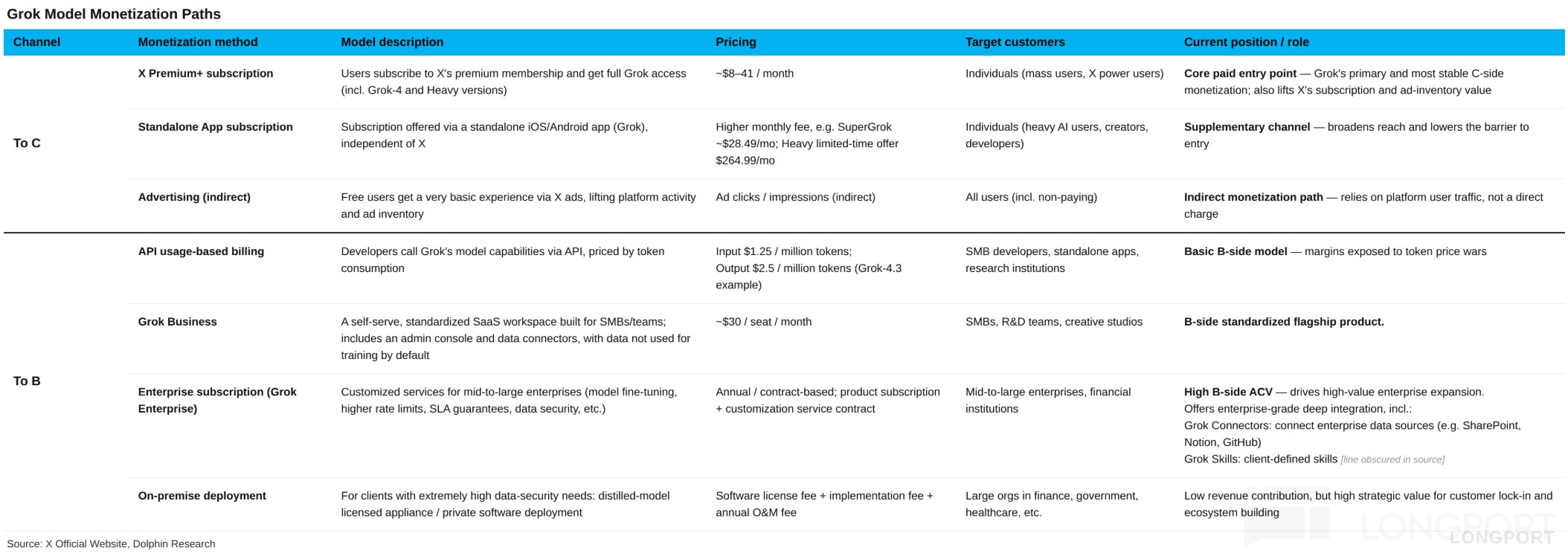
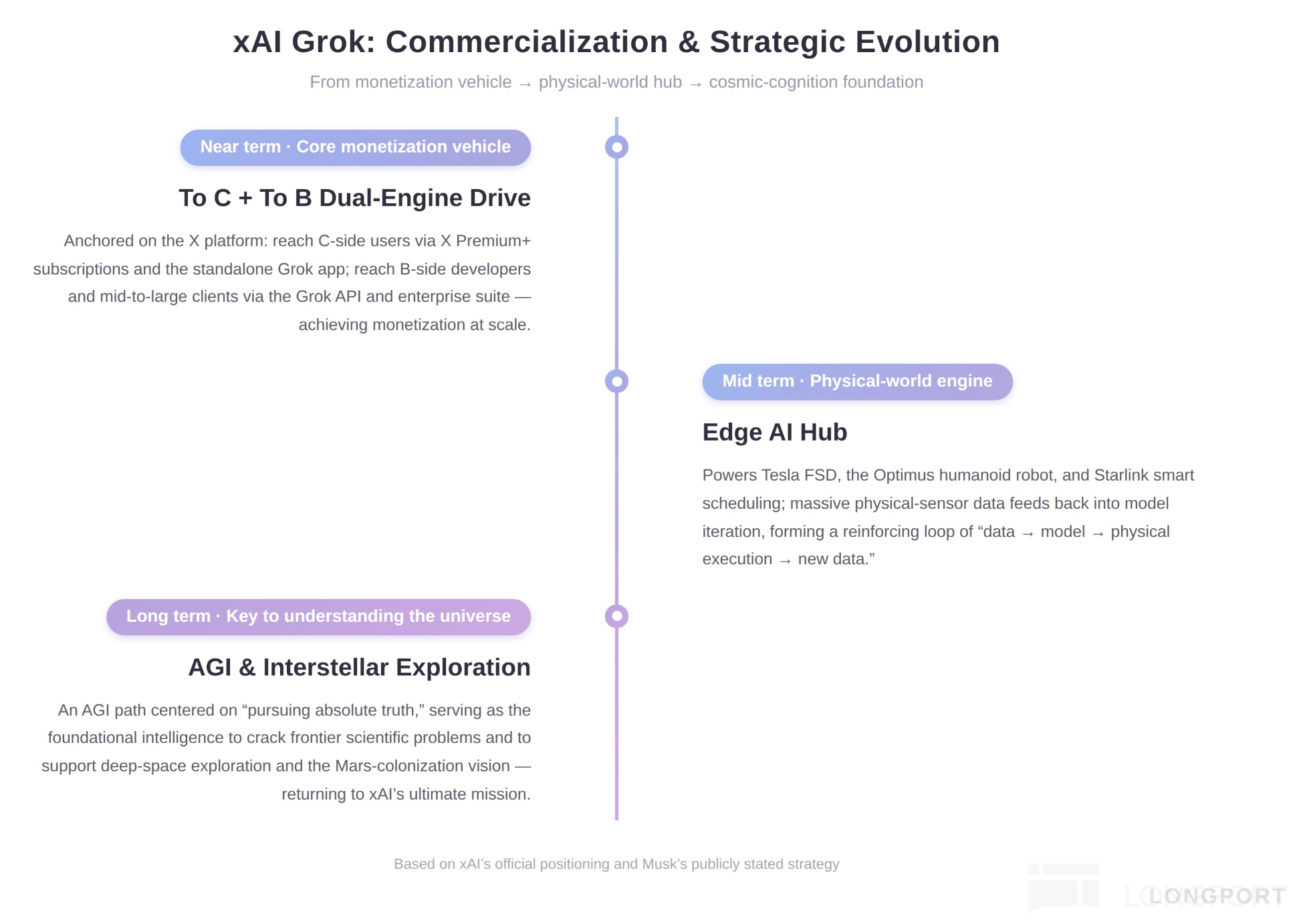
In Musk's broader plan, Grok is the intelligence hub across Tesla, SpaceX, X, Optimus, and Neuralink. Near term, X anchors consumer subs and a Grok app, while Grok API/Enterprise reach developers and B2B; mid‑term, Grok becomes the on‑device/edge AI core for Tesla FSD, Optimus, and Starlink network orchestration.
Longer term, Grok would serve as the base intelligence for frontier science, deep space exploration, and Mars colonization. That is Grok's 'end mission'.
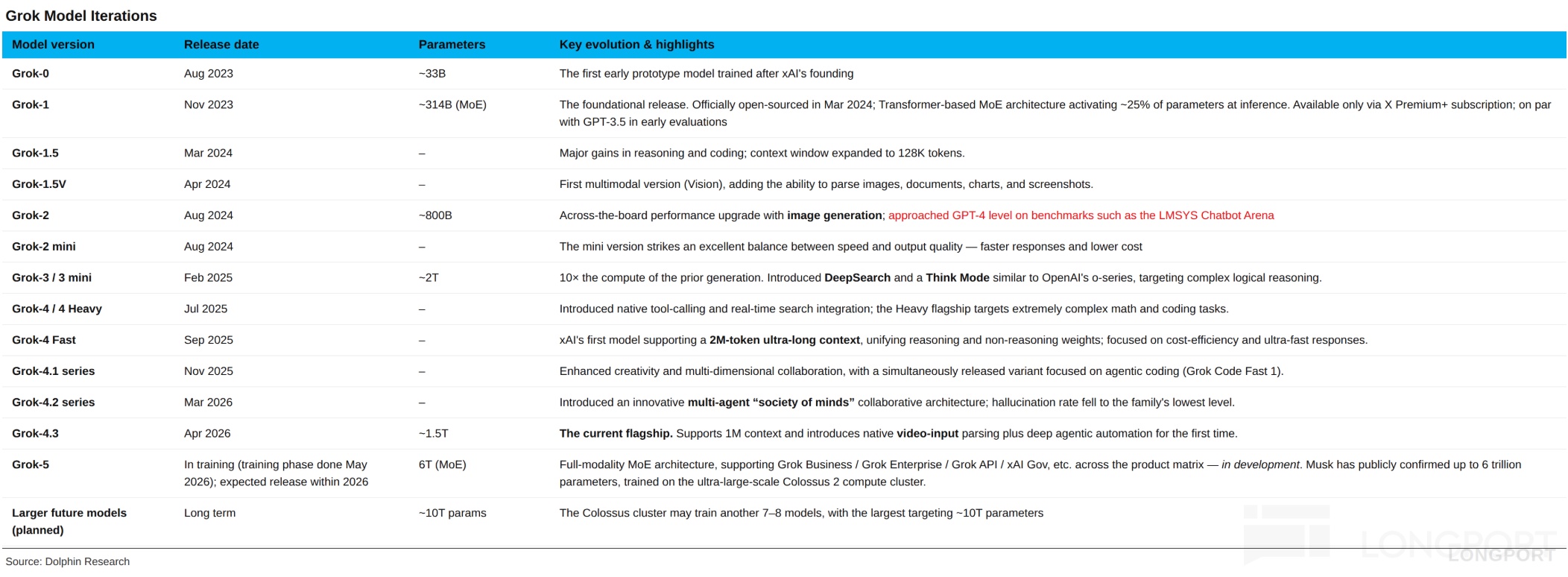
Ambitions aside, Grok still trails first‑tier models from Anthropic and OpenAI on composite metrics, playing catch‑up.
Since xAI's launch in Jul 2023, Grok iterated from 1 to 4.3 in under three years, a 4‑5 month major‑version cadence. Fast iteration, however, is not the same as leadership:
Base IQ lags materially: Grok 4.3 scores ~38 vs. Claude Fable 5 and GPT‑5.5 at far higher levels, and has been overtaken by value leaders like GLM‑5.2 and DeepSeek V4 Pro. This signals stalled core capability gains.
Code and agent gaps cap B2B monetization: despite niche wins (e.g., telecom τ²‑Bench), coding (~42.2) and agent (~24.1) indices are well below leaders (74+ and 45+). It struggles with planning and executing complex tasks.
This weakens fit for high‑value enterprise use cases such as workflow automation, CX agents, and dev copilots, lagging OpenAI and Anthropic in commercialization. Key edge: ultra‑low latency and value pricing
With first token latency ~13.7ms and end‑to‑end speeds far faster than GPT‑5.5's ~82s, plus API at ~$1.25–$3 per mn tokens, Grok is compelling for real‑time interaction. As such, Grok is an engineering‑centric model focused on speed and value, not a pure AGI frontier leader.
It works well for C‑side chats and light B‑side tasks (QA, summarization). But it trails on complex code, multimodal generation, and end‑to‑end enterprise automation.
B2B is where value and moats accrue: higher ARPU, heavy token usage, and high switching costs once embedded in core workflows. Enterprises pay for best‑in‑class accuracy, not just low price or speed.
Grok's skills are misaligned with B2B needs: enterprises want low hallucination, high precision, and auditability. Weak base IQ and coding limit adoption in automation‑heavy, high‑value scenarios.
Labor substitution and efficiency gains from top models dwarf price diffs, so buyers pay for top intelligence. Why haven't 1GW+ of GPUs and X data translated into model leadership? Likely gaps in algorithms, data mix, and org culture:
a) Hitting a 'just add compute' wall; inefficient RL:
Grok's code weakness suggests a compute ceiling. With ~half compute on RL, subjective code quality and poor auto‑grading make reward signals noisy and RL inefficient vs. SFT.
Compute cannot replace high‑quality supervision. To break IQ limits, xAI needs algorithmic upgrades: SFT+RL to reduce blind exploration, and quant metrics plus RLHF to supply clear reward signals (e.g., memory, time, compile success).
b) X data are consumer‑skewed and light on B2B corpora:
Great for consumer hot topics, but short on high‑quality code, complex reasoning, and structured knowledge (cf. StackOverflow, arXiv). High‑quality coding needs a generate→run→feedback→fix loop, where rivals like Anthropic leverage proprietary dev tools to build a flywheel.
Grok arrived late to coding toolchains and lacks sustained, real feedback data. c) Org culture: engineering‑led
Setbacks are not only technical. Since Feb 2026, ~half of xAI's founding and core training staff have left, disrupting frontier iteration.
As Starlink‑bred leaders took over, SpaceX's strong engineering culture now steers xAI. That boosts deployment speed and value economics, but may curb the exploratory freedom needed for AGI research.
Frontier LLMs demand massive opex/capex, creating diseconomies of scale: each gen costs hundreds of millions, with a monetization window ~1 year, and the next gen costs often doubling. For SpaceX AI:
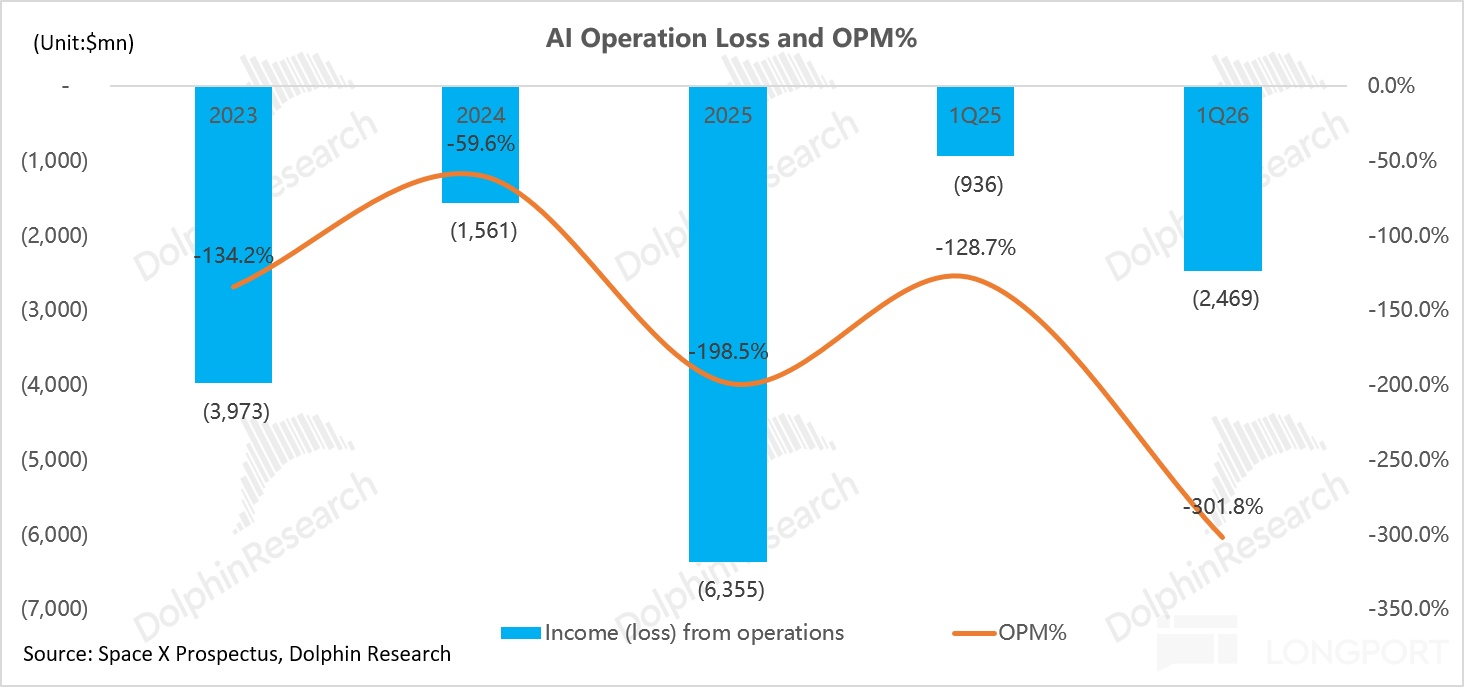
OP is under heavy pressure: in 2025, segment revenue was ~$3.2bn, while standalone R&D hit ~$5.1bn (~1.6x revenue). Total opex drove an OP loss near ~$6.4bn (OPM ~‑200%).
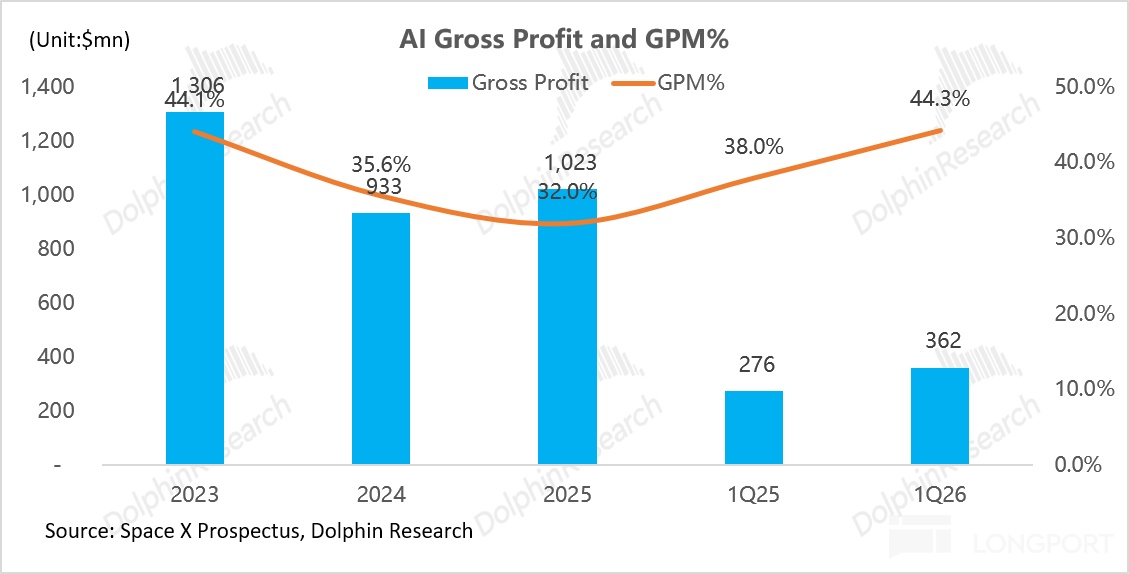
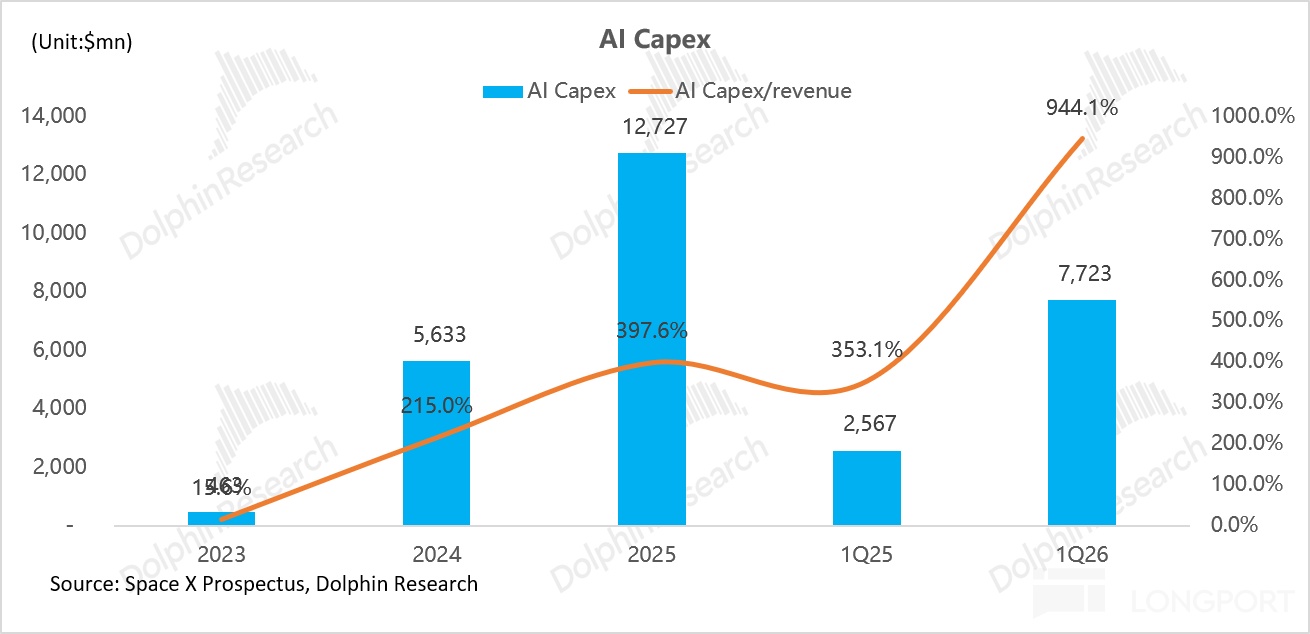
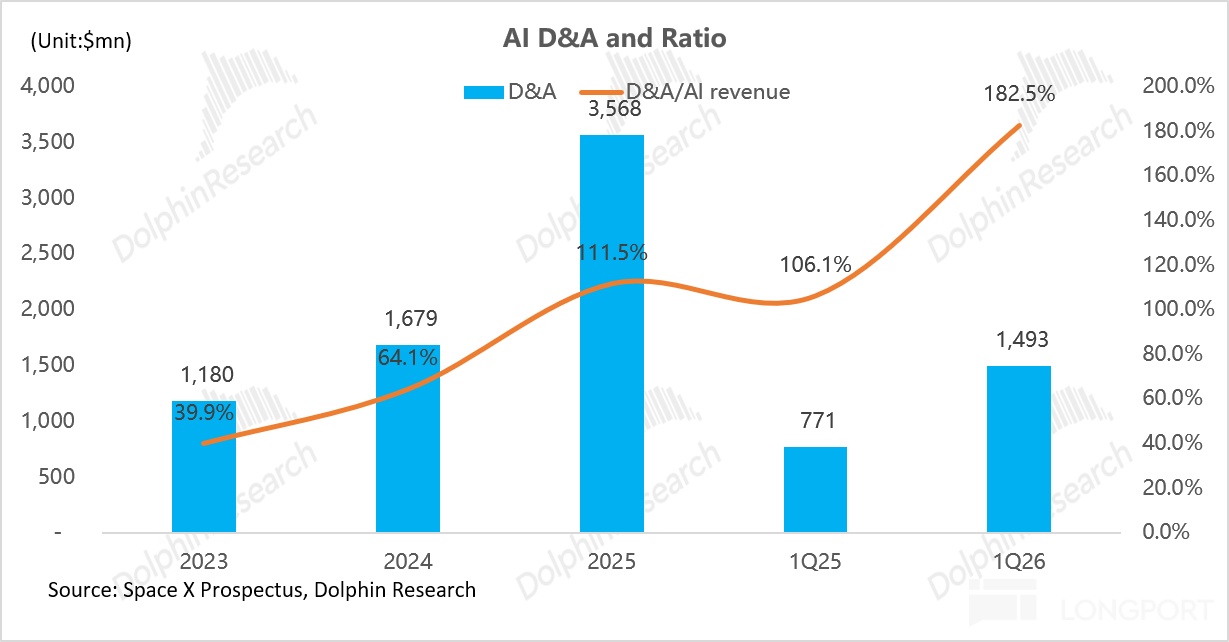
Capex drives cash strain: 2025 AI capex was ~$12.73bn (~61.4% of SpaceX total), ~4x segment revenue. D&A was ~$3.6bn, meaning current revenue (~$3.2bn) cannot cover depreciation alone; AI relied on cross‑subsidy (notably ~$4.4bn profit from Starlink) and external funding.
The root is Grok monetization lagging investment:
C‑side scale mismatch and low pure‑AI paid mix: by Mar 2026, Grok had ~6.3mn paid users, but ~4.4mn were X social subs with Grok as a perk. Only ~1.9mn paid for SuperGrok, with ARR of ~$1bn.
By comparison, OpenAI, also consumer‑led, had >50mn paid users and ARR >$25bn. The gap is stark.
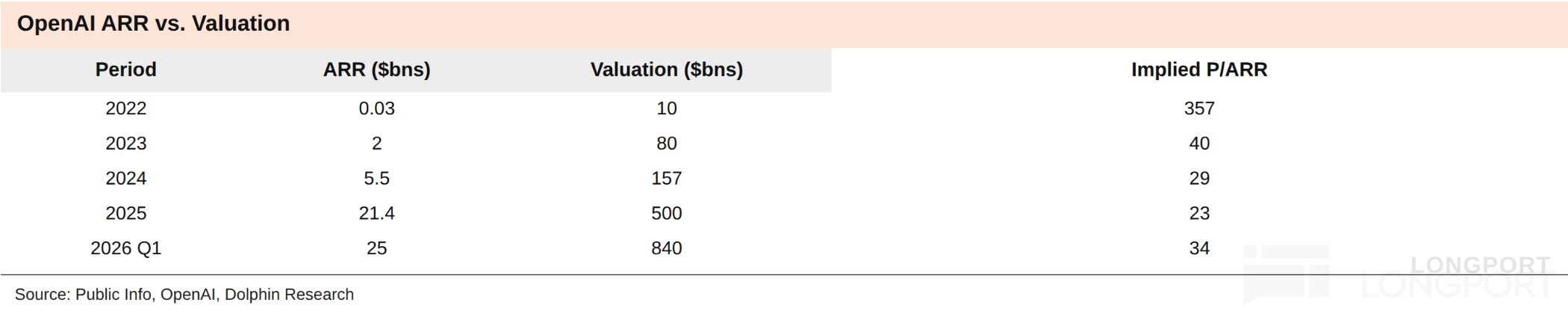
B‑side was late: Grok Enterprise/API only launched at end‑2025, far behind the mature ecosystems of OpenAI and Anthropic. To bridge investment vs. monetization, xAI pivoted from model‑only to a dual engine: model monetization plus compute leasing.
4) Compute leasing: how long can the cash‑flow windfall last?
Leasing was not the original plan; it emerged from a technical bind and Grok's delay:
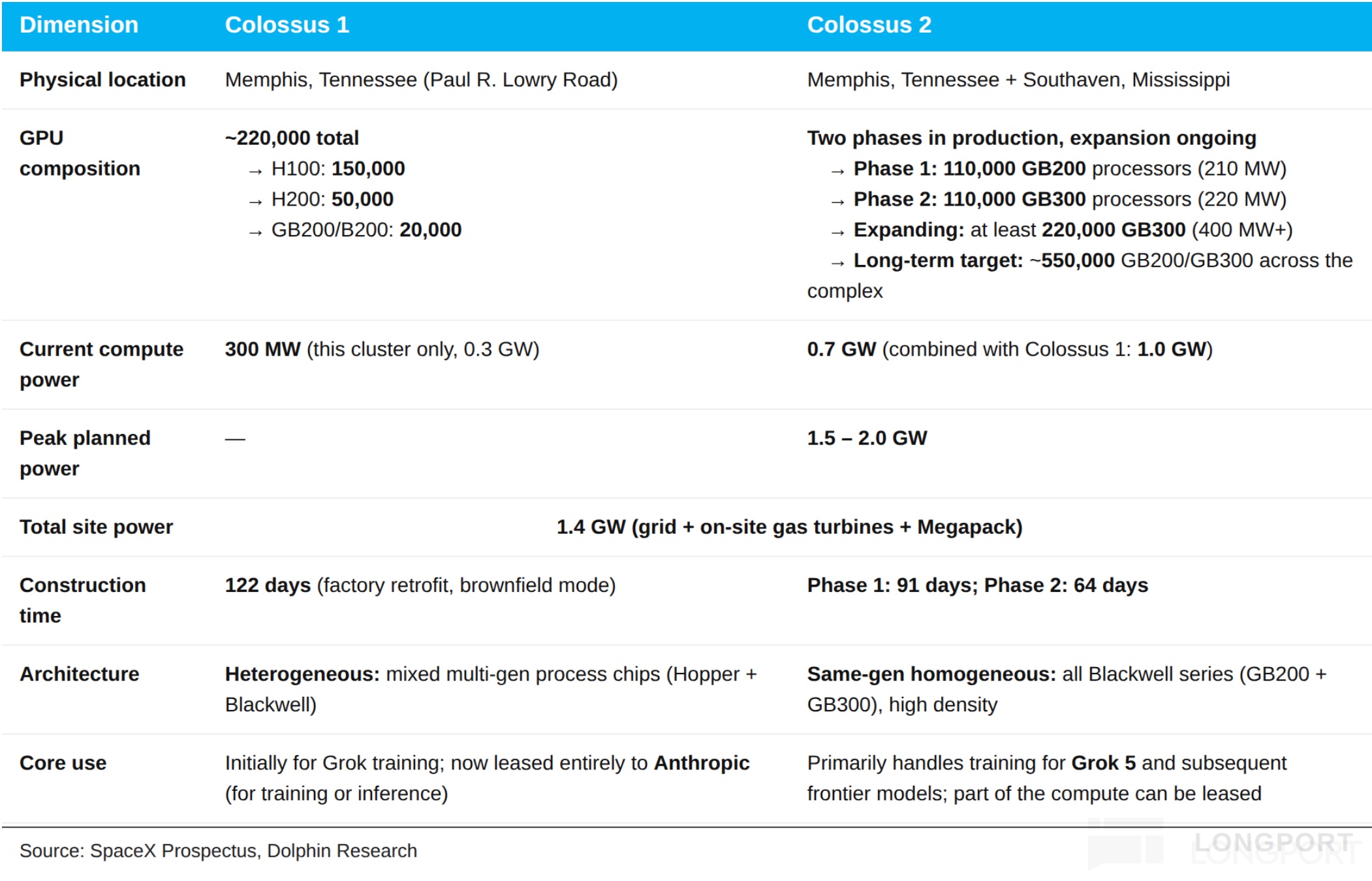
xAI's compute backbone is the Colossus supercluster in Memphis. By Q1 2026, its pure compute load (GPUs and racks, excl. cooling/power overhead) reached ~1.0GW across Colossus 1 and 2.
Colossus 1: a heterogeneous cluster with ~150k H100, 50k H200, and 20k GB200, totaling 220k+ GPUs. Pure GPU TDP sums to ~164MW, rising to ~300MW at the rack/server/network level.
Initially used for Grok training, its mixed generations caused a bucket effect in distributed training, with MFU at ~11% vs. >40% for top peers, making it unsuitable for 6T‑parameter‑class Grok 5. xAI migrated core training to the homogeneous Colossus 2 and leased all of Colossus 1 plus part of Colossus 2 to Anthropic, likely for inference.
Inference has looser sync requirements than training, fitting a heterogeneous cluster. It also reflects Grok's lag and lower self‑inference demand.
Colossus 2: a highly homogeneous cluster built in phases: ~110k GB200 in phase 1 (~210MW) delivered far faster than industry norms, and ~110k GB300 in phase 2 (~220MW), with further expansion planned. By Q1 2026, Colossus 2 ran at ~700MW.
It targets >550k GB200/GB300 chips over time and is the training bed for Grok 5 (expected Jun–Jul launch) and beyond.
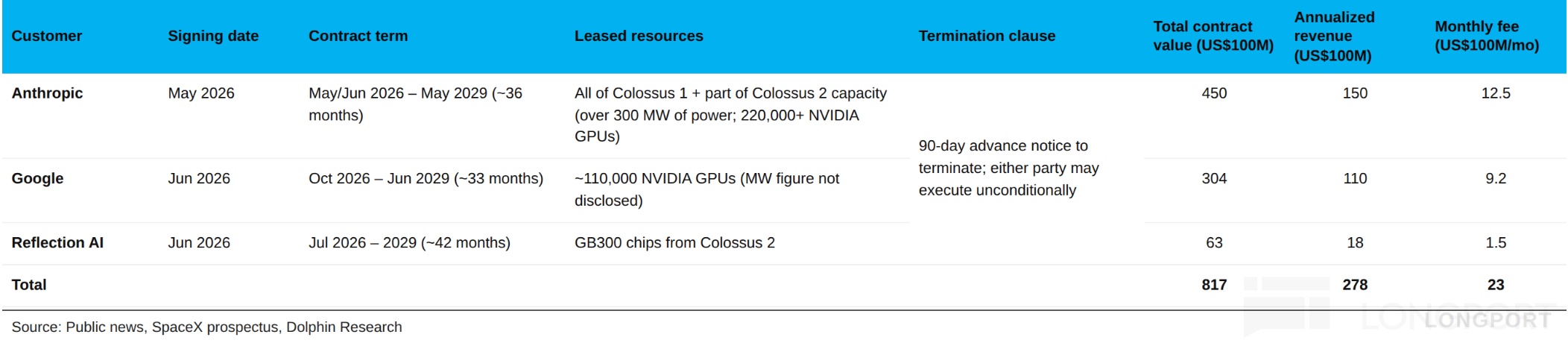
On customers, SpaceX favors a few mega single‑tenant deals over long tails:
i) Anthropic (ARR ~$15bn): signed May 2026, total ~$45bn, leasing ~300MW from Colossus 1 (inference assumed), through May 2029. This is the core revenue pillar.
ii) Google (ARR ~$11bn): signed Jun 2026, total ~$30.4bn, access to ~110k GPUs (GB200/GB300) for AI services. iii) Reflection AI (ARR ~$1.8bn): signed Jun 2026, total ~$6.3bn, using GB300 capacity on Colossus 2.
These three alone add ~$27.8bn of ARR. For context, total AI segment revenue in 2025 was ~$3.2bn (with ~60% from X ads and only ~$1.3bn from AI solutions/infrastructure), making compute leasing the fastest‑growing and largest sub‑segment in 2026.
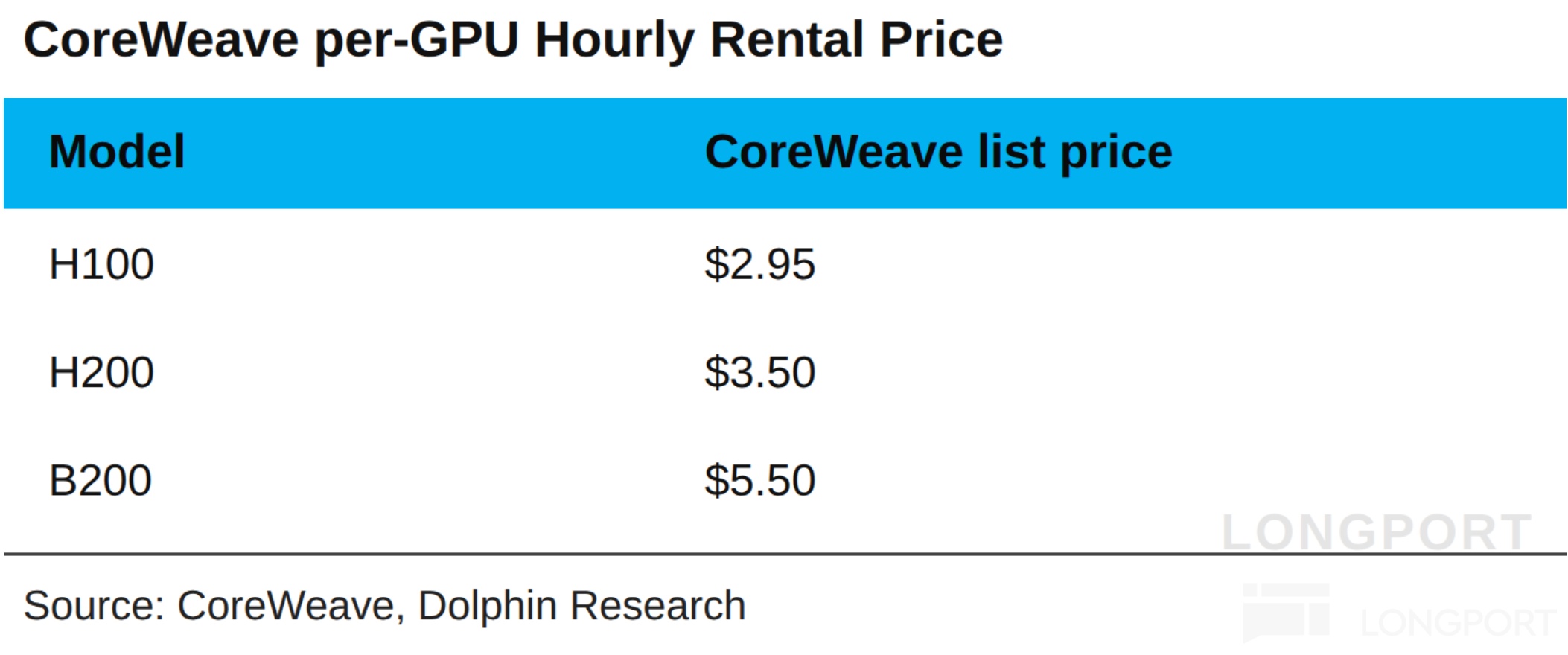
xAI has not disclosed detailed pricing, but deals with Anthropic and Google imply extraordinary premiums vs. industry:
a) GW‑level ARR well above peers
Anthropic deal math: at ~$15bn ARR for ~330MW IT load (servers/racks only), with Colossus 1 mostly air‑cooled H100/H200, typical PUE ~1.3–1.5 implies ~430–495MW facility power. This suggests ~$30–35bn ARR per GW facility load, noting the contract also taps some Colossus 2 capacity.
Cross‑check: Google deal:
Assuming 110k GB300 at ~1,400W each, IT load ~220MW. L2L liquid cooling PUE ~1.1–1.2 implies ~242–264MW facility load, or ~$41.6–45.5bn ARR per GW.
By contrast, neocloud bare‑metal runs at ~$10bn/GW, while full‑stack CSPs are ~+$15bn/GW. Either way, xAI pricing is far above industry averages.
Given Anthropic and Google have strong proprietary stacks, xAI is effectively selling bare‑metal compute rather than high‑value software ecosystems.
Colossus 1 is also largely prior‑gen H100/H200. Bare metal plus prior‑gen hardware should not command such premiums, unless for three reasons:
i) Scarcity: few GW‑scale inference clusters
Colossus is among the very few GW‑scale clusters in operation. Inference at the frontier needs low latency and high throughput, and multi‑region small clusters hit network bottlenecks.
Colossus 1 solved power and network storms at tens of thousands of nodes within one campus (InfiniBand/Spectrum‑X), making it a scarce asset. ii) Time premium: ready‑to‑use vs. long‑dated buildouts
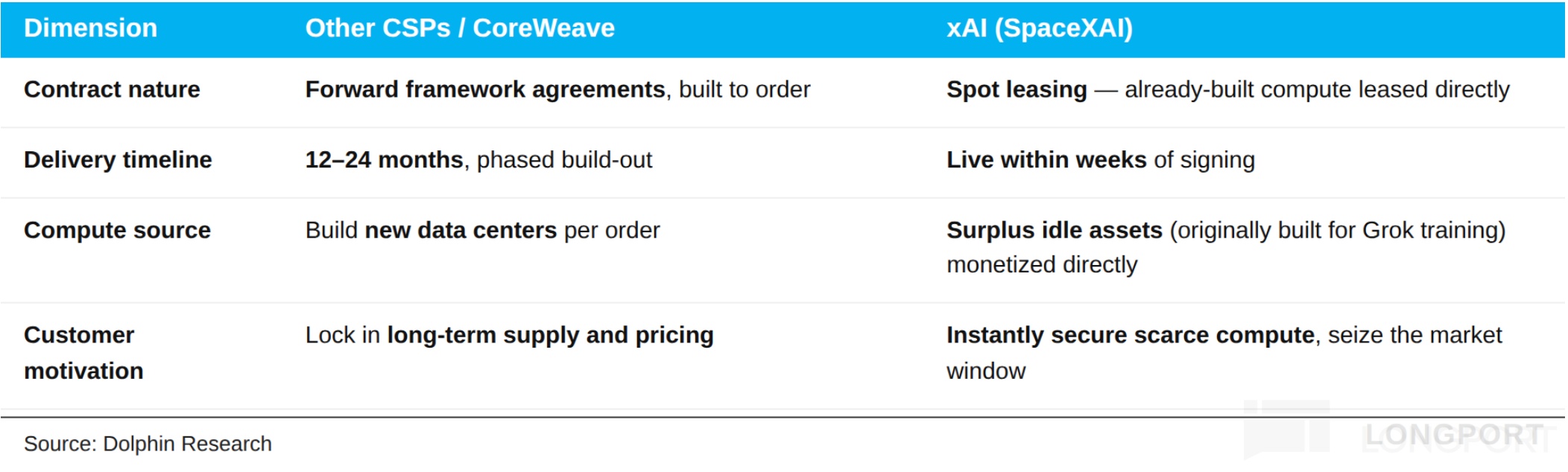
Speed to compute is life in the AI land‑grab:
Go‑to‑market lead: clouds need 12–24 months post‑contract to build, while Colossus 1 is live and ready. Clients pay for a 6–12 month head start; e.g., post‑deal, Anthropic doubled Claude Code quotas and loosened peak throttling and Opus API limits.
Supply certainty: xAI builds at breakneck speed (C1 in 122 days; C2 phase‑1 in 91 days vs. industry 1–2 years), offering valuable certainty for future expansions in a capacity‑constrained market.
iii) Risk transfer premium: the 90‑day termination clause
Typical long‑lock contracts (3–5 years, non‑cancelable, heavy prepay) leave hardware obsolescence risk to customers. Here, both Anthropic and Google can terminate with 90 days' notice, shifting GPU generational risk to xAI.
To compensate, xAI must charge above‑market rates to cover this risk window; if a deal lasts 3 months, not 3 years, much of the payback must be front‑loaded. The premium functions like insurance for a flexible exit and tail‑risk protection.
On costs, while SpaceX has not broken out 1GW capex detail, cumulative AI capex of ~$26.5–30.0bn from 2023 to Q1 2026 implies ~1GW mixed compute deployed (~0.3GW H100/H200 and ~0.7GW GB200/GB300).
Versus $40–60bn to build a 1GW state‑of‑the‑art AI DC (e.g., Vera Rubin/GB300), xAI is well below. Advantages include brownfield retrofits, Megapack storage over diesel gensets, vertically integrated power/cooling/network, and modular standards.
a) Facility 'shell' costs at ~1/3 industry: per Oppenheimer, ~$3mn/MW (~$3bn/GW) vs. ~$10mn+/MW (~$10bn+/GW) industry. b) Likely lower GPU unit costs: privileged NVIDIA supply and potential discounts given scale and rapid deployments.
Near term, this is highly profitable: sub‑industry capex with 3–4x industry pricing locks in outsized margins on scarce assets and risk‑premium terms.
But sustainability is constrained: i) 90‑day termination means mega deals can vanish; ii) as supply/demand re‑balance in 2027/28, premiums compress. This is a scarce‑window windfall, not a perpetuity.
5) Space data centers: sci‑fi or orbital compute dominance?
SpaceX is running a dual‑track strategy: near‑term ground DCs, long‑term orbital data centers. Near term: Colossus II as the ground cornerstone
As the first GW‑scale AI supercomputer, Colossus II went live in Jan 2026, targeting 1.5GW in 2026 and 2GW by 2027 (~555k GPUs). Operating such clusters not only enables leasing revenue, but also builds the end‑to‑end engineering playbook for space.
Long term: orbital compute beyond grid constraints
To bypass grid and land bottlenecks, space is viewed as the best path to hyper‑scale in the next four years. Deployment timeline:
First‑gen orbital AI satellite 'AI1' with 70m wingspan, ~120kW avg. power and 150kW peak, targets scaled commercial constellations starting 2028. 2028–2030: leveraging Starship high‑frequency heavy lift (V3: 100t to orbit, V4: 200t; long‑term 10k ships/launches per year) and Texas Terafab (2nm, 1TW/yr target compute output, ~80% for space), SpaceX aims to ship ~1mn tons of compute hardware to orbit annually.
At ~100kW per ton, that implies ~100GW annual orbital compute adds by 2030–2031, with a long‑term goal of 1TW (1,000GW). For comparison, global CSP AI compute is ~30–50GW today, meaning annual orbital adds alone could recreate 'global cloud' capacity each year.
From leasing out compute to fund itself, to attempting to reshape the global compute map with a mega‑constellation, SpaceX is making one of the boldest bets ever.
Are space data centers technically and economically viable, and how should such a giant be valued? We will explore this in the next report. Stay tuned.
<End>
SpaceX history series:
<SpaceX: Will the Sky Net Become Unstoppable?>
<'From Daydreams to Fortunes: Is SpaceX Really That Sci‑Fi?'>
<SpaceX Challengers: Can Bezos and the China Contingent Catch Up?>
<Musk Plays Another Trump Card: Can SpaceX Redefine the Economics of Space?>
The copyright of this article belongs to the original author/organization.
The views expressed herein are solely those of the author and do not reflect the stance of the platform. The content is intended for investment reference purposes only and shall not be considered as investment advice. Please contact us if you have any questions or suggestions regarding the content services provided by the platform.
