
D
Jul 16 at 11:23 AM
TSM (Trans): FY growth 40%+; capex hike remains prudent.
Below is Dolphin Research's transcript of TSM FY26 Q2 earnings call; for our take, see Did not get the blowout we hoped for — 'good enough' as TSM falters as the AI bellwether?.
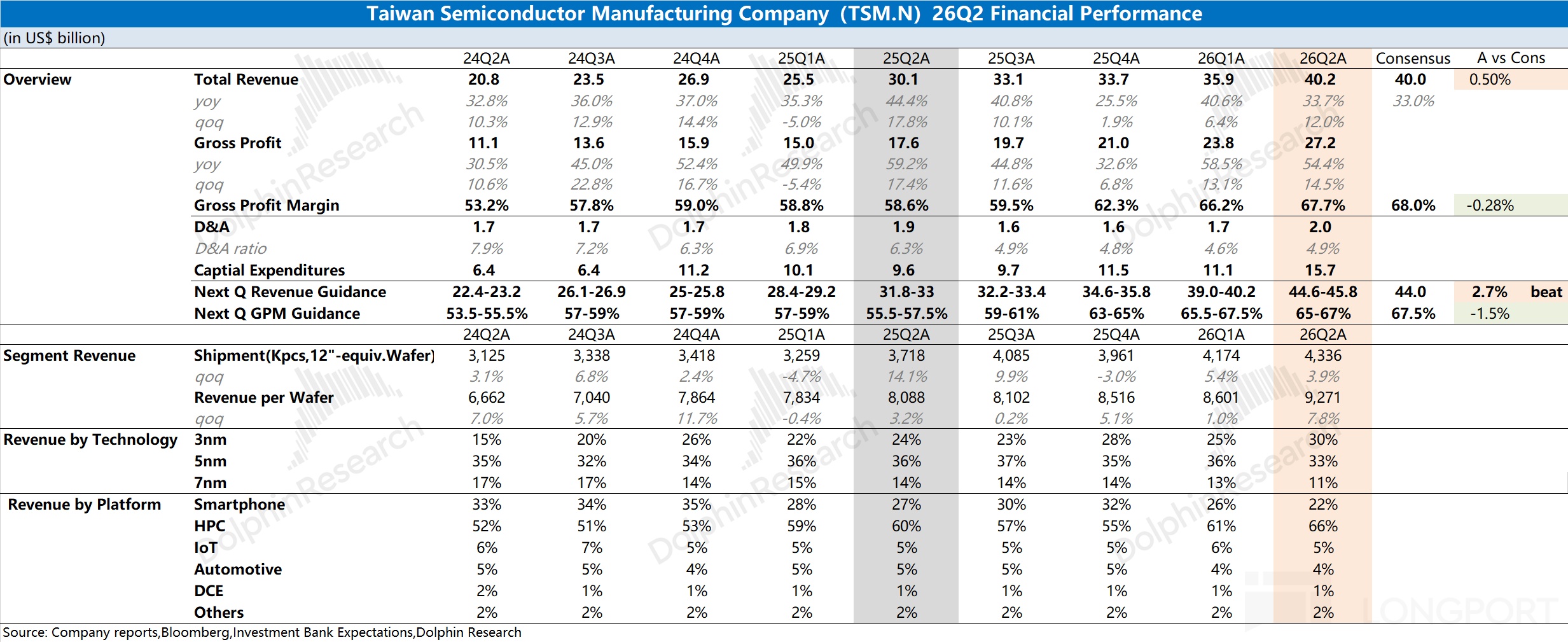
I. TSM FY26 Q2 headline recap
1. Shareholder returns: Cash dividends totaled TWD 467 bn in 2025 (+28.6% YoY), or TWD 18 per share for the year. Per-share dividend will rise to TWD 24 in 2026 (+33% YoY), and management committed to further increases in 2027 with a steady annual and quarterly payout trajectory.
2. Q3 guide: Revenue of $44.6bn–$45.8bn, with the midpoint implying +12% QoQ and +37% YoY, on an FX assumption of USD/TWD 32. GPM at 65%–67% and OPM at 56%–58%.
3. Full-year outlook: Management raised 2026 USD-reported revenue growth to 'slightly above 40%' (from 30%+). This reflects stronger AI-driven demand across advanced nodes.
4. GPM trend: Q2 GPM rose 150bps QoQ to 67.7%, slightly beating guidance, driven by cost improvements and a modest uptick in utilization, partly diluted by overseas fabs. For Q3, midpoint GPM is guided down 1.7ppt to 66%, mainly as the steep N2 ramp dilutes margins by ~3–4%; overseas ramps dilute 2%–3% in early phases and 3%–4% later.
5. Capex: 2026 capex was raised to $60–64bn (vs. Jan guide ~$52–56bn and Apr ~$56bn), with ~70%–80% for advanced nodes, ~10% for specialty, and ~10%–20% for advanced packaging, test and mask. Q2 capex was ~$15.7bn; quarter-end cash and marketable securities were TWD 3.5 tn (~$110bn); inventory days rose 7 to 87 on the N2 ramp.
II. Call details
2.1 Management commentary
1. Demand and end-market
a. Q2 revenue landed at the high end of guidance, driven by strong advanced-node demand. Q3 will remain supported by advanced nodes, including a continued N2 ramp.
b. Consumer and price-sensitive segments face pressure from component cost inflation and China macro uncertainty. The company remains prudent in its business assessment.
c. AI-related demand is exceptionally strong, with the secular AI trend continuing to drive compute needs. Signals and outlook from CSPs and their downstream customers are very positive, underpinning high confidence in multi-year AI growth.
2. Agentic AI
a. The rise of Agentic AI brings CPUs back into a central role in AI data centers, driving incremental silicon demand beyond AI accelerators. This broadens the compute mix.
b. Regardless of CPU architecture (x86, ARM, RISC-V), most suppliers are TSM customers. TSM is working closely with them, offering leading technology and capacity to capture the Agentic opportunity.
3. Capacity expansion and global footprint
a. An additional $100bn will be invested in the U.S., taking cumulative investment to about $265bn for multiple 2nm-and-below logic fabs and advanced packaging to support long-term demand from major U.S. customers. TSM expects to add roughly four more fabs.
b. Over the next few years, TSM will build 13 advanced-node and advanced-packaging fabs in Taiwan, continuing to scale local investments. These will underpin long-term capacity needs.
c. N3 expansion: three new 3nm fabs globally (one each in Taiwan, Arizona and Japan), and continued conversion of 5nm tools to support 3nm. Wafer output will also grow via cross-node optimization (flexible allocation across N7/N5/N3) and higher per-fab productivity.
4. Mature-node strategy
a. Strategy unchanged: prioritize full customer support and keep expanding mature capacity in high value-add niches, not cutting it. Focus is on differentiated segments.
b. Additional mature-node capacity will come via JASM in Japan (CMOS image sensors) and ESMC in Germany (auto and industrial). These address targeted demand.
c. Outside PMICs and CIS and a few other niches, commoditized mature-node demand is not strong. TSM will focus on high value-add and strategic sub-sectors.
5. Advanced-node roadmap (A14 and derivatives)
a. The cycle from R&D to capacity build and HVM for new technologies has stretched to 5–7 years. There is no shortcut.
b. A14, TSM's 2nd-gen nanosheet, delivers 10%–15% speed at iso-power or 25%–30% power reduction at iso-speed vs. N2, with ~20% density gain. R&D is on track, with internal product yield demos near 90% and 256Mb SRAM yield near 90%; customer interest is strong across smartphones and HPC/AI, with tape-outs leading, pre-production in 2027 and HVM in 2028.
c. Derivatives A13 and A12: A13 achieves >6% area savings via optical shrink with partial backward-compatible design rules for smooth IP migration; A12 introduces super power rail for PPA benefits. Both target HVM in 2029, and management expects the A14 family to be larger and longer-lived than N2.
2.2 Q&A
Q: Will you provide a multi-year capex outlook for '26–'28 as in the last upcycle?
A: No specific numbers to share yet. We are investing this year to capture future opportunities, and as long as demand is there, we will not hesitate; we have high conviction in the multi-year AI trend, hence the capex increase, and capex over the next three years will grow even more significantly than in the prior three.
Q: With the extra $100bn, Arizona totals about $265bn; what is the rollout plan and timeline?
A: Timing depends on market conditions. Given the very strong trend, we announced the incremental investment, and we are likely to add about four more fabs, including those under prior funding plans.
Q: How do you compete with Samsung, buoyed by memory profits, and Intel, supported by U.S. policy? Are you concerned others will preempt EUV capacity as ASML expands for 2028?
A: One Korean competitor is making a lot of money and I envy that, and another in the U.S. gets strong Gov. support; we also receive support, just not publicized. But there is no shortcut in semis: fundamentals are technology, manufacturing and customer trust, and choosing and ramping a node is not like buying milk at a 7-Eleven; it takes test chips, joint work, capacity prep and a ramp that is about five years.
Q: Given stronger signals from customers and their customers, will you revise your 5-year AI/semis CAGR, previously in the high-50% range? How should we think about memory cost inflation within AI capex vs. your growth?
A: We are investing more and lifting capex for good reasons. If you ask for AI CAGR, I will not give a number, except to say it keeps getting stronger, and stronger than we said before.
Q: Advanced packaging competition is intensifying, especially EMT; how will TSM respond?
A: Our packaging capacity is very tight and has constrained customer growth. More external flexibility actually helps our core wafer biz., and we hope these technologies succeed to take some load while we work to close the supply-demand gap.
Q: If new packaging tech adopted by customers runs into issues, how would TSM handle special needs or alternatives?
A: Our first priority is to support customer success. We will do whatever helps our customers' businesses.
Q: In capacity planning, beyond customer and downstream demand, do you factor in competitive builds? How long to close the current gap, and how do data center delays or power constraints fit in?
A: Competition is always a first-order consideration, then we assess our position and triangulate demand bottom-up and top-down, which is the hardest part. We cross-check with customers and CSPs, but summing all 'truths' may not be the truth since CEOs tend to be aggressive, so we are prudent given large dollars at stake, and we monitor AI DC builds, siting, demand and leases to avoid inventory pile-ups.
Q: Even with large expansion plans, do you still see shortages through next year-end?
A: You want a guarantee; my view is demand stays very strong through about 2029–2030. AI is a new industry touching daily life, autos, humanoid robots and more, with massive CSP and ecosystem investment, and semis sit at its core, much of it at TSM.
Q: On profitability: leading-edge foundry economics should exceed memory long term, yet TSM is no longer the most profitable manufacturer; does this ease pricing pressure vs. a year ago?
A: Pricing should maximize value but we are partners; customers must succeed and we will not hike prices 4x–5x and jeopardize them. We earn what we deserve to sustain long-term expansion; I would love 68% GPM while memory enjoys 86%, but trust and sustainability guide our approach.
Q: With AI outgrowing other end-markets and top-5 customer mix at record highs, how do you view concentration risk?
A: Not a concern. Customers are getting bigger and some are growing very fast, but we also see new entrants across the AI ecosystem.
Q: Some direct customers are financing end-customers to support AI demand; will TSM do similar financing or investments for customers' customers?
A: Different companies have different strategies. So far, TSM does not engage in such financial arrangements, as our current model with customers works smoothly and successfully.
Q: How will the additional $100bn U.S. investment be phased over the next 3–5 years?
A: We have plans, but pace and timing depend mostly on market and customer needs. We will move as fast as possible in Taiwan and Japan as well, given the large supply-demand gap.
Q: When will compute-side platforms such as CPO make a material revenue contribution?
A: Production has begun and will ramp over time. AI data centers need lower power and higher bandwidth, so demand will grow and this will become important over the next few years.
Q: With Agentic AI boosting CPUs, how do you see growth and visibility across GPUs vs. CPUs/XPUs?
A: No specific mix to share, but they all use TSM advanced nodes. We are working with customers to allocate wafers and balance CPU, GPU and XPU supply.
Q: You outlined a roadmap for 14x reticle size to enable larger AI packages and showed CoWoS glass-substrate progress in Japan; how are glass core/substrate/carrier efforts progressing?
A: CoWoS remains mainstream, while we develop alternatives to lower cost and work with substrate vendors to help time-to-market. Pooling lines announced a few quarters ago are under construction, need about a year to mature, and will be ready for volume with customers.
Q: Can you quantify sales growth in coming years, and decompose the capex hike and this year's demand drivers? Is it still mostly cloud, or spreading to edge, and is tool inflation a factor?
A: Revenues align with investments: we forecast demand, assess, then set capex, and the next few years look very strong for TSM. Drivers are all things AI.
Q: As back-end competition intensifies (notably Intel EMT), are you concerned about erosion of TSM's foundry value from fab through packaging?
A: Front-end wafers and back-end are different businesses. Our back-end is in shortage, so competitors offering flexibility to get wafers packaged actually helps our wafer sales.
Q: High-NA tools are expensive and have smaller fields, creating stitching challenges; will this slow adoption despite improvements?
A: High-NA has half-size fields and we factor that into cost and manufacturability. It is a very good tool, and we are working with ASML to improve cost and maturity before deciding on adoption.
Q: Street assumes unconstrained 3nm and below demand exceeds your supply by 30%–50%; is the gap even larger?
A: No specific numbers to share. The gap is large.
Q: At your tech forum, you showed '26–'28 CAGR of ~17% for the 2nm family and ~25% for N3/N5; do these still hold, and has anything changed in the past quarter?
A: The chart you saw then would be larger today. That is all we will say.
Q: Advanced packaging capex is bundled with test and mask at ~10%–20% of total; what portion is truly packaging, and how do you view the gap between revenue and capex contribution? Should this be broken out separately?
A: We aim for accurate capex, but need flexibility between front-end and back-end to alleviate bottlenecks. Over time, back-end stays ~10%–20%, and mix shifts with customer needs for test and packaging, so we will not split it more finely.
Q: TSM has raised capex guidance by nearly $10bn YTD; what changed vs. six months ago across CPUs/accelerators, memory, or back-end?
A: The key is rising demand, with customers pushing and partnering with us to expand. Second is inflation, as we are buying tools at inflated prices.
Q: While focus is on AI-leading nodes, mature nodes are also seeing a recovery and some tightness; how do you see supply-demand and pricing given AI spillover vs. weak consumer?
A: Mature spans many segments, and tightness is concentrated in AI-related areas—most notably PMICs as AI data centers need substantial power management, and in sensors feeding environmental data for AI analysis. Beyond those, as you note, consumer is soft and broad-based tightness is not evident.
<End>
Risk disclosure and statement:Dolphin Research Disclaimer and General Disclosure
Login to unlock12,724characters for free
This content is only available to signed-in users. Sign in to your Longbridge account to read the full post.

