
D
dingdongbell

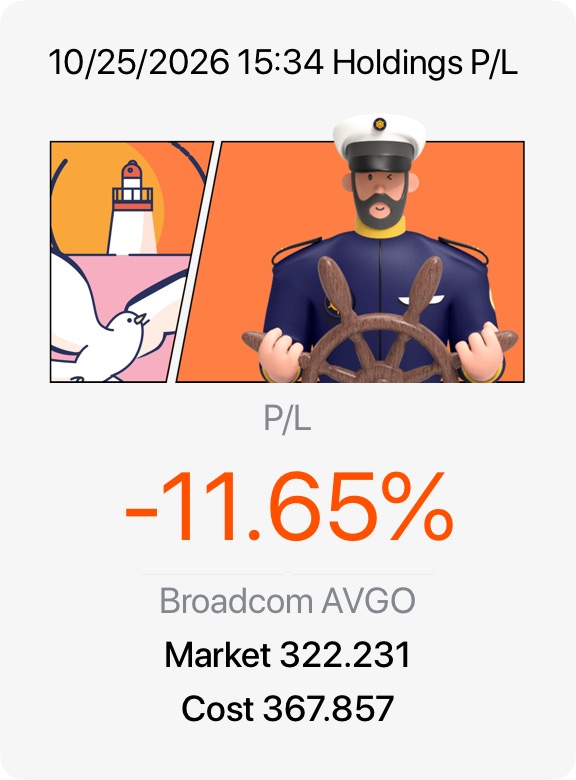
$Broadcom(AVGO.US)

Post 5 Ep.25

Context: Broadcom has been active in Singapore’s new advanced semiconductor substrate facility. While investors often focus on custom AI accelerators and networking chips, producing these increasingly sophisticated devices requires specialised packaging materials. Broadcom is taking steps to address that bottleneck directly.

My trade: This adds an interesting dimension to my Broadcom thesis. Through its partnership with TOPPAN, the company is strengthening access to the advanced substrates required for its next-generation AI and networking products. For me, this is about more than expanding capacity. It is about reducing supply-chain vulnerabilities that could otherwise limit growth, even when customer demand remains exceptionally strong.

Takeaway: Having the best chip design means little if you cannot manufacture enough of it. In an increasingly capacity-constrained AI industry, securing the ability to deliver may become just as important as securing the customer orders themselves. Sometimes competitive advantage is built long before the finished product reaches the market.

@Captain's Treasure
图片 1,共 1 张
N
Newbee2025

$iShares Semiconductor ETF(SOXX.US)

Background: SOXX tracks major semiconductor companies, benefiting from AI chip demand and data-centre spending. But after the massive rally, profit-taking and valuation concerns can trigger sharp pullbacks.

My trade: Bought at an average cost of US$489.

Takeaway: Long-term still bullish lah, as AI demand remains a key growth driver. Current price is around US$478, slightly below my cost. I would hold for the long term and avoid panic selling. If adding, do it in small batches only — semiconductor stocks can be very volatile one.

图片 1,共 1 张
H
Heroic Lifesaver

$Sandisk(SNDK.US)

Post 4 of Episode 25

Context: What caught my attention recently was Sandisk’s new partnership with Meta. While much of my investment thesis has centred on AI infrastructure and enterprise storage, this development highlights another opportunity. As computing evolves toward immersive experiences, spatial applications and increasingly sophisticated devices, demand for fast, reliable storage could expand well beyond traditional PCs and data centres.

My trade: I see this as another interesting dimension to Sandisk’s long-term growth story. Its exclusive position in Meta’s upcoming VR Glasses storage accessories ecosystem demonstrates how its technology can become integrated into emerging computing platforms. The immediate revenue opportunity may be modest, but I’m more interested in whether similar partnerships can create additional growth opportunities as new device categories gain adoption.

Takeaway: Technology revolutions don’t just create demand for more computing power. They also create entirely new places where data needs to live. For Sandisk, the opportunity may be broader than supplying more storage to existing markets — it could be about becoming part of the next generation of devices that haven’t yet reached mass adoption.

@Captain's Treasure

图片 1,共 1 张
E
EdmundK

Western Digital +55% and Lam beat both falling -6% and -12% is positioning not thesis change - market priced after Tesla Meta AI calls and SpaceX Tesla merger talk, waiting for Micron SanDisk SK Hynix guide. US chops. At home banks slip while REITs bounce is bull - after hot CPI PPI and two banks changing rate calls, REIT bounce proves 5.35% 10Y topped and MAS surprise hold validated, STI rotation healthy.

C
Captain's Watch
Featured☕️ [Task Coins Giveaway] Daily Market Talk — Western Digital Beats, Chip Stocks Crumble

Western Digital grew revenue 55% and raised its dividend, then fell 6%. Lam Research beat and fell twice as hard. At home, banks slip while REITs bounce. Let's dig in 👇💬 Chip stocks are selling off on...

A
amit

A TON OF THINGS HAPPENED IN THE STOCK MARKET TODAY.

Here's a full recap:

1. The Nasdaq $QQQ was down 2.60% on today, its worst session since June 5, while the Nasdaq 100 fell 2.90%, erasing nearly $1.2T in market value. The selloff was fueled by concerns over AI spending and profitability, with Meta $Meta Platforms(META.US) dropping 7% despite beating revenue expectations, as investors questioned its massive AI investments and negative free cash flow. Semiconductors were hit hardest, with the Philadelphia Semiconductor Index falling 6.7%, led by AMD $AMD(AMD.US) (-8%), Micron $Micron Tech(MU.US) (-6%), and NVIDIA $NVIDIA(NVDA.US) (-4%). AI and chip stocks accounted for roughly 90% of the Nasdaq 100's losses. However, broader market participation remained positive, with the Dow and Russell 2000 gaining. Meanwhile, Brent crude surged 4% toward $113 amid Middle East tensions. Despite the decline, the Nasdaq remains up 11.9% YTD, sitting 5.8% below its October 6 record high.

2. NVIDIA $NVIDIA(NVDA.US) CEO Jensen Huang pushed back against concerns surrounding neocloud financing, arguing that demand for AI computing infrastructure remains “off the charts” and that strong customer demand will ultimately help companies secure the capital needed to expand. Huang emphasized that “you can't solve the absence of demand,” but when demand is high, financing challenges can be addressed. He noted that neocloud providers already have excellent customers and significant demand, with their primary challenge being access to working capital to fund additional compute capacity. Huang expressed confidence that financing solutions will emerge, reinforcing his view that the industry's biggest challenge is not finding customers, but securing the capital and infrastructure needed to meet accelerating AI demand.

3. Bloom Energy $Bloom Energy(BE.US) delivered a massive Q3 2026 earnings beat, with revenue surging 138% YoY to $1.24B, well above the $1.05B estimate, while adjusted EPS of $0.94 exceeded expectations of $0.68. Adjusted operating income reached $285.7M, beating the $214M estimate, while adjusted gross margins expanded 412 basis points to 34.5%, reflecting significant improvements in profitability. The company also raised its FY2026 revenue guidance to $4.4B–$4.6B, above the $4.1B consensus, and increased its adjusted EPS outlook to $3.10–$3.40, compared with $2.73 expected. Despite the strong results, operating cash flow was negative $27.1M during the quarter.

4. OpenAI is reportedly nearing a $30B funding round at a $1.25T valuation, with UAE investors and Coatue Management leading the financing, according to CNBC. The round is being positioned as a bridge ahead of a potential 2027 IPO, with OpenAI targeting investor signatures by the end of next week, although the final fundraising amount remains subject to change. Separately, OpenAI is negotiating an additional agreement to secure AI computing capacity from the UAE, highlighting the company's continued need for massive infrastructure investment as it scales its frontier AI models and expands its commercial operations. If completed at the proposed valuation, the financing would further cement OpenAI's position among the world's most valuable private technology companies.

5. SK Hynix has reportedly scrapped plans for a U.S. IPO of its Solidigm subsidiary and halted a related pre-IPO investment round following regulatory concerns and shareholder opposition, according to Bloomberg. South Korean regulators argued that separately listing the company's flash-memory business could constitute a “duplicate listing,” potentially diluting the economic interests of existing SK Hynix shareholders. The proposed IPO, which had Goldman Sachs $Goldman Sachs(GS.US) and Morgan Stanley $Morgan Stanley(MS.US) lined up as lead underwriters, was previously targeted for 2027. The decision represents a significant development in South Korea's efforts to strengthen minority shareholder protections and address the longstanding “Korea discount,” as regulators increasingly scrutinize corporate structures that could disadvantage existing public shareholders.

6. The top 10 most active options today by contracts traded were $NVIDIA(NVDA.US) with 3.5M contracts, $AT & T(T.US)esla(TSLA.US) with 2.6M contracts, $SpaceX(SPCX.US) with 1.7M contracts, $Apple(AAPL.US) with 1.4M contracts, $Micron Tech(MU.US) with 1.2M contracts, $Meta Platforms(META.US) with 1.2M contracts, $Intel(INTC.US) with 1.2M contracts, $Amazon(AMZN.US) with 1.0M contracts, $Netflix(NFLX.US) with 967K contracts, and $Coreweave(CRWV.US) with 941K contracts.

7. SpaceX $SpaceX(SPCX.US) is reportedly seeking access to at least 80,000 cell tower sites across the United States as it accelerates plans to turn Starlink into a fourth nationwide wireless carrier, according to Bloomberg. The company is in discussions with major tower operators, including Crown Castle $Crown Castle(CCI.US), over potential agreements that could be worth billions of dollars. The push follows SpaceX's recent acquisition agreement for nationwide low-band spectrum and FCC approval for a constellation of 15,000 direct-to-device satellites, giving Starlink the foundation to combine satellite connectivity with terrestrial cellular infrastructure. If successful, the expansion would position SpaceX to compete more directly with AT&T $AT & T(T.US), Verizon $Verizon(VZ.US), and T-Mobile $AT & T(T.US)MUS, potentially reshaping the U.S. wireless market.

8. China is continuing to accumulate significant amounts of gold, with Goldman Sachs estimating that Chinese purchases through the London OTC market reached 25 tonnes in August, approximately 25% above the 20 tonnes officially reported by China's central bank. The bank estimates China purchased 35 tonnes in July, 40 tonnes in June, and 48 tonnes in May, with estimated OTC purchases exceeding officially reported central bank purchases by 83 tonnes, or 128%, over the four-month period. Meanwhile, global central banks are estimated to have purchased 79 tonnes of gold in August, roughly 365% above the pre-2022 monthly average of 17 tonnes. The figures highlight exceptionally strong demand for gold amid ongoing geopolitical uncertainty, reserve diversification, and efforts by central banks to reduce reliance on traditional reserve assets, although estimated OTC purchases are not necessarily all central bank acquisitions.

9. NVIDIA $NVIDIA(NVDA.US) CEO Jensen Huang told CNBC that he believes a surplus of memory supply is unlikely by 2029, signaling continued confidence in long-term demand for DRAM, HBM, and other advanced memory technologies as AI infrastructure expands. Huang emphasized that “one of the things that’s really great about memory is that you can always use more of it,” highlighting how increasingly sophisticated AI models, larger context windows, and more demanding inference workloads continue to drive memory requirements higher.

10. SpaceX $SpaceX(SPCX.US) is reportedly finalizing a $40B debt financing package at significantly higher borrowing costs than its previous financing, according to Semafor. The deal, led by Apollo and Goldman Sachs, is expected to include a lower-rated tranche carrying an interest rate of approximately 8.3%, while a more secure portion backed by AI chips could price around 7.75%. Even the chip-backed debt is expected to carry a yield more than 100 basis points above SpaceX's existing bonds, highlighting the rising cost of financing large-scale AI infrastructure. The transaction is expected to close next week and underscores the growing financial burden associated with SpaceX's aggressive expansion into AI computing and data centers.

11. Nebius $Nebius(NBIS.US) secured a $3.5B senior secured credit facility from Citi to finance its accelerating global AI data center expansion and GPU purchases. The facility carries a 364-day maturity, with borrowing costs starting at SOFR + 2.75% and potentially increasing to SOFR + 3.50%, giving Nebius additional access to capital as it scales its infrastructure. The company also highlighted more than $40B in long-term contracts with investment-grade customers, which could support further asset-backed financing as it expands AI computing capacity throughout 2027 and beyond. The agreement underscores how neocloud providers are increasingly leveraging contracted AI demand to secure billions in financing for next-generation data centers and GPU infrastructure.

12. The U.S. 10-year Treasury yield fell below 5.00% for the first time since September 23, as the selloff in technology and AI-related stocks intensified. The decline in yields suggests investors are rotating capital toward the relative safety of U.S. government bonds, pushing Treasury prices higher as risk appetite weakens. The move highlights a growing divergence between the bond and equity markets, with falling yields reflecting demand for defensive assets even as concerns over AI valuations, capital spending, and broader market volatility continue to pressure technology stocks.

WALL STREET IS THE GREATEST SHOW ON EARTH.

Source: amit

E
Equity research

Expert Takeaways: Memory

> S/D gap of at least 20% in second half of 2026.

> Big vendors have just begun forecasting since demand for 2027 has not settled yet.

> S/D gap for 2027 is possibly around 10%. A pessimistic take believing in balance by end of next year.

$Micron Tech(MU.US) $DRAM $EWY $SK Hynix(SKHY.US)

图片 1,共 1 张
云
云起落

Today (October 22, 2026), the US stock market showed clear divergence and risk-off sentiment, with funds shifting from tech growth stocks to safe-haven assets and traditional cyclical sectors.

Concerns over tech capex trigger fund outflows

Overnight earnings from several tech giants missed expectations or offered cautious guidance:

Meta's increased capital expenditure turned free cash flow negative, sparking market concerns about the ROI on AI investments.

Statements from Lam Research and IBM on AI demand or capital costs fell short of expectations, putting pressure on the semiconductor and tech sectors (XLK) after the open.

Tesla was dragged down by a slight decline in automotive revenue, breaking below key moving averages.

Rise in safe-haven and defensive flows

Influenced by geopolitical risk rumors (Middle East situation) and high, volatile US Treasury yields, risk-off sentiment rose:

The energy sector (XLE) was boosted by rising crude oil prices (Brent broke through $112/barrel), becoming the main direction for fund inflows.

US Treasuries and gold attracted some safe-haven inflows, with the 10-year yield finding short-term bid support near 5.08%.

Long-term positioning is not considered yet as the opportunity hasn't arrived; those who bottom-fished have entered and are prepared for timely take-profit and stop-loss operations$Oracle(ORCL.US)NVIDIA

$Direxion Semicon Bull 3X(SOXL.US)$Tesla(TSLA.US)$Micron Tech(MU.US)$Sandisk(SNDK.US)$NVIDIA(NVDA.US)

O
optionspuppy

📊 22 October 2026 — Today’s Market Watch

🇺🇸 1️⃣ US Earnings: P&G, Blackstone and Comcast

Investors will be watching results from Procter & Gamble, Blackstone and Comcast for clues about consumer spending, private-market investment activity and the health of the US media and broadband businesses. Strong earnings and optimistic guidance could support their shares, while weaker outlooks may trigger selling even if reported profits beat expectations.

🇹🇼 2️⃣ Micron: Taiwan Labour Dispute

Micron faces a 24-hour strike by its Taoyuan union over employee bonuses and profit-sharing, despite reaching a separate agreement with its Taichung union. The key concern is whether industrial action disrupts DRAM and high-bandwidth memory (HBM) production used in AI server.@Captain's Watch

C
Captain's Watch
Featured☕️ [Task Coins Giveaway] Daily Market Talk — Tesla Cuts Capex, Meta Raises It

Tesla and Meta reported the same night and made opposite calls on AI spending. One cut its budget, the other raised it. At home, banks are easing back after Wednesday's gains. Let's dig in 👇💬 Tesla cu...

N
NewUser_tXvx48

Context

Micron Technology (MU) is riding an unprecedented AI-driven memory supercycle. The company recently reported blowout fiscal full-year 2026 results, with revenue surging 256% year-over-year to $133.19 billion and net income skyrocketing 895% to $84.97 billion. This structural boom is driven by tight industry supply and high-volume demand for High-Bandwidth Memory (HBM3e/HBM4) paired with next-generation AI GPUs like Nvidia’s Vera Rubin.

Despite these record-breaking fundamentals and strong fiscal Q1 2027 revenue guidance of $61.5 billion, the stock has experienced heavy volatility. After peaking at an all-time high of $1,255 in June 2026, MU has pulled back roughly 30% to around $878–$906. This correction is fueled by macro headwinds (sticky inflation data) and competitive anxiety following reports that Chinese rival CXMT is making rapid progress on a denser DRAM design. However, this panic ignores Micron’s massive cyclical buffer: over 75% of Micron’s fiscal 2027 capacity is already locked up in volume-secured contracts with predefined pricing floors. Because of the massive earnings growth, the valuation has compressed significantly, leaving Micron trading at an incredibly cheap forward P/E of just ~5.3x.

My trade

• Strategy: Scaling into long equity positions using a multi-tranche approach to exploit the near-term technical oversold territory.

• Tranche 1 (Immediate Entry): Buy 50% allocation at $890, near current structural support.

• Tranche 2 (Limit Order): Buy remaining 50% allocation if the price tests the key technical overlap zone between $775 and $800.

Takeaway

Fear Over Fundamentals: The market is prematurely pricing in a structural structural downturn from Chinese competition that won’t realistically threaten server-level qualified allocations until at least 2028 or 2029.

图片 1,共 1 张
T
TheRaccoonAnalysis

Meanwhile, the Philadelphia Semiconductor Index’s 1.6% rebound ends an eight-session losing streak that erased 15.7%, with Sandisk and Western Digital leading gains. The memory-led recovery may reflect bargain hunting and renewed interest in AI-related storage demand, but one session does not establish a sustained reversal. Investors will likely monitor Treasury yields, Fed expectations and semiconductor earnings guidance to assess whether the rebound can broaden beyond memory stocks.

C
Captain's Watch
Featured☕️ [Task Coins Giveaway] Daily Market Talk — Chips Snap Their Streak, Asia Doesn't Follow

The chip rout that defined last week ended on Monday, and Asia is not buying it. At home, the STI is slipping. Let's dig in 👇💬 Wall Street says the selloff is over, Asia says it isn't. Which side are ...

M
Minerva Capital

AI rebound ahead of earnings

Market Action

The S&P 500 closed at 7,690.73 (+0.41%), the Nasdaq Composite at 26,430.89 (+1.11%), the Dow at 51,966.03 (−0.07%), and the Russell 2000 at 2,728.30 (+0.25%). Tech and AI-linked names drove the rebound after last week’s sharp selloff (Nasdaq −4.5% for the week). The Philadelphia Semiconductor Index rose and snapped an eight-day losing streak. Breadth was mixed—most non-tech names lagged—as investors selectively reloaded into chips and AI infrastructure ahead of a heavy earnings stretch. The 10-year yield settled near 5.14%. Oil eased on reports of a U.S. waiver on certain Russia sanctions and tariffs (amid ongoing Hormuz tensions), though levels remain elevated.

Story of the Day: Selective AI Dip-Buy Ahead of Earnings

Nothing fundamental flipped over the weekend, but sentiment had turned extremely negative after last week’s rate and financing pressure (especially around neocloud debt). Dip buyers stepped in on chips, memory, and AI infrastructure. The real test is this week’s earnings from AI spenders and enablers: SpaceX (Tuesday), Meta and Tesla (Wednesday), Netflix, and others. A clean delivery of growth and capex discipline can extend the bounce; disappointment reopens the debate on valuations and balance-sheet quality at elevated yields.

Key Catalysts and Movers

- $Amazon(AMZN.US) : Morgan Stanley named it a Top Pick and raised its price target to $350 from $335 (Overweight). The firm lifted AWS growth forecasts to 47% in 2027 and 42% in 2028 (from 41%/37%), citing expected Nvidia GPU deployments of ~2 million units, plus higher incremental margins supporting ~$16.50 of 2028 EPS. Other catalysts include Bedrock visibility, agentic shopping, and robotics. Shares rose ~5% to the mid-$260s (highest close since late August). Earnings October 29.

- $Intel(INTC.US) : JPMorgan upgraded to Neutral from Underweight (ending a bearish call held since late 2022) with an unchanged $85 target. The firm cited improved execution under CEO Lip-Bu Tan (yields, advanced packaging, core PC/data-center competitiveness) and support from agentic AI workloads that are CPU-intensive. The stock had pulled back ~36% from its June peak, bringing risk/reward closer to balance; JPM’s 2028 EPS estimates sit ~15% above consensus. Shares rose ~3% into the low-$90s. Share losses and a still-tiny external foundry business remain open issues.

- $Coreweave(CRWV.US): Goldman Sachs upgraded to Buy from Neutral while cutting its price target to $106 from $139 (still implying substantial upside from Friday’s close). The firm views financing concerns as overstated—asset-backed debt is manageable, DDTLs remain available, and the ~$104B backlog provides visibility. The stock ended essentially flat near $61 after an early bounce; it had fallen ~25% last week as bond yields spiked toward 15% on its debt load. Peers $Nebius(NBIS.US) and $IREN(IREN.US) also recovered. The debate is now whether credit spreads stabilize or whether the higher cost of capital permanently compresses the unlevered-IRR/WACC spread.

- Memory/storage complex: $Sandisk(SNDK.US), $Western Digital(WDC.US), $Micron Tech(MU.US) and related names posted strong gains (several in the mid-to-high single digits) as last week’s sentiment damage reversed. The move is primarily a bounce in the AI-hardware tape rather than fresh fundamental data.

- $Cleveland Cliffs(CLF.US): Reported strongest quarter in three years—adjusted EPS $0.28 (beat), revenue $5.61B, adjusted EBITDA $612M (well above prior guidance). Guides Q4 adjusted EBITDA ~$715M on higher pricing. Shares surged 16%+. Tariff and pricing backdrop remains supportive.

- $Silence Therapeutics(SLN.US): +125% after Merck KGaA agreed to acquire the company for $20 cash per ADS (~130% premium to Friday’s close; ~$1.3B equity / $1.1B enterprise value). Adds a Phase 3-ready siRNA asset (divesiran for polycythemia vera). Expected close Q1 2027; remaining spread reflects time and completion risk. Analysts quickly moved to Hold/Neutral at the deal price.

Macro and Cross-Currents

Europe underperformed on French political unrest and weekend protests. Oil is still historically high but pulled back on the Russia waiver headlines. Elevated long-end yields continue to pressure rate-sensitive sectors (real estate, housing) while the AI tape can absorb them on growth optimism. Monday also marked the 39th anniversary of Black Monday 1987—more calendar note than market signal.

What Matters Next

The earnings calendar is the clear catalyst: guidance and commentary on AI spend, margins, and financing from $Meta Platforms(META.US), $Tesla(TSLA.US), $Netflix(NFLX.US), $SpaceX(SPCX.US) and the broader Mag7 complex will decide whether today’s bounce sticks. For storage, watch whether pricing and allocation tightness hold. For neoclouds, credit spreads and the ability to refinance at acceptable spreads remain the swing factor. High yields keep the bar high for pure multiple expansion.

FinTwit / Narrative Pulse

The dominant tape narrative is “oversold bounce into earnings.” Goldman’s and JPM’s defenses of $Coreweave(CRWV.US) and $Intel(INTC.US) were widely circulated. Selective dip-buying in AI infrastructure is the story, not a broad risk-on regime. Narratives around neocloud debt sustainability versus backlog durability continue to trade in real time.

NFA / DYOR. This is independent market commentary based on public information for informational purposes only and is not investment advice, a recommendation, or a solicitation to buy or sell any security. Markets, facts, and circumstances change rapidly.

S
StockMarket.News

39 years after Black Monday, Wall Street got a bounce instead of a crash

On Oct 19, 1987, the Dow plunged 22.6% in a single session, still the worst day in US stock market history

This Monday, the weekend chatter was full of crash talk after last week's AI selloff. Into the open, Nasdaq 100 futures were up about 1.2% and S&P 500 futures about 0.5%, per Reuters

Last week was brutal. The Nasdaq fell 4.5% and the S&P 1.95%, the worst week for both since late June. The Philadelphia Semiconductor Index dropped for 8 straight sessions, its longest losing streak since October 2008, closing Friday at 11,137 after a 3.8% drop and down 16% since Oct 6

$Coreweave(CRWV.US), which had plunged more than 25% last week on debt fears, climbed about 6.6% in premarket. $Broadcom(AVGO.US) and $Micron Tech(MU.US) were up more than 3% each, with $NVIDIA(NVDA.US) and $Amazon(AMZN.US) up more than 2%

Oil cooled too. Brent was down about 1.5% near $108 after some Russia sanctions were waived, taking a little pressure off rate-sensitive tech

The real test is still ahead. $Netflix(NFLX.US) and $SpaceX(SPCX.US) report Tuesday, then $Meta Platforms(META.US) and $Tesla(TSLA.US) on Wednesday. Last week's selling was about how the AI buildout gets financed. One quiet open on the anniversary of 1987 does not answer that. It just shows that when everyone is positioned for a crash, the bounce often shows up first

Source: StockMarket.News

图片 1,共 1 张
K
koolgal

Why $VanEck Semiconductor ETF(SMH.US)Is Still A Buy?

🌟🌟🌟The Philadelphia Semiconductor Index has just wrapped up its 8th straight losing session. To make matters worse, hedge funds have sold off AI stocks for 5 consecutive sessions. Headlines are screaming "AI bubble". But let's pause.

Is $VanEck Semiconductor ETF(SMH.US)still a buy?

Yes it is because this isn't a structural collapse of AI. It is a textbook inventory and valuation sanity check.

SMH has taken a 9.70% haircut over the past week, testing crucial technical floors around the USD 537 to USD 539 mark.

The Culprits: A nasty cocktail of debt financing drama at AI cloud companies like Coreweave, sticky inflation spiking capital costs and macro jitters.

The Smart Money Exit: Hedge funds are fleeing to lock in profits, considering SMH was still up 44.6% YTD.

Why Is SMH Still A Buy?

SMH's foundation still remains rock solid for the following reasons:

The Infrastructure Inertia:

Data centers do not stop construction midway because of a bad week on Nasdaq. Billions of Capex are already locked in. Power contracts are signed. GPUs are ordered.

The Monopoly Board:

SMH is concentrated in the crown jewels of tech: $NVIDIA(NVDA.US)$Taiwan Semiconductor(TSM.US)and $Broadcom(AVGO.US). They are the money printing moat heavy monopolies. If you believe the world needs more computation tomorrow than it does today, you buy the chipmakers.

Overdone Bubble Fears:

Analysts noted that this pullback is pricing in a catastrophic tech crash that is not actually supported by the high enterprise demand.

Concluding Thoughts

When Wall Street is panicking, the long term compounding machines go on sale. Keep you head cool while everyone else runs for the exit.

As Warren Buffett famously said:

"The stock market is a device for transferring money from the impatient to the patient".

Dear fellow investors, do you agree with the Oracle of Omaha?

WARREN BUFFETTETHE STOCK MARKET IS A DEVICE FOR TRANSFERRING MONEY FROM THE IMPALong image
C
Captain's Watch
Featured☕️ [Task Coins Giveaway] Daily Market Talk — Chip Stocks Log Their Longest Losing Streak

Chip stocks fell for an eighth straight day, the longest run on record, and the traders shorting them are up about $32B. At home, the banks have split. Let's dig in 👇💬 Eight days down and the Fed goes...

T
TheRaccoonAnalysis

The semiconductor sector is facing sustained selling pressure, with the Philadelphia Semiconductor Index recording an unprecedented eight-session losing streak. Approximately $32 billion in gains on chip short positions suggests bearish traders have benefited from the decline, while five consecutive sessions of net selling in AI stocks by hedge funds indicate a broader reduction in exposure to the theme. These trends may reflect concerns over elevated valuations, AI capital expenditure sustainability, or profit-taking after strong gains.

C
Captain's Watch
Featured☕️ [Task Coins Giveaway] Daily Market Talk — Chip Stocks Log Their Longest Losing Streak

Chip stocks fell for an eighth straight day, the longest run on record, and the traders shorting them are up about $32B. At home, the banks have split. Let's dig in 👇💬 Eight days down and the Fed goes...

W
win win

Chip stocks dropped 8 straight days, what does it mean ? Buy on dip or release some position or keep holding our position ? what is your strategy ?

C
Captain's Watch
Featured☕️ [Task Coins Giveaway] Daily Market Talk — Chip Stocks Log Their Longest Losing Streak

Chip stocks fell for an eighth straight day, the longest run on record, and the traders shorting them are up about $32B. At home, the banks have split. Let's dig in 👇💬 Eight days down and the Fed goes...

S
Shyon

I see this chip selloff as a potential opportunity, but I am not rushing to buy the dip just yet. AI demand remains a strong long-term driver, especially for memory and semiconductor companies, but even solid fundamentals cannot prevent short-term corrections when sentiment turns negative and leveraged positions unwind.

I will keep watching key technical support levels and wait for signs of stabilization before adding more. I am bullish on the long-term AI trend, but I would rather miss the first part of a rebound than catch a falling knife. For me, discipline and capital preservation matter more than trying to buy the exact bottom.

C
Captain's Watch
Featured☕️ [Task Coins Giveaway] Daily Market Talk — Chip Stocks Log Their Longest Losing Streak

Chip stocks fell for an eighth straight day, the longest run on record, and the traders shorting them are up about $32B. At home, the banks have split. Let's dig in 👇💬 Eight days down and the Fed goes...

G
gedebe

$Coreweave(CRWV.US)

Context: let's analyze some of the casualties of last week's AI rout. Nasdaq Composite dropped by 4.5% from the record high just 1 week ago and The PHLX Semiconductor Index (SOX) was worst, falling 11.4% for the same duration. Dell drop ~22% after Barclays downgraded it from Overweight to Equal-Weight and Coreweave the owner of AI datacenters which uses a lot of GPU lost ~25% due to high cost in repaying its debt, both happened last week.

My trade: stay put, but i won't open any new position

Takeaway: Is there light in the tunnel? Yes, if you believe in Jensen Huang who was being interviewed by Bloomberg in Berlin last week, he just brushed this market correction aside asking people to concentrate on the fundamentals instead $NVIDIA(NVDA.US)$Intel(INTC.US)$Netflix(NFLX.US) .

图片 1,共 1 张
J
JPJP

$iShares Semiconductor ETF(SOXX.US)

Context: Semiconductor stocks and ETFs have experienced a valuation pullback during the recent market correction. This was driven by macroeconomic concerns over rising borrowing costs and projected interest rate hikes this year and next year. However, recent earnings still show demand for AI, data center hardwares, and semiconductor manufacturing equipments. The most recent ETF inflows on 16 Oct for SOXL shows $1.3 Billions net inflows representing 6.5% increase in AUM.

My trade: I am holding onto my core position in SOXX through this current correction. Maintaining my holding gives me diversified exposure across top tier semiconductor leaders. I am willing to ride out this macro driven volatility and stay invested.

Takeaway: The market recovered 2 days ago and was followed by a sell down yesterday. It was volatile and the corrections can trigger emotional panic selling. It may not be easy to hold through the corrections. In view of this, it is better to follow own plan and be clear minded when investing in volatile times.

2026.07.27 ~ 2026.10.16 All orders
Cumulative P/L-19.58 (USD)-4%
2026.07.272026.10.16
N
NewUser_hCn26

SMH (VanEck Semiconductor ETF) offers the most attractive capital rotation play. Following a seven-day pullback that flushed out leveraged positioning, semiconductor fundamentals remain backed by structural AI compute demand. With long-end yields easing and dovish Fed signals lowering discount rate pressures, SMH provides broad, high-conviction exposure to lead the next leg of market recovery.

C
Captain's Compass
🎁[Reward] Warsh’s AI Optimism Cools Hike Bets as Falling Yields Revive Theme Trades

Odds of an October hike fell below 15% after Warsh spoke, from about 27% beforeLong-end Treasury yields fell faster than short-end yields as money sought safety in long bondsSmall caps and equal-weigh...

66 “We made very clear that we would deliver price stability, and we removed a d
United States 30 Year Government Bonds Yield·1D·TVC 5.550% -0.050 (-0.89%) % Hig
N
NewUser_vN57Ih

$Western Digital(WDC.US)will wdc should pass 400? Bought it too early and it drop so much, not sure how long will i be gaining back the lost?

图片 1,共 1 张
T
TheRaccoonAnalysis

South Korea’s 8% KOSPI decline and circuit-breaker activation signal acute risk aversion and potentially forced selling, amplifying concerns about regional equity-market volatility. Higher yields generally pressure growth stocks and other long-duration assets through higher discount rates, while tighter financial conditions can weigh on valuations and economic activity.

C
Captain's Watch
Featured☕️ [Task Coins Giveaway] Daily Market Talk — Hot CPI Doubles October Hike Odds

September CPI came in hotter than anyone wanted, and the market's odds of an October hike doubled within the hour. At home, the STI is down about a percent. Let's dig in 👇💬 With an October hike now cl...