

ORCL plunge? AI infra can't offset a core flaw — high interest costs, heavy debt + a sluggish software biz

The most watched and debated name in the 'new cloud' cohort, $Oracle(ORCL.US), reported Q4 FY26 (to end-May) after the U.S. close on Jun 11. Overall, the print was mixed. For example, OCI accelerated but legacy software weakened; GPM improved QoQ from the trough but still missed; next-quarter guidance topped, while FY27 outlook stayed conservative. As a result, the quarter felt largely uneventful; details below:
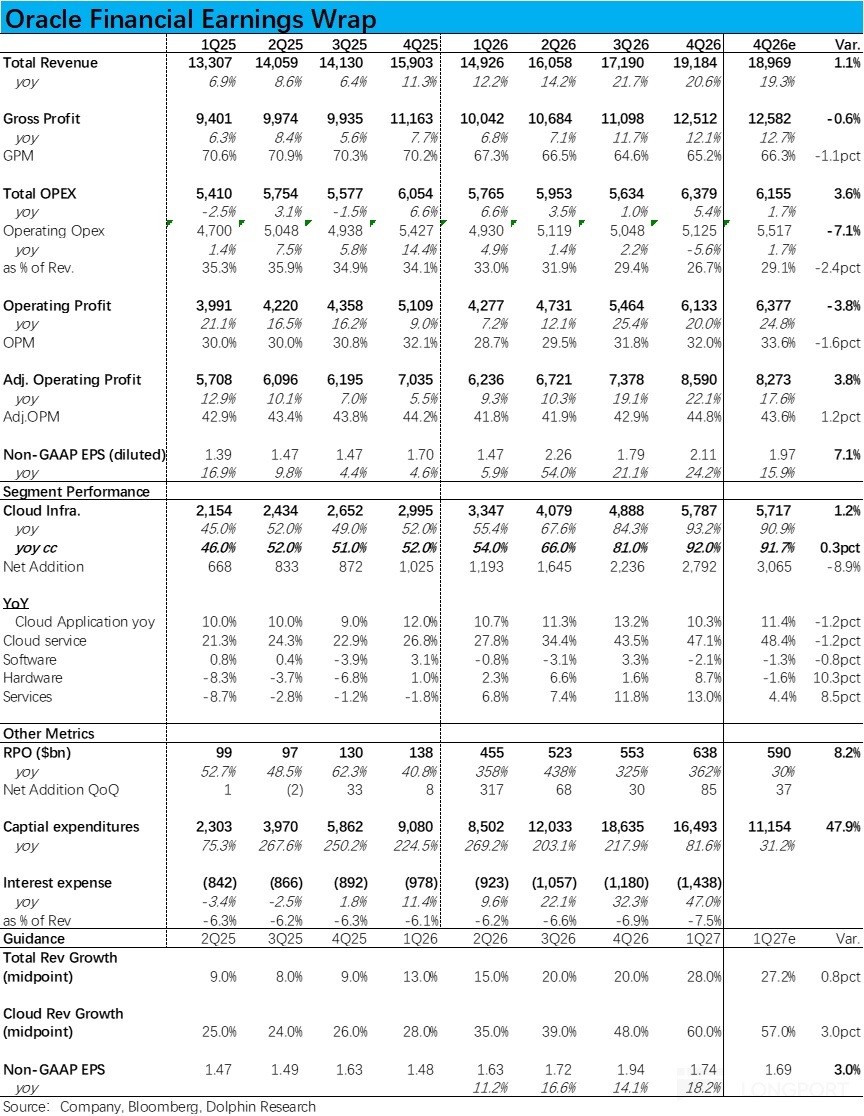
1) Core business — OCI accelerated as expected: Within Cloud, IaaS OCI revenue reached nearly 5.8bn, up about 93% YoY. Ex-FX, growth was 92%, accelerating from 81% last quarter, though the magnitude of acceleration moderated. Growth broadly matched expectations, leaving little upside surprise.
In other words, absolute growth was strong, but on a relative basis the most critical OCI line was not 'great' this quarter.
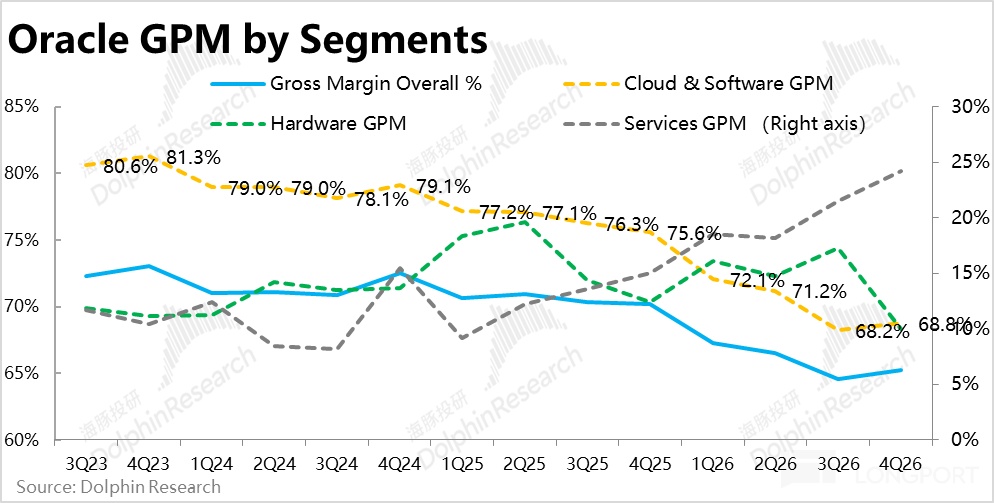
2) GPM rebounded QoQ but still missed: Combined Cloud + Software GPM was 68.8% this quarter, up from 68.2% last quarter, suggesting a bottoming. YoY contraction was still 680bps, albeit narrower than last quarter.
Given the mix includes OCI, SaaS and legacy software, it is hard to tell whether the uptick came from OCI stabilization or higher margins in software.
From an expectations lens, the Street was at 66%+ for overall GPM, while actual came in at 65.2%, a miss. Net-net, margin performance skewed slightly negative.
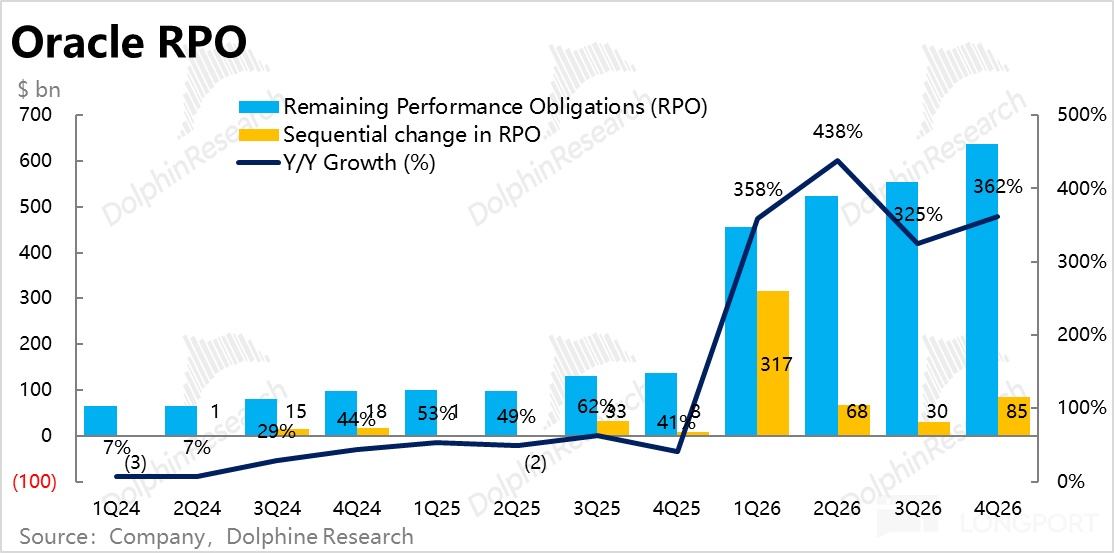
3) RPO beat; Capex co-invest model takes hold: The demand indicator RPO rose by 8.5bn QoQ to 63.8bn. With no pre-earnings chatter of mega deals, market expectations were low at ~59bn, and recent news suggests government awards likely contributed.
Notably, about 7.5bn of orders now use a Capex co-invest model — customers prepay or self-procure hardware to fund part of the build. This is a clear positive for cash flow and the balance sheet.
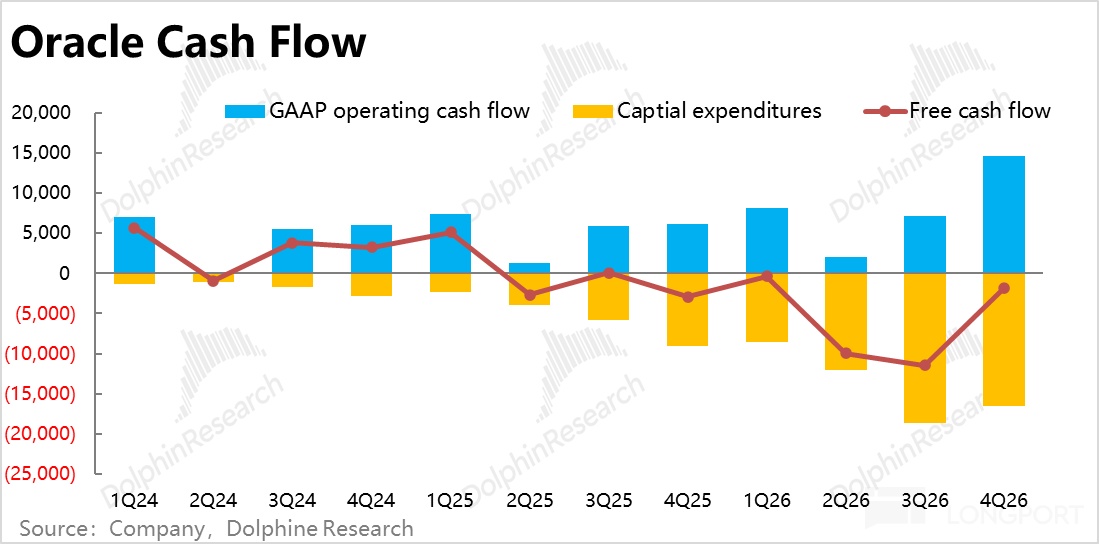
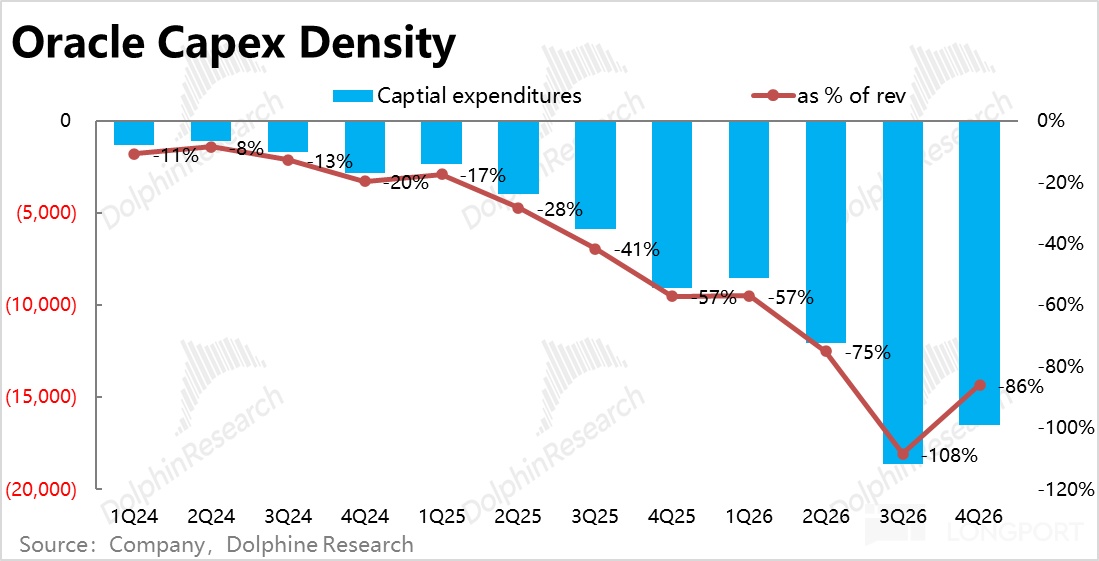
4) Capex above 'mechanical' expectations, cash flow improved sharply: Capex was ~16.5bn, down from 18.6bn last quarter. The Street’s 11bn was a mechanical back-solve from the 50bn full-year guide and thus not very informative, even if it implied a big beat.
More importantly, the co-invest model covered ~4.6bn of Capex this quarter. As a result, FCF improved from ~10bn outflows in each of the prior two quarters to under 1.9bn of net outflow, easing cash pressure.
5) Financing needs also easing? The company said it plans 20bn and in total 40bn of debt and equity financing in FY27 (already disclosed), below ~48bn this year. This largely secures funding for next year’s Capex.
Dolphin Research and the market had seen FY27 FCF shortfalls at 50bn+. We think customer co-invest is likely taking some of the load, reducing the company’s own financing needs.
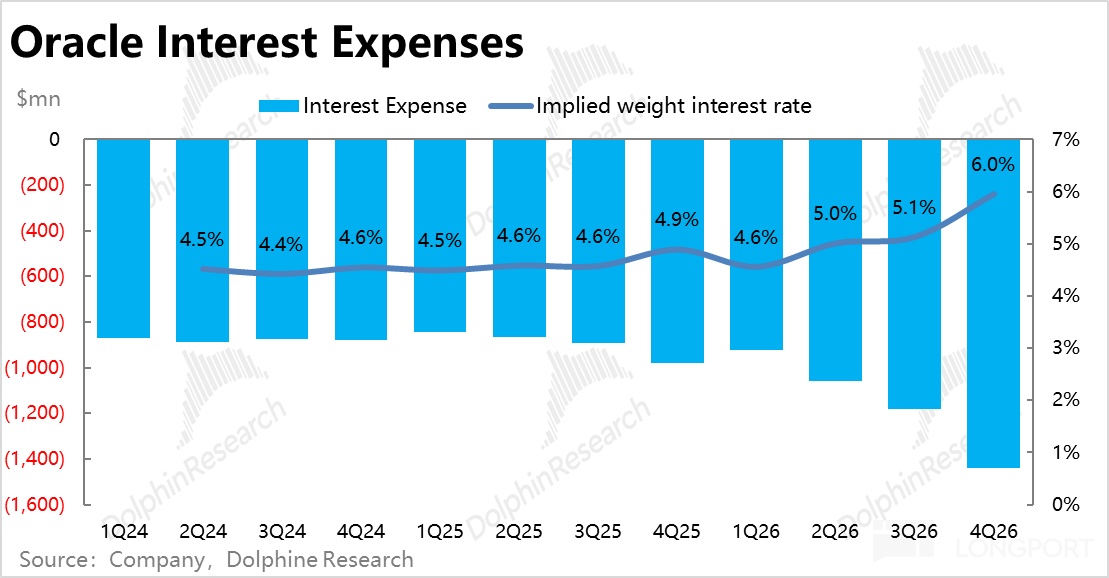
However, long-term logic improves but near-term pressure remains; interest expense reached 1.44bn, up ~22% QoQ, lifting interest to 6% of revenue.
6) Other businesses weakened further: Legacy segments, still ~75% of revenue, deteriorated. SaaS and Software revenue grew +10% and -2%, respectively, both decelerating and missing. Hardware and Services outperformed, but combined they are just over 10% of revenue, so the impact is limited.
7) Overall performance
Total revenue grew 20.6%; ex-FX, underlying growth was 20%, up 200bps QoQ.
Given the GPM decline noted above, GP grew 12% YoY, well below revenue growth and slightly below expectations.
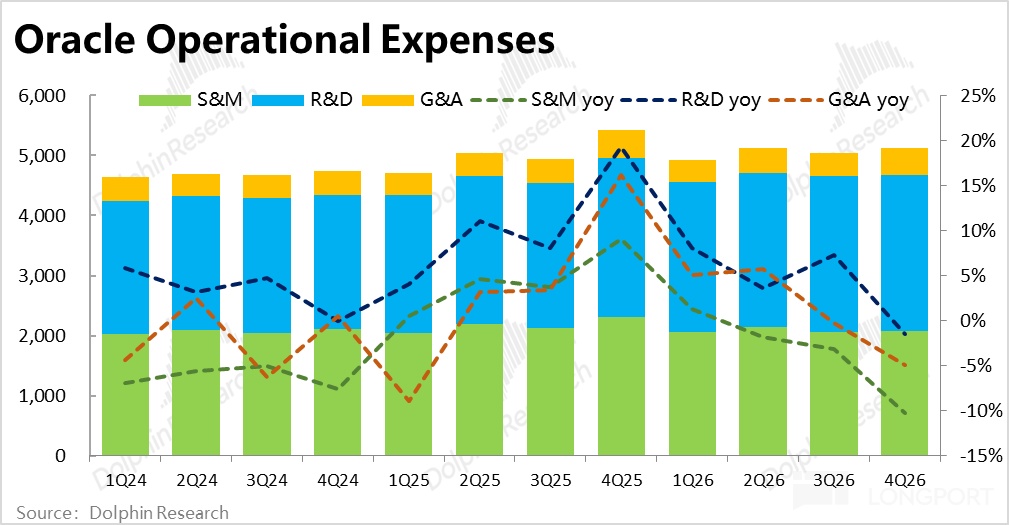
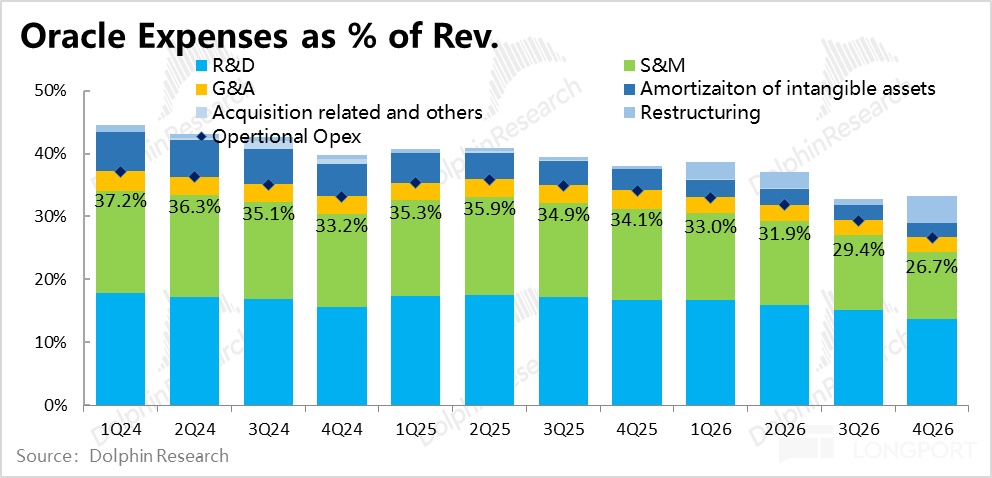
Fortunately, excluding one-offs from layoffs, the three core opex lines fell ~5.6% YoY, 700bps better than the Street. With tight cost control, despite lower GPM, Adj. OPM returned to positive YoY growth by ~50bps, ahead of expectations.
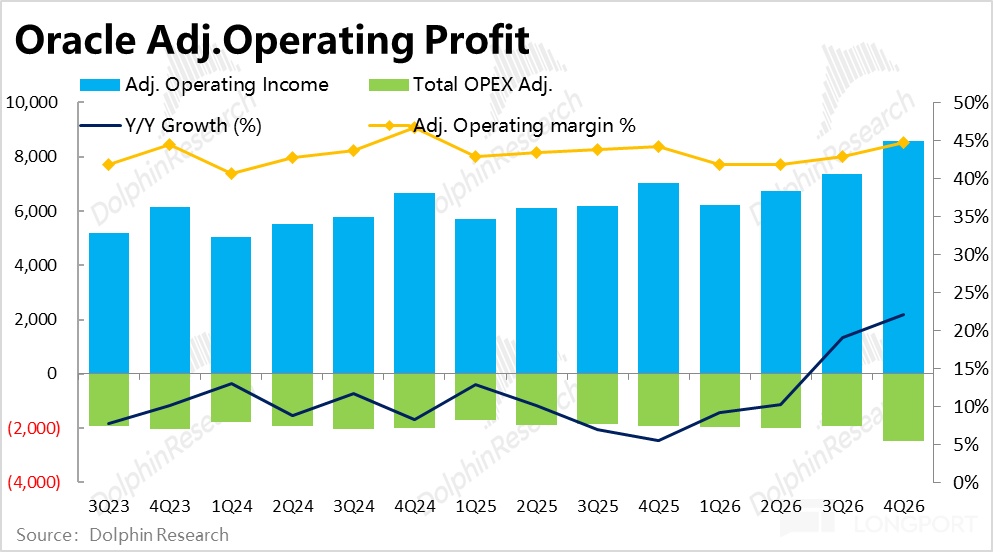
Adj. OP was 8.6bn, up ~22% YoY, meaning profit growth outpaced revenue and beat despite GP shortfalls.
Dolphin Research view:
1) Near- to mid-term, the market still focuses on: a) OCI revenue release and acceleration, which depends on the pace of compute build-out, while RPO has drawn less attention recently; b) whether higher AI revenue still drags margins; c) Capex ramp and financing. Sentiment has shifted from disliking high Capex and worrying about ROI to viewing higher Capex as evidence of faster capacity build.
On these points, this quarter’s answers are:
a) OCI did accelerate as expected, but exactly in line with estimates, so not exciting. Meanwhile, while OCI benefits from AI, larger legacy software is logically an AI 'victim', making Oracle not a pure 'AI winner'.
b) GPM shows signs of bottoming, but attribution is unclear and the print still missed. We need several more quarters to judge if this is a blip or a trend inflection.
Given AWS and Google Cloud margins have not clearly deteriorated in recent quarters, the widely accepted assumption that AI cloud margins are structurally below traditional cloud is debatable. For NeoClouds like Oracle, the mix shift toward AI appears to depress margins more visibly, making this a key debate.
c) The most positive signal is the Capex co-invest model with customers, which materially reduces the pressure and risk of funding massive AI Capex and compute build with the company’s own cash flow and balance sheet.
Dolphin Research sees this as a major logical shift. But near term, net debt and interest expense will likely keep rising, so we need to watch how much Capex can be co-invested by customers.
2) Investment logic: As we noted previously, completing the 50bn debt + equity program eased concerns about funding the build-out. Meanwhile, with Agent-driven token/compute consumption surging, fears of overbuilding compute without sufficient end demand have eased.
With both issues improving, Oracle’s narrative has partially reversed. The stock has rebounded 40%+ from early Apr, while macro risks and volatility have ticked up again, so investors came into the print with a high bar.
Thus, the genuinely mixed quarter is likely to disappoint those high expectations.
On guidance, management guided Cloud (IaaS + SaaS) growth at a 60% midpoint next quarter, continuing QoQ acceleration and slightly above the Street’s 57%. Non-GAAP EPS midpoint of 1.74 implies +18% YoY, ~3% above consensus.
However, alongside a solid next quarter, FY27 revenue guidance stayed at 90bn, and the updated full-year Non-GAAP EPS of $8.05 is also merely in line with consensus. With full-year guide uninspiring, the market cannot 'reward' the near-term beat much. We suspect management lacks visibility and therefore simply matched the Street.
On recent developments, Oracle has been relatively quiet since last earnings with no major new moves, but two trends stand out:
a) Bringing AI into software: While IaaS headlines were limited, Oracle rolled out AI features across SaaS and Database, launching Fusion Agent Application and Agentic AI for Database.
Dolphin Research views this as a defensive move. As of FY26, OCI — the direct AI beneficiary — is only ~25% of revenue, with the bulk from Software, SaaS and Database, which could be AI 'victims'. That said, drawing from Salesforce, adding AI into legacy apps has shown limited uplift, so whether it can sustain growth or re-accelerate remains to be seen.
b) Advancing government partnerships: In late Mar and early May, Oracle announced contracts with U.S. federal agencies and the Department of Defense, covering OCI, AI Database and Enterprise AI. Pre-print, the market thought gov’t contracts would be small versus large enterprise deals, but the orders now appear to be in the multi-bn range. Beyond P&L contribution, they also signal government support, helping sentiment.
3) Valuation: Two lenses apply — the near- to mid-term multiple that swings with quarterly performance, and the long-term 'steady-state' valuation that should not shift much absent a change in long-term guidance or thesis.
Near term, the market often values Oracle on FY27 Non-GAAP EPS. On the company’s ~$8 guide, the current price implies 22x–23x FY27 PE, not demanding.
In other words, recent, visible earnings can support the stock, allowing investors to play for upside from estimate revisions even without multiple expansion.
Dolphin Research prefers a long-term steady-state view. Using our recent deep-dive, we model ~160bn OCI revenue in FY30, with ~120bn from AI and ~17bn net income, at 20x PE, implying ~$88 per share in FY27 PV terms.
Including legacy, SaaS and non-AI OCI, we model ~103bn revenue in FY30, ~33bn profit at 12x PE, implying ~$104 per share in FY27 PV. Summing both yields ~$190–200 per share, or ~15x PE.
Given the rebound from the lows, today’s valuation is roughly neutral against the company’s medium- to long-term outlook. A pullback on a so-so print is reasonable.
That said, the implied multiple is only ~15x, and the new signals of lighter cash and leverage burdens could structurally improve the narrative. Absent systemic AI risks, while Oracle is not a high-certainty first choice, it warrants attention.
Detailed review follows:
I. Oracle business and revenue breakdown
Founded in the 1980s, Oracle’s historical core has been Database and Software services (perpetual license model). With cloud transition and AI’s rise, Cloud has taken the lead and is now the most important and watched segment.
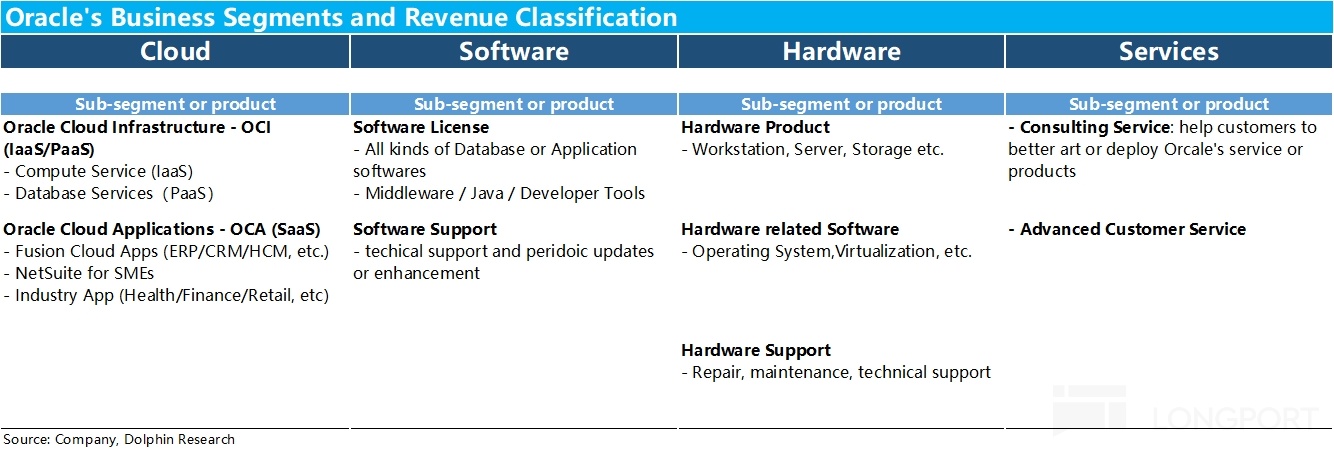
In the new FY26, Oracle revised disclosures to split revenue into Cloud, Software, Hardware and Services more clearly. Details:
a) Cloud: Two lines — IaaS (OCI) and SaaS (OCA). OCA covers SaaS-based ERP/CRM/HCM and vertical tools, while OCI includes Database-as-a-service and compute leasing.
OCA used to dominate Cloud; over the past 1–2 years, fast growth has lifted OCI’s share above OCA.
b) Software: On-prem software deployed and managed by customers, formerly the largest revenue contributor but now behind Cloud.
Two parts — one-off Software License sales and recurring Software Support (support, updates and maintenance).
c) Hardware: Similar to software, including one-off servers and related sales plus hardware maintenance and support, the smallest portion of revenue.
d) Services: Everything else beyond the above, including consulting and custom services, a high single-digit percent of revenue in recent years.
II. Focus: OCI performance
1) Key line — OCI keeps accelerating
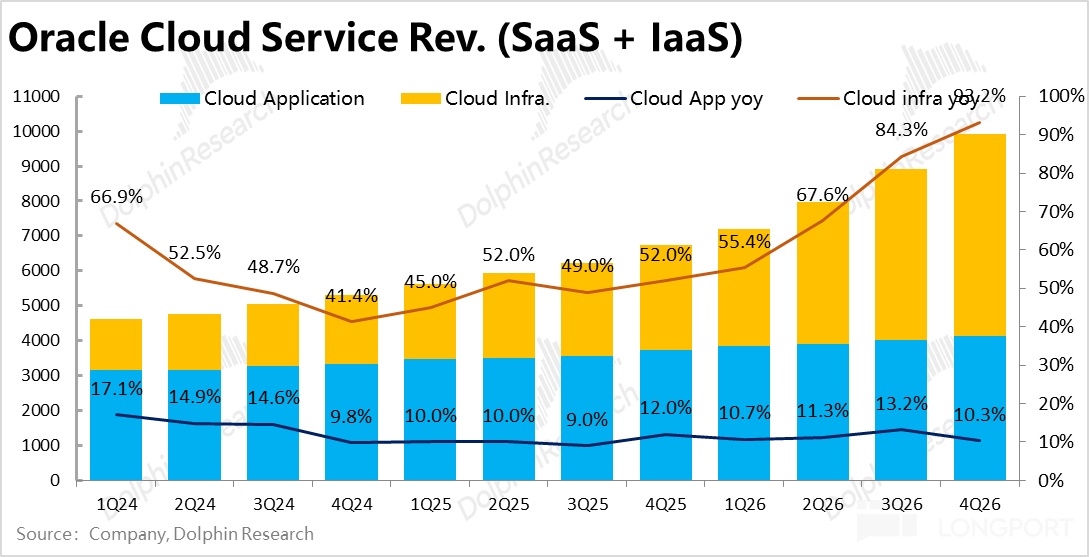
The critical IaaS/PaaS OCI revenue was nearly 5.8bn, up about 93% YoY. Ex-FX, growth was 92%, accelerating from 81% last quarter, though the incremental acceleration slowed (from +16ppt to +11ppt).
Consensus was ~92%, so OCI remained on an accelerating path but did not beat.
By contrast, SaaS growth worsened. Ex-FX, revenue fell 3% YoY, vs. -1% last quarter, underscoring ongoing pressure downstream in SaaS even as AI lifts upstream infrastructure.
2) Margins still pressured, signs of bottoming?
It is widely assumed that scaling AI revenue weighs on margins, especially for newer cloud providers. Combined Cloud + Software GPM was 68.8%, up from 68.2%, and YoY down 680bps, but the decline narrowed QoQ.
Because both Cloud and Software are included, it is hard to attribute the recovery to OCI stabilization vs. other margin drivers. And Street GPM was 66%+, vs. actual 65.2%, so margins still skew negative and have not dispelled concerns.
3) Leading indicator — RPO beat; co-invest model becoming mainstream?
With no rumored mega deals, the market looked for ~59bn RPO, up less than 4bn QoQ. Actual rose 8.5bn to 63.8bn, one of the few clear bright spots.
The company did not detail new logo wins, but given recent federal and DoD announcements, we infer much of the upside likely came from government.
Also, last quarter management noted some orders would be funded by customer prepayments or customer-procured hardware. This quarter, ~7.5bn of orders are under this co-invest model.
As these orders likely came in over the last two quarters, more than half of recent bookings may already be co-invested. This is a positive for cash flow and leverage.
III. Balance sheet worsens near term, but medium-term signals improve
With OCI still accelerating, Capex was ~16.5bn vs. 18.6bn last quarter. Since the 50bn full-year Capex guide was unchanged last quarter, the market mechanically back-solved ~11bn for this quarter, making the actual look high. But with capacity ramping, the issue is more about low expectations than high spending.
Per disclosure, the co-invest model covered ~4.6bn of Capex this quarter. Hence, FCF narrowed from ~10bn outflows in each of the prior two quarters to under 1.9bn, clearly easing cash strain.
To fund heavy Capex, the company completed 43bn of bonds and 5bn of equity in FY26. In FY27, it plans 20bn and in total 40bn of debt and equity (previously disclosed), securing most of next year’s Capex.
In fact, the target is below Dolphin Research and market estimates of 50bn+ FCF shortfalls. We think customer co-invest likely offsets part of the need, reducing balance-sheet pressure, which is a constructive long-term signal.
Still, the positives are not yet evident in P&L. Interest expense hit 1.44bn, up nearly 22% QoQ, rising to 6% of revenue, and net debt rose by over 16bn YoY by our balance sheet read.
Near term, leverage and debt service burdens are still increasing.
IV. Legacy segments continue to trend down
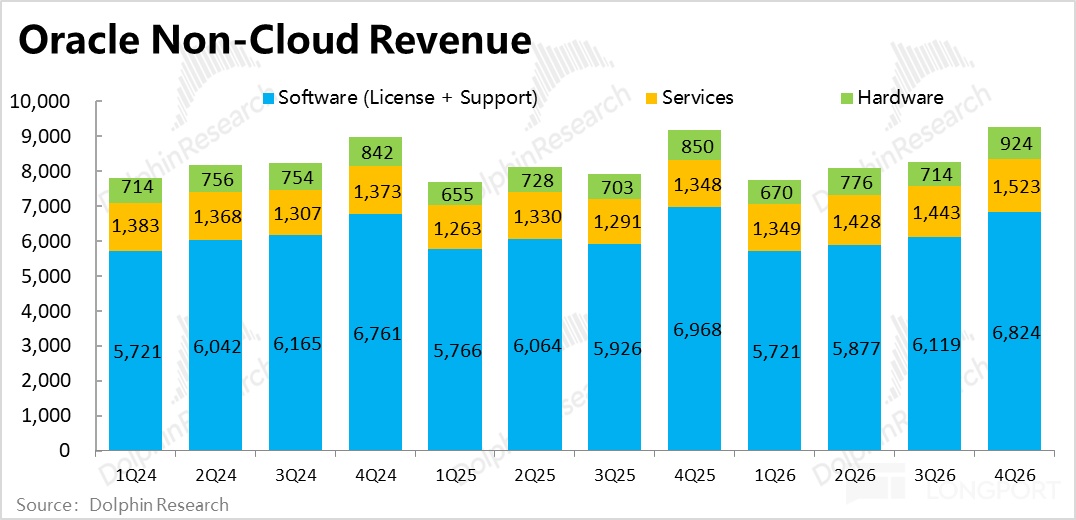
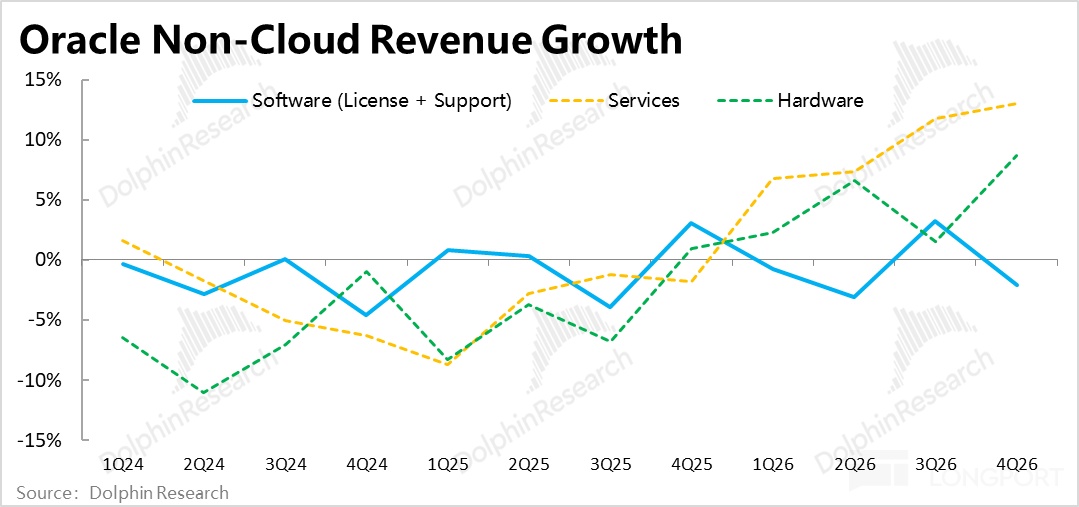
Unlike OCI’s acceleration, legacy segments, still ~75% of revenue, worsened. SaaS and Software revenue grew +10% and -2%, respectively, both decelerating and missing.
Hardware and Services grew well above expectations, but together are just over 10% of revenue. The core issue remains Software and SaaS.
Thus, while OCI benefits from AI at the infrastructure layer, larger legacy software faces mounting pressure.
V. Mixed overall results
1) Strong infra, weak software, steady overall growth
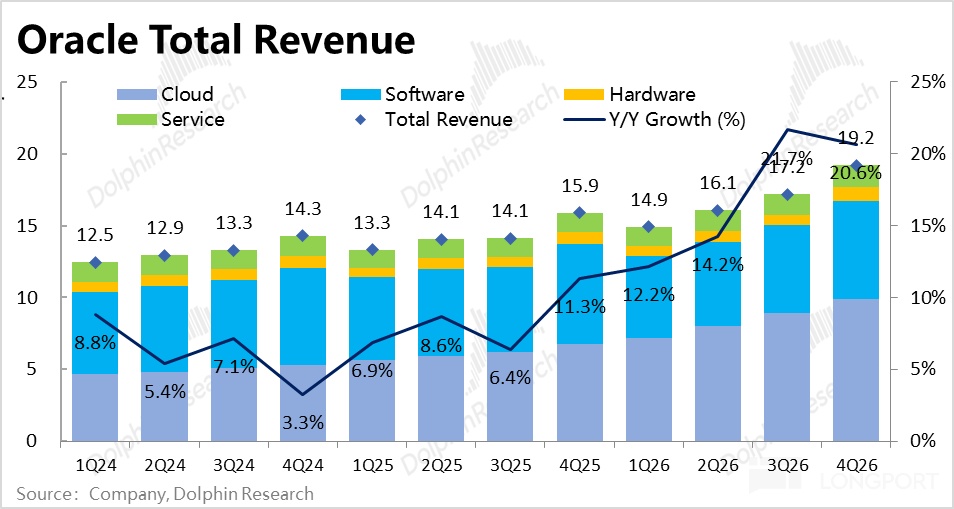
Across the four segments, accelerated OCI and weaker Software offset each other. Total revenue grew 20.6%, seemingly slower QoQ, but ex-FX, underlying growth was 20%, up 200bps vs. last quarter.
2) GPM still down YoY
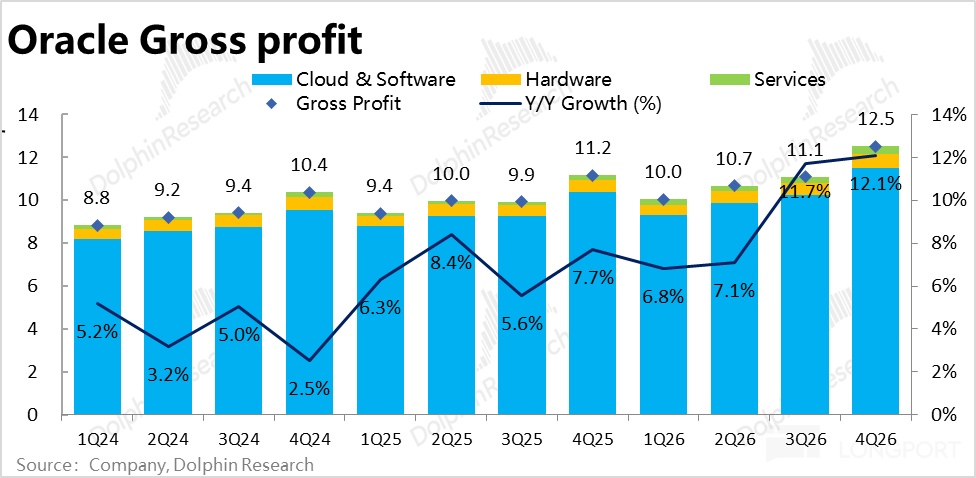
As noted, overall GPM stabilized QoQ but contracted YoY. Hence, GP grew 12% YoY, well below revenue growth and ~60bps below the Street.
3) Strong cost control helped profits outgrow
At first glance, total opex rose 5.4% YoY, up from +1% last quarter and above the Street’s 1.7%, seemingly indicating higher spending. In reality, there was ~0.8bn of 'restructuring' costs this quarter, likely linked to news reports of ~30k layoffs (~19% of workforce, unconfirmed by the company).
Excluding one-offs, the three core opex lines fell ~5.6% YoY, 700bps below expectations. All three declined YoY, with S&M down over 10%. With GPM under pressure and Capex tight, cost discipline was solid.
On the back of cost control, despite a notable GPM decline, Adj. OPM turned positive YoY by ~50bps, beating expectations.
Adj. OP reached 8.6bn, +22% YoY, so profit growth outpaced revenue and beat despite weaker GP and revenue.
<End>
Past Dolphin Research on Oracle:
Deep dives:
Jan 22, 2026 coverage initiation — 'Picking Up Scraps, Backing Giants: Is Oracle Betting Its Life?'
Apr 27, 2026 — 'Oracle: All-In on AI Compute — Are the Odds Good Enough?'
Risk disclosure and disclaimer: Dolphin Research Disclaimer and General Disclosure
The copyright of this article belongs to the original author/organization.
The views expressed herein are solely those of the author and do not reflect the stance of the platform. The content is intended for investment reference purposes only and shall not be considered as investment advice. Please contact us if you have any questions or suggestions regarding the content services provided by the platform.
